
[In November 1989, the Cleveland Cavaliers traded its rising young backcourt star Ron Harper and three future draft picks to the Los Angeles Clippers for swingman Reggie Williams and the rights to former Duke All-American Danny Ferry, who signed with an Italian team out of college. Cavs fans grumbled about the trade, and so did some in the team’s front office. The reason: the Cavs already were stacked at forward, Ferry’s likely pro position.
Cleveland area journalist Terry Pluto weighed in a few months later with this plese-remain-calm synopsis of Ferry:
Assuming he signs, Danny Ferry will come to the Cleveland Cavaliers as advertised, assuming there is some truth in the advertising. Ferry is a 6-feet-10 small forward, a superb shooter, a shrewd passer, a remarkably polished, team-oriented player.
But he’s no Larry Bird, no matter what the folks in Italy say about the $2 million investment made by his Ill Messaggero Roma team. Nor should any Cavs fan believe Ferry will be the whole package, that he’ll run and dunk or even create shots like Ron Harper. Just because the Cavs traded Harper to the Los Angeles Clippers for him won’t make Ferry an athlete like Harper.
So what is Ferry? He can be the ribbon that ties together a package that already contains the likes of Mark Price, Larry Nance, Brad Daugherty, and the rest. On any team, Ferry will be a good NBA player. Given the Cavs’ propensity toward intelligent, unselfish basketball, Ferry will inevitably be very good.
Three seasons later, Pluto was back with this update on Ferry and his so-far underwhelming career in Cleveland. The piece, which ran in Hubie Brown’s 1993-94 Pro Basketball magazine, is very level-headed and a reminder of how big-time college stars of the past faced big-time pressure to excel in the NBA. In Ferry’s case, he wasn’t Larry Bird, and, as Pluto notes below, Cleveland was a bad fit for him and his NBA liabilities. He may have never lived up to his advance billing out of Duke. But to Ferry’s credit, he hung in there and carved out 13 NBA seasons, including 10 in Cleveland.]
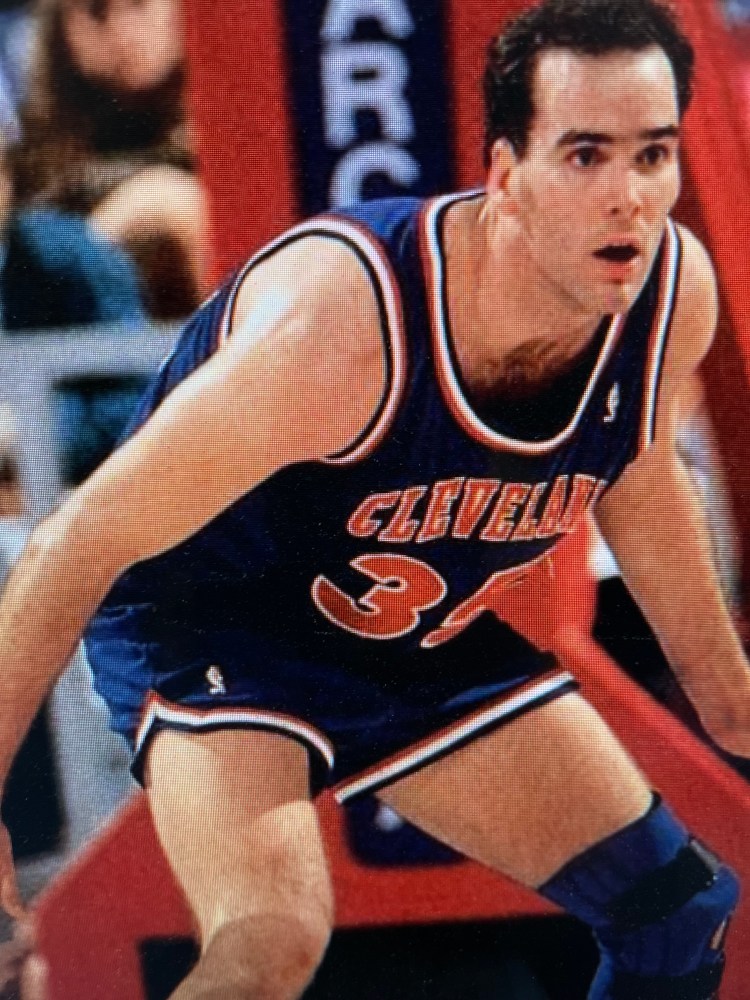
What is it about Danny Ferry, after three largely unproductive seasons with the Cleveland Cavaliers, that NBA insiders and fans still bother to scrutinize, even care about, his pro career?
In comparison, Benoit Benjamin who was traded for Sam Bowie—the third and second players picked in their respective drafts—barely makes the agate type in most newspapers.
Never mind that Ferry has spent most of his NBA life buried on the Cavs’ bench, unable to beat out Mike Sanders, Winston Bennett, and Chucky Brown for a starting job. People will ask, whatever happened to him?
Even he abandoned a team that in the 1989 draft made him the second pick overall. After he bolted to the Italian League for big paychecks and a cushy life. After he came back to the States, with a bad knee and eroding skills, to a team willing to lavish money on a player whose abilities, it appears, had been severely overestimated.
Now 27 and heading into his fourth season, Danny Ferry is no kid anymore. He knows it, and knows what must happen to get his career moving forward again.
“I realize some people think I’ve failed in the NBA,” he said. “I don’t think it’s fair to say that. I’ve had a lot of talented guys playing ahead of me. I don’t think I’ve had a chance to fail. I’ve been in the NBA for three years, but I don’t know what my role is. I have no idea what kind of player I can become because I don’t believe I’ve had the chance to find out. Until I get a regular role with some regular minutes, I have no idea what kind of player I’ll be, and no one else will be able to know, either.”
Much of what Ferry says is true. That’s why all the accolades and comparisons to Larry Bird heaped upon him in the past, his basketball pedigree, all have been tossed aside.
Former coach Lenny Wilkens, never a fan of the Ferry deal, is gone to Atlanta. The new Cavs coach is Mike Fratello, who promises to evaluate Ferry with an open mind and a willingness to find him some minutes—if he earns them.
As the 1989 NBA draft approached, Ferry seemed destined for greatness. Many people insisted that he should be the first player selected. Holding the top pick was Sacramento, whose general manager was Bill Russell. “I told Russ that if it were me, I’d take Danny and not lose one wink of sleep worrying about it,” Cleveland general manager Wayne Embry said in June 1989.
Embry had reason to be impressed by the Duke All-American. In his senior season, Ferry won the Naismith Award as the nation’s best college player while leading the Blue Devils to the third Final Four in four years. He finished his career as the first player in Atlantic Coast Conference history with 2,000 points, 1,000 rebounds, and 500 assists—a testimony to his all-around game. “Ferry may not be the most-talented player in our league, but he’s the best,” North Carolina State’s Jim Valvano said in 1988, when Ferry was still a junior.
Ferry was always on the fast track to the NBA. Top coaches at high-profile programs shepherded him all along. His first teacher was his father, Bob, a former NBA player and general manager of the Washington Bullets. Then there was Morgan Wootten at DeMatha High School and Mike Krzyzewski at Duke. His basketball bloodlines were unrivaled, his hoop smarts unquestioned. “At 15, he had the basketball mind of a 30-year-old,” Duke assistant (and former DeMatha assistant) Mike Brey once said.
But Russell selected Pervis Ellison instead.
“When that happened, I figured I was going to San Antonio at No. 3,” Ferry said. “I had talked to the Spurs. They seemed very interested in me. The Clippers had the second pick. They had all these forwards. They never interviewed me before the draft. As far as I could tell, they had no interest in me whatsoever.”
Naturally, the Los Angeles Clippers picked Ferry. “I was completely shocked,” he said. “To this day, I don’t know why they drafted me. Really, it made no sense.”
When Ferry was called to center stage at the NBA draft headquarters at New York’s Felt Forum, someone put a Clippers cap on his head. He wore a hollow expression, like a man just sentenced to jail.
“Some people said that I really wanted to play for my father’s team, and that was why I was disappointed with the draft,” Ferry said. “But that wasn’t right at all. In fact, my dad and I talked about it, and that probably wouldn’t have been a good situation for me to play in Washington, because he was still the general manager.”
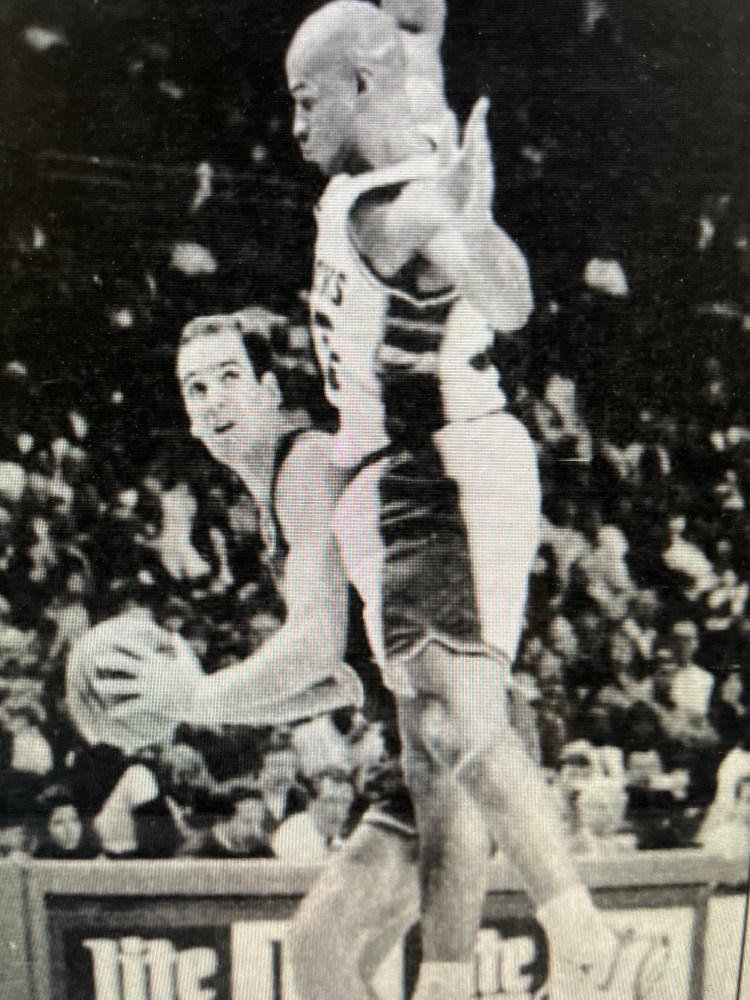
But growing up in a family, where the salary cap and NBA politics are discussed over meatloaf, Ferry also knew about the futility of the Clippers, their erratic owner Donald Sterling, their incompetent front office, and locker room full of head cases. He knew the Clippers were not what he wanted out of the NBA. So, it was off to the Italian league, lured by Il Messaggero Roma and its offer: $2 million a year and housing, in one of the most-exclusive areas in Rome, in a 13th-century piazza that included five floors, two maids, a sauna, a rooftop terrace, a BMW, state-of-the-art appliances and conveniences—even a phone that quacked like a duck. None of it would cost him a dime—the team would pay all his living expenses.
Il Messaggero knew Ferry might be inclined to listen to its pitch, because lurking in the background at the draft assessing Ferry’s reaction, was Valerio Bianchini, Italy’s best-known pro coach. Bianchini had just been hired by Italian billionaire Raul Gardini, whose family owned Il Messaggero Roma. Bianchini’s mission was to go to America and snag a player who not only would help his team win, but would produce publicity for Gardini and his team.
“The night of the draft, I left the hotel where I was staying, and Bianchini came up to me on the street,” Ferry said. “He talked to me about Italy. Playing there was the last thing on my mind. I didn’t even have an agent yet, and I told him to call my father. He left, and I figured that was the last I’d hear from him.”
But Bianchini called Bob Ferry and Danny. He convinced them to meet him for lunch. When they did, Bianchini and a representative from Il Messaggero were there.
“They said that they wanted to fly me and my family to Europe on a Concorde,” Ferry said. “They said the trip didn’t mean I was making a commitment to play. They just wanted me to see it and then decide.” It was an offer too good to refuse. Ferry’s parents and one of his friends accompanied him. They went to Rome, Wimbledon, and Monte Carlo, jetting across Europe in a private plane, a Rolls-Royce waiting at every stop.
Discussions turned to money. “They made me the financial offer,” Ferry said, “which was more than I ever would have made in the NBA that first season. I admit, after the trip and all the attention, my eyes started to pop out of my head a bit.”
When Ferry returned to the United States, he talked to the Clippers and told them about Italy. “I thought they might trade me,” Ferry said. The Clippers didn’t, which sealed it. Ferry decided to go to Europe, the first high-profile college player to do so since Bill Bradley, who went on a Rhodes scholarship.
“I had dreamed about playing in the NBA, and that was where my heart was,” Ferry said. “But I wasn’t comfortable with the Clippers. Until that point of my life, I had done everything I was supposed to do. I went to DeMatha, to Duke. I saw Italy as a chance to do something different. After all the things they showed me and what they offered me, I was starstruck. I really was.”
Ferry teamed with guard Brian Shaw, who was signed to a deal similar to Ferry’s, and led Il Messaggero to third place that year. Standings weren’t as important as the hype. Stories about Ferry and Shaw in Italy gave European basketball the kind of worldwide exposure it hadn’t had before and hasn’t had since.
“I enjoyed my year in Italy. I thought it was a great experience,” Ferry said. “I have great memories. I had fun, but after a while, it was like a vacation that went a little too long. I just wanted to come home and get to work and start a real life.”
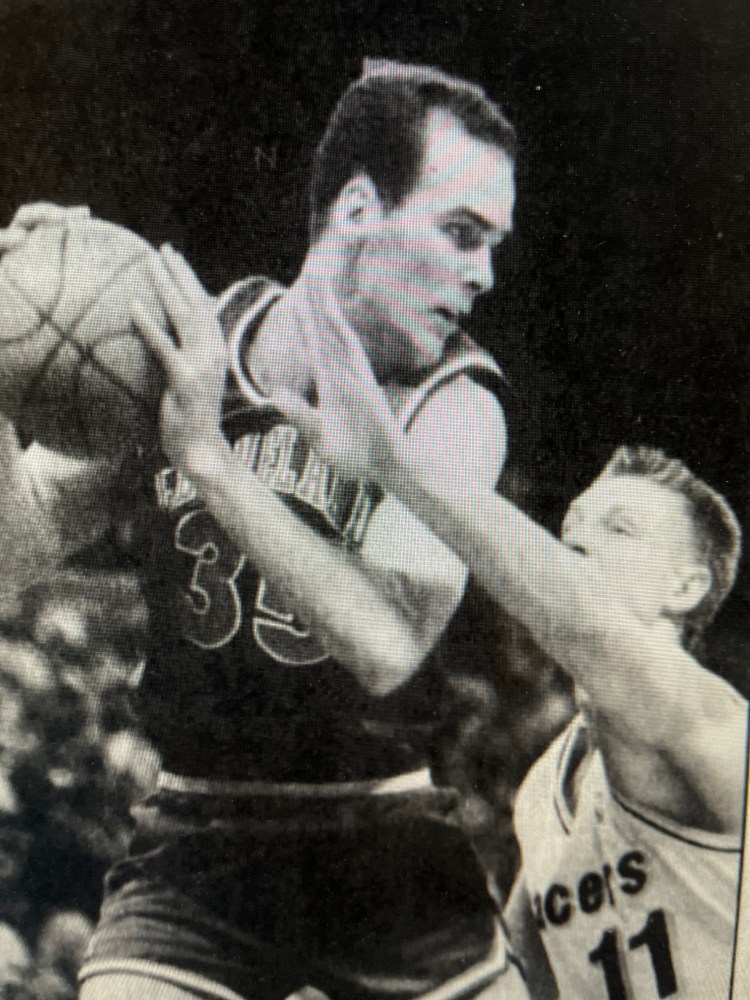
Real life started November 16, 1989, when the Cavs sent guard Ron Harper and two first-round picks (which became Loy Vaught in 1990 and Elmore Spencer in 1992) to the Clippers for swingman Reggie Williams and the rights to Ferry, who still was overseas. “Boston waited two years for Larry Bird, San Antonio waited for David Robinson. We believe that Danny Ferry will be worth the wait,” Embry said at the press conference announcing the deal.
Later, Embry said that he didn’t mean to compare Ferry to Bird and Robinson, but it sure sounded like it. On top of the expectations dropped on Ferry, the trade itself wasn’t well-received on a number of fronts.
First, Harper was a poor man’s Dr. J. Cleveland fans loved his athleticism, his dunks, his glowing personality. But Harper said the deal was made for more than basketball reasons: “Wayne Embry didn’t like the guys I hung around with.” Embry confirmed that this was a factor for making the trade.
Second, coach Lenny Wilkens gave tepid lip service to the deal. Wilkens later said that he went along with the decision, because he was a good company man. Embry said that Wilkens raised no objections to the trade.
Third, Cleveland already had a couple of 6-feet-10 forwards—John Williams and Larry Nance—which made Ferry apprehensive about coming to the Cavs. “But they talked to me about playing small forward, which had been a trouble spot for them. I figured they had a position for me.”
Then Ferry’s agent, David Falk, and the Cavs talked contract. The Cavs may insist now they never thought Ferry would be another Bird, but they sure paid him like it. The contract was worth a possible $38 million over 10 years. Seven years and $25 million were guaranteed. The Cavs also included a clause whereby Ferry sold them, for $3 million, part of the endorsement rights to his name.
“My plan was to play out the year in Italy,” Ferry said, “then come home and play for the Clippers. But I also told Cleveland that I had made a commitment to Italy, and I was going to stay the season. I never gave the Cavs any impression that I would go back to Italy. Whatever pressure they felt to get me signed came from them.”
Right away, the Cavs were under the gun. Trading Harper was universally despised. Cleveland’s blue-collar fans read of Ferry living in the lap of Italian luxury, and that didn’t sit well. But the Cavs had to sign him, or risk a public-relations disaster. So they paid.
When Ferry came to the Cavs for the 1990-91 season, the front office was still praising his outside shooting, passing, basketball brains, and ability in the clutch. On the day the trade was announced, Embry said, “Danny can be a go-to guy. He’s not afraid to take the big shot.”
But the Cavs saw none of this in training camp. What they saw instead was alarming—Ferry was dragging his left leg. He had come back from Italy with a full-blown painful case of tendonitis.
There were other problems, too.
“He played defense with his arms and hands, instead of his body and feet,” Embry said. “When you reach all the time, you get called for fouls.” And Ferry was in constant foul trouble.
Take a guy with a bum knee and bad defensive habits and put him at small forward—well, it just didn’t work. The Cavs thought he’d at least be able to score, but that, too, wasn’t a given. In Italy, Ferry had constantly fallen away on his jump shot. And when he tried to post up under the basket, he wasn’t strong enough to hold his ground.
Ferry was reluctant to admit it, but going to Italy was more than a sidetrip on the way to the NBA—it was a setback. “That year screwed me up,” he said, “because I lost some of the momentum I had after my college career.”
“I tried to play him at small forward,” Wilkens said, “but you could see it wasn’t going to work. That left power forward, and you could see that Danny wasn’t good enough to take minutes away from Larry Nance or John Williams.”
So, Ferry sat as Winston Bennett and Chucky Brown split time at small forward. Wilkens found nearly 20 minutes a game, and he averaged 8.6 points but shot only 43 percent. As for the passing, it was hardly seen. With Duke, Ferry was the hub of a motion offense. With the Cavs, the offense ran through Mark Price and Brad Daugherty. Nance was the third option. Ferry was considerably lower on the pecking order.
For a second season, Ferry added 15 pounds. “They told me that I’d play power forward and some backup center,” Ferry said. “So, I tried to get stronger. But all that did was make me even slower.” He averaged 5.1 points and shot 41 percent, seldom playing meaningful minutes, on a team that went 57-25 and reached the 1992 Eastern Conference Finals.
“I want to help Danny be a better player,” Wilkens often said. “But I can’t give him minutes he didn’t earn. My main job is to win games.”
As Ferry floundered, controversy roared. Many NBA players resented the contract. “The least they could have done was pay a white guy who could play,” Charles Barkley said. On the road, fans taunted him.
The case against Ferry is that he’s a marginally talented player with no position. He was hidden at Duke by zone defenses, which masked his lack of lateral movement. Since he was the focal point of the offense, plays were run for him to shoot. But in the NBA, Ferry lacks the athleticism to create his own shot in a one-on-one situation.
The case for him was best expressed by Bob Ferry: “Usually, when the team makes a trade of the magnitude that the Cavs did for Danny, they have a spot where they can plug in that player. But the Cavs didn’t have that. Nor did they create one for him. They didn’t want to take a chance on losing a few games to develop him.”
Then Bob Ferry brought up an interesting point having to do with the forgotten man in the deal—Reggie Williams. The Cavs were clobbered by injuries in 1989-90 and 1990-91 to players such as Price, Daugherty, and John Williams.
“Everyone knows that Lenny (Wilkens) was not exactly the trigger man of the trade,” Bob Ferry said. “But it might have worked out differently had Lenny had more patience. He had Reggie Williams for only a couple of months, then released him (in the spring of 1990). Reggie has gone on to Denver and been a very good small forward. The year he let Reggie go, Lenny’s contract was up, and he felt he had to win as many games as he could. Reggie was shellshocked after the trade, but he really didn’t get much time to settle in with the Cavs.”
Bob Ferry believes that Danny wasn’t going to get a fair shake from Wilkens because of the politics of the trade. “That’s garbage,” Wilkens said. “People told me I didn’t like Danny, so I didn’t play him. That makes no sense. I wanted Danny to play well, because it would help me as a coach. He struggled. I can’t help it that he isn’t the great player they (the front office) hoped he’d be. We worked with him. We gave him a lot of chances.”
Last season, Ferry returned to his natural playing weight of 232. He corrected shooting flaws and played well. His last-second shots won two games, he averaged 7.5 points, and shot 48 percent in 19 minutes a night. But he remained stacked behind Williams and Nance, and a liability on defense.
“My knee problems are over, and I felt I moved better than at any time since I was in college,” he said. “I don’t know if I was caught up in the politics with the Cavs. I heard that Coach Wilkens was not in favor of the trade. But there was nothing I could do about it, even if it was true. We never talked about it. I do consider him a good guy, and we always got along. I didn’t play as much as I wanted. It was frustrating. Sometimes, I didn’t sleep well. I got depressed. The first few years, it was hard to cope.”
Ferry said that his teammates have been accepting of him, and that is contract was never an issue. “I do know that for the most part, the media and fans in Cleveland have been more than fair with me. I just want to become a good player for the fans, (owner) Gordon Gund, and Wayne Embry.”
The talk of Ferry being a player who can lift the Cavs to a championship had long ceased. Mike Fratello, who replaced Wilkens as coach, promises a fair shake for Ferry. “I want to see how he can help us,”Fratello said. “But it is time to bury the past, the trade, Italy, all of that. I know there had to be times when Danny wondered if he did the right thing going to Italy. Or if he should’ve done something else. Well, it’s over. I know he’s a good kid, and he works hard. But I don’t know what he can do for us until I have him in training camp.”
With four more guaranteed years left on a contract that counts $3.2 million against the salary cap this season, Ferry is virtually untradable. He has earned the respect of Cavs fans because he hustles, has never criticized the coach or offered an excuse, or been anything but remarkably polite when meeting with the public. If Ferry were as good a player as he is a person, he would be Larry Bird.
“It’s nice when people say that, but what counts is what I do on the court,” Ferry said. “I want to succeed—and to succeed here. I never imagined it would be this hard for me in the NBA, and I had great respect for the league. But now I figure if I can be a real contributor to the Cavs, it will mean a lot to me personally, especially after all I’ve been through the last few years.”
 From Way Downtown