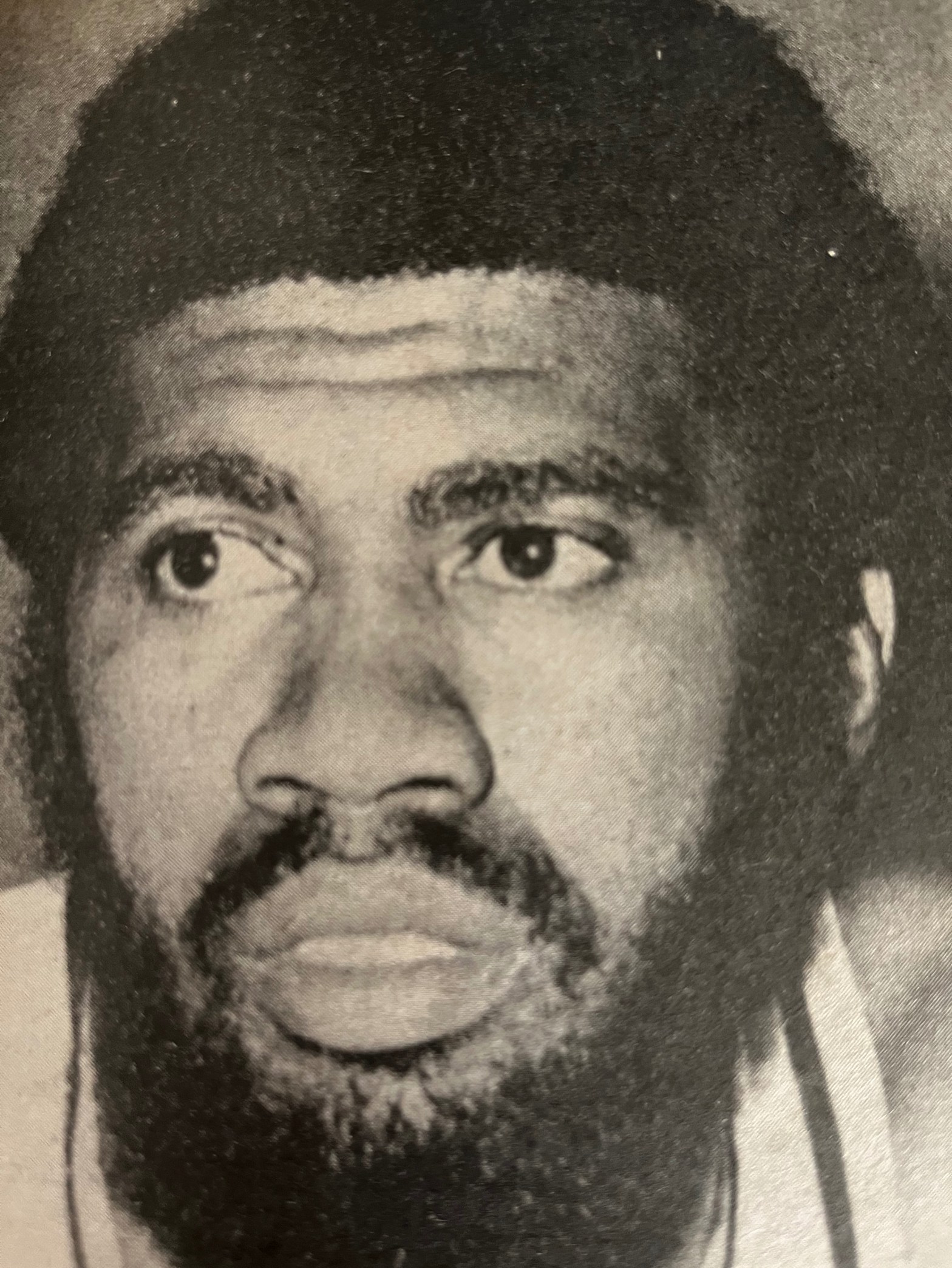
[Here’s a brief article on Garfield Heard during his Buffalo Brave years. It comes from the April 1975 issue of Basketball Digest, and at the keyboard is the legendary Phil Ranallo with the Buffalo Courier Express. The article is good one, though it ends abruptly. I’m guessing the bottom of the story got cut to fill the space. Nevertheless, it’s Phil Ranallo!]
****
For some strange reason, the Buffalo Brave who gets less acclaim, less ink, and fewer accolades than any regular on the club is that muscular, bearded, workhorse—Garfield Heard.
Oh, Gar is noticed all right. After all, how can you possibly not notice a guy who scrapes so many basketballs off backboards? But Heard rarely gets his due—the due merited by a fellow who just may be the NBA’s champion rebounder among players standing 6-feet-6 and under.
That’s why justice was done by Jack Ramsay when he named Gar Heard captain of the Braves during the injury to Jim McMillian. “Naming Gar Heard captain,” Ramsay said, “is my way of acknowledging the contributions he has made to this team.”
“I was pleasantly surprised to be named team captain,” the soft-spoken Heard said. “I regard it as an honor. That gives me a little more responsibility, and I like that.”
Heard, a 26-year-old with poise and maturity, is a true-blue laborer—like the guy who carries a lunch-bucket to work, rolls up his sleeves, picks up the heavy jackhammer, and does his job, from 8 AM to 5 PM.
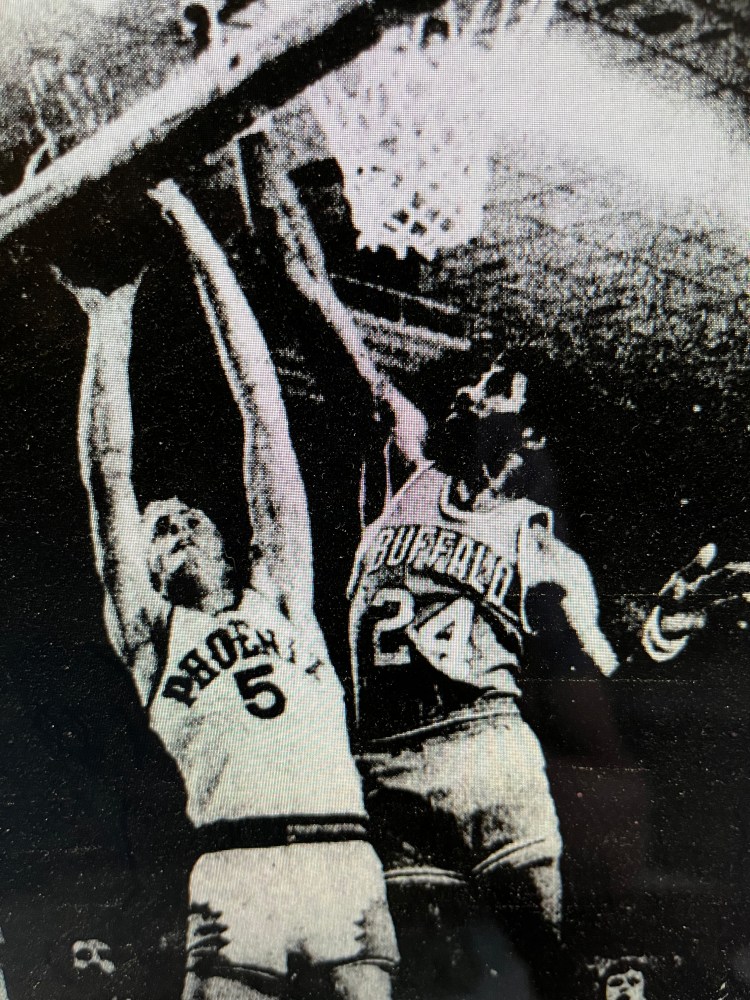
Nobody Heard’s size does his job better—the job of scraping those balls off the boards. Gar is smaller than most of the opponents he tangles with night after night. He takes on the big, strong forwards—Elvin Hayes and Spencer Haywood, to mention a couple. And he somehow manages to hold his own against them.
Last season, Heard grabbed 947 rebounds. If that figure doesn’t grab you right off, consider this: Dave. DeBusschere didn’t make that many rebounds in any of the last six years of his career.
The thing about Heard’s 1973-74 total is that almost a third of it—270 of the 947, to be exact— was compiled off the offensive boards. And there’s quite a difference between an offensive and defensive rebound. Sort of the difference between a swing pass completed to a curling fullback and a bomb completed to a streaking wide receiver.
What makes Heard so tough off the offensive boards? “Constant movement,” Gar responded. “It’s hard for the other team to box you out when you’re moving. So I try to keep moving, and when one of our players takes a shot, I go straight to the board, instinctively.”
Heard confessed that he learned “a few tricks” from Paul Silas, Boston’s jumping jack Celtic. “I don’t move as much as Silas, or as well as he does—but I move enough to usually keep my guy away.
“That Silas, he’s something. Paul is the best offensive rebound in the NBA, I’d have to say. Elvin Hayes is very good, too, but he doesn’t move like Silas.”
Does an offensive rebound give Heard his biggest kick?
“No, a blocked shot does. There aren’t many guys around who block a lot of shots without fouling or being called for goaltending. I feel I’m the best in the league at blocking shots, without fouling.”
Last season, Heard blocked 230 shots. That’s an awesome total for a fellow who stands only 6-feet-6. It was the sixth best total in the league, topped only by five centers who stand 6-feet-10 or taller.
Heard’s game isn’t all rebounds and blocked shots and defense. He is a consistent, double-figure shooter, thanks to his patented specialty—that high-arc shot he triggers over taller defenders.
Gar starts his specialty with his back to his man. Gar leans back “to feel where my man is,” then whirls, leaps, falls away, and fires the ball, whose trajectory forms a perfect, upside-down “U.”
“I learned to shoot that way when I was a kid and played with my brother Robert. I had to shoot the ball without high arc, because my brother was taller. The high arc prevented my brother from blocking the shot.”
 From Way Downtown