
[The ABA experimented with several innovations to the pro game during its nine-year run. One that’s now sometimes forgotten is the regional franchise, or a team that divided its home games among several nearby cities, usually within the same state.
The ABA regional franchise traces to Don DeJardin. a proud West Point grad who had been discharged from the military in 1967 and hoped to run his own pro basketball team. DeJardin latched on as a talent scout with the founding Pittsburgh Pipers. During Board of Trustees meetings, this poised officer-and-a-gentleman wowed his ABA colleagues with his command of numbers, his nose for business, and his mastery of the game as a former college player.
By late 1968, DeJardin, now working a white-collar job in Pittsburgh for Westinghouse by day and crunching on a graduate degree by night, carved out time to travel the country pitching his brainstorm: the ABA regional franchise. He got a nibble in Miami from the relocated Floridians and a full bite in North Carolina from Jim Gardner, who would rescue the abandoned Houston Mavericks and rehome them to cities across the Tar Heel State.
His next bite came from the ABA Washington Caps owner Earl Foreman. Acquiescing to the NBA and his ABA colleagues, Foreman abandoned the District (whose fanbase belonged to the NBA Baltimore Bullets) relocated to Virginia writ large.
Though DeJardin pitched a strong case for the regional franchise, the concept would prove to have several soft spots. The main one: some home cities were more supportive of the regional franchise than others. And that was certainly the case in Virginia. Norfolk, where the regional Virginia Squires set up shop, rallied around the team. Not so much Richmond, Roanoke, and other stops in between.
This article, pulled from the December 6, 1971 edition of the Roanoke World-News, offers a nice vignette of an ABA game in a soft regional home venue. The Squires, in just their second season in Virginia, are itching to pull the plug on Roanoke, a long four-hour drive from Norfolk. Though the plug isn’t pulled, the Roanoke Civic Center clearly isn’t crackling with enthusiasm for a home team that features this starting lineup: Doug Moe, Julius Erving, Jumbo Jim Eakins, Fatty Taylor, and Charlie Scott. Not bad.
The article comes from a young Steve Waid, who would go on to make a big name for himself covering NASCAR. But on this December night, the young Waid hears the thud of basketballs bouncing in the Civic Center. The second-place Squires (15-9), who had played the night before in Indianapolis, have just trotted out to an underwhelming crowd to meet Rick Barry and the New York Nets.]
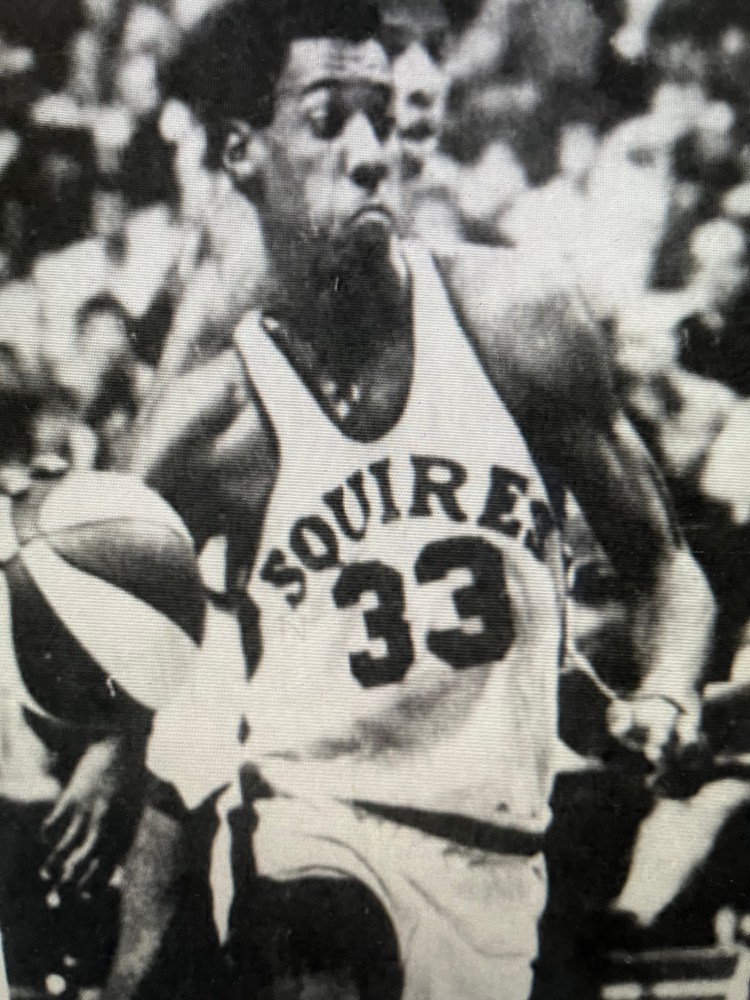
During the first half of the Squires-Nets game Saturday night, a man sitting in one of the box seats made an observation about the crowd of 4,932 watching the game: “They don’t cheer, fellows,” he yelled to the Squires sitting along the sideline. “They only cheer for high school games! Let’s make our own cheers! Squires are great! Squires are great!”
Some of the fans around him began to laugh, but some began to join him in the cheer. Noticing that he was generating some enthusiasm among the crowd, he stood up and led them in a cheer: “Two bits! Three bits! Four bits, a dollar, all for the Squires stand up and holler!”
The cheer was incorrect (it’s two bits, four bits, six bits, etc.), but nevertheless, some of the fans stood up and yelled the words, and a great many more just yelled. But the Squires played sluggishly during the first half, and the fans could find little to cheer about.
The man in the box seat continued his cheerleading. But he wasn’t getting any response. Finally, he left his box seat and sat in front of the cheerleaders. He joined them in every cheer.
As the second half got underway, the Squires began closing the gap, and the fans began to yell louder—without the man’s leadership. Finally, as the game closed in a thrilling 126-124 Squire victory, the fans were on their feet, yelling jubilantly.
It was enough to make the man smile. And enough to possibly keep the Squires in Roanoke.
As most fans in the Roanoke Valley know, there had been some doubt as to whether the Squires would continue to play in the area. Low attendance at earlier games prompted owner Earl Foreman to announce that unless the situation improved, the Squires might no longer play in Roanoke. Foreman was going to use Saturday’s crowd in helping him make the final decision.
The fans came through. Shortly after the end of the contest, Squires’ vice-president John Kerr announced that the team would keep their remaining two appointments at the Civic Center.
The players themselves never objected to coming to Roanoke—providing there was a crowd for them to play for. “We don’t dislike one another,” said ABA scoring leader Charlie Scott, “we try not to be hypocrites about all of it. We go out there and do our jobs—that’s what basketball is all about, and it makes us one of the closest-knit professional basketball teams.”
“And we shouldn’t have to come here if people aren’t interested,” said Doug Moe. “Because we would be forcing the team on them. You can’t expect people to come to watch the team just because it’s ‘their’ team. They come to watch because they’re interested.”
“I can see a crowd of 3,000 or 4,000 on a road game,” added Scott, “but not at a home game. With crowds like that, you wonder if the people really want you. If they don’t, it’s time to get out.”
As for Saturday’s crowd, Scott said he didn’t pay them any attention. “I was too busy trying to win a ballgame.”
Willie Sojourner (pronounced SOUL-jouner, according to the “cheerleader” in the box seat), noticed the crowd, however. “Down at the Scope in Norfolk, it’s beautiful,” he said, “the fans cheer, they stand up, and they really make noise. Here, the folks seem to just sit there and turn their heads from side to side. They’ve got to yell to keep us motivated.
“We all thought it was encouraging toward the end of the game, though. Maybe the fans finally realized we’re here.”
There was one man, Willie, who knew you were here all along. One of the notices that flashed across the Civic Center scoreboard Saturday read, “Welcome to Squire Country.” And at last, it appears that it may be just that. The Saturday victory was the Squires’ fifth in a row,
[By March 1972, Scott had jumped to the NBA Phoenix Suns. By April, Julius Erving had jumped at his agent’s urging to NBA Atlanta Hawks to team with Pete Maravich, though not for long. By October, the Squires were preparing for their third season in Virginia and a few underwhelming home games per season scheduled in Roanoke.]
 From Way Downtown