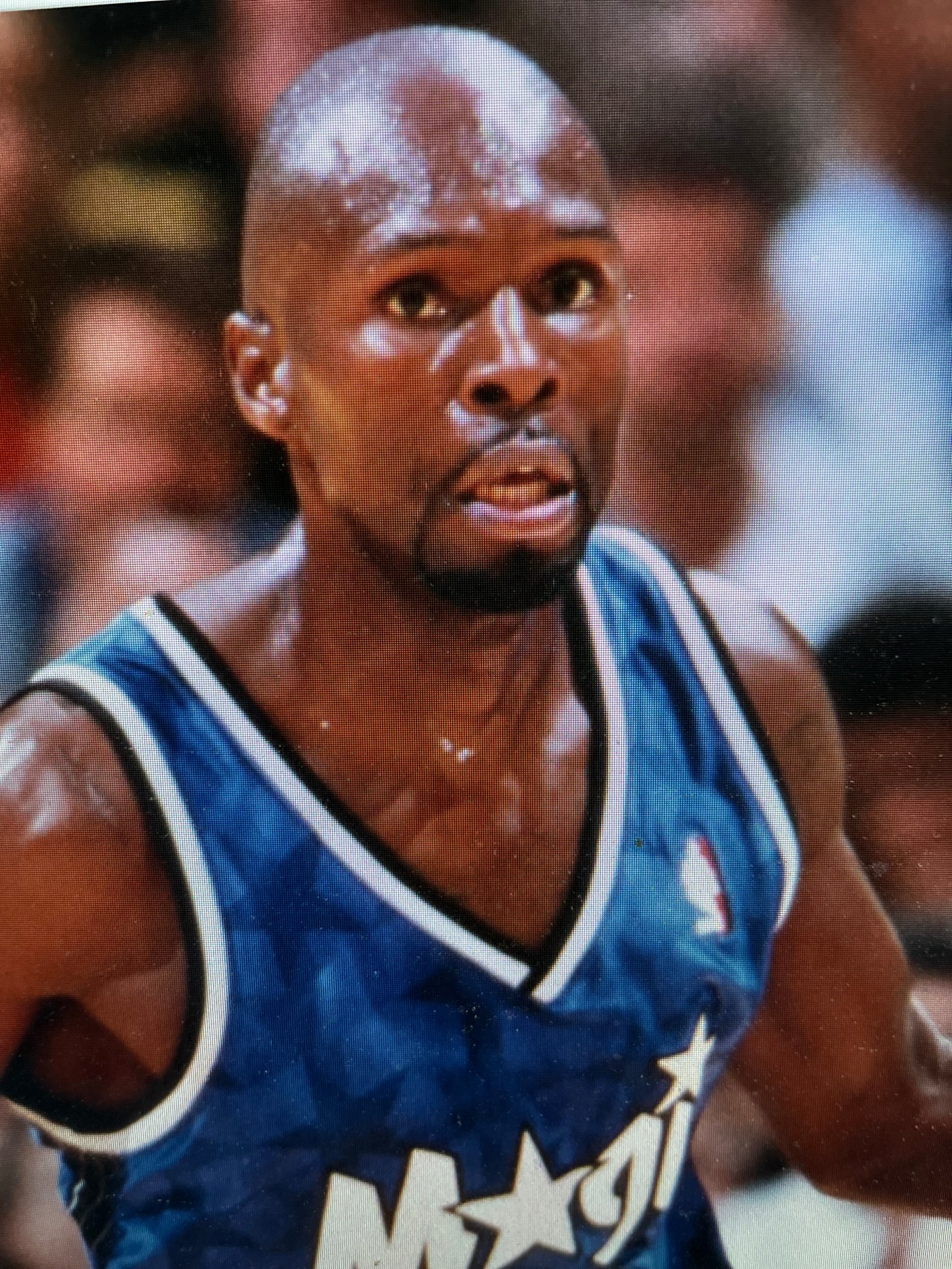
[Darrell Armstrong was one of the NBA’s all-time great hustling players and a fantastic sixth man to boot. Armstrong also was known for his coffee habit before games. Here’s a brief story on Armstrong, his coffee habit, and his breakout 1998-99 season. The story ran in the Orlando Sentinel on April 22, 1999, and the byline belongs to L. C Johnson.]
****
He has a sweet tooth.
This much we know about Orlando Magic guard Darrell Armstrong, which probably explains his abundance of energy. He keeps his 6-feet-1, 165-pound frame lean despite a steady diet of Hershey’s Kisses—two at halftime of every game—and Barnie’s coffee equipped with, get this, seven lumps of sugar.
“It started when we were playing on the West Coast in March,” said Armstrong, 30. “The game would start at 10:30 [Eastern time], and I could feel my body starting to get tired, because that’s normally the time when our games would be over.
“[Coach] Chuck Daly suggested that I start drinking a cup of coffee to get a little caffeine in my body. We were playing the Golden State Warriors, and I drank some coffee. I ended up having a good game, and I’ve been doing it ever since.”
Usually about an hour before tipoff, once the sugar rush starts to kick in, Armstrong can be heard issuing playful, rapid-fire chatter in the locker room.
In Chicago one night, Armstrong was working off some high-octane coffee beans. Teammate Horace Grant, who had been sitting at his locker, suddenly heard Armstrong’s rumblings begin to pick up adjacent to the shower area. “Oh, yeah, there he goes,” Grant said.
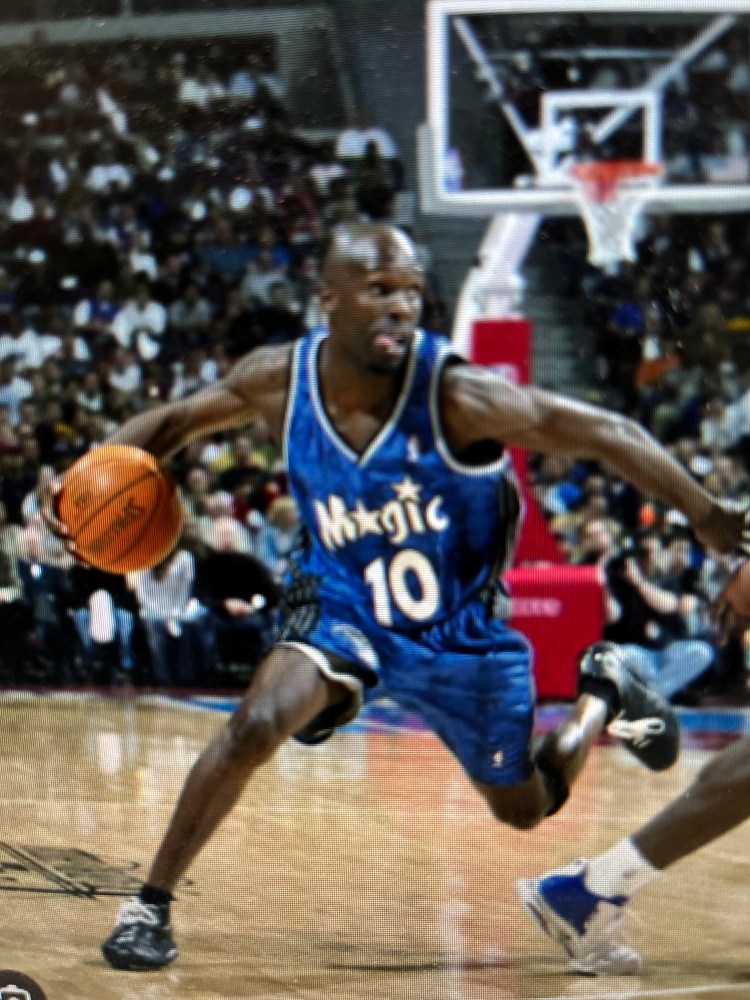
The NBA world is learning more and more about Darrell Armstrong. He has emerged as the leading candidate for the NBA’s Sixth Man and Most Improved Player awards. Armstrong’s stats place him among the elite of reserves in scoring (13.7), assists (6.5), and steals (2.24).
“Words cannot describe what Darrell has meant to us,” Grant said. “For me to try to put it into words would diminish what he means to us.”
Last season, Armstrong was off to his best start. He averaged career highs of 9.2 points, 4.9 assists, and 3.3 rebounds. Daly often lamented: “The guy goes out some nights and leads us in scoring, rebounds, and assists. He’s an incredible story.”
The story took an unexpected twist when Armstrong tore his right rotator cuff and was lost for the season. “He had a pretty bad tear,” Dr. Richard Shue said. “One of his tendons was completely torn off from the bone, and the other tendon was partially torn. . . . This was the type of injury that quarterbacks or pitchers normally get because of the repetitive overhand motion.”
There was no guarantee he could play again, let alone go out and shoot three-pointers and dive all over the floor like he does. There’s no wonder the buzz in Orlando Arena goes up a couple of octaves when Armstrong checks in at the scorer’s table. “I just try to give it everything I have every night,” he said.
Fact is, Armstrong has an uplifting effect on nearly everyone. Normally before Magic home games, Armstrong will bound from the locker room—coffee cup in hand—to greet fans and well-wishers.
Once he makes his social rounds on game nights, he usually heads to a small room at the O-rena for a pregame chapel service. It is there that Armstrong can put everything in perspective. His life. Family. Game.
“I pray every day,” Armstrong said. “I’m really thankful for everything I have. It’s amazing when you think about it. I think a lot of pro athletes really don’t take time to sit down and think how good we’ve got it. But I’m thankful every day just for waking up. There are no guarantees. So, I pray to God every day because I know that I’ve been blessed.”
Penny Hardaway remembers his first impression of Armstrong. “All I remember is seeing this little guy going at it in practice and dunking on everybody,” Hardaway said. “It was amazing. I knew right away that he could play.”
Former Magic guard Brian Shaw quickly gave Armstrong the nickname “Tasmanian Devil” for his relentless play.
Armstrong has had plenty of nicknames in his day. He has the name “Sky” tattooed on his left calf. That was the nickname he was given for his dunking as a college player at Fayetteville (NC) State, where he won the Central Intercollegiate Athletic Association’s slam-dunk contest. He was known for his tenacious play, despite his modest stature.
“I got that from playing sandlot football as a little kid,” said Armstrong, who was a wide receiver and kicker at Fayetteville State. “I wasn’t very big, but I loved to get hit and make big hits.”
Armstrong signed a five-year, $18 million contract in January after the NBA lockout was resolved. Even though he never made more than $350,000 in the NBA, Armstrong had saved his money and invested wisely.
With that new wealth, Armstrong has been able to do some things he always wanted to do. He recently purchased a home in the Gastonia, NC area for his mother. He said it was the happiest day in his life when, two weeks ago during a trip to Charlotte to play the Hornets, he was able to see his mother walk through the house.
“Hey, the league minimum, $350,000, is more money than I ever dreamed of making, Armstrong said. “But it’s nice to have some security in knowing that you can take care of things now and do things for your family.”
[In December 1999, Hoop Magazine ran a brief article on Armstrong. Here’s the rest of the story on Armstrong’s breakout 1998-99 season. The byline belongs to the great Curtis Bunn, then with the Atlanta Journal and Constitution.]
In a year’s time, Darrell Armstrong raised his stature from question mark to exclamation mark. The one-time fringe player who traveled the world to find a game—the CBA, USBL, Greece, Spain—now reigns as the Orlando Magic’s cornerstone. A point guard who has made his point.
The checklist of departed players from last year’s Magic roster is scary. Penny Hardaway? Gone. Horace Grant? Gone. Nick Anderson? Gone. Ike Austin? Gone. That Armstrong remains the only starter from the 1998–99 Orlando playoff team tells you all you need to know about what the 6-feet-1 mercurial floor leader did when he finally got healthy enough to play an entire season after a torn rotator cuff threatened his career.
“It’s just a great testament to Darrell,” Orlando general manager John Gabriel said. “No one can take credit for his success but him. He’s worked his way to his position. He’s earned everything he has received.”
He received the trophy for last season’s NBA Sixth Man of the Year Award after a splendid start to the year as a reserve. Although he closed the season as a starter—the sooner he was on the court, the better for the Magic—he still took the award as the top player off the bench. That hardware sits next to one that says 1999 NBA Most Improved Player.
“It was a big year for me,” he said. “I proved that the injury didn’t hurt my ability. I was ready. I heard the negative talk, people thinking I wasn’t going to make it back. But I was more aggressive than I’ve ever been. I was taking the shots when they were there.”
There will be more shots this year for Armstrong and definitely more responsibility. First-year coach Doc Rivers is working with a patchwork team comprised of virtually all newcomers. The constant is Armstrong. And as the point guard, it has been up to him to keep some order as players learn a new system and each other.
“I always wanted to be a leader,” he said. “I’ve looked forward to this situation. I think we might have some bumps early because we won’t know each other. But it’ll be up to me to keep the team together.”
Armstrong said being more assertive vocally—telling players where to be on the floor and imploring effort and poise—goes with his personality. But now he’s more adept at showing the way. “The first thing you have to do is lead by example,” Armstrong said.
“As a leader, I can’t take a night off. The team is looking for me to be out there playing hard. And when you look at the point guards in the NBA, there’s no room to take off. One night it’s Allen Iverson, the next night is Stephon Marbury or Terrell, Brandon or Jason Kidd or Rod Strickland. I don’t like to get embarrassed or for people to score on me. So, it could be trouble.”
But not as much trouble as what he experienced in the CBA, according to Armstrong. Surprisingly, he considers his battles with the NBA’s top point guards somewhat of a step down from—get this—the CBA. Not in overall talent, but in competition.
“The CBA is tougher [than the NBA] because every guy is playing hard every second because he wants to get to the NBA,” said Armstrong. “Guys are scrapping and hustling so much and swarming you so much that you can smell someone’s breath every time you move.”
It is that experience of competing to get to the NBA that Armstrong believes will keep him in the big leagues. And flourishing. “You look around the NBA and you see guys like Anthony Mason, Mario Elie, John Starks, me . . . we are the guys who are diving for loose balls. You come from the CBA, you get after it,” Armstrong said. “There’s no quit in CBA guys.”
Despite his allegiance to his pre-NBA days, the trophy-laden Armstrong has very much established himself as an NBA guy. “Darrell Armstrong’s one of those guys who it’s easy to root for,” Rivers said. “He fought his way into the league. And when he got here, he took advantage. You’ve got to love that in a player.”
 From Way Downtown