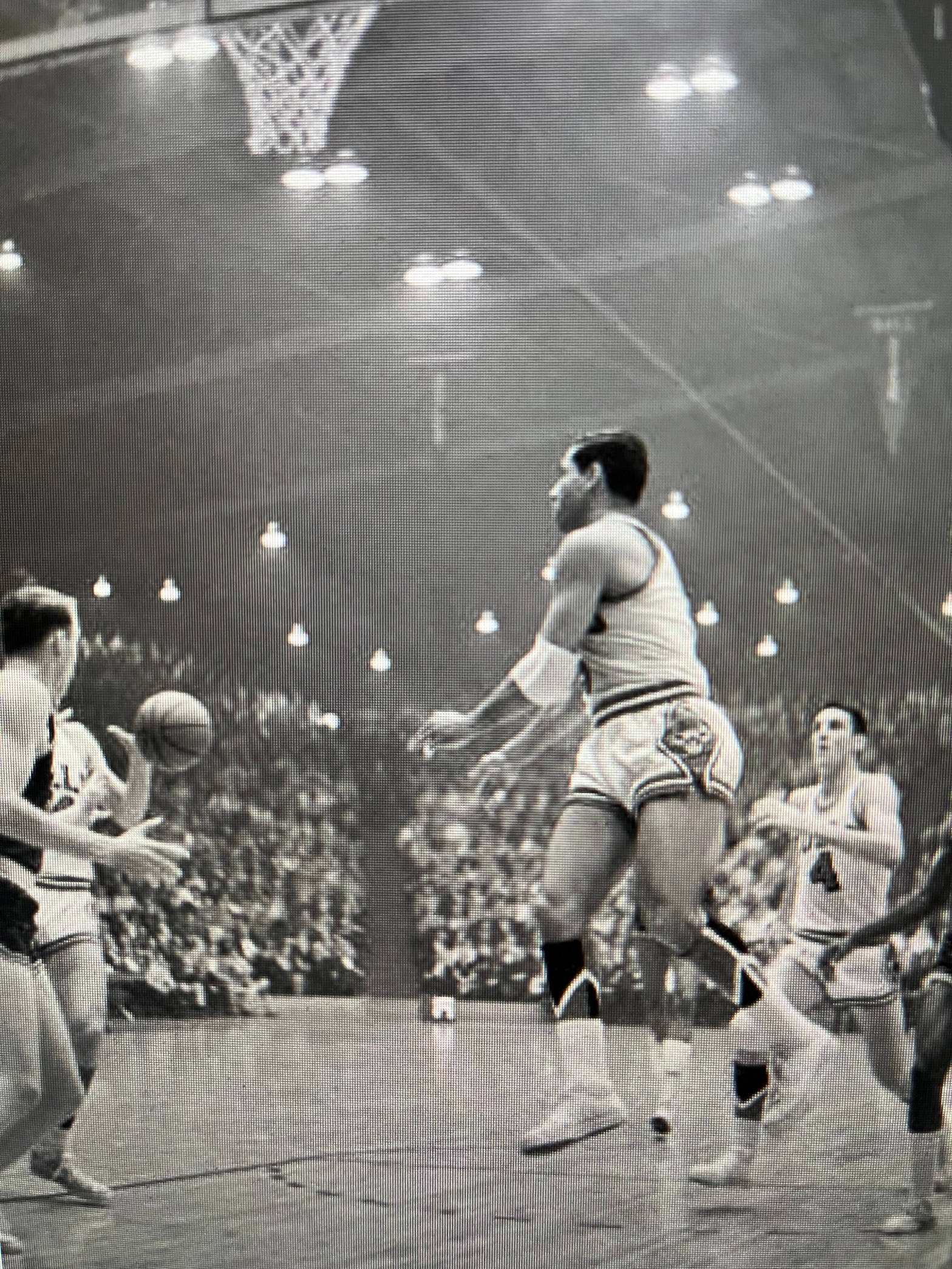
[For my last book, Shake and Bake: The Life and Times of NBA Great Archie Clark, I was asked to do the inevitable in our now do-it-yourself society. I had to solicit comments about the book for bolded placement on its dust jacket. Sonny Hill, Philadelphia’s living basketball encyclopedia, was an obvious choice. After all, Hill nicknamed Archie’s crossover move “shake and bake” as a young radio broadcaster in the early 1970s.
I called Hill and, if you’ve ever talked to him, he doesn’t suffer fools wisely. He’s also VERY serious about his basketball. “Let me tell you,” Hill started in, “Archie had the best crossover move EVER—and I’ve seen them all.” Like a college professor, Hill dissected the modern crossover move and explained that Archie didn’t carry the ball on his crossover. “Today’s players,” he said, “they all carry the ball. They can’t do it cleanly.” Hill gladly offered up a dust jacket blurb, praising Archie just like he does so many other players whose greatness has been dimmed by time, not merit.
Among Hill’s loudest never-forgets is the memory of his own boyhood hero, Guy Rodgers. Or, as Archie once told me about Rodgers, “He could do everything Cousy could do, just three times as fast.” Matter of fact, Rodgers and his college backcourt mate Hal Lear reportedly were clocked in the 1950s running from endline to opposing basket somewhere in the neighborhood of three seconds. In February 2001, Rodgers passed away unexpectedly at just age 65, and Hill wrote his no-nonsense homage to one of the all-time greats. Hill’s appreciation ran in the Philadelphia Inquirer on February 25, 2001.]
****
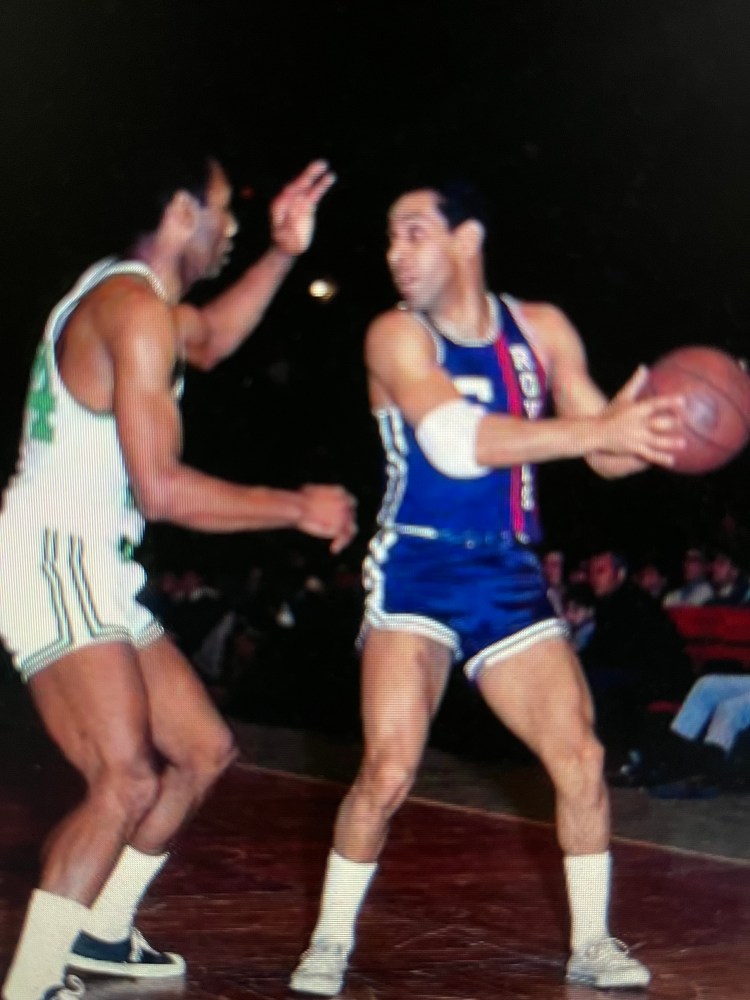
He was my hero, my mentor. He was my friend. Without Guy “Flip” Rodgers, I wouldn’t be where I am today, wherever that is. And I’m far from the only person who can say that.
Let’s look at how Guy helped shape the game. He had a drive and determination that were second to none. He would pick me up to go play basketball, and, the first 15 minutes, we’d spend just passing the ball to each other. At the time, I never understood it because I never questioned anything he did. He was a teenager, but he knew it was important to develop hand-eye coordination.
He had a spot on the wall. He’d practice passing the ball behind his back. He would do It with his left hand, his strong hand, and with his offhand, his right hand. He’d practice for five or 10 minutes. What’s so unique about that? You’ve seen video of Bob Cousy passing behind his back. You’ve seen Magic Johnson. You’ve seen Jason Williams do it in the modern era. The difference is this: Guy Rodgers could pass the ball behind his back the length of the basketball court. He didn’t do it some of the time. He did it all the time. You’ve never seen that. Today, you see guys throw the ball the length of the court, it curves, it floats. He could throw the basketball behind his back, the full length of the court for a layup.
Oscar Robertson, the Big O, says the greatest passer, dribbler, and ballhandler is not Oscar Robertson. It’s Guy Rodgers. Remember, I didn’t say that. Oscar Robertson said that.
The thing about Guy, he never came to bring the show. Guy never liked the show. It was all spontaneous. It just happened to be the thing to do.
After Guy’s senior season at Temple, after he brought Temple to the Final Four two times, he went on a barnstorming tour playing against the Harlem Globetrotters. The Globetrotters put the show on. Guy didn’t like it. He decided he would go home. The late Abe Saperstein, who owned the Globetrotters, called Guy and said, “We need you.” Guy told him, “I don’t like it.” Abe Saperstein talked to him and gave him some more money, and Guy went back. And he put a dribbling exhibition on the Globetrotters. They were trying to get the ball for real. They couldn’t get the ball.
As quick as Allen Iverson is and as fast as he gets the ball up and down the court—and he’s one of the top five in the history of the NBA—number one is Guy Rodgers. That’s Nate “Tiny” Archibald saying that. And he’s also one of the top five. I said to him once, “Nate, who is the quickest, fastest player you’ve ever seen dribbling the ball up the floor?” He said, “Sonny, it’s Guy Rodgers.”
These are the stories that the NBA should have been telling when he was alive, and it’s to the league’s discredit that it has not put him in the category of the great entertainers.
The Basketball Hall of Fame is the Hall of Shame if it does not have a Guy Rodgers. I thought the Hall of Fame was about what you do as a basketball player throughout your career. Guy Rodgers and Hal Lear are considered the best backcourt in the history of college basketball. That’s not me saying it. That’s the establishment.
Intellectually, he was light-years ahead of the game of basketball. The game has never caught up with him. I would put him in with Oscar Robertson, Bob Cousy, Magic Johnson, Larry Bird, Rick Barry. Guys who were thinking about the game in ways no one could understand.
Guy patterned a lot of his game about Bob Cousy. And his dribbling idol was Marques Haynes of the Globetrotters. He grew up on Cumberland Street, which is probably no more than 40 paces from Fun Field, right across from old Shibe Park. I’m from 16th and Dauphin. One day at Fun Field, he touched me. He said, “You can play.” Man, what a motivation. I was 12 or 13. I wasn’t that good a player. My first love was baseball. My goal was to get to the major leagues. But he motivated me to work harder at basketball. All the way home, my buddies were saying, “Guy said you can play!”
We formed a friendship that carried into a relationship, and that relationship carried into him being my big brother. He was a year older than me, two years ahead of me in school. He went to Northeast High School. He was the inspiration for me to go to Northeast.
To put it in proper perspective, pro basketball at that time was not large. I’d listen to games on the radio. But Guy Rodgers was as large as they were. What Guy perfected in the schoolyards and the rec centers, he took to Northeast High and Temple and the NBA.
Guy used to come to my house, and we’d go out and play basketball for four, five, six hours. We’d play all day, then drink milkshakes. I was just a struggling player; I could make a shot. But we never played five-on-five. We’d play at 17th and Susquehanna, 19th and Reed in South Philadelphia. We’d go to Atlantic City. We’d travel the area.
Guy still is the Warriors’ all-time assists leader. Today, you just pass the ball to an open guy, and they give you an assist. Those guys, when they played, an assist had to lead directly to a basket. If they put it on the floor, you lost the assist. Oscar said that Guy would have averaged well over 20 assists game today. Compare that to John Stockton, who gets 12.
Guy’s game was adopted by Walt Hazzard at Overbrook. He brought the behind-the-back dribble and some of the pizzazz to John Wooden. He put UCLA on the map. He took the Philly game to California. He had been touched by Guy.
Earl Monroe learned the game from Bobby Lewis, who taught Earl some of the basics. Then Earl went and tinkered with it and developed his own style.
Think about this: Guy Rodgers was a senior at Northeast High when Wilt Chamberlain was a 10th grader at Overbrook high. Wilt was good enough to play in the NBA and dominate as a 10th grader! That year, Guy Rodgers averaged 35 points a game at Northeast and was selected the city player of the year.
I carried his bag. I say that with pride.
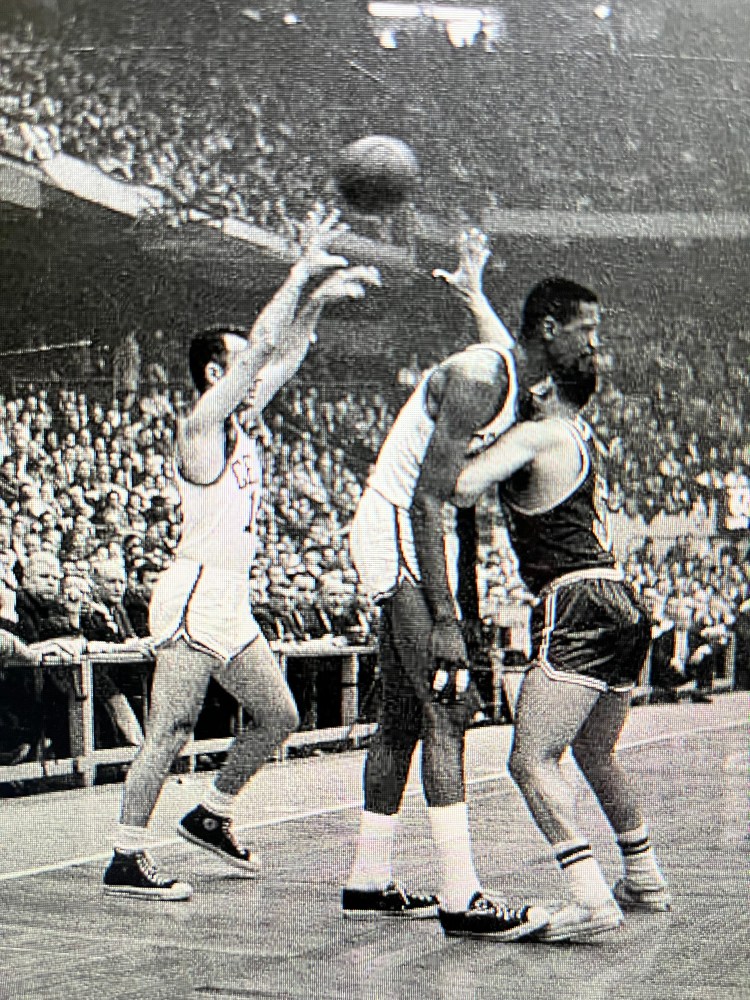
[The Basketball Hall of Fame remained the Hall of Shame for several more years. Then, in 2014, the Hall belated voted to enshrine Rodgers. In this article from the Philadelphia Inquirer to mark the occasion, reporter Joe Juliano revisits much of Hill’s blue-in-the-face contention that no basketball hall of fame would ever be complete without a nod to Rodgers. The story appeared on August 7, 2014. Also, be sure to click on the video from the enshrinement ceremony.]
Sonny Hill minces no words when he discusses the basketball career of Guy Rodgers, his “big brother [and] mentor.”
“When people ask me, ‘Who is the greatest player in the Big Five?’ It’s not even close,” Hill, Philadelphia’s iconic basketball organizer and advocate said Wednesday. “That’s how good he was.
“Let’s put it in Philadelphia perspective: Whoever it is that you think is the second-best Big Five player, he’s not close to Guy Rodgers.”
Rodgers, a heady and gifted point guard who won three straight Big Five Player-of-the-Year awards at Temple, will be inducted posthumously Friday night into the Naismith Hall of Fame in Springfield, Mass., picked by the Hall’s veterans committee.
Rodgers retired from the. NBA after the 1969-70 season and died in 2001 at age 65. The fact that he had to wait so long to find a place in the Hall is a sore spot with Hill and others who played with Rodgers on the Philadelphia playgrounds or spent time as his teammate at Temple or during his 12 pro seasons.
“I was on a couple of Hall of Fame committees, and I was one of the advocates for Guy for many years,” former Temple coach John Chaney said. “Some of the people that voted against him were unbelievable. When the committee changes, and they put a lot of young people on, they don’t know the great players from the past. His assist records were second to none.”
Rodgers is the first Big Five player to make it to the Hall; Paul Arizin of Villanova and Tom Gola of LaSalle played before the Big Five existed. He is the fifth Philadelphian to make it, joining Arizin, Gola, Wilt Chamberlain, and Earl Monroe. Monroe will present Rodgers for induction.
Rodgers was admired by his peers in the NBA, where he led the league twice in assists and averaged 7.8 per game for his career. Hill said that Oscar Robertson once told him Rodgers “was the greatest dribbler and passer that he’s ever seen,” and that Nate “Tiny” Archibald called him “the fastest guy to get the ball up the floor.”
Al Attles, who also will be enshrined for his services to basketball, roomed with Rodgers during their days with the Philadelphia and San Francisco Warriors, and the two stayed close after their playing days. “He was the best, I don’t know anybody better,” said Attles, who still works for the Warriors as a team ambassador. “He was terrific with the basketball.
“Many times when you’re playing defensively against someone, they’re concerned about you, and they’re looking at you rather than what’s going on on the floor. Guy never looked at you. He always looked at the next play.”
“He was Magic Johnson before Magic Johnson,” Hill said. “[In high school] he rebounded the ball. He dribbled the ball up the floor. He made all kinds of passes. He stole the ball. He played the pivot on offense. His senior year, he was the Markward Club’s Player of the Year over Wilt.”
Chamberlain would become a teammate of Rodgers in Philadelphia and San Francisco. Chaney said Rodgers was the best thing that happened to Chamberlain. “Wilt would get so frustrated—he didn’t have a point guard until Guy Rodgers came out,” he said. “Guys would be rolling the ball to a seven-footer, and Guy was the only one that could make good passes to Wilt. I think that helped a great deal with Wilt’s success.”
While Friday’s honor may be belated for some, many basketball greats are thrilled to see Rodgers be enshrined for all time. “Guy’s game translates into any era,” Hill said. “He could have played in this era or in the era after that. He would still be the same great basketball player. Guy was a transcendent player because his game was far ahead of its time.”
[Now back to 2001 and news of Guy Rodgers’ passing. Veteran journalist Acel Moore, then with the Philadelphia Inquirer, couldn’t let the moment pass without offering his level-headed best about Rodgers and his larger place in the game. Definitely worth reading. His encomium appeared in the Inquirer on February 22, 2001.]
I am the only member of this paper’s editorial board who saw Guy Rodgers play in person. Rodgers, a basketball legend whose Philadelphia story weaves through Northeast High School, Temple University, and the Philadelphia Warriors, died Monday at age 65 in Los Angeles.
Many are saying that he might have been the best point guard this town ever produced. It’s the kind of glib phrase that you hear all the time—but I don’t want it to go by without comment. I wonder how many people realize what an astonishing distinction it would be to be the best ever from this town.
As a basketball guard, watching Rodgers was like listening to smooth jazz. “He was a virtuoso,” said attorney and former state representative Hardy Williams, who was a pretty good ballplayer himself at West Philadelphia High School and Penn State, where he captained the Nittany Lions team in the early 1950s.
The distinction of having seen him play says more about me than it does about my colleagues on the board. What it says is I’m older than the rest of the board. And I’m the only Philadelphia native. Those two facts mean that Guy Rodgers and I have a lot in common.
When Rodgers played high school, college, and professional ball, the tallest building in town was still crowned by Billy Penn. He played before television came to dominate the world of sport, before the NBA had reached the prominence it enjoys today. It was a time when basketball players wore Converse sneakers, short trunks, and the mainstay of many players was the two-handed set shot.
Rodgers was one of the city’s storied players. But he was more. As an African American, he was a pioneer. In the early 1950s, basketball was dominated by white athletes, among them some Philadelphia greats such as Tom Gola. But Rodgers represented a new world coming. He, along with Wilt Chamberlain, Jackie Moore, and a stellar list of other Overbrook High School players, including Wali Jones and Walt Hazzard, not only became college All-Americans and NBA stars but also changed the way the game was played and its place in American society.
Philadelphia was a major conduit for Black talent into basketball; these players who changed the face and meaning of the game really were importing a little piece of Philly into national culture. The list of greats who went to the pros, not a short one, includes Ray Scott and Gene Banks of West Philadelphia High School and Earl “the Pearl” Monroe of Bartram High. And no such list is complete without a mention of Sonny Hill, a great high school and semipro player considered by many to be the city’s greatest basketball impresario.
The news of Rodgers’ death brought forth reminiscences of the days when Black basketball players were struggling to enter the sport. Among those players was John Chaney, now the men’s basketball coach at Temple. He was an all-Public League player in 1951 at Ben Franklin and played against Rodgers as a schoolboy. Chaney didn’t get to a major college or make the NBA as a basketball coach, but he has his own secure place in the annals of basketball, both in this city and nationwide.
Rodgers, therefore, stands at the head of quite a distinguished list. On Tuesday, WHAT radio talk-show host Reginald Bryant conducted what amounted to a memorial to Rodgers on his program. For two hours, callers talked about not only Rodgers but also many other players of the 1950s.
Several of the city’s legends, including Chaney, called his program to talk about Rodgers’ contribution to the sport. Many others who called are former players whose names may not be recognized nationally but who were great athletes whose scholastic and schoolyard legends are still remembered by many. They have names like Larry and Dave Riddick, Jay “Pappy” Norman, Mike Cooper, Donald “Ducky” Birts, Jimmy “T” Parham, Hal Lear, and football Hall of Famer Herb Adderly.
Guy Rodgers is a symbol of how formerly marginalized people rose to the top in the American fashion—through their abilities. Basketball integrated well before the larger society was ready to do so. And indeed, that society has a ways to go to catch up to the game. But the process has started, and Guy Rodgers and the city he grew up in, the city that loves him still, had a lot to do with it.
[Last but not least comes the hoorah. Newsday’s George Vecsey was in Madison Square Garden on the night of November 23, 1965 when Guy Rodgers, playing for the visiting San Francisco Warriors, went off.]
There is still a place in basketball for the six-foot player. There is even a place in basketball for the six-foot coach. But is there a place in basketball for the New York Knicks?
Guy Rodgers is a throwback, like the appendix or dinosaur bones. He qualified to be six feet only by lying. It is a wonder that the seven-footers haven’t dunked him in the basket. Last night, he scored 46 points for the San Francisco Warriors in a stirring 134-125 victory over the Knicks. He is averaging 20 points a game and having, at 30, the year of his life.
Al Attles doesn’t look like an NBA coach. In a time when coaches must be tall and smart—at least tall—Attles is a physical midget but may be a mental giant. Every time 6-feet-6 Warrior coach Alex Hannum gets thrown out of a game, Al Attles becomes a coach. He’s only six feet tall (6-feet-2, if you believe the roster . . . and you shouldn’t), but he has that knack. Only Red Auerbach is shorter, and he isn’t undefeated like Attles.
Hannum very thoughtfully got himself thrown out of last night’s game at just the right moment. The Warriors were going nowhere, and the score was 109-96, in favor of the home team. Hannum had already earned himself a technical foul and the automatic $25 fine. This time, he threw a towel at the floor, and the laws of gravity and the NBA went into effect. Simultaneously, Hannum was out another $25. He was also out of the game.
It was a time for great decisions. Hannum had used Attles in a similar situation in Los Angeles and won. “He’s smart, and he has the respect of his teammates,” Hannum said. “Also, he wasn’t in the game at the time.” This was no time for innovations, Hannum reminded. “I was going to use (Gary) Phillips for (Keith) Erickson for a while.”
Then Hannum left the floor as the announcer explained to the crowd of 12,003 that “the Warrior coach has been relieved of his responsibility for the remainder of the game.”
That was the start of it. Rodgers, who had already scored 38 points, scored eight more. But more important, he utilized favorable matchups to spring Tom Meschery loose for 10 points. Attles dutifully replaced Erickson with Phillips and made no further substitutions. He did call two timeouts, gave serious advice to everybody, and popped up and down on the bench like a superball.
The Warriors won the game despite Dick Barnett’s 41 points. “We were in command of the game,” sighed Knick coach Harry Gallatin. It was true. The Warriors just kept coming. “Like gangbusters,” Attles said.
The Warriors had their finest time in the dressing room. Penitent and expansive, Hannum appeared with a tray full of beers. “Alex, I only drink orange juice,” Rodgers snorted.
“Let Attles buy, he’s the coach,” Erickson shouted.
“Al, don’t let Alex in the dressing room,” somebody suggested.
“What’s the secret of your success?” Attles was asked.
“Guy Rodgers,” Attles said.
“Were you tempted to take Rodgers out?” somebody asked.
“Yeah, when he missed a shot. I was so surprised. I almost took him out.”
Rodgers hit 19 of 30 shots, most of them on drives up the middle or short jump shots. He also had 12 assists. This means he was directly responsible for 72 of his team’s 134 points. He played all 48 minutes. “Guy Rodgers is doing things I haven’t seen a six-footer do in years,” Hannum said. “I didn’t think they could be done anymore.”
Basically, they can’t. The behind-the-back pass is as ancient as Al Cervi; the two-handed layup as prehistoric as Wat Misaka. But this is the year that Guy Rodgers is a jolly pterodactyl buzzing around everybody’s ears.
“He’s got his confidence,” Hannum said. “It started last year. Then he played in the (Maurice) Stokes charity game this summer and was most valuable player. The thing just snowballed. He got his confidence, and now he’s out of this world.”
Some people think that Rodgers’ confidence came back the day Wilt Chamberlain was traded to Philadelphia last winter. Rodgers thinks so, but he doesn’t want to make a lot of noise about it. “Wilt is one of my best friends,” Rodgers said, practically beseeching the listener to understand.
“I’ve been playing with Wilt for 17 years. We grew up together. I think he’s terrific. Anybody who can score 100 points a game is . . . is a machine. If you don’t use him to score points, you’d be foolish. That’s what we did with him. We all had specialties.”
But Chamberlain is gone now, and the center is Nate Thurmond. Thurmond is not the offensive threat that Wilt is. “That lets Guy drive up the middle more,” points out Tom Gola, an admirer. “That’s what he did all the way back at Temple.”
“This is the way I love to play,” Rodgers said. “But lay off that Wilt thing. I don’t want to sound as if I’m knocking him. I never would do that.”
“The whole thing,” said Hannum, finally asserting himself again, “is being in the right time at the right place. Guy is exactly the right player for our team right now. He makes us go. He’s our most valuable piece of property.” The way Rodgers is playing, he is one of the league’s most valuable properties, too—despite being its smallest.
 From Way Downtown