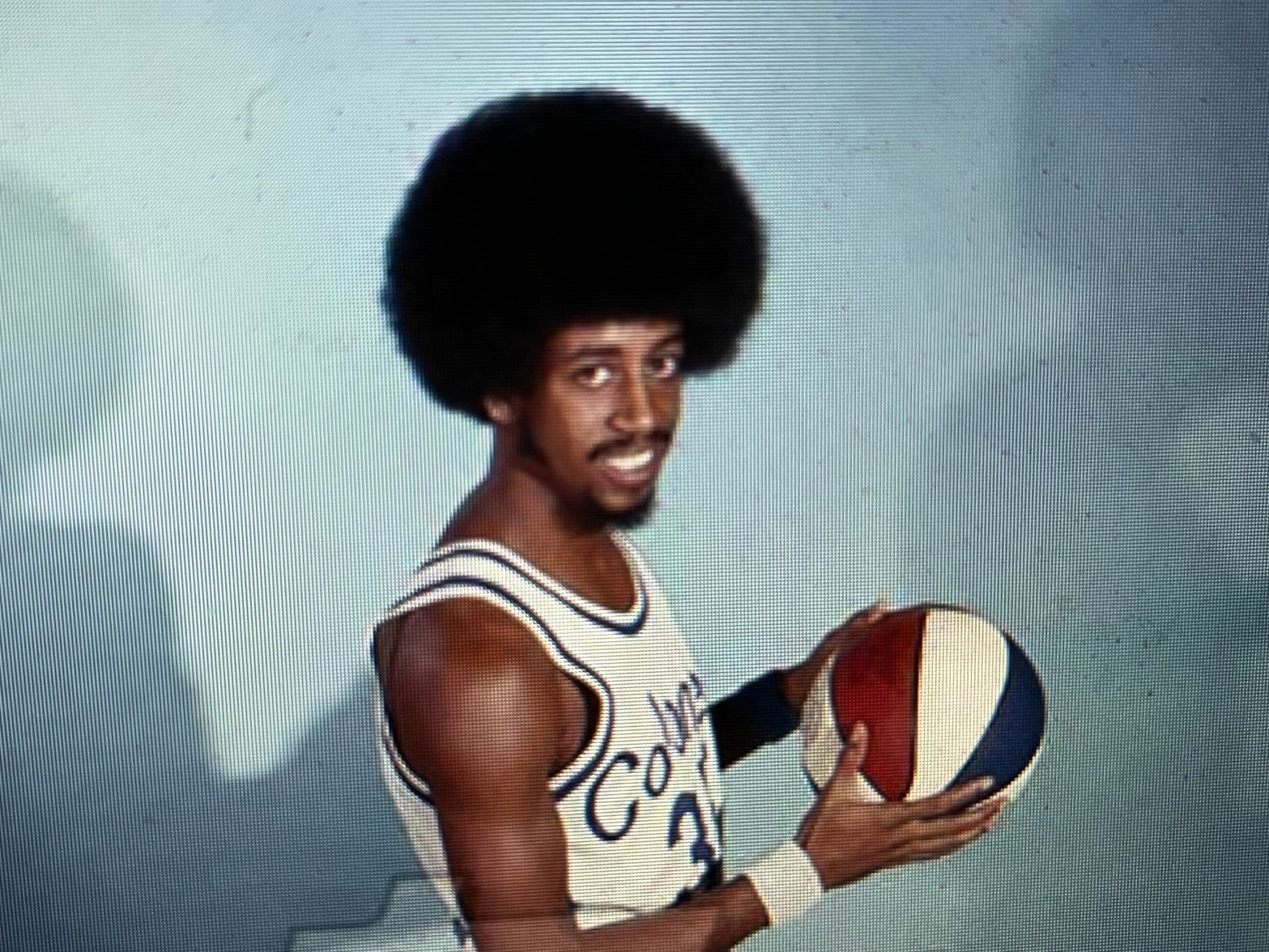
[Way back in my preteen years, I went through a spell of writing college players just to see if they’d write back. To my everlasting appreciation, some actually did. My short-lived pen pals included the late Phil Sellers (Rutgers), Roscoe Pondexter (Long Beach State), Sam McCants (Oral Roberts), and Ron King (Florida State). All were solid college players, but King was the real standout. Or so it seemed to me a few years later when, as junior, he briefly lit up UCLA in the 1972 NCAA championship game.
A lot people have forgotten about that great Florida State that featured an all-Black starting five. Sure, this was nearly a decade after Loyola of Chicago and six years after Texas Western. But Florida State was Deep South, and these guys were on a mission to dress like champions and prove their critics wrong on the court. “We hear the thing about Blacks not being able to play together all the time,” said Florida State forward Reggie Royals, resplendent in dazzling orange. “Like we have nothing but a bunch of all-stars on this team, yet we’ve overcome it with team play—we’ve really put it together.
“The guys are so close together, I mean, you never see me without Ron King (King was standing not three feet away in white knickers, gray Stetson, and black fur coat.”
Though King had didn’t have it made like a Bill Walton or an Ernie DiGregorio, he had a legitimate shot at the pros and a big contract. As recounted in this December 25, 1985 article from the Louisville Courier-Journal, it all came to a crashing halt early in his senior year with a simple twist of fate. Staff writer Glenn Rutherford tells the story, reminding us just how fragile stardom can be. And just to close the loop. Despite his setback in the early 1980s, King would thrive in his native Louisville with the Parks and Recreation Department.]
****
The 1972-73 basketball season had just begun, and Ron King was on top of the world. He was the star of a Florida State University team ranked first or second in the national polls, depending upon which magazine or wire service you read. The previous spring, he and his teammates had reached for—and almost grabbed—college basketball’s brass ring, the NCAA championship.
Florida State had been a 15- to 30-point underdog to UCLA, but King had been brilliant and helped to turn a predicted rout into a near upset. He scored 27 points—mostly on high-arching, long-range jump shots. In the end, Florida State missed the prize by just five points, 81-76.
Basketball experts were confident of a rematch in the 1973 finals, and King—a 6-feet-4 guard-forward with a quick first step and large, soft hands—was a consensus preseason All-America. He had just one more year of college ball. One more year of satin-smooth jumpers and jaguar-like glides to the basket. One more year, and the big money would be his.
Few people doubted that King would have a career in professional basketball. They thought he’d have the big salary, big car, and big sneaker contract that sets a basketball player for life. So did King.
Three games into his senior season, in the blink of an eye and twist of an ankle, everything changed.
Today, King is 34 and living with his mother on Virginia Avenue in Louisville. He has neither a career in pro basketball nor a college degree—he doesn’t even have a steady job. When weather and good fortune permit, he and a friend paint houses. And he’s beginning to referee junior varsity high school basketball games—for $17.50 a night.
He still looks fit enough to play, but now he dreams of finishing college, not of completing three-point plays. He knows that, somehow, mostly through his own doing, he fell through the cracks in the big business that is both college and professional basketball.
For Ron King, the cheering stopped long ago. “I remember the play like yesterday,” he said of the moment that changed his life. “It was our third game, against Alabama, and I don’t think a minute had run off the clock. I know my dad said he was just getting into his seat when he looked at the floor, and I was already down.”
King had launched one of his pillow-soft jump shots, when Riley Odoms, an Alabama guard, gave him a slight and unintentional nudge. “I came down on [Alabama center] Leon Douglas’ foot,” King recalled.
When he looked down, his right foot was at a right angle to where it should have been. In the weeks to come, his life became even more disjointed. “I was so depressed,” he said. “Nothing like this has ever happened to me before. I honestly just stayed in my room for days. Weeks. My roommate even had to bring me food. I lost about 10 pounds during that season, just sitting and feeling sorry for myself, I guess.”
More importantly, King quit going to class. An elementary education major, he made good enough grades before his injury to avoid eligibility problems. “I wasn’t a dumb student,” he said. “My average was above a 2.0 when I was playing. But that last year, I just stopped going.”
And nobody came to tell him to get back into the classroom, he said. King could have taken a redshirt year—he could have had a fifth year of eligibility because the injury occurred so early in his senior season.
But he had to stay eligible academically to do that, and he couldn’t by hibernating. “Coach (Hugh) Durham was occupied with the team and all, and I can’t recall him ever coming by,” King said. “He may have, I can’t say he didn’t. But I don’t remember . . . I was 21 years old then, and I should have been man enough to go on and do what I was supposed to do. But I didn’t.”
Rather than having another year of college ball, left to hone his skills and prove his worth to the pros, King flunked out. After the season, he said, Durham came to him and offered some advice. “He said my grades were so bad that I couldn’t get back in school, and that I should go on and get drafted and try to make it,” King said. “See, the sad thing is I could have gone on to class with crutches or whatever. Or I could’ve even withdrawn, taken incompletes that semester, and then gone to summer school and not had any problems with my grades.”
At Florida State, King had faced mandatory courses during his first two years. But by his junior year, he’d found his way “into some crib courses, you know the kind I mean. My advisor had me taking basketball theory, track and field, and judo, stuff like that,” he said.
The courses didn’t help toward his major, although they did give him credits toward a minor in physical education. “And they weren’t all that easy, he said. “But they were just keeping me eligible, not pointing me toward my degree . . . But it’s nobody’s fault but my own. That’s the truth, and that’s something I’ll live with the rest of my life.”
After college, King was drafted in the third round by both the ABA Kentucky Colonels and by the NBA Golden State Warriors. He signed a guaranteed one-year contract with the Colonels—for $44,00—then was waived after a month on the roster. After that, there were tryouts with Golden State, San Diego, and Detroit, and nine months spent in Los Angeles playing in the NBA’s summer leagues. In between all that was a brief stay with a team in Israel.
It was in 1976 that King, his $44,000 long gone, gave up the dream of pro ball for good. Now he wants to go back to school—he has about a year of classes left to get a degree—so he can coach and counsel youngsters to avoid the mistakes he made. He knows there are only 23 teams in pro ball, with only 12 men each on the rosters. He knows few ever get a shot at making the pros, let alone signing a contract.
“I’ve had it rough,” he said. “I haven’t had a good job in a long time, and I think I’ve applied for every job in the city. I’ve been a security guard, recreation aide, and maintenance man. I’m talking about some real little jobs. Now I know I’ve got to be back in school.”
He also deeply believes that if he hadn’t stepped on Leon Douglas’ foot, he might still be playing. “If that hadn’t happened, it would have been all different,” he said. “I know I could play. When I was that age, I don’t think there were five players in the country who could shoot better than me from 20 feet on out. I could flat shoot the ball.”
 From Way Downtown