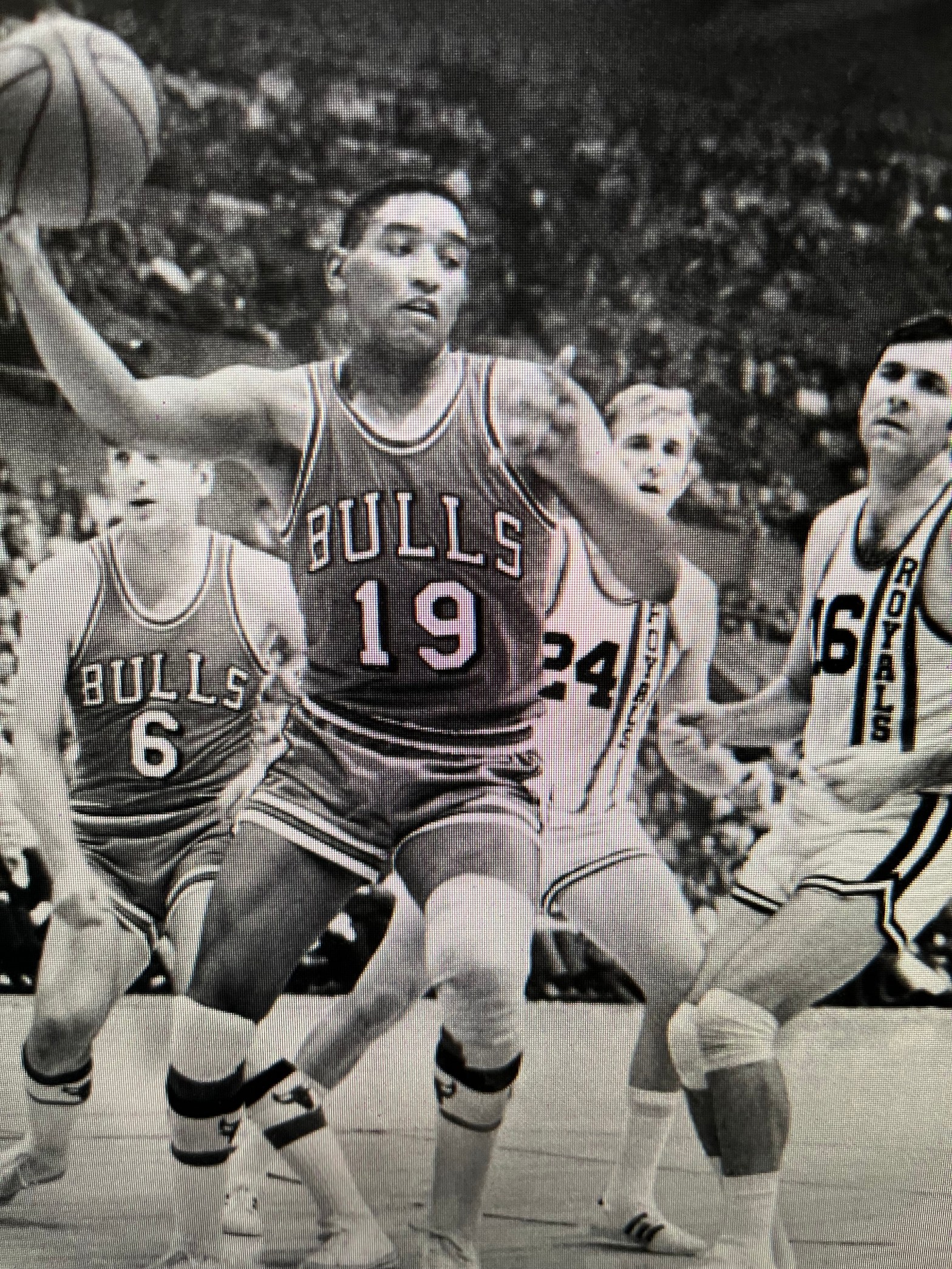
[In the early 1990s, the Chicago Tribune ran an article about the Bulls and their inaugural 1966-67 season that started like this:
When Johnny “Red” Kerr was head coach of the Chicago Bulls during their NBA debut season 25 years ago, he never left home without it.
A popular credit card?
No, a pocketful of dimes.
“Those are the days that we’d always have coins in our pockets before going to games,” Kerr said, “so we could call the press afterwards. I’d dial up the papers’ sports desks and say something like: ‘Hi, this is John Kerr, coach of the Bulls. The Bulls won tonight, 110-106, and Bob Boozer was our leading scorer with 26 points.’
“The desk guy would say: ‘Boozer? How ‘ya spell that?’ I’d say: ‘B-o-o-z-e-r,’ and then the operator would jump in and say, ‘Please deposit another dime.’”
Such were the trials and tribulations of selling a product that was initially as popular in Chicago as slush. Kerr, Boozer, and the baby Bulls tried to succeed in a town where previous pro basketball teams—the Stags, Packers, and Zephyrs—had failed miserably.
B-o-o-z-e-r who? If you grew up in Omaha, the answer was automatic. Bob Boozer was one of the city’s finest basketball players ever (he has a street named after him there), an All-American at Kansas State, and a member of the 1960 U.S. Olympics men’s basketball team. It took Boozer a few seasons to break out of his NBA shell, and he bounced around the league a bit. But Boozer finally found stardom with the expansion Bulls late in his 20s. Here’s Chicago sportswriter Bob Logan with Kerr discussing Boozer and the early Bulls:
Said Kerr: “The thing most people don’t realize Is that we didn’t have a center. Not really. Wolfgang (Erwin Mueller) was listed at the position, but Bob Boozer (a veteran forward) actually was my center. We ran what I called a ‘B series’ offense, which provided a stack down low for Boozer to come off and take that short jump shot. Bob stuck around the NBA a long time (11 years, only three with the Bulls) on his little jumper from around the lane.”
True, and pioneer Bulls’ fans appreciated the scoring touch of Number 19, who usually took the last-second shot, just the way Chet Walker was two in later years. Boozer’s baskets were greeted with a thunderous bellow of “BOO-ZAH!” from the original P.A. man, Don Harris, a WGN-TV newscaster doubling in brass.
It’s tough today to find written material on Boozer during his brief years of stardom as a Bull. Here’s one exception, a very brief synopsis pulled from the 1969 All-Pro Basketball Annual Fast Break magazine. Doing the BOO-ZAH here is the then-hailed Philadelphia sports columnist Sandy Padwe.]
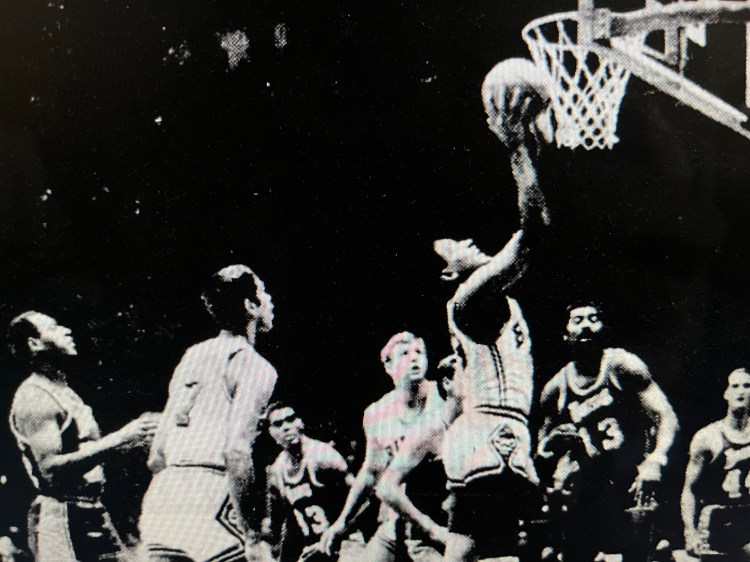
All those years Bob Boozer was shuttling from team to team in the NBA, he always seemed to be one step away from stardom. He was like a baseball player with a perfect swing. You knew he would connect eventually.
Two years ago, the Chicago Bulls entered the NBA as an expansion team. One of their prime acquisitions was 6-feet-8, 215-pound Bob Boozer who, in the five previous seasons had averaged 13.7, 14.3, 14.9, 14.2, and 12.2 points per game for Cincinnati, New York, and Los Angeles.
Then in Chicago, Bob Boozer found himself with a steady job. No looking back. No worrying about being on the bench if he made a mistake on the court. That first year, Chicago stunned the basketball world by beating Detroit for fourth place in the Western Division and a playoff spot. One of the main reasons was forward Bob Boozer, who averaged 18 points a game.
Last season was an even better one for Boozer. He scored 1,655 points, 13th-best in the league, and led the Bulls with a 21.5 average. He also led the team in minutes played (2,988) and was ninth-best in the league in field-goal percentage (.492). He was the Bulls’ most-consistent performer, and his fine play earned him a spot in the All-Star game for the first time.
Boozer’s success, though a long time in coming, did not surprise Wilt Chamberlain. “I always thought he would develop,” Chamberlain said. “We’ve been bumping heads for a long time. Back to our college days. He was always tough. I knew once he got adjusted to pro ball—and once he got a chance to play—he’d be one of the best.”
Boozer readily admits that he had a difficult time making the transition from college ball at Kansas State. “I had to get used to playing with the hands on you,” he said. “I had to learn to push back. It took me a long time to get used to taking a shot with a guy leaning on me, or pushing me.
“Now, when I shoot, I never think about the hands on me. It’s part of the game. You accept it. Now, I keep thinking that my confidence is growing with every shot I take. I’m always getting more confidence. Now, when I release the ball, I’m pretty confident that it’s going in.”
So are the Chicago Bulls.
 From Way Downtown