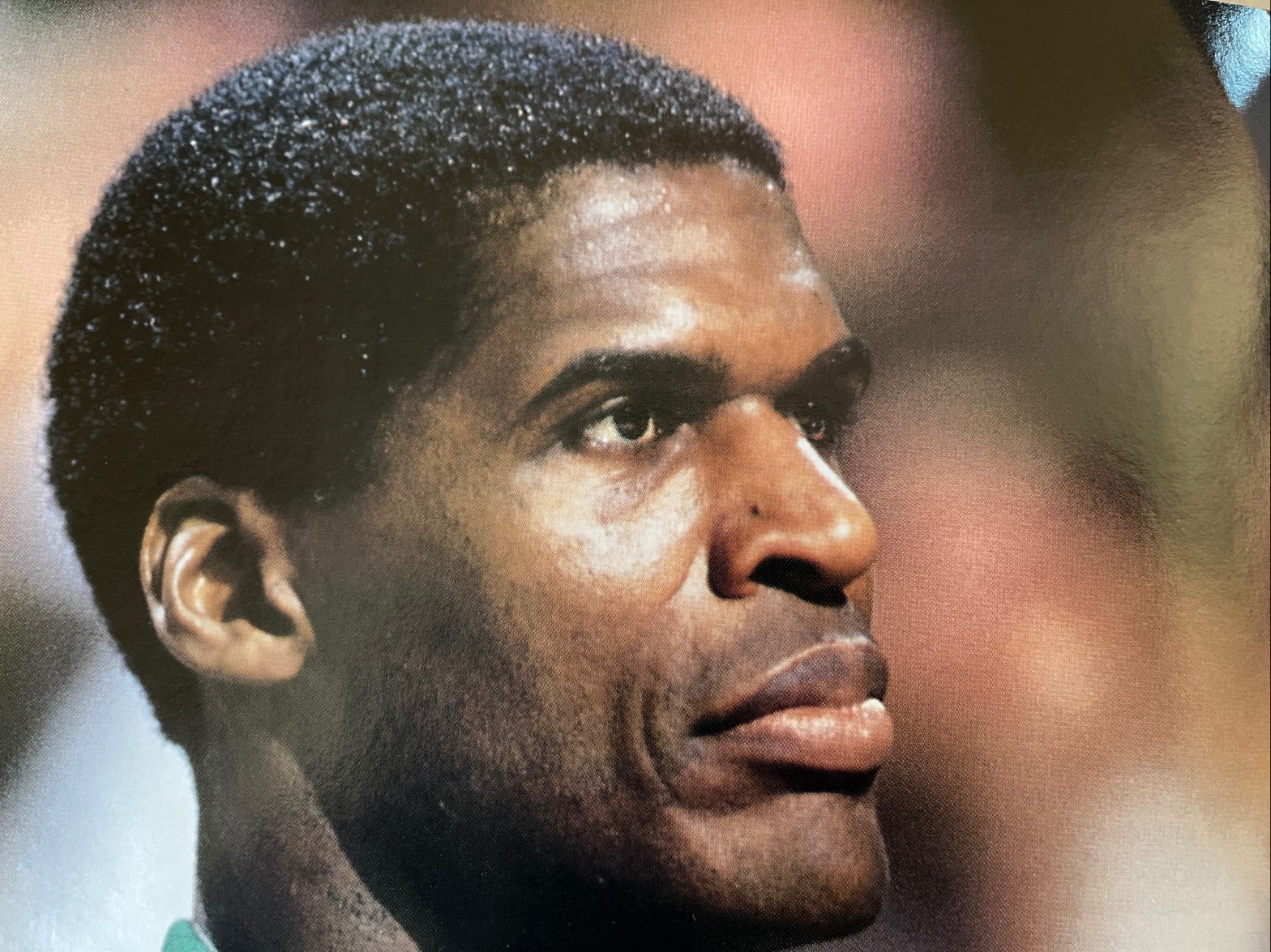
[In his autobiography, the Boston Globe’s Bob Ryan writes, “The third member of the great Boston Big Three was Robert Parish. If McHale was Gehrig to Bird’s Ruth, what, then, was Parish? George Harrison to Bird’s McCartney and McHale’s Lennon?”
Ryan then offers a few positive observations about Parish, which I’ll spare you. That’s because the article that follows from Ryan does the same, only in greater detail. The article, published in the February 1994 issue of the magazine Rip City, weighs in on Parish—The Chief—in his 18th NBA season and, at age 40, still taking care of business inside the paint. Little does Ryan know that 1994 would be Parish’s final season in Boston. He’d finish his career in Charlotte. But more on that in a future post.]
****
Mickey Mantle once said, “If I knew I was going to live this long, I would have taken better care of myself.”
The flip side of this rationale has to be Robert Parish. It is not just that Parish has survived into his 18th NBA season, a phenomenal feat in and of itself. The salient fact about this man is this: He plays the exact same game at 40 that he played at 35, 30, or 25. This is not the 40-year-old Kareem Abdul-Jabbar, a liability playing defense and a joke on the boards. Robert Parish still presents the entire center package in each game he plays.
“I see no real drop-off in his play,” says Celtics head coach Chris Ford. “It’s amazing. I don’t know how he does it, to be able to run like that or even to get through the practices with the young players.”
There are no “yeah buts” in the Robert Parish saga. He remains a viable NBA center, just below the top tier. Anyone going up against him knows he’ll be meeting a fully qualified professional with a very well-rounded game. The only difference between 1993-94 and, say, 1990-91 is that Parish will generally be on the floor less, usually from 25-28 minutes, and that’s only because the Celtics finally have drafted a young big man—a Parish clone, many have said—who is worthy of some non-garbage NBA minutes in the person of Acie Earl.
Parish never sought to become the NBA’s elder statesman. But he did take steps a long time ago to ensure a relatively long career. Call this Robert Parish’s anti-Mantle approach. First, he gave up eating red meat. “I stopped doing that in 1975,” Parish reports. “I’ll eat a little chicken, but it’s mostly seafood and pasta.”
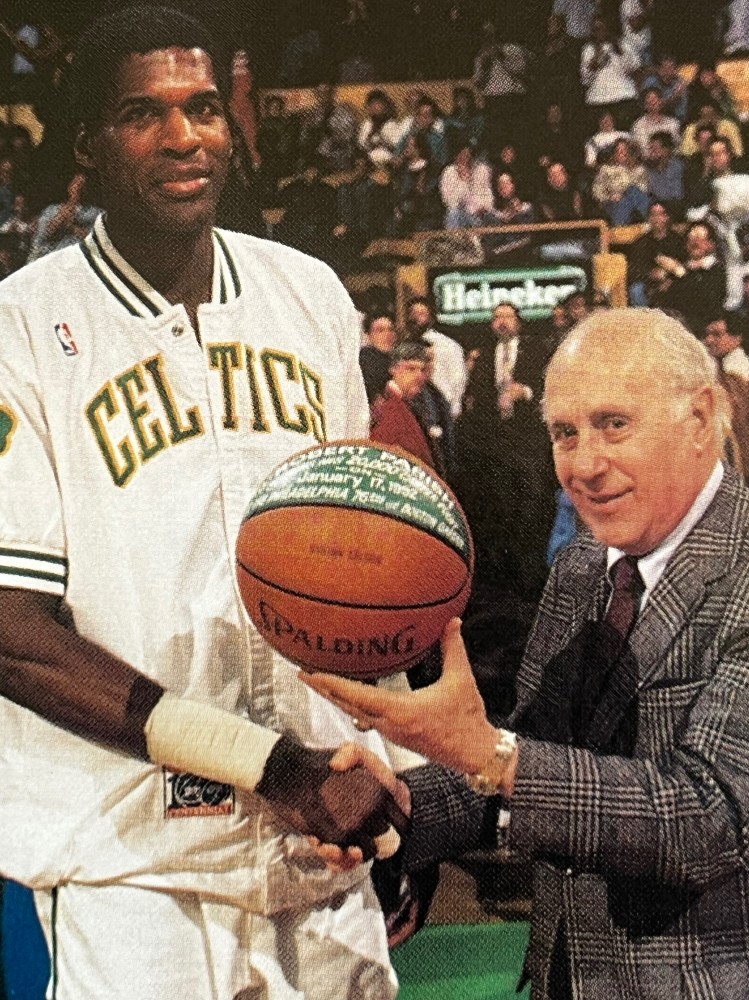
Second, he became a martial arts devotee (judo) in the early 1980s. There are many benefits to this regime, not the least of which is an emphasis on flexibility. Parish has adapted to the discipline of the program, and this has spilled over into his entire approach to his profession. His mind and his body are in tune.
With no specific career goals at this point, Parish just keeps showing up and showing up and showing up. The Celtics, meanwhile, are very pleased to see him. Each new season, people—which included management, media, fans, and teammates—are curious to see if they can detect a difference in his game.
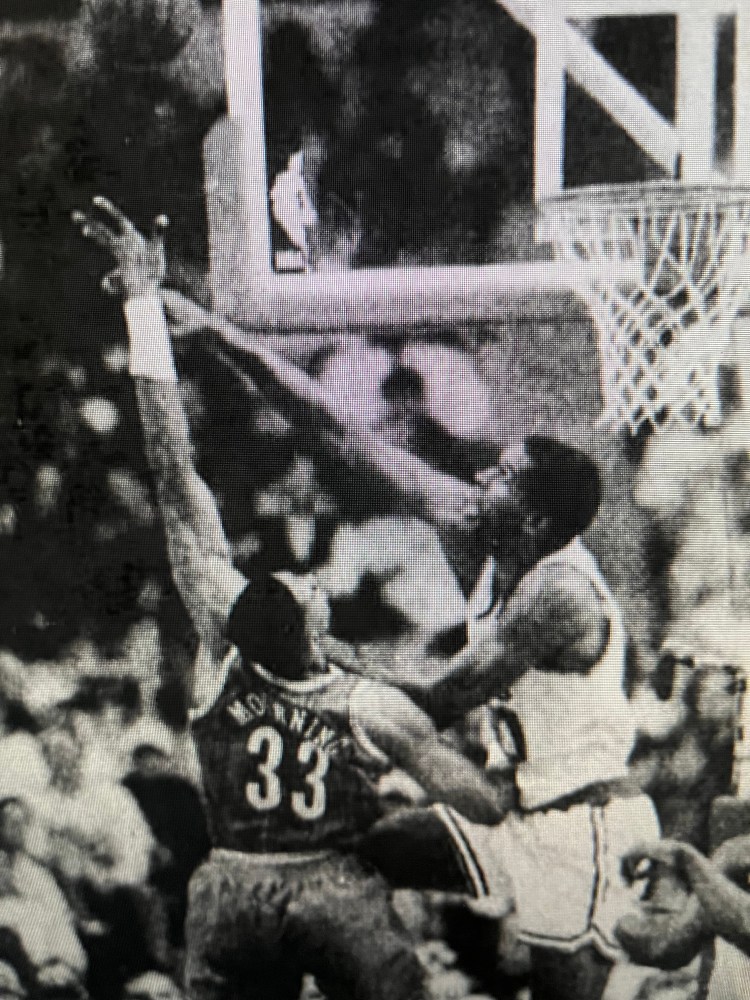
Will the patented rainbow turnaround jumper stop falling? Will he cease sneaking away from younger centers for easy baskets? Will he stop grabbing rebounds in heavy traffic? Will he no longer be the anchor of the team defense? Each season, though, the jumpers go in, the sneak-aways don’t stop, the rebounds keep coming, and the defensive intimidation remains constant.
Most amazing of all, Robert Parish is enjoying himself as much as he ever has in his career. “If things were any better,” he says with a smile, “it’d be criminal.”
This comes from a man who owns three championship rings and who has played alongside some of the greatest basketball names of all-time. How could he possibly remain enthused at age 40, after he’s seen it all and done it all?
“I’ve said it many times,” he explains. “It’s because there is absolutely no pressure on me. I’m not playing for statistics, and I’m not playing for a contract. I don’t have those worries for the first time in my career. I’m just out there having a good time.”
He’s also out there with a new title. When Reggie Lewis died tragically this past summer, the Celtics were left without a captain. To the surprise of many, the honor was given to Robert Parish.
Why a surprise? Indeed, the man knowns as The Chief was so nicknamed because he reminded Celtics forward Cedric Maxwell of the taciturn Indian character played by the late Will Sampson in the movie One Flew Over the Cuckoo’s Nest. Robert always has preferred the role of the strong, silent type. The Celtics in his time always had talkers. It was easy for Parish to slip away from the media without being forced to comment on the daily goings-on. And while he was an accomplished needler at practice and in the locker room, he overtly resisted any leadership role. He really didn’t want to be bothered.
So, while he deserved to be the captain based on seniority and stature, it did not seem to be an appropriate role for Robert Parish. The first surprise, therefore, was that he accepted the role. The second is that he loves it.
There are times now when The Chief just will not shut up. He is the willing team spokesman—the Larry Bird, if you will—of the 1993-94 season. You want to get an evaluation of the Celtics’ talented Croatian newcomer Dino Radja? Go to The Chief. You want an opinion on the Clinton administration’s handling of NAFTA? Okay, that might be a stretch . . .
“I’m having a lot of fun with it,” Parish says. “But I really haven’t been challenged either. Later in the season, if we’re on the road and we’re struggling, or if there is some kind of a problem, that’s when I’ll have to do the job. That’s when I’ll have to step forward and make everybody feel good about themselves again.”
Everyone notices the change, starting with the coach. “There’s definitely been a change in his role on the team,” Ford asserts. “He’s clearly more involved.”
Parish always has led the team by example. Any young players seeking tips on game preparation need only study The Chief. After all, a man who has suited up for 97 percent of his games over the last 13 years must know something about his trade.
“My diet has helped and the martial arts have helped, but I’ve been lucky to be relatively injury-free,” he admits. “I’ve avoided major injury. Once you have that, you lose a half step or a step, and it makes a difference. But I’ve been lucky. I’m still a factor, still a force.”
He’s all over the NBA record book, of course, even if he doesn’t either know or care about such things. Going into the season, he was second in games played, fifth in blocks, seventh in minutes played, and ninth in field goals made and rebounds.
“I have no idea about any of that,” he explains. “I don’t know how many points I’ve scored, how many rebounds, or anything else. And I don’t want to know. If I start thinking about things like that, I might get complacent. And when you get complacent, that’s when you get hurt.”
It is pretty clear at this point that he will walk into the Basketball Hall of Fame as one of the 10 best centers ever, and he hasn’t given that much thought either. “I’ve absolutely never thought in terms of the Hall of Fame,” he insists. “The only thing like that I’ve ever thought of are championships and all-star games.”

The scoring stats will never do justice to Robert Parish because of his total context. Throughout his 13-year Boston career, he never was the focal point of the offense. There was Larry Bird and Kevin McHale and some guards who would put the ball up. Whatever was left over went to Robert Parish.
The average most shots per game he ever took in a regular season were 15 in 1981-82. His Boston career average for shots per game is 12. Suffice it to say, he’s made the most of the opportunities that he’s had.
His consistency is unsurpassed. In his first 13 years as a Celtic (his first four seasons came with Golden State), he has ranged from a field-goal percentage low of .535 to a high of .598, the high coming three seasons ago at age 37. He has kidded about his limited shot opportunities on occasion, but that’s as far as it goes. He’s never deluded himself about anything.
“I stopped worrying about things like that somewhere around 1983 . . . or maybe 1985, at the latest . . . when I became the fourth or fifth option,” he maintains. “That’s when I learned to get beyond personal accolades and worry about one thing—winning.”
At this stage of his career, he needs to find new stimuli. There’s a natural available for him this season. It seems that most local observers predicted totally dire things for the Celtics when asked to make their preseason analyses. The most-optimistic local pundit penciled the Celtics in for 37 victories. Nobody in town believed they could make the playoffs. That’s all Robert Parish needed.
“I really want to go out and prove all the critics wrong,” he says. “I want to hand all you guys a slice of humble pie at the end of the year. As far as you guys were concerned, we’ve already bottomed out. We can’t go any lower.”
Parish has reasonable goals. I think we can be in the middle of the pack,” he declares. “I’ve got to be realistic. We’re not championship material. That’s unless 26 other teams come down with some kind of disease.”
There is no stopping point in sight. Parish is officially on a year-to-year program here. Ford intends to keep him on a rational minute schedule (“He might go 35 some night if that jumper is falling, and he’s just killing ‘em.”).
As long as the mentor sees that Parish is playing a Parish game, and not just imitating a Sequoia out there, then he will remain the number one center on the Boston Celtics. “Thus far,” says Ford, “there has been no regression, none at all. He really believes age is just a number to him. He just goes out there every night and plays the game the way he always has.”
“Let’s put it this way,” says Sherman Douglas, the team’s quarterback. “Every night I’m going to get the ball in to him early and see what he’s got. We know he is the stability of our entire defense. He still gets the job done.”
And not part of the job, either. The whole job. In that sense, there has never been another basketball player like him.
[Just for the record, the 1993-94 Boston Celtics finished with a 32-60 record. Bad enough for fifth place in the seven-team Atlantic Division, 25 games back of the champion New York Knicks. And yes, for the first time in 14 seasons, Parish and the Celtics didn’t make the playoffs.]
 From Way Downtown