[After his pro basketball career, George Mikan took to the links and soon became a scratch golfer. As one of his close friends chuckled many years later, “Everybody wanted to play George for money.” Why? To brag that they beat the mighty Mikan. As the friend claimed, Mikan rarely, if ever, lost. “Sinking a putt,” Mikan told the friend, “is nothing when you’ve stood on the free-throw line at Madison Square Garden with 19,000 people going crazy for you to miss.”
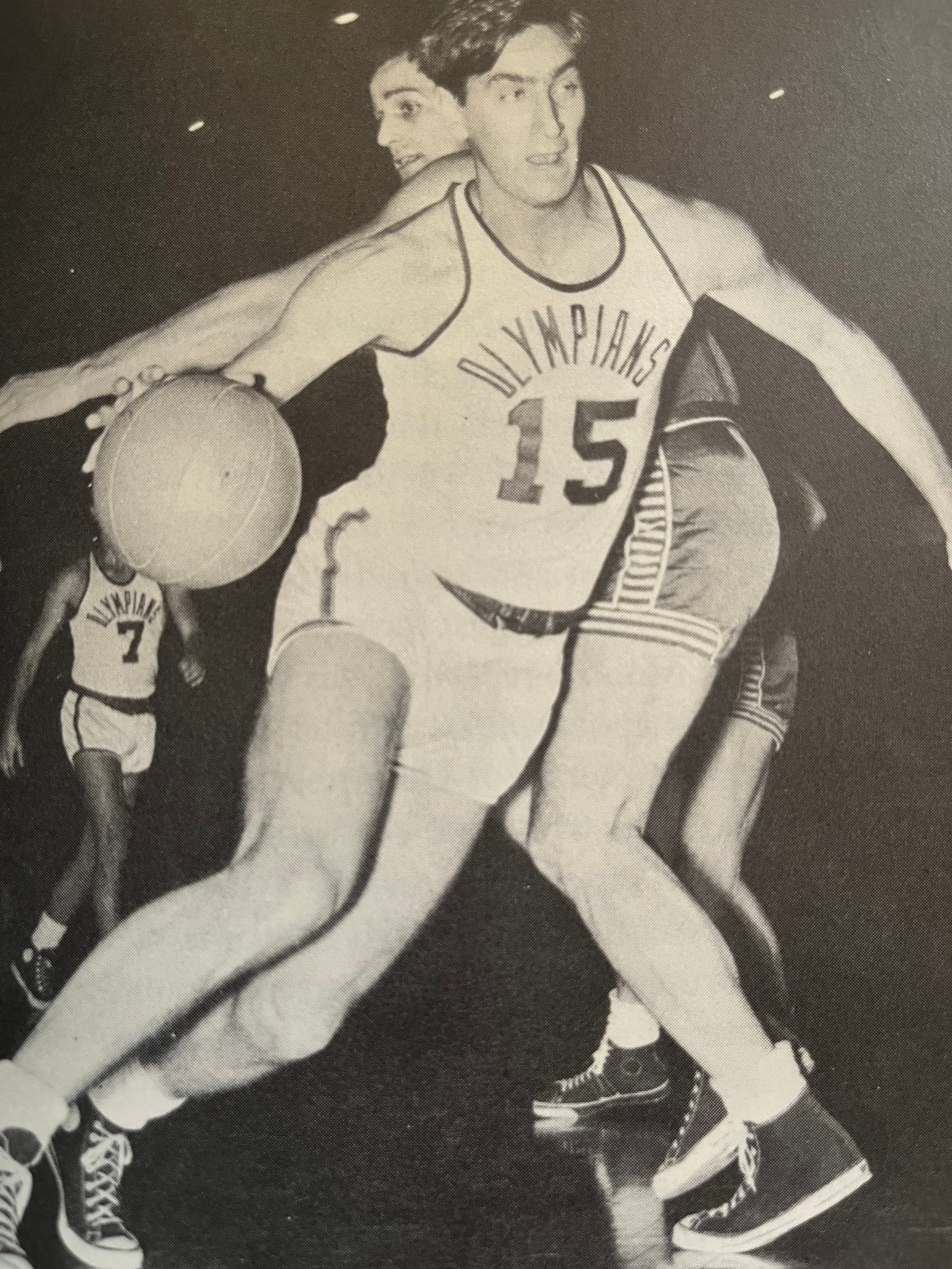
Or, when opposing centers jostled Mikan each and every night to nudge him out of position and get under his skin. The rough stuff was a constant, but there was no one way to play Mikan. Each center had to figure out the best approach for himself. That included Alex Groza, the high-scoring, 6-feet-7 rookie center of the NBA’s Indianapolis Olympians.
In this article, Groza shares his right from wrongs in guarding Mikan. Groza, whose Mikan musings were published in the March 1950 issue of SPORT Magazine, wouldn’t be around long enough to have a chance at mastering Mr. Basketball. In October 1951, Groza and two of his teammates on the University of Kentucky’s “Fabulous Five” were belatedly arrested for accepting $500 to shave the point spread in a 1949 college game at Madison Square Garden. The three admitted doing it, and a judge placed them on indefinite probation. The NBA followed up by banning Groza and teammates Ralph Beard and Dale Barnstable for life.
As writer Stanley Cohen once framed the tragedy: “But the losses suffered by Beard and Groza could not be measured in terms of money. Basketball was the substance of life for both of them, and their banishment was the equivalent of an attorney being permanently disbarred after he had been graduated from law school, passed the bar, and completed the first two years of a successful practice.”
But until his NBA disbarment, Groza was a rising NBA star, the league’s 1950 NBA Rookie of the Year, an All-Pro in his first season, and a part owner of the Indianapolis franchise. Here’s what he had to say about playing Mikan.]
****
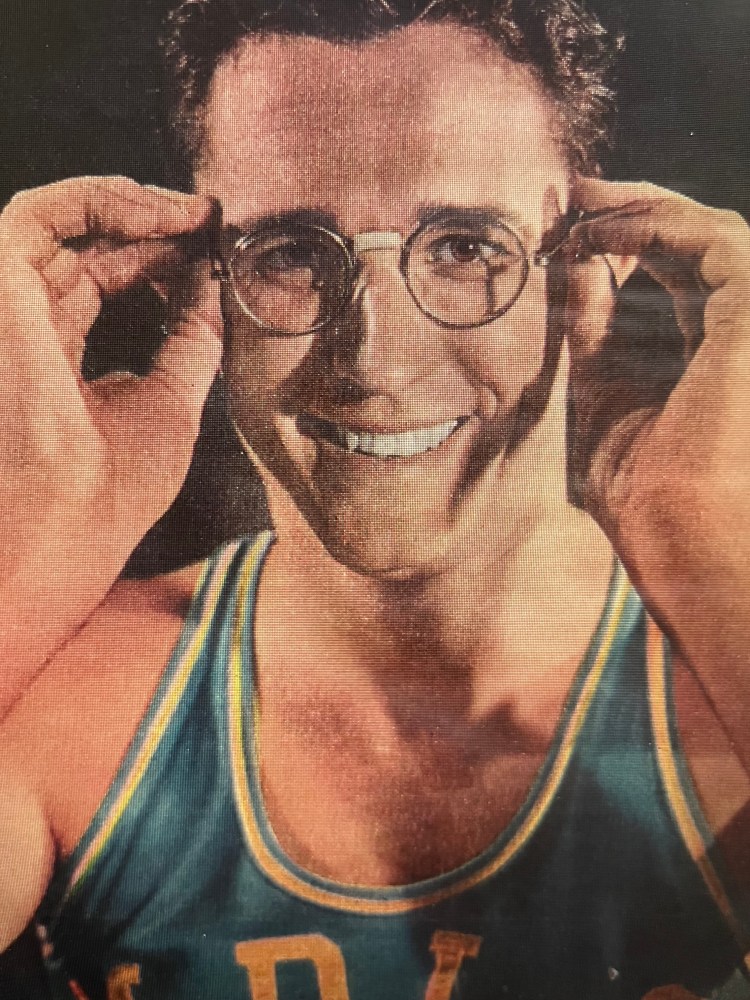
When a basketball center gets ready to play George Mikan, he feels much the same as a big-league pitcher about to face Ted Williams. There’s no sense kidding yourself about it, you’re going up against the best.
Since I started playing professionally—along with four of my old Kentucky teammates—on the Indianapolis Olympians, I have played against Mikan twice. We aren’t scheduled to play the Minneapolis Lakers, Mikan’s team, again this year unless we happen to meet in the championship playoffs (which I profoundly hope happens), so I’ve got plenty of time to think about the right way to handle George. I believe I’m on the right track.
Mostly, I go out on the floor resolved to follow the old basketball rule—never let your man get between you and the basket. If Mikan, who is not only 6-feet-10, but is also a wonderful shot, does that, you might as well go out for a sandwich. It’s a sure two points.
Of course, you have to be mighty careful, no matter what you do against George. The best thing to do, I think, is to play the ball as much as possible. It is so hard to stop him from scoring once he has the ball in his hands, unless you foul him, that it is much more profitable to spend your time trying to keep him from ever getting the ball. The Lakers usually feed him high, soft passes, and I try to intercept them if I possibly can.
Because Mikan is such a tremendous threat, any center who plays him can count on getting some help from his forwards. For instance, if the Lakers have the ball up in the front of the court against us, both our forwards will drop back a little and try to help me defend against passes to George.
Then, too, on the Olympians, we use the weak-side forward a lot to help me out. That is, if the ball is in play on the right side of the court, the forward playing the left side will come back to see what he can do to get in Mikan’s hair. It doesn’t always work, but it’s comforting to know that somebody else is trying to give you a hand.
Most people, when they ask you what it’s like to play Mikan, are just thinking about holding his points down. When you consider that he averaged 28.3 points a game in the former Basketball Association of America (BAA) last year, you can understand why that’s uppermost in their minds. But there is another side to the problem, too. You’ve got to do some scoring yourself, especially if George is having a good night. If you can’t stop him from scoring, the least you can do for the team is try to cancel out his points by throwing in a bunch of your room. Against Mikan, that’s not easy. He knows how to take care of himself on defense, and he knows that he isn’t helping his club any if he gets 30 points and his opponent gets 31.
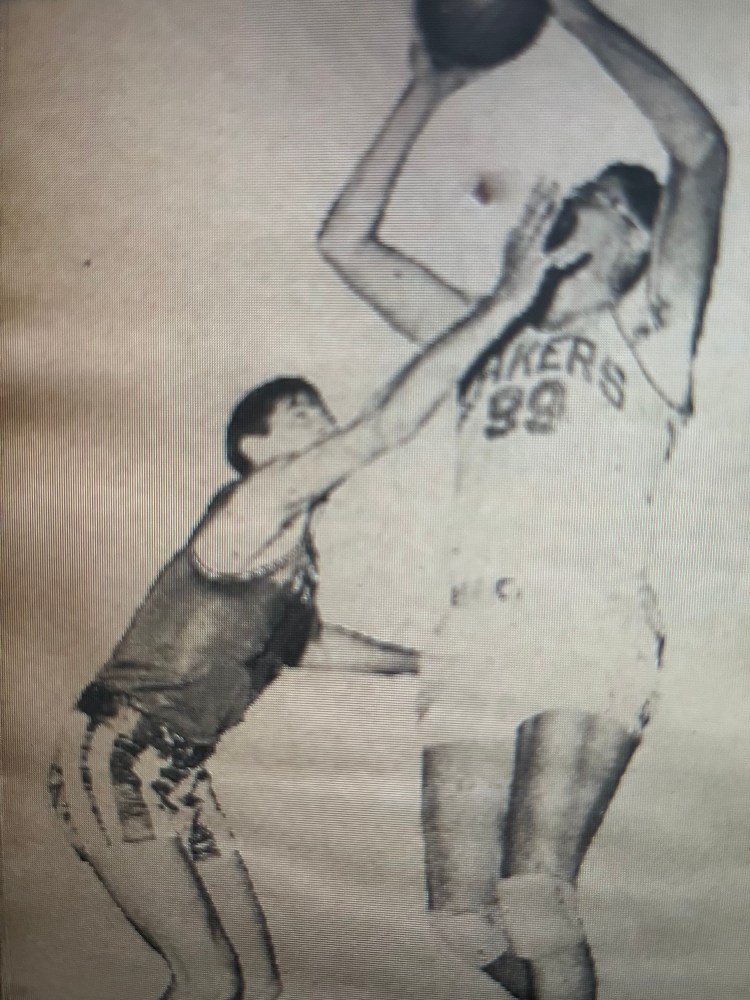
I play back under the basket on offense and wait until the ball gets up to one of our forwards. Then I try a fake and cut toward the basket, hoping to get a quick pass and make a layup. Of course, I’m always trying to get the ball off the backboard and tap it in, but George is three inches taller than I am, and it’s not easy to get away with that very often.
Sometimes, I try long shots against him, because he is reluctant to come out and try to stop you. He likes to stay in close, where he is handy to that backboard and can go up for the rebound. But in one of our games this year, I made a few long ones in a row on him and drew him out. Then I tried to drive around him, and I had some success, particularly in that he was forced to foul me as I was on my way in. Naturally, when you’re playing against him, it is always pleasant to see George accumulate fouls. There’s always the hope that he might get six and be put out of the game. Neither of us fouled out in either of the two games we played against each other during the regular season.
I had my best night against him in that game. I scored 38 points, and he scored 33. So, I had a net profit of five points. Any time you show any kind of a profit against Mikan, you’re doing good. In our other game at Minneapolis, he outscored me, 29 to 21. So that puts him ahead for the season so far.
****
George is something of an iron man, too, you know. He generally plays almost all of the game. He may get tired late in the second half and, if he does, the Lakers take him out and let him rest for a while. But they slow down the game terrifically while he’s out, trying their best to hold things up until he gets back in there. It’s easy to see what he means to the ballclub.
On jump balls, too, Mikan is a tough man. He’s so big, and he’s so wise to all the tricks of the trade, as far as timing the referee’s toss is concerned, that he almost always beats you to the jump. He and Jim Pollard of the Lakers, another great player, don’t often miss out on a jump ball.
All in all, Mikan is a basketball education. Anything you don’t know when you start out against him, you are bound to pick up in a hurry. Speaking for myself, one of the things that makes it exciting to play him is the way the fans treat our rivalry as a sort of a game within the game. In other words, while they are primarily interested in who is going to win the ballgame—the Olympians or the Lakers—they are also vastly concerned about whether Mikan will outscore Groza, or vice versa. It keeps you on your toes.
Playing Mikan is hard work, and it’s not always rewarding, but there’s one thing you can say for sure. It’s always interesting.
 From Way Downtown