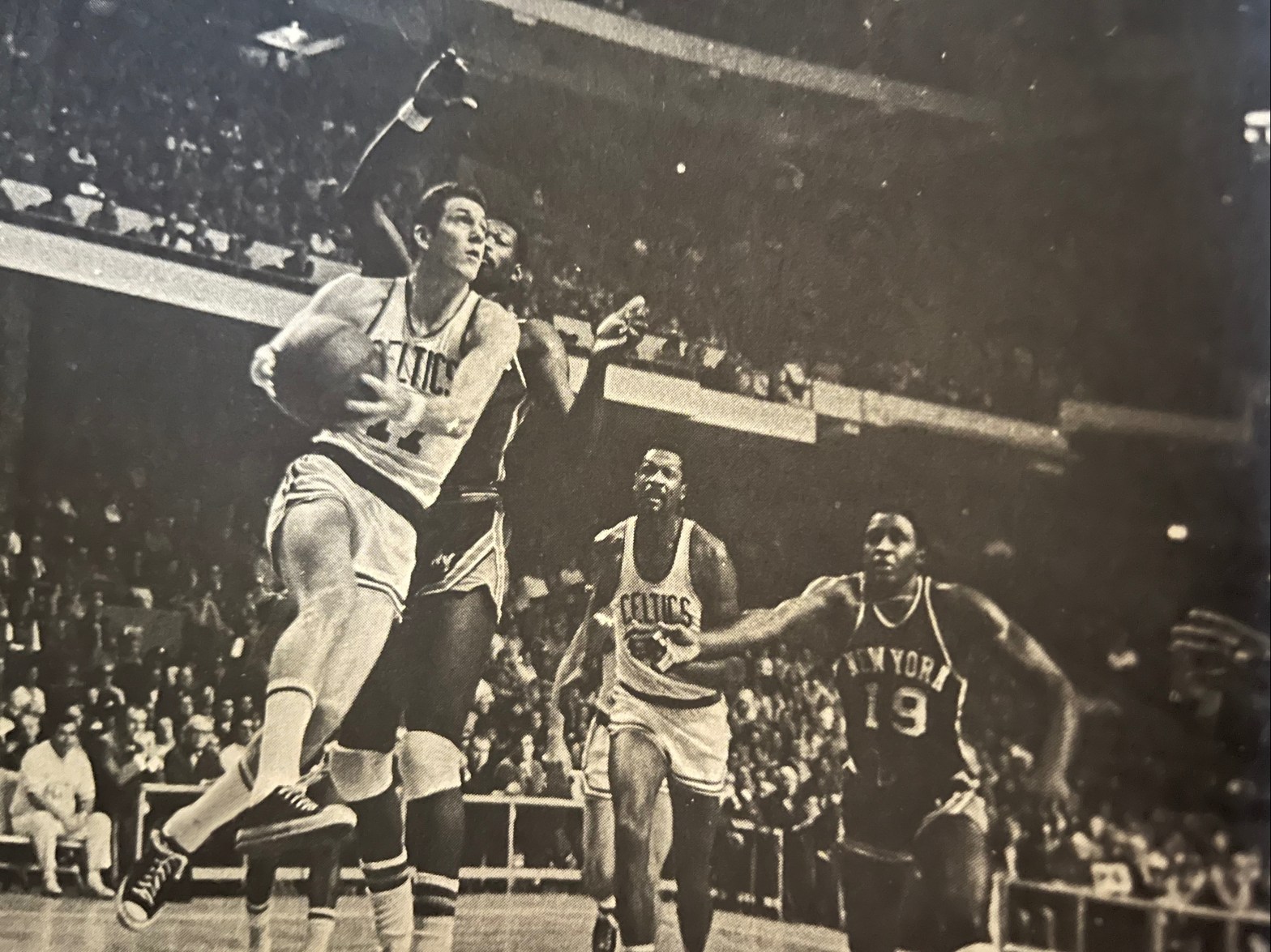
[This article is sincere, but a little hagiographic in places. It also is a little too well organized and concisely written. I’m guessing that Dave Cowens worked here with a ghost writer to put pen to paper, though I don’t know that for sure. Either way, here are Cowens’ thoughts on “the old geezer,” John Havlicek, to celebrate his retirement from the NBA. The story is a quick skim and certainly raises some great points about Havlicek, the player and the man. Cowens’ farewell ran in the November 1978 issue of Basketball Digest.]
****
John Havlicek, you old geezer, we’re all going to miss you.
Havlicek has earned a place in the history of American sports, and his name is known in millions of households across the nation. Most folks are apt to think of John in terms of his statistical accomplishments, having played in more NBA games than any other individual, participating in 13 All-Star Games, scoring more than 26,000 points, and getting 1,000 or more points in each of his 16 seasons—including this final one at age 37.
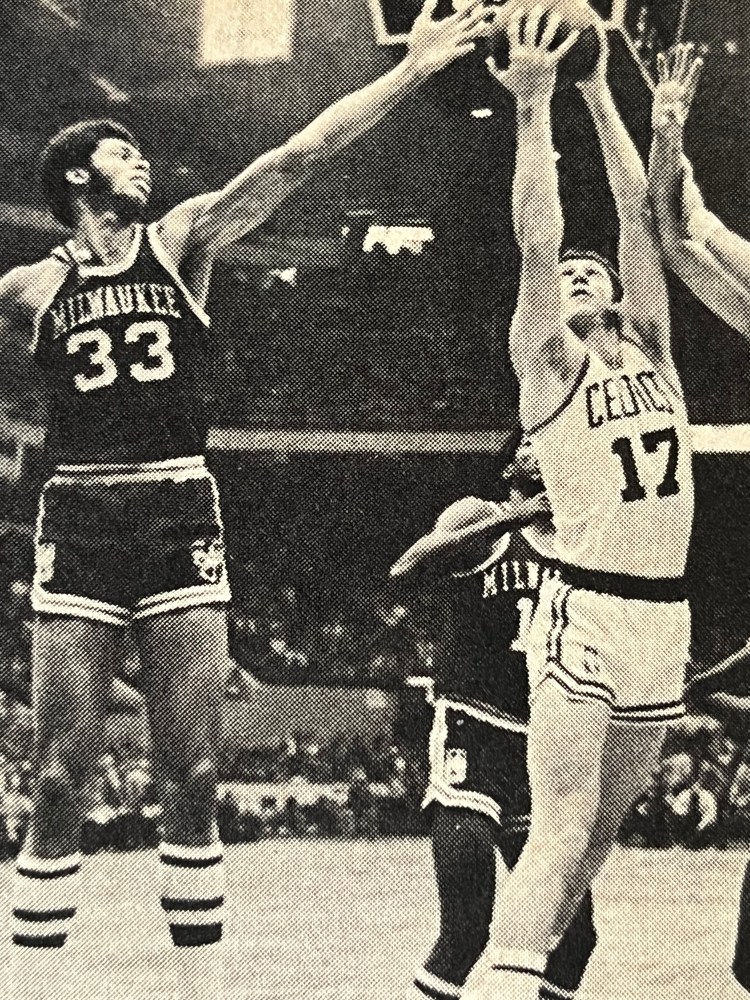
But there’s a great deal more to John than these impressive records. As one who had the good fortune to be his competitive partner for the past eight years, perhaps I can shed a little more insight on the man himself.
It’s as if Havlicek plotted a definite outline on what basketball involved in its every detail, and then adhered to it in every way. On and off the court, he has been the most orderly, disciplined, and fastidious person I’ve ever known. Had he not been an athlete, I think he had the temperament to be a scientist.
He always strived for perfection and would often get frustrated when the Celtics fell short. Even though he never overburdened you with the fact that he had been through it all before, there were times when this well-composed and refined man would step out of character. It wouldn’t last long and would only be seen in the privacy of the dressing room. It was the Havlicek few people ever knew.
I remember when John came in after one game in which we played very dumb. He called us a bunch of dummies and then rattled off 50 cuss words that I never heard before without taking a breath. There he was, shaking his head, hollering away, and making a scene while all of us sat there watching him.
We respected John so much that we wouldn’t dare laugh at him. But I looked at Don Nelson, who was biting his lip, and Paul Silas, who was holding himself back from breaking up. Havlicek was right in what he was saying, but every one of us wanted to tell him to cool it and just relax. None of us did.
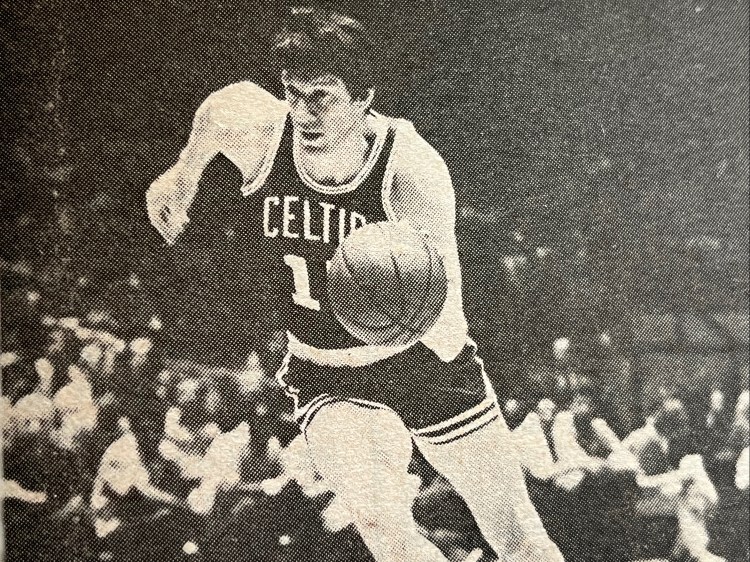
You have to appreciate Havlicek’s ability to rescue a broken play or go hellbent-for-leather to the hoop in order to get something positive out of the situation when every other player sits back and waits for the next man to do something. John always had that steady flow of energy and alertness to deal with every situation. He was never a player who had surges. His game and his personality were marked by control and balance. Because of his consistency, I think John was taken for granted during much of his career.
Now that he has retired, people are finally appreciating what he has done. You look and see that he scored so many points, played on eight championship teams, and played more games than any other man. Then you realize what a player he was.
Other top stars were more outstanding to the public. Bill Russell and Wilt Chamberlain were big men who rebounded and scored. Oscar Robertson was the big guard who scored and controlled his team’s offense.
But what can you say about Havlicek? He wasn’t known as a shooter. He wasn’t the ballhandler that Bob Cousy was. He did nothing that was radically different. Fans couldn’t focus on one aspect of his game and identify with it.
Now I think everybody realizes that John Havlicek did it all. He was the player’s player. He was the guy who could play both forward and guard equally well. He could move the ball and hit the open man and never stopped moving without the ball. He played defense. He ran. He knew how to set the picks, screen people out, post people low. He had strong, sure hands. He was the man who the Celtics looked to for the clutch shot to win games. He did the whole thing for 16 years.
John has been a fun guy to know. He enjoyed playing basketball, and you knew it. He had a sense of humor and was able to relate to teammates and opponents, rookies and veterans. He made everyone feel comfortable.
He was always accessible to the press, even when the Celtics played poorly or lost a crucial game. Again, everything he did had a purpose. He knew his duty as a player and team leader included relating the club’s views to the news media. He would never waver from his responsibilities as he believed them to be.
People ask me who will replace John Havlicek this year. I tell them there will be another name on the roster, but that nobody will replace him—ever.
I’ll recall John as the player who was always there to meet any challenge or respond to any situation. I’ll remember him as one person who held a team prayer to make a statement to the heavens that we were thankful about winning the 1974 championship in Milwaukee. Players might come and go, but there haven’t been—and won’t be—many like this man.
The Celtics will retire his number after this season. No, they won’t wear number 17 again. But John was more than a Celtic. He was an example that all of basketball can be proud of. Strangely, I can’t think of another player in the NBA who wears number 17. If there is one, I think he should change it. The fitting tribute to John Havlicek would be for the league to retire number 17 forever.
 From Way Downtown