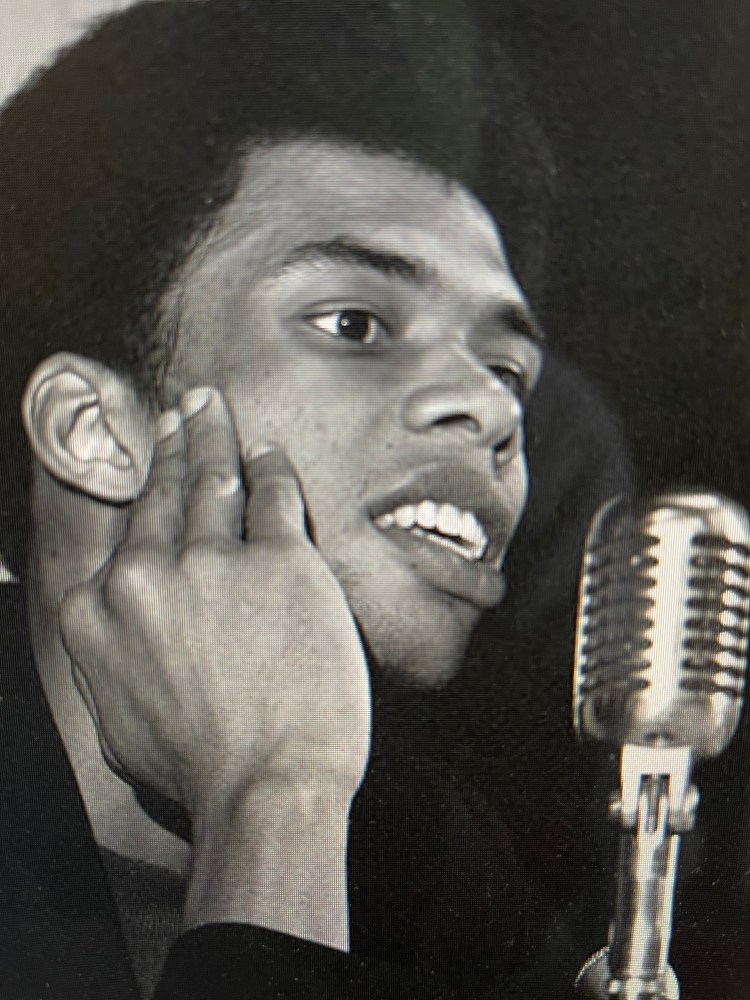
[For ABA fans, one of the most discussed what-if’s is the failed signing in 1969 of the All-Everything Lew Alcindor (today Kareem Abdul-Jabbar), the pro game’s next projected superstar. Had the ABA landed Alcindor, its war with the NBA likely would have taken a sharp turn for the better. The league almost certainly would have landed a network television contact, including a few million to subsidize the 11 teams, and become a viable destination for more college All-Americans to begin their pro careers. The signing also might have hastened a merger of the leagues by forcing the NBA owners to negotiate from a position of weakness rather than a loathing of their rival. The loathing left little room for the required compromises that would have enabled the merger sooner.
Today, when most people revisit the Alcindor signing, they quote the much-cited account of ABA operative Mike Storen. Not a good idea. Storen wasn’t in the room for the negotiation. He also was known among his ABA critics for stretching the truth when needed.
That’s why I took a closer look at the ABA’s missed opportunity to sign Alcindor. My deeper dive includes interviews with three people who were in the room (including Alcindor/Abdul-Jabbar), interviews with Storen and his partner Dick Tinkham, and reading virtually every available newspaper and magazine clip on the signing.
All that research led to the following brief excerpt from my just-published book Balls of Confusion. If you like the excerpt, you’ll love rest of the book. The best place to order Balls of Confusion is from my distributor or, if you must, Amazon works, too.. Happy holidays!]
****
Arthur Brown had retained the ABA’s exclusive rights to Lew Alcindor. Though Mark Binstein, his Jersey City nemesis, had tried to move heaven and the Securities Exchange Commission (SEC) to access Wall Street’s capital markets and join the bidding, he was out of luck. The SEC remained an administrative black hole, possibly with cause. Binstein likely was on the SEC watch list for his previous 23-count indictment for rigging stocks, and so was the New York security’s firm Kenneth Bove & Co. Inc., which Binstein had hired for the SEC filing. Either way, without the estimated $1.5 million windfall from the capital markets for the team’s purchase, Binstein was stuck. And so was his seller Bill Erickson in Minneapolis. “It may take from 20 days to four months to become effective,” Erickson clarified near mid-March.
All eyes now turned to sunny Southern California and the roly-poly special advisor Sam Gilbert. Alcindor had agreed to allow Papa Sam to cut through all the seven-figure jive and negotiate pro bono a legitimate-and-lucrative pro contract for him. His qualifications: As a successful Los Angeles contractor, Gilbert had experience bidding on many a lucrative construction project.
Gilbert remained true to his contractor roots. He scrapped the art of the deal for the order of the application process. Gilbert advised both leagues that he, Alcindor, and Ralph Shapiro, a 37-year-old UCLA alum and successful Beverly Hills stockbroker, would travel to New York on March 23. They would meet individually with the NBA Bucks and ABA Nets and formally ask each to present its one-and-only contract offer. Importantly, neither team would be privy to the other’s bid. The highest bidder got Alcindor.
According to public opinion, Gilbert and his call for order to protect Alcindor from a Conga line of agents and hucksters seemed as right as a Sunday sermon. “You might say we are the chastity belt for Lew,” quipped Shapiro. But, when viewed from the ABA’s perspective, the unorthodox winner-take-all format seemed curiously scripted to serve the NBA’s interests. Walter Kennedy sometimes quipped during the winter of 1969 that the NBA refused to participate in a bidding war for Alcindor. Gilbert’s winner-take-all plan granted Kennedy’s wish.
The NBA also won another absolutely critical consolation. The senior league could much more easily control the outcome of a single bid than the chaos of four or five secret counteroffers. That, of course, assumed the NBA had the inside track to outbid the ABA. According to those present when the ABA Nets presented its offer to Team Alcindor, the winner was already pretty obvious.
****
Sam Gilbert and Ralph Shapiro had just arrived. Waiting to greet them was a smiling, best-foot-forward ABA contingent led by Nets owner Arthur Brown. Joining Brown was his attorney Leon Rock and accountant Ralph Dolgoff. Towering over everyone at 6-foot-10 was Mr. Basketball himself, George Mikan.
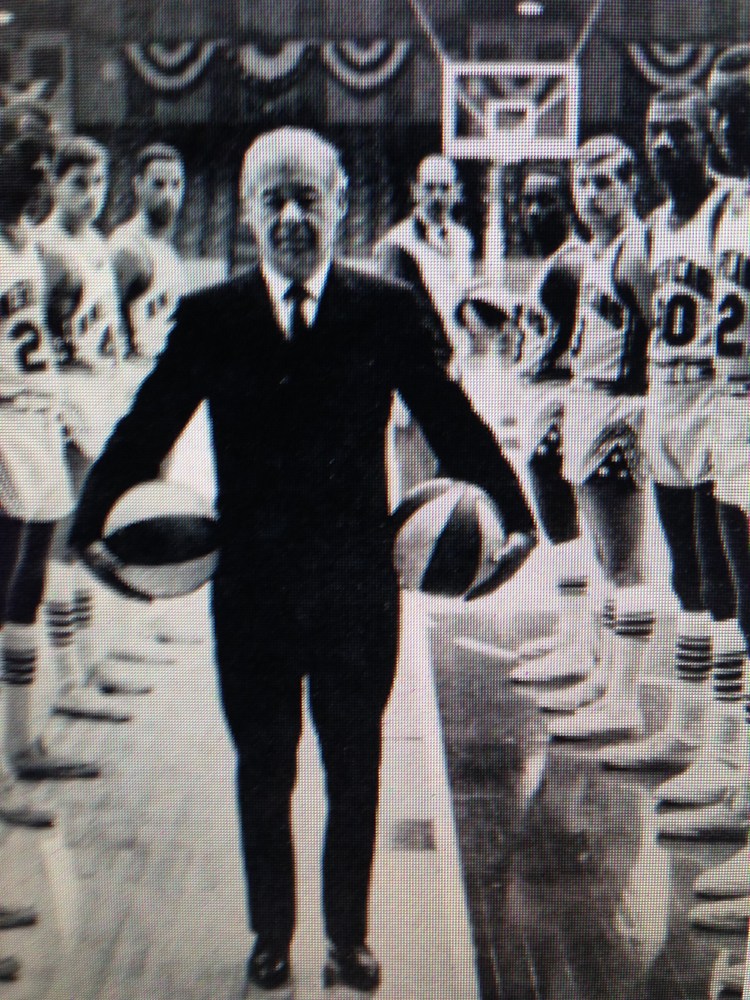
All parties settled into their seats. The view from Brown’s 15th-story apartment at One Central Park West on Manhattan’s West Side was anything but minor league. Below rustled the green of Central Park, further on rolled the blue of the Hudson River, and further yet raised the monochromatic gray of Manhattan skyscrapers. To think that 30 years ago Brown had started out in his native Chicago with a cardboard box as his desk and a hole in his pocket to pay for his freight-shipping company. Now the world was his oyster, and Brown was one million dollars and a scrawled signature away from also striking it big in professional basketball.
Leon Rock stepped toward Gilbert and Shapiro, placing on the table in front of them a certified check, the imprimatur Chemical Bank across the top. The check read: Pay to the order of Lew Alcindor Payroll Fund. Printed in the box to the right was the figure one million dollars. All sets of eyes scanned the check but one. Alcindor was running late. The chuckle was he’d been on a date but would arrive shortly.
When Alcindor and his father appeared in the apartment, Brown scooped up the check according to plan. Brown and his ABA mates had left nothing to chance. Brown would start the meeting by talking man to man with the younger Alcindor. He would place his certified check from Chemical Bank like a gold bar in the middle of the table. Next to it he would place another gold bar—a million-dollar signing bonus from the league—and tack on a 6 percent ownership stake in the New York Nets, their team and basketball partnership. Accountant Ralph Dolgoff would take the floor next and explain a special brokerage account that Brown would establish that combined a mutual fund and a $250,000 life insurance policy for Alcindor. On Alcindor’s 41st birthday, the account would mature and pay him $62,500 per annum over 20 years. The brokerage account, bonus, ownership stake, and base contract brought the Nets’ contract offer to a then gaudy $3.5 million.
“When they started talking money, I left the room with [the Nets’] Max Zaslofsky,” said the Nets’ late-arriving assistant coach Dick Schramm. “You could just feel that something was wrong, and I remember thinking that we could offer Alcindor 50 million dollars and 55 blonds, and we’ll still get nowhere with this negotiation.”
Brown stuck to the script at first. He asked Alcindor if he was open to playing in the ABA?
Yes.
Was his preference to play in New York or Milwaukee?
New York.
Brown handed him the certified check from Chemical Bank. Alcindor fingered the paper, eyed his name printed as clearas day across the middle, and handed it back. “Mr. Brown said to me, ‘We’ll give you a million dollars,’” recalled Alcindor, but without mentioning a timeframe.
“I told him he could take it any way he wanted—over five years, 10 years, 20 years, or all in one year. I didn’t care,” Brown said afterwards. That should have done the trick, according to the ABA’s expensive psychological profile of Alcindor. “Our research showed that the idea of becoming an instant millionaire was something that would appeal to Alcindor,” Indiana’s Dick Tinkham said of the ABA’s likely junk science.
Brown then talked about the Nets, the team’s $10 million future home Nassau Coliseum, and Bob Cousy. The former Celtics great had been interviewed by Brown the day before. If Alcindor signed with the Nets, Cousy likely would be his first pro coach.
Seated nearby, Mikan and Dolgoff exchanged nervous glances. Wasn’t Brown supposed to place the bonus check on the table? He never did. In fact, a signing bonus wasn’t mentioned. Brown reportedly advised them afterwards not to worry. As he had been prepped beforehand by Tinkham and his partner-turned-shrink Mike Storen, Alcindor would make the final decision, not Gilbert or Shapiro. Alcindor had just told him, man to man, that he wanted to return to New York, not shiver through a Wisconsin winter. Brown perked up. The ABA held the upper hand, and Brown started instinctively to hedge for a more economical deal. That’s what good businessmen do.
After all, factoring in the Dolgoff Plan and ownership stake, his total offer already reached a record $2.5 million. Why give Alcindor another million? Storen, Dolgoff, and others would share their “what about the bonus check” story through the years, allowing it to assume tragic significance. According to one interpretation, Mikan was to blame for not handing off the check and sticking to the script. Another version blamed Brown for misreading Alcindor.
However, the real gaffe was about to come. Alcindor didn’t offer a timeframe for the million dollars. He left it to Brown, who threw a few more-economical numbers at the wall for Gilbert’s benefit: $200,000 over five seasons. The numbers stuck, and that equaled the end for the ABA.
Alcindor already had tossed around a few numbers with Milwaukee’s John Erickson and Wes Pavalon. Erickson explained: “We were in New York for what I thought was a get-acquainted session. [Alcindor] and his agent Sam Gilbert walked into the hotel room and asked us for an offer. Well, we didn’t have an offer. But I noticed that Lew appeared hungry, so I said, ‘We’ve got a plan in mind, but we’d like a little time to work it into a firm offer. Let’s go have lunch. Then, give us a couple of hours, come back, and we’ll present it to you.’”
Erickson and his staff scribbled several scaled, back-of-the envelope options and presented them later to Team Alcindor as strictly preliminary offers. But scribbled offers are still offers. The best was a five-year, $1.5 million deal. It was an amount beyond Milwaukee’s expansion budget—without some GoFundMe support from the league’s pooled Alcindor fund. They’d have to make a few phone calls and get back to Gilbert.
Instead of penalizing Milwaukee for failing to follow his one-bid rule to a T, Gilbert made a major and later oddly overlooked concession. He allowed Milwaukee’s back-of-the envelope hedge to stand as a space holder. Erickson and the Bucks would finalize their offer after Alcindor et al. met with the Nets. In short, the Bucks would get two bites at the apple; the ABA got one.
At Brown’s apartment, with a rented Rolls Royce and Cadillac now idling downstairs to whisk Team Alcindor away, Gilbert turned to Mikan and asked if he had the Nets’ final offer? Mikan nodded yes, believing correctly the package, minus the signing bonus, still totaled a record $2.5 million.
Unbeknownst to Mikan, Gilbert and his financial expert Shapiro had done the math differently. They didn’t include the Dolgoff Plan, considering the time-share brokerage account to be funny money. The same applied to the ownership stake in the iffy Nets, who could fold at any time. Gilbert and Shapiro boiled down the ABA’s offer to Brown’s $1 million certified check to be paid in full over five years. That came to roughly $500,000 below Milwaukee’s preliminary offer.
“They [Gilbert and Shapiro] said if the NBA didn’t renege on its offer, they would get back to us,” Mikan recalled, confirming Milwaukee got a second bite at the apple to set the final price.
Gilbert paused and asked one final question. What about a signing bonus? He’d been told beforehand that the ABA had a healthy bonus check. Mikan shrugged no, following Brown’s lead. Gilbert then called Erickson and locked in his high offer, now backed by the full faith and credit of the NBA.
“Back at our hotel, we sat and talked about it,” Alcindor recounted. “I told Mr. Shapiro and Mr. Gilbert that I really preferred New York over Milwaukee, but not at that price differential. They agreed with me. The NBA offer was clearly superior. So we called Walter Kennedy and told him I’d be playing for the new Milwaukee franchise. He asked if this was final and if he could count on our word, and we said yes, it was, and asked him to start drawing up the papers.”
Indiana’s Dick Tinkham and Mike Storen, apoplectic over the bonus check omission, tried to call Alcindor. No answer. He was out taping an interview with Chip Cipolla of New York’s WNEW radio station to announce his decision. The NBA had hand-fed the story to Cipolla, an NBA favorite, to lock in Alcindor to his decision.
“Guys went to the airport [later on Tuesday night] and found Alcindor and were telling him about the $1 million checkand saying, ‘Let’s talk again, we’ll raise the offer,’” said Tinkham. “He just said that he had made a commitment to Milwaukee and that was it.”
According to Mikan, Gilbert then made a puzzling request. Fly to Los Angeles on Wednesday, and the ABA could continue its negotiation there. Mikan agreed and brought Tinkham and Storen with him. When the two sides finally met in a hotel suite around 1 a.m. on Thursday morning, Tinkham handed a mink coat to Alcindor for his ailing mother and finally presented the million-dollar bonus check. If you believed in the Dolgoff plan, the ABA’s offer now spiked to $3.5 million, or more than double the NBA’s offer.
“Gilbert kept repeating, ‘Is that all? Is that all,’ Is that all?” said Tinkham. “I’m thinking, ‘Wait a minute. You’re talking about a million dollars and a mink coat. You’re acting like it’s nothing.’ Then Gilbert announces, ‘I have to go make a phone call.’”
Tinkham and the others weren’t sure whom Gilbert had to call at this wee hour of the morning, but they could guess. At the top of the list was Sam Schulman, who had befriended Gilbert and helped send him off to New York. Another possibility was Jack Kent Cooke, one of the ringleaders of the NBA money pool.
“Gilbert leaves the room for, I want to say, five minutes, comes back, and says, ‘Milwaukee has topped the offer,’” Tinkham continued. “It was as though he already had his mind made up. We never had a chance.”
That was by design. Call it stage management. Gilbert had invited the ABA contingent to Los Angeles to keep them under wraps until Friday. Why Friday? Jack Kent Cooke had scheduled a press conference to announce the NBA’s good fortune in grand style at halftime of a Los Angeles Lakers playoff game. That’s also when Cipolla had agreed to air his interview with Alcindor in New York and send out his nationally syndicated story.
“My decision was based mainly on the fact that it was the best situation for me financially,” Alcindor told Cipolla over the airwaves. “It would have been a lot easier playing in New York, all things being the same. But, as it was, things were not the same.”
“How could he say that?” an indignant Brown said after hearing the interview. “I know how much I offered. I have the figures right in front of me. Nobody in the NBA has even hinted that their offer is as big as ours.”
Brown was angry but certainly not shocked. In anticipation of losing the Alcindor sweepstakes, Brown had begun a fewweeks ago to cut his pro basketball losses. He had secretly offered a 50 percent ownership stake in the Nets to a consortium of investors, headed by Roy Boe, a Long Island businessman. Boe countered that his group wanted full ownership of the Nets. Brown told his lawyer Leon Rock to draw up the papers.
Brown’s decision to sell, however, was based on the realization that the Nets, as envisioned three years ago, would never conquer Manhattan. Indeed, Manhattan already had conquered the Nets. The NBA and their powerful Madison Square Garden business partners had successfully thwarted Brown from gaining even a toehold there.
“Arthur Brown had been committed to the ABA for the long haul,” said Rock, meaning Brown believed the Nets would become profitable over time. “But we soon realized that for the ABA to have any chance of succeeding in New York, the Nets needed an owner who had the right contacts. Roy Boe was friendly with the owners of the Knicks and the [NHL] New York Rangers. That’s why he sold the team to Boe.”
As Brown prepared to exit the pro basketball fray, he could claim one small moral victory. He may have lost Alcindor, but this time the NBA and those skulking figures behind the scenes had left a fingerprint.
 From Way Downtown