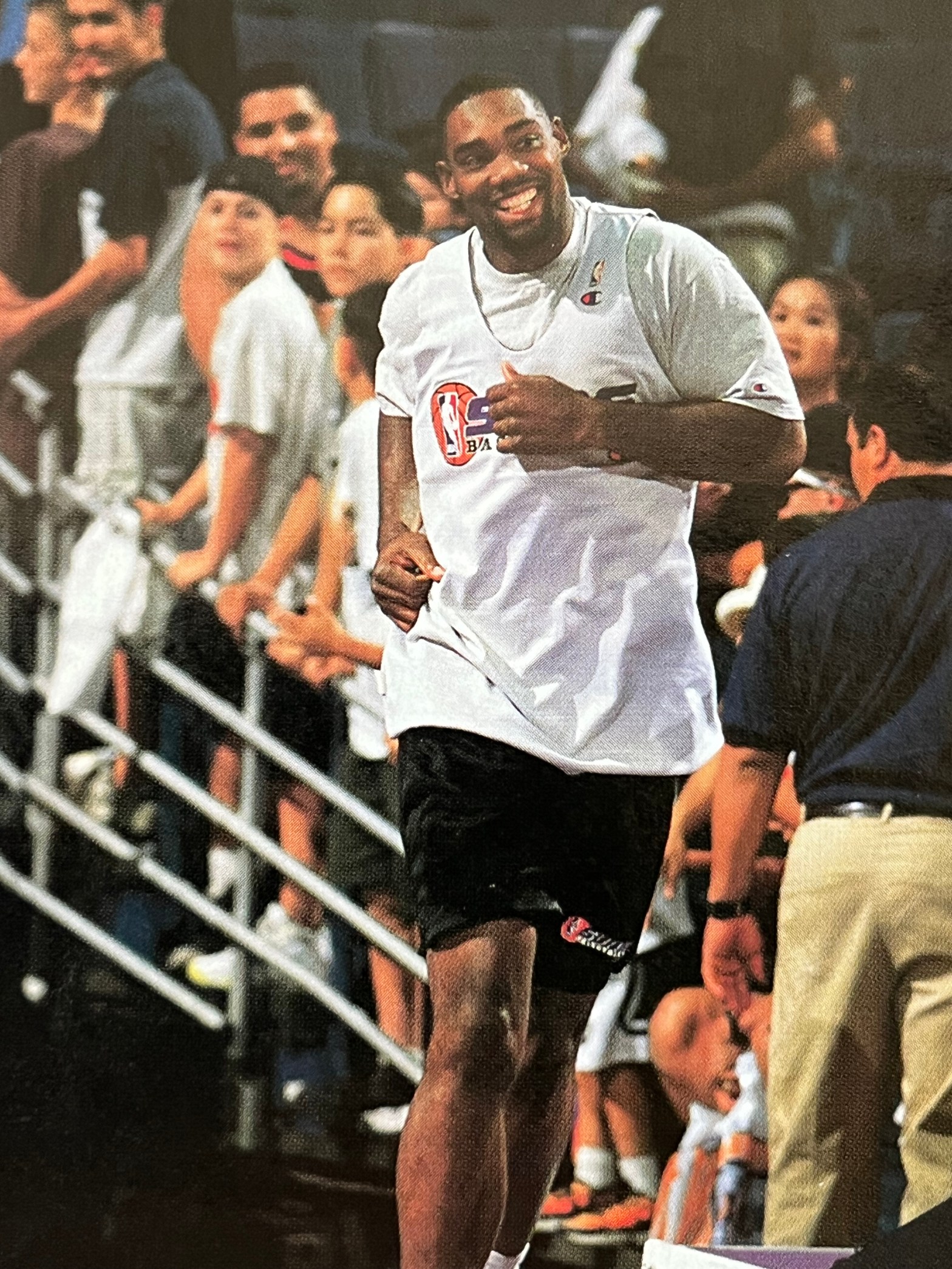
[In the summer of 1999, six-year NBA pro and free agent Rodney Rogers signed a two-year deal with the Phoenix Suns. Afterwards, Rogers said, “I’m finally in the NBA,” Rogers said afterwards, taking a parting shot at the Los Angeles Clippers, where he’d languished at the end of his four-year stint with one of the NBA’s more dysfunctional franchises.
Rogers, a mobile 6-7, 255-pound inside-and-out player, then looked positively to the future. He’d joined a winning team with elite playmakers in Penny Hardaway, Jason Kidd, and briefly Kevin Johnson. If Rogers stayed healthy, he’d hopefully get his career back on track running the floor and snatching perfect passes at the perfect time and in the perfect places.
Hope, however, took an unexpected twist early in the season. Coach Danny Ainge preferred Rogers’ brawn and unquestioned skill coming off the bench. Rogers kept his head up and fully embraced his new role in Phoenix, winning the NBA’s Sixth Man Award.
What follows is the welcome-to-the-team profile of Rogers that ran in the December 1999 issue of the magazine Fastbreak, published by the Suns. Twenty-five years later, this story by the great Joe Gilmartin helps us to remember what a special player Rogers was during most of his 12 NBA seasons.
This remembrance is doubly important because Rogers, a few years after retiring from the league, was paralyzed from the shoulders down in a tragic dirt bike accident. Whether on the court or in his wheelchair, Rogers is a classy guy. He will always be the Durham Bull.]
****
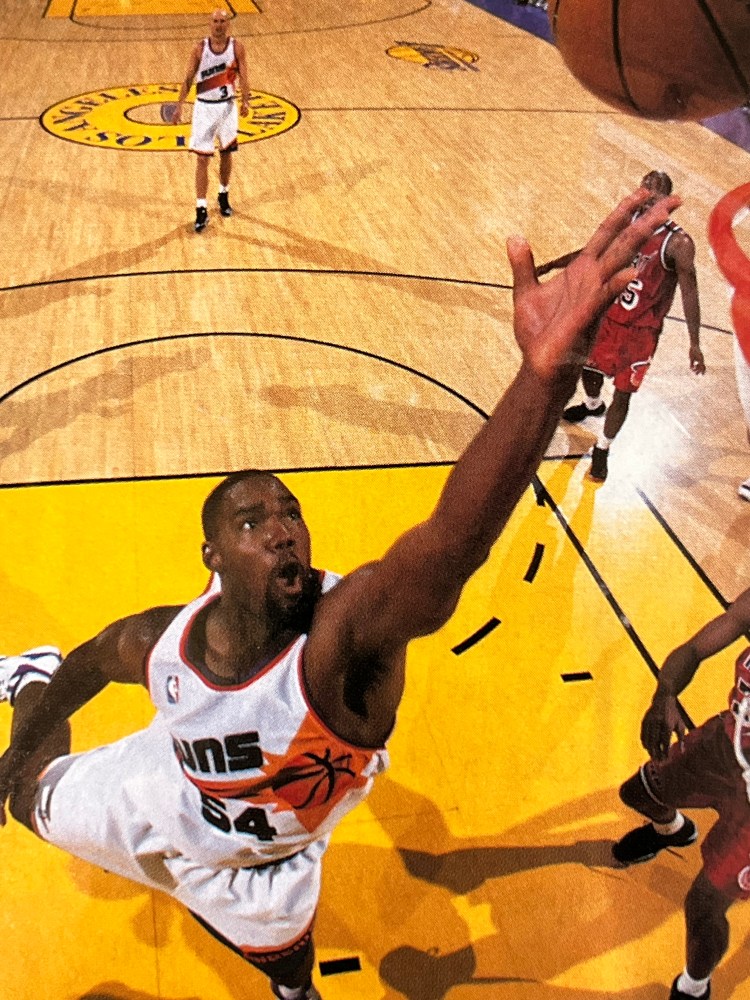
At the end of last season, Suns President and General Manager Bryan Colangelo said that, among other things, the Suns needed more interior toughness, more interior scoring, and more interior versatility. And although that’s a tough trifecta to hit in a league where the demand for such qualities always exceeds the supply, Colangelo hit it in one shot with the signing of Rodney Ray Rogers.
“Rodney was one of the few available players, we thought could give us all of those things,” Colangelo said. “We knew he wasn’t entirely happy with his situation in Los Angeles, and we were one of the few teams lucky enough to be in the running for him. And since he was coming off a tough year, we thought he’d be motivated to do a better job here.”
“Not entirely happy in Los Angeles” stamps Colangelo as one of the early leaders in the Understatement of the Year race. What Rodney was in Los Angeles was downright miserable. And while this was hardly a unique state for a member of the perennially basketball disadvantaged Clippers, Rogers, unlike many, admits part of the problem was him.
“For the first time in my career, I reported to camp out of shape,” he said. “Basically, the way the lockout was going, I didn’t think there was going to be a season at all. I’ve got a trucking business and some real estate action back home, and I was concentrating more on those things. When, all of a sudden, they rushed and put something together, I wasn’t ready. I didn’t even have my mind on basketball. But I don’t fault anybody but myself for that.”
What he did fault the Clippers for was what happened later.
“I worked hard to get myself back into shape,” he said, “but the Clippers got to a point where they said they weren’t going to play me and stuff, so I told them to trade me. But they didn’t trade me and things got real nasty, and they went to the papers with things about how I came into camp overweight and all kinds of things. It just got real sour, and I was glad when the year finally ended, and I was a free agent. ‘If they don’t want to play me,’ I said to myself, ‘that’s their loss, I’ll just go somewhere else.’”
When the Suns called Rogers, he was faced with a dilemma—go to Phoenix and play for less money than he might receive elsewhere but be assured that he would be an integral part of a winning organization. Or take the most money and run. Lucky for the Suns, he chose the former.
“I actually took less money to get away from Los Angeles, but money’s not everything,” Rogers said. “You want to be happy, and you want to win.”
“I think Rodney kind of got lost with the Clippers,” said the Suns coach Danny Ainge, “but I wasn’t surprised when I heard there were about 15 clubs going after him. That told me there were 15 coaches out there who knew that on any given night he was one of the best players on the court, and a guy who frequently needed to be double-teamed. He gives us some toughness inside, and he’s a guy who can also play some small forward. And he’s got a great attitude. He has been one of the hardest workers since the first day of camp.”
That was part of the plan. Two plans, in fact. Rodney’s and Colangelo’s.
“We put it on him that coming into camp overweight was definitely a thing of the past,” Colangelo said. “We wanted to make sure he was in a position to help us immediately. And I have to tell you, he really came into camp ready. In fact, when informal workouts started in September, Rodney was one of the few people we felt was really ahead of everybody. And from the first day of camp until the first day of the regular season, he was the biggest surprise or impact player we had, along with Shawn Marion.”
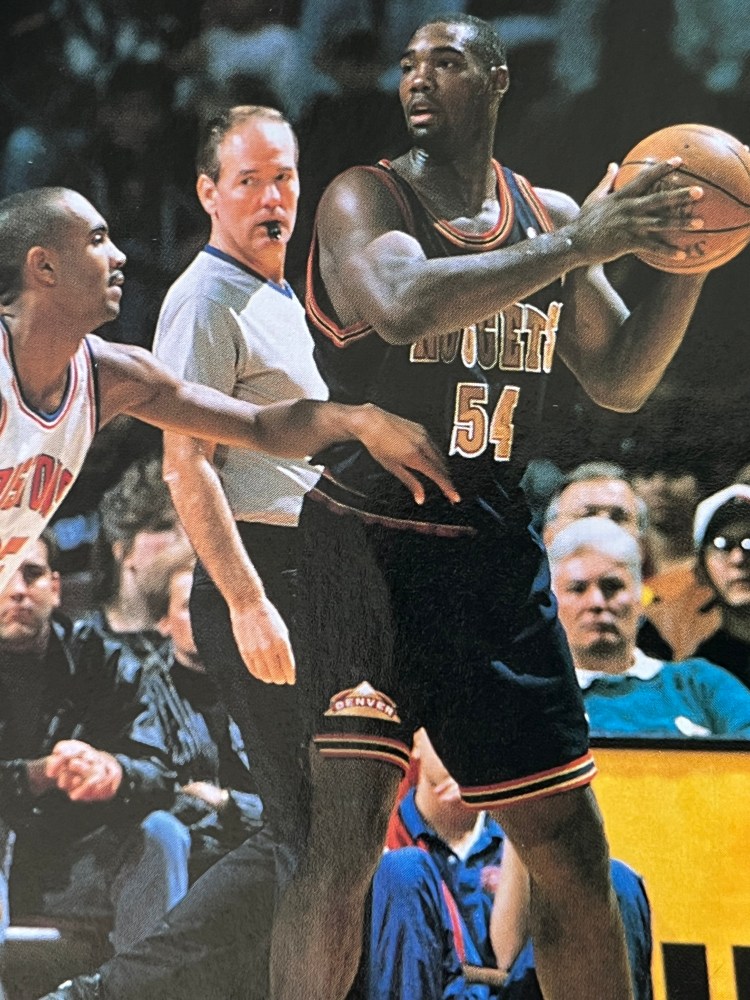
Actually, the 6-feet-7, 255-pound former Wake Forest star didn’t need much urging to be prepared. The chance to prove himself on a winning team was incentive enough.
“I was really excited at the opportunity to be part of a winning organization that really wanted to put people out there who could help you win ballgames and try to win the championship,” he said. “So, I came to my new team feeling like I was back in basketball, and this was a whole new beginning for me. So, right from the start, I was back to my old self, playing hard and practicing hard just like the Rodney Rogers of old.”
He made his presence felt early, scoring 32 points in a preseason game against the Lakers. He scored 22 in the regular-season opener at Denver, and scored 12 of his 18 points in the fourth quarter, including a couple of tide-turning threes, to help the Suns register a come-from-behind victory over the defending NBA champion San Antonio Spurs on November 7.
In between those games, he drew a blank in a victory over the 76ers, but Ainge had no problem with that. “One game, he’ll score 32 points, and another game he doesn’t score at all,” said the coach.
But that’s not so much Rodney as how he’s being used and the people he’s matched up against. The night he got 32, he was matched up against Shaquille O’Neal and used his quickness to take vantage of it.
“He has a decent touch and has actually played outside a lot in his career,” Ainge said, “but we need him more inside than outside. He’s a great box-out guy and a very physical player, but he has proven he has the ability to step outside.”
Is Ainge comfortable with one of his power guys taking threes?
“Yes, I am, because he can make them,” he said. “Rodney’s not a great three-point shooter, but he’s a pretty good one. And while I wouldn’t want him taking a lot of them, I certainly don’t have a problem with his taking two or three a game.”
And Rodney’s role on the retooled Suns?
“He and Cliff Robinson will be the first two guys off the bench,” Ainge continued. “In fact, they’ll probably come off the bench together a lot. They are our sixth and seventh man, in no particular order.”
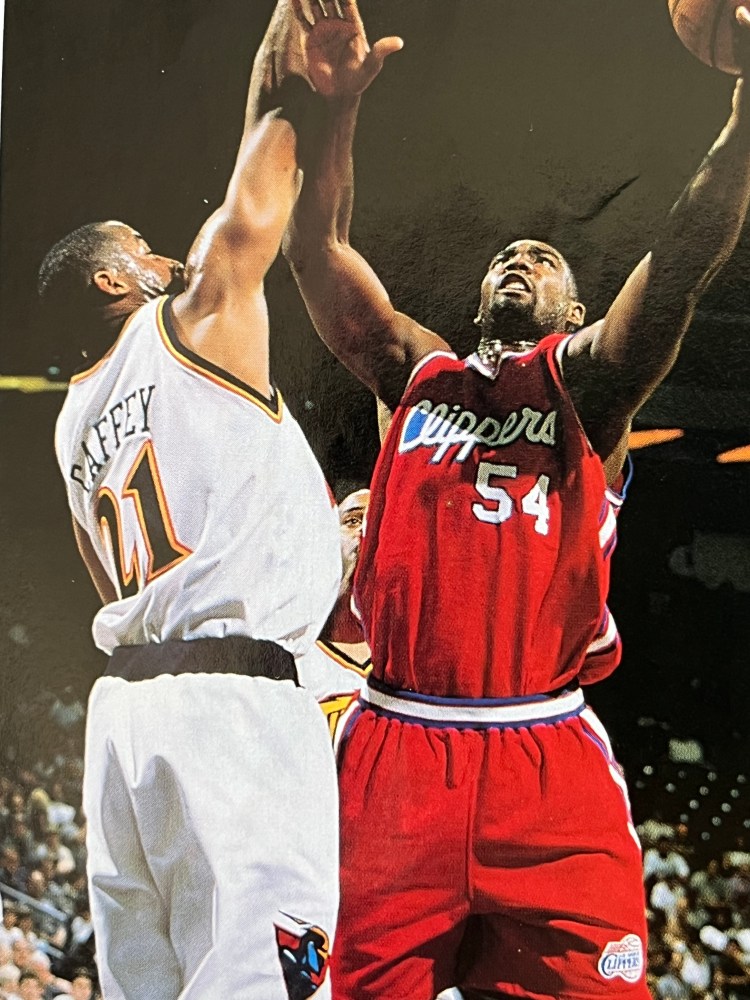
This is certainly a much better role than the one he had with the Clippers last year (i.e., scapegoat. Rogers played in 47 of the teams 50 games, but his minutes were down sharply (to 20.6 a game), and not surprisingly, his key statistics—rebounds, assists, and scoring—were the lowest in his four seasons as a Clipper. The biggest drop was in point production, which plummeted from 15.1 the previous year to 7.4.
Until last year, life as a Clipper, at least stat-wise, hadn’t been all that hard to take. For one thing, the Clippers actually made the playoffs the second season. And for another, his scoring and rebounding averages improved in each of his first three seasons, all the way to career highs in points (15.1), rebounds (5.6), assists (2.7), steals (1.2), and minutes (32.9) in 1997-98.
His single-game career highs of 34 points (twice), 21 rebounds, nine assists, five steals, five threes, and 53 minutes support Ainge’s contention that some nights he IS the best player on the court.
He’s certainly one of the best players ever to come out of Wake Forest. The Atlantic Coast Player of the Year in 1992-93, Rogers became the first Demon Deacon since 1978 to be named to the All-Conference first team in consecutive seasons. That year, he led the ACC in scoring with a 21.2 average and was fifth in field goal percentage at .555. He was the overwhelming choice for Freshman of the Year and was a member of the USA developmental squad that helped prepare the original Dream Team for the 1992 Olympics.
The funny thing is, he didn’t really want to go to White Forest.
“I definitely wanted to play in the ACC,” said the Durham, NC native, “but the place I wanted to play was Carolina. But I told Dean Smith that if he went out and got Cliff Rozier, I wasn’t going to come because I would have been like the seventh player. So, when he signed Cliff, I went to Wake.
“Another reason was my mom has been in a real bad accident and was in a coma for a month or so, and I didn’t want to play too far away from home. But I had a good time at Wake.”
Prior to becoming a Demon Deacon, Rogers actually had to decide which sport he wanted to play at the collegiate level. He asserts that he was better on the gridiron and the diamond in high school than he was on the hardwood. But basketball was his true love, and his decision was easy.
It’s hardly surprising that Rogers loved basketball best. Not only did he grow up in hoops crazy North Carolina, but his mother played high school basketball, and his older brother, Stacy, won a gold medal in the 1981 World Games for the Deaf in West Germany.
“I always wanted to be like him,” said Rodney. “He was great in basketball and an okay wide receiver in football. He was a skinny guy, about 6-1, and my other brother was about the same. I am the baby, so everybody kept asking me how I got so big. My mom’s about 5-9 and, actually when I was younger, I used to play against her a lot, and she could beat me because I was a lot shorter then. She had a nice little jump shot. But she’d have no chance against me now.”
Rogers came out after his junior year and was taken with the number nine pick in the first round by the Denver Nuggets. He averaged 8.1 points and 2.1 rebounds as a rookie and improved to 12.2 and 4.8 the second year.
“The first year, we were the first eighth seed ever to win in the first round when we beat Seattle, and that made me feel good,” he said. “We made the playoffs again, the next year, but got swept in the first round.”
On draft day that June, Rogers was traded to the Clippers along with the draft rights to Brent Barry for Randy Woodson and the rights to Antonio McDyess. “Although we did make the playoffs my second year there, everything went downhill after that. Most teams build on a playoff team, but the Clippers just went downhill.”
And the Suns? How good will they be this year?
“As good as we want to be,” he says, “and that’s no lie.”
Fortunately for the Suns, Rogers will play an important part in establishing how true that statement turns out to be.
[Just for the record: In 1999-00, the Suns finished 53-29, third best in the Pacific Division. In the playoffs, Phoenix fell to the Lakers in the Western Conference semifinals after upsetting
 From Way Downtown