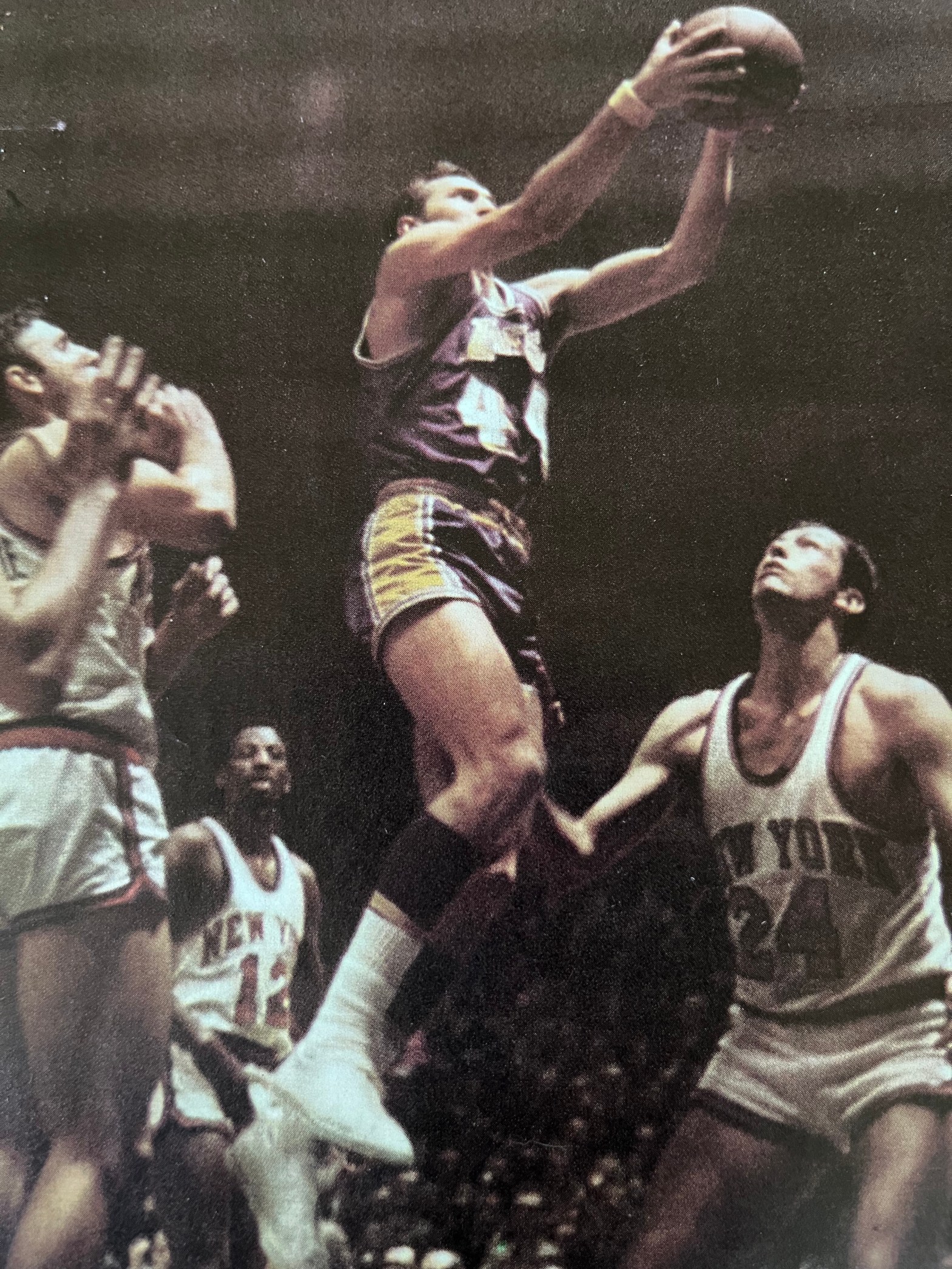
[Toward the end of his life, Jerry West spoke in-depth about “the perfect season” of 1971-72 that brought Los Angeles its first NBA title and brought him some needed peace of mind. For example, the Logo’s 2011 autobiography West by West is a great place to start. But if you want to get West’s more contemporaneous reflections on the championship, the brief article below might work. It’s bylined by West, and I’m guessing that he really did have a heavy hand in either writing or editing it. The point being, the article reads a little stiff in places, but it does provide a broader thematic glimpse into his thinking several months after one of the happier moments of his self-described “charmed, tormented” life. West’s article ran in the magazine Cord Sportfacts’ Pro Basketball Guide 1972 with, you guessed it, Jerry West on the cover.]
****
I think you might well be able to call last season “the perfect season.” One could not write a better script, one could not write a better ending to the season the Los Angeles Lakers had. Winning the championship was just the culmination of that perfect season.
Much of the credit must, of course, go to our coach Bill Sharman. He took a club that most coaches would not want. He didn’t step into an ideal situation, but he did convey one thing to us. He got across to the players the fact that he felt we could win. He made us believe we could win the title.

Conditioning helped us a lot. There’s a fallacy that many teams work under to the effect that you can play yourself into shape as the season progresses. This view is particularly prevalent with veteran teams. Bill did not allow us to do that.
Bill Sharman ran the most-organized practices I’ve ever seen. His total organization showed in everything he did along with his dedication to the conviction that we could win the championship. He dedicated himself totally to that end and he made us dedicate ourselves.
He conveyed to us the fact that we could change our style of play and be successful. Many coaches felt we were physically unable to play a running-type game and wouldn’t even consider it. But he believed we could run and win, and he made us believe, too.
I, personally, felt the running game made my job much easier. It’s easier to play when there is not a lot of pressure on you. You don’t have the constant pressure of hands and body checking. He showed us we could be successful playing a running style.
Another important factor in our success was his handling of players. He treated everyone alike. Many coaches feel that players have to be treated differently. Some have to be babied. Some have to be pushed. He didn’t believe in that. His theory was to treat everyone the same, from star to sub. It was a very pleasant thing to go through and a very worthwhile thing, and it was very important to the players.
Sharman played a lot of men, and he conveyed confidence to all of us. He did not hesitate to substitute a player in a critical situation. He made good use of our bench and the way he substituted was simply fantastic.
Another key to our success was Wilt Chamberlain. Everyone looks at Wilt and his scoring records and says here’s a guy who should be able to do everything. He scored so much in the past because the teams he played with went to him so much that he had to score. Wilt changed his style last season because of our style. Lots of times we would get a shot off before he would get to midcourt.
He concentrated on the quick outlet pass to me or Gail Goodrich, and we’d move downcourt quickly. He really didn’t have to get into the flow as much with our style of running. He didn’t score as much as usual, but he had a great year nonetheless. The great thing about Wilt was that he made up for so many mistakes some of our players made on defense. I think he played better defensively last season than any time in his career, especially in the playoffs, when he was simply fantastic.
Of course, one of the most remarkable things about last season was the 33-game streak. Winning the championship was almost secondary to the winning streak. It was really so much fun. We just didn’t play any bad games. We played great basketball and, when you do play great basketball, you get the good breaks, you gain confidence, and you feel you can beat anyone.
It was like a big snowball—it just grew and grew. The more we won, the easier it got. It carried over to everyone, and I think it even carried over into the playoffs. We thought we couldn’t be beaten.
All the guys were shocked when we were finally beaten. In fact, for the next couple of weeks, we stumbled around a bit until we got back to our pace. During the streak, I think we played outstanding ball. We didn’t win any cheap games. It was absolutely fantastic the way our team responded.
Looking ahead to this year, I honestly feel we’re in the toughest division in the league now that Phoenix has been moved to the Pacific Division. The only grouping that could possibly compare is the Midwest, with Milwaukee and Chicago. Phoenix, Golden State, and Seattle are all solid clubs. Seattle has a heckuva club this year. They’ve picked up John Brisker, who is a fine talent from the American Basketball Association, and they also have Jim McDaniels and Spencer Haywood. They have a tremendous frontline and a solid backcourt. I think they’re going to be solid contenders.
What we’re going to have to do this season is to go out with the idea that we have to win every night. It makes no difference whether we’re playing Golden State or Seattle or Portland or Buffalo. We have to go out with the idea of winning every game, especially in our division.
Much has been written about the possibility of my going into coaching when my career is finished. In some respects, it’s going to be very difficult for me to get into a situation where I’m not going to be the master of my own fate, so to speak. As a coach, you’re trying to coach players through your own eyes. You can’t physically help those guys out there.
Another factor to be considered is that because a player has had a successful career doesn’t necessarily mean he’ll be a good coach. I think a star player might have spent his career concentrating more on playing the game and then watching, while someone who spent a lot of time on the bench might see things more clearly as coach. He would have the advantage of having seen situations develop and noting the reactions to them.
It’s a hard thing to say. There are days when I feel like I’d like to be a coach, and often there are times when I don’t. If the right offer and the right situation came along someday, I might consider it.
Right now, I think that’s quite a ways down the road. Right now the important thing is the upcoming season. It’s been a great summer. But when another basketball season is coming up, you always look forward to it, no matter how long you’ve played.
I remember sitting on the bench in the Forum in the last quarter of the last playoff game against the Knicks and looking at the clock and finally realizing that there is no way we could lose it. The greatest thing was the relief and getting the pressure off. We were the favorites—and we had to win—and it was a tremendous relief to know that we had done it. We had capped the perfect season.
 From Way Downtown