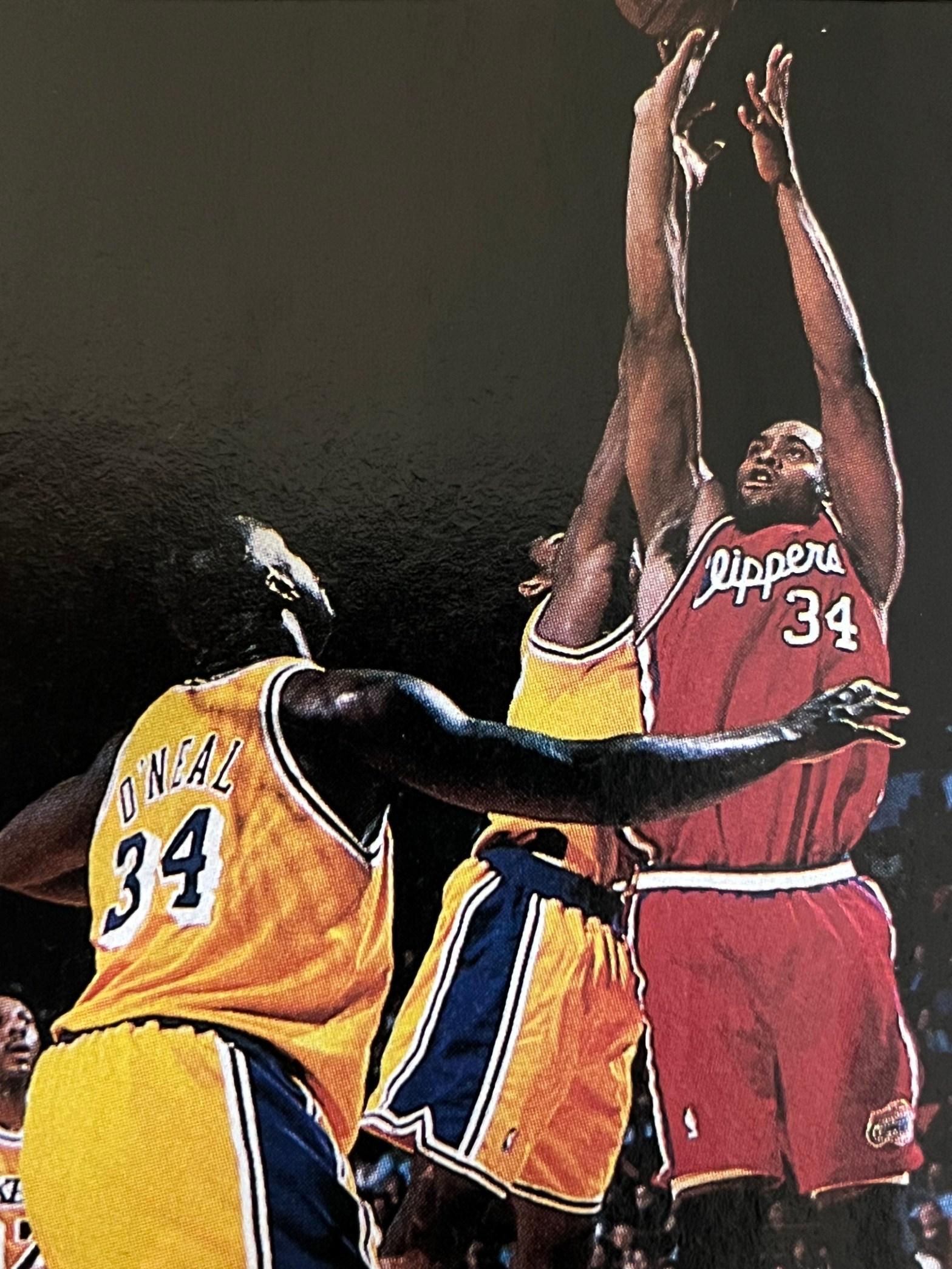
[Basketball offers no one single pathway to stardom. There are many, some traditional and others circuitous and seemingly zany. Take the mind-bending rise of Michael Olowokandi? In the mid-1990s, the seven-foot Olowokandi was a 20-year-old basketball neophyte in the United Kingdom who cold-called America and, as it happened, one Tony Marcopulos, assistant basketball coach at the University of the Pacific, Stockton, Calif.
Here’s a quick recap of The Phone Call from the Philadelphia Daily News’ Dick Jerardi (June 23, 1998):
The now-legendary call came on April 3, 1995, Olowokandi’s 20th birthday. The big man had been thumbing through Petersen’s Guide to American Colleges and Universities. His thumb ended up on the University of the Pacific. He rang up the basketball office, and Tony Marcopulos, now a 10-year assistant at Pacific, answered.
Michael Olowokandi was on the other end of the line. The big man wanted to play basketball for a small American college with an engineering school.
“I was eating lunch at my desk,” Marcopulos remembered. “We start talking. He had this thick British accent with a Nigerian twang to it. If you can imagine that. I have no idea what he’s saying. I finally get him to slow down, and he tells me how big he is. Of course, I started to pay a little bit more attention.”
Marcopulos explained that Pacific had no scholarships available. Olowokandi said that was no problem, that he would pay his own way. So Marcopulos did what any sane coach would do. He said, “We’ll take you.”
“If he can’t play,” Marcopulos thought to himself, “there will be a big, old student walking around the engineering hallways. And if he is good, well then, hell, I’m a brilliant guy.”
Four years later, Marcopulos was considered a brilliant guy, and Olowokandi was the top pick in the 1998 NBA Draft. In the story that follows, published in the December 1999 issue of Fastbreak Magazine, Randy Hill of the Long Beach Press Telegram takes a memorable drive with Olowokandi. It’s a brief, but clever, narrative. Very nicely done.
Less well done was Olowokandi’s nine-year NBA career. Chronic injuries helped to zap Olowokandi’s tremendous potential, as well as spending his healthiest NBA seasons with the then-dysfunctional Los Angeles Clippers. As Mick Minas wrote in his book The Curse, “He played 323 games for the Clippers and averaged 9.9 points and 8.0 rebounds, a solid return during an era where productive centers were a scarce commodity. When you consider Olowokandi’s late introduction to the game, this is a remarkable achievement. And while nobody can say for certain, it is quite likely the most observers would have a very different opinion of his professional career had he been selected a little later in the 1998 draft.” That makes a lot of sense to me. More so than Olowokandi’s driving skills.]
****
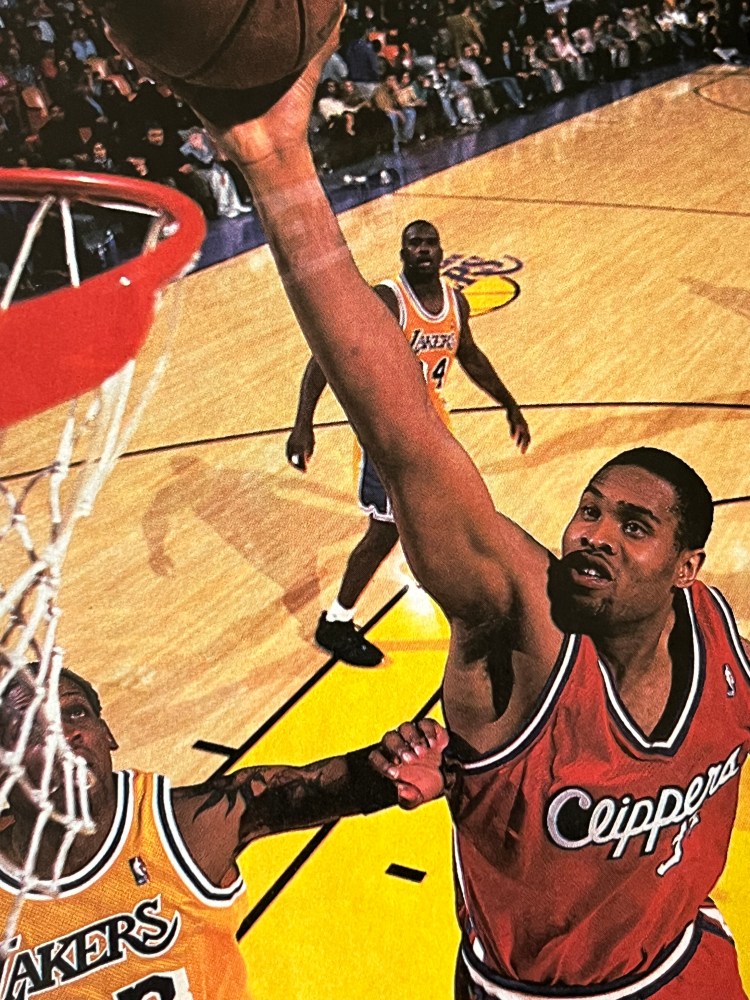
When the safety of the driveway has been left behind, Michael Olowokandi confesses his troubling motoring history.
“It was probably a lack of coordination, but the accident definitely was my fault,” the Clippers’ second-year center deadpans in a wandering British accent. “It was a stick shift, and I hit the wrong pedal.”
Gas pedal?
“That’s the one.
As if the bit has been rehearsed, Olowokandi, the first pick in the 1998 NBA Draft, looks over at his passenger and smiles. “Went right through a wall . . . but I was only 13.”
You can drive in England when you’re 13? Seat belt is pulled tighter. We’re rolling in Olowokandi’s Lincoln Navigator for a 60-minute tour of Southern California’s lively South Bay. If encountered by anything less than a Chevy Suburban, we’re in business. “But I’m a pretty good driver,” he said assuredly. “And I’ve been practicing.”
The Kandi Man performs a regional maneuver known as the California Stop (just a hint of brake pedal at a stop sign), and the technique is flawless. He may not be a native, but the kid has enough behind-the-wheel chutzpah to maneuver around L.A. traffic.
Remember, when you’re 7-0, you don’t have to pump fake before driving. “This,” he says when asked to compare California motoring with his learning curve in the NBA’s fast lane, “is much easier.”
For the freeways and surface streets, he has a learner’s permit. For the low post, he has at least two more guaranteed seasons before a comprehensive verdict can be rendered. But the picky, picky national hoop jury wants more evidence to consider. Will he develop into a consistent “15 and 10” guy or will he join the pantheon of didn’t-live-up-to-expectations Clipper draft picks—the second coming of Bo Kimble, Randy Woods, Benoit Benjamin?
He’s in the crosshairs of this question, but trouble looms on the motoring horizon. A minivan is roaring downhill in our direction, hogging more than it’s prescribed share of asphalt on this narrow South Bay thoroughfare. Now is the time to worry about a London flashback.
****
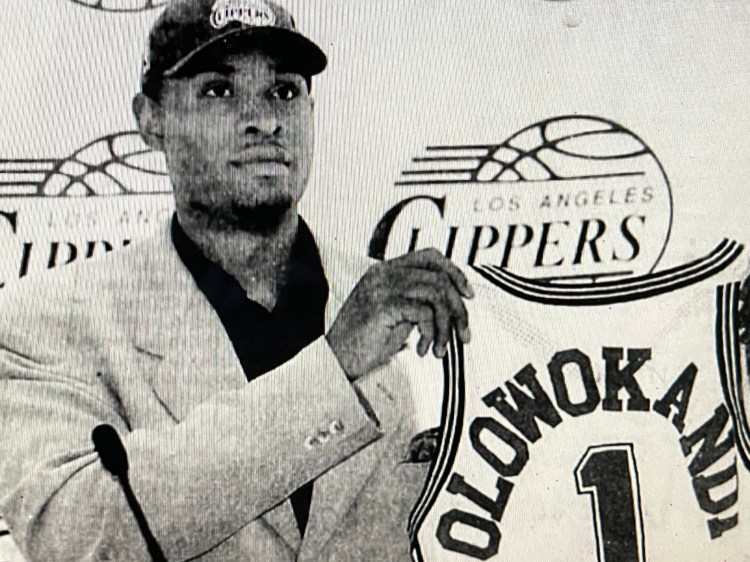
Unless you’ve been AWOL, Olowokandi’s storybook journey to the NBA is well known. His father, a Nigerian diplomat, moved the family from Lagos to London when Michael was three. “London will always be home to me,” he says.
As a kid in England, Olowokandi developed into an exceptional athlete in soccer, cricket, rugby, and track and field (long jump and triple jump). He attended Brunel University in Middlesex, England, but by then he was stretching to 7-0, and he began to play basketball—a better fit for his height. The NBA, he thought, might be an option, so he plotted a way to play basketball for an American school. His method was less than scientific. Olowokandi obtained a college guidebook, and that was all he needed.
“I just opened the book, and it opened to Pacific,” he says.
Pacific assistant coach Tony Marcopulos answered the ringing phone that day, and upon learning that the caller was 7-0, he offered Olowokandi a spot on the team, sight unseen. Three years later, the improving young center, who had not played in an organized basketball game until he was 20, became the first pick in the draft, following in the large center footsteps of such notables as Shaquille O’Neal, Tim Duncan, David Robinson, and Patrick Ewing.
****
But we’re still concerned about the London flashback. Keep the Navigator to the right, big fella. Steady. Slow down. The van closes in; Olowokandi surrenders just a pinch of the lane. And then, quicker than his baseline spin, the Clipper jerks the steering wheel, the Navigator veers right, and rides the curb to safety.
Olowokandi still hasn’t blinked.
****
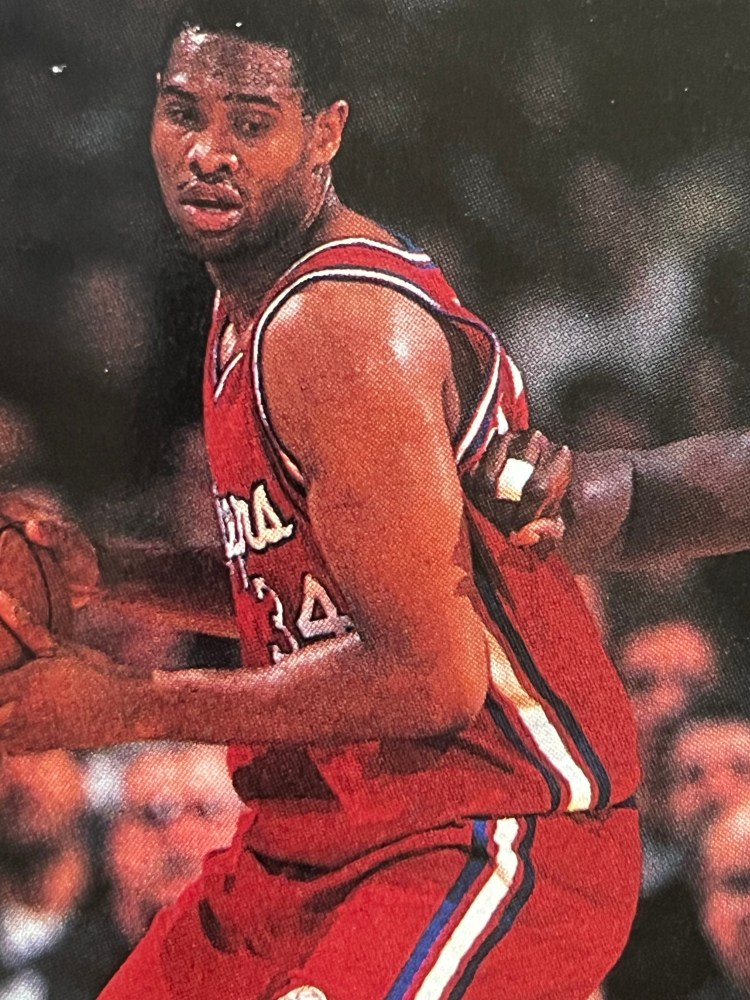
“I think I could have done more,” he says.
He’s talking about his rookie season. The numbers were modest (8.9 points, 7.9 rebounds, and 1.22 blocks), but he did register seven double-doubles. What didn’t appear on the stat sheet was his bum knee; it was presumed the problem was tendinitis. Eventually, it was determined that this particular gremlin was a cartilage problem.
“I felt like the whole season was a punishment,” Olowokandi says of his nagging knee, a legitimate calamity that was cleaned up the week after the regular season ended. “The difference now seems so significant.”
His teammates agree.
“He’s going to be a monster,” says forward Maurice Taylor.
The accelerated footwork makes Olowokandi seem almost, well, frisky. His leaping is quantum, and the stamina has reached a requisite professional level. “I thought that if you had raw talent and played hard, you’ll be fine,” Olowokandi says of his early NBA plan. “I’ve figured out that you have to spend a lot of time on your skills.”
With that important piece of knowledge, he worked hard during the offseason on his low-post repertoire and sweetened the shooting touch. “I think he’s improved a great deal,” says Clippers assistant coach Jim Todd. “His shooting has improved, his movements are more efficient; now he just has to transfer that work into game situations.”
****
He also has to make a left turn from Aviation Boulevard to Rosencrans while compensating for the challenge of road repair. When the vehicle ahead of the Navigator is slow out of the blocks, Olowokandi—who seems fully assimilated now—leans on the horn. After the mild traffic tremor, the Navigator is rolling west, making a beeline for the Pacific Ocean. If this was a movie set, it would be time to cue the fog.
“Is that fog? I’ve never seen it like this around here.”
Seems like home?
“A lot like home.”
But, by Olowokandi standards, L.A. and the South Bay are just fine the way they are. “Like I said, London will always be home to me, but I love it here, too,” Olowokandi says. “The people here have been very supportive, which sort of surprised me, considering how we won only nine games last season.”
And while the archival nightmare of Clipper seasons past must be dealt with, Olowokandi has the added pressure of proving it’s something more than another franchise miscalculation. “Do I think about that? Honestly, yes. But I don’t think I’ve allowed it to become pressure that affects me negatively. I expect a lot more for myself, and I’ve had a lot of players and coaches in the NBA say encouraging things.”
He slows down to chuckling speed.
“Maybe I’m one of those guys people like to feel sorry for.”
Maybe he has one of those stories that is so good and the main character is so affable that people want to see it have a happy ending.
“I’m blessed no doubt,” Olowokandi says. “Many people have worked hard for years to get where I am and never will. But, to me, this just didn’t happen overnight, so it may seem like a bigger deal to other people than it does to me.”
The Navigator executes a reverse pivot in a parking lot adjacent to the Manhattan Beach Pier. “You wan drive around some more?”
Nah, we’ve had enough. Let’s head back. Late in the day, there is no obstruction in sight to challenge the man in the middle, nothing but sky and open road. He seems to be headed in the right direction.
“I know I can get a lot better,” says the Clipper behind the wheel. “But how much better? That’s going to be interesting to find out.”
If Olowokandi puts his foot on the proper pedals, he could be driving for a long time.
 From Way Downtown