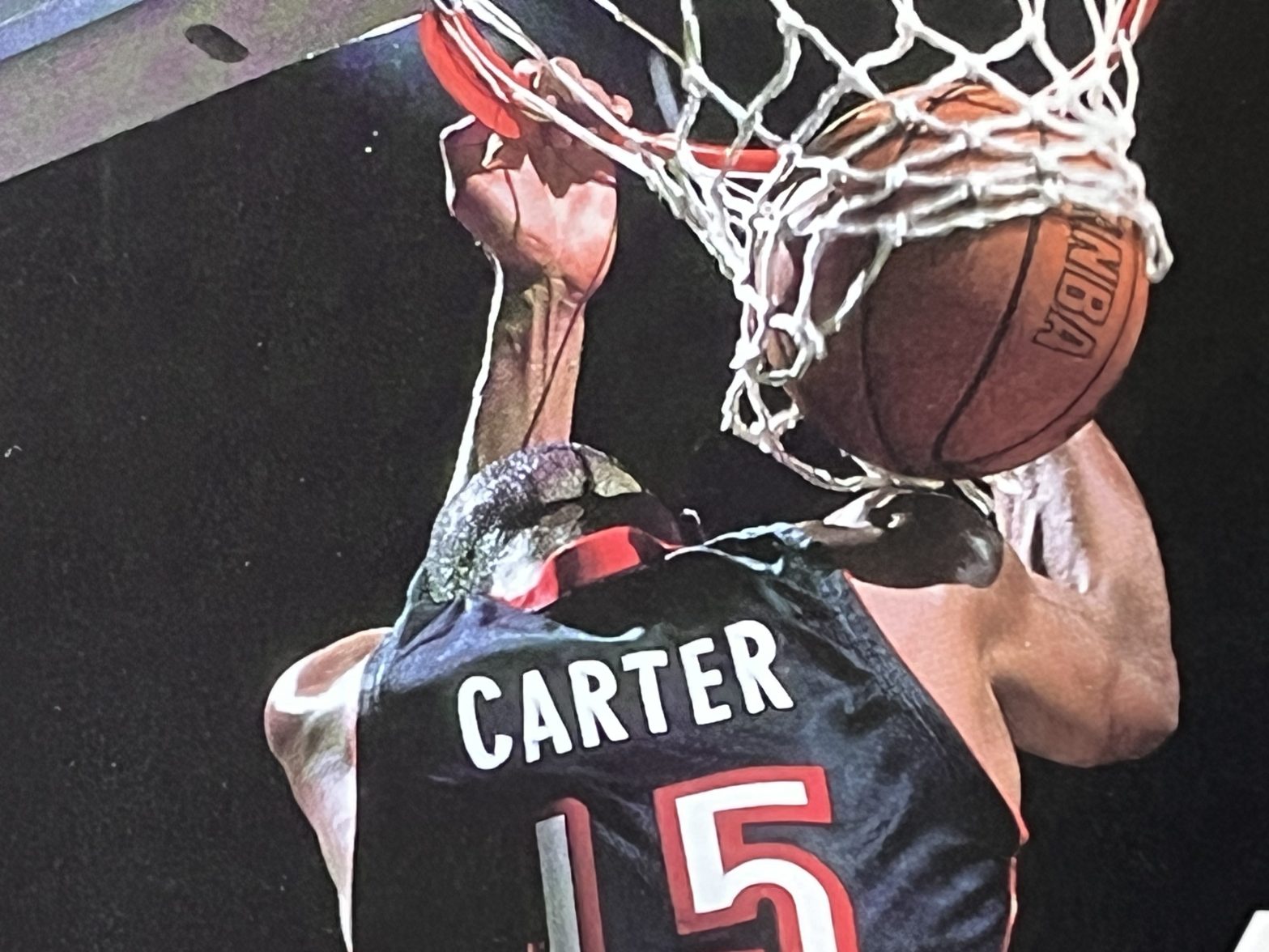
[No intro needed for Vince Carter, except briefly to set the stage for this story. I found it in the January/February 2000 issue of the magazine Hangtimes. The story looks in on Carter during his second NBA season, or back when he was the rising star and the newly anointed face of the expansion Toronto Raptors. Telling Carter’s story is Alon Marcovici, who would go on to work for the Toronto Globe and Mail, the Toronto Board of Trade, three NHL teams, and the Olympics. Marcovici’s lead paragraph is a little choppy, but just keep reading. This story offers a memorable portrait of Carter the NBA artist as a young man.]
****
He has an old-school work ethic and love for the game, but he exemplifies new-world skills and flash. It really depends on how the mood moves Vince Carter, and what he wants because what Vince Carter wants, he usually gets.
Of course, it didn’t take long for Carter to declare what he wants. After only one season, Carter calmly announced that he would carry the Toronto Raptors to the 2000 NBA playoffs. It is a declaration he does not regret making.
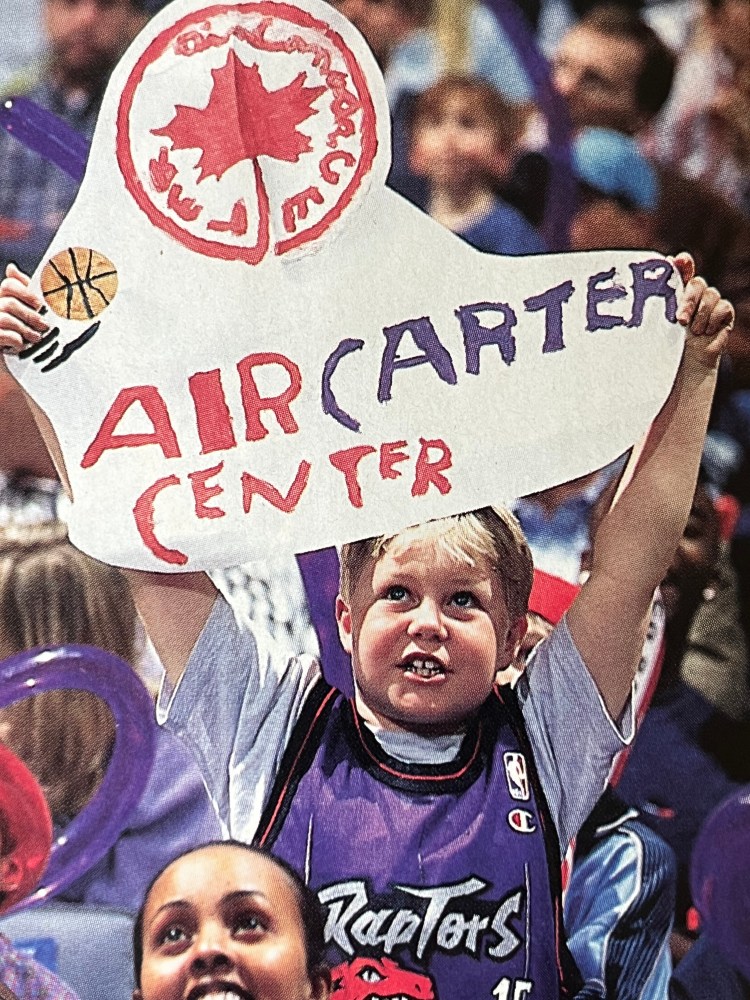
“Every time I step on the court, I’m planning to get into the playoffs,” the reigning aerial king said. “If it doesn’t happen, it doesn’t happen. I know that that’s just reality. But if it’s in your mind, you get that mindset. And maybe everyone else begins to believe it.
“I see it as this: If you don’t talk about it, you’re never going to believe it. So why not put it out there? Some people would say it’s a farfetched goal, but if you keep saying it day-in and day-out, then it’s going to happen.”
While Carter might have locked his statement in his mind, it’s one that general manager Glen Grunwald took to heart. Attacking last offseason like his young star attacks the rim, Grunwald practically built a new Raptors bench for Toronto coach Butch Carter, resigning Charles Oakley, bringing aboard free agents Dell Curry and Muggsy Bogues, and trading for a much-needed veteran in Antonio Davis.
Fortunately, Grunwald’s efforts were not lost on his franchise player. “I think Glen and Butch supported me with the additions,” Carter said. “I think they believe.”
While Davis, Oakley, Dee Brown, Curry, and all the Raptor veterans know what it takes day-in and day-out to earn a berth in the playoffs, Carter doesn’t know of such effort—at least not at an NBA level. He only knows his desire is pushing him there.
“We always told him that if there’s something you think you want to do, you go for it,” said, Michelle Carter-Robinson, the mother who doubles as the best friend. “Obviously, if you want to do it, in the back of your mind you think you can. And you don’t quit.”
That attitude, along with the good-natured character that makes him a fan favorite in his adoptive town across the 49th parallel, has not been changed by success. “I’ve seen Vince play since he was in high school,” said fellow Florida native Brown. “He hasn’t changed. Not one bit. He’s still the same kid that got to this league.”
But the Carter that Brown sees in his second year is not the player Antonio Davis sees. “Before, I thought Vince was all about the ‘ooohs’ and the ‘aaahs’,” said the six-year Indiana Pacer veteran who came to Toronto with the promise of toughening up the Raptors and providing leadership to the team’s youngsters.
“Now, watching him before, in, and after practice, I see Vince is all about getting better and making his team better. That’s something I didn’t think he had before. Most guys who are into making the highlight film aren’t looking at the columns to see if their team is in a good position to make the playoffs. I think he feels and knows what’s more important.”
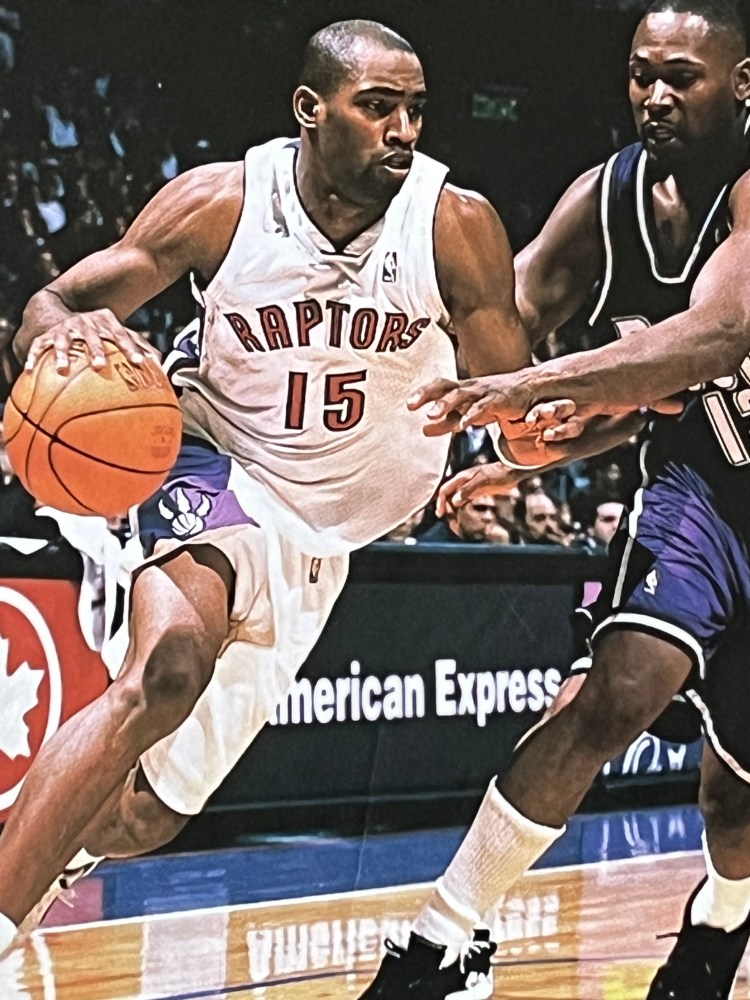
That hasn’t meant Davis can become complacent in his role to educate and motivate. “In one of my first games with him, he made a great play. He had a spectacular dunk and then he came down on defense and took a charge,” recalled Davis. “I ran over to him and said, ‘The charge you took was more important, more valuable, and has more substance than that dunk you made. And that’s how you have to look at the game.’ I think from that point on, he really understood what I was telling him.”
Oakley has similar expectations for Carter. “He’s a star, and he keeps growing and growing and growing,” said the Oak Man. “I hope he won’t change, because there’s a lot of stuff coming his way and a lot of challenges.”
Those challenges weren’t all placed in front of Carter innocently. At the press conference announcing that Oakley had been resigned, the veteran forward spent much of the time preaching about how the Raptors have to become Vince Carter’s team.”
“Oak really made it known that it’s my team, so now you hear ‘Vince and the Raptors,’” Carter said. “It’s an honor, but it’s tough because when you don’t get the wins, it’s on you. That just made it more public.”
To satisfy those higher expectations from himself, fans, teammates, and coaches, and to combat the greater attention from opposing teams to attempt to intimidate, grab, hook, knockdown, and double-team Carter, the student of the game went back to school. High school.
“I first started playing with guys from my old high school,” said Carter of the summer, when he set his sights on improving his court vision, shooting, and timing. “The players were not as tall as I am, so when I played, I knew they were going to double-team me. Then I went to local junior colleges and worked my way up from there. Then I got back to the NBA and recognized the plays and the double-team much better. I have an understanding now that when I get the ball, I make sure to make my move really quickly. I went completely back to the basics.”
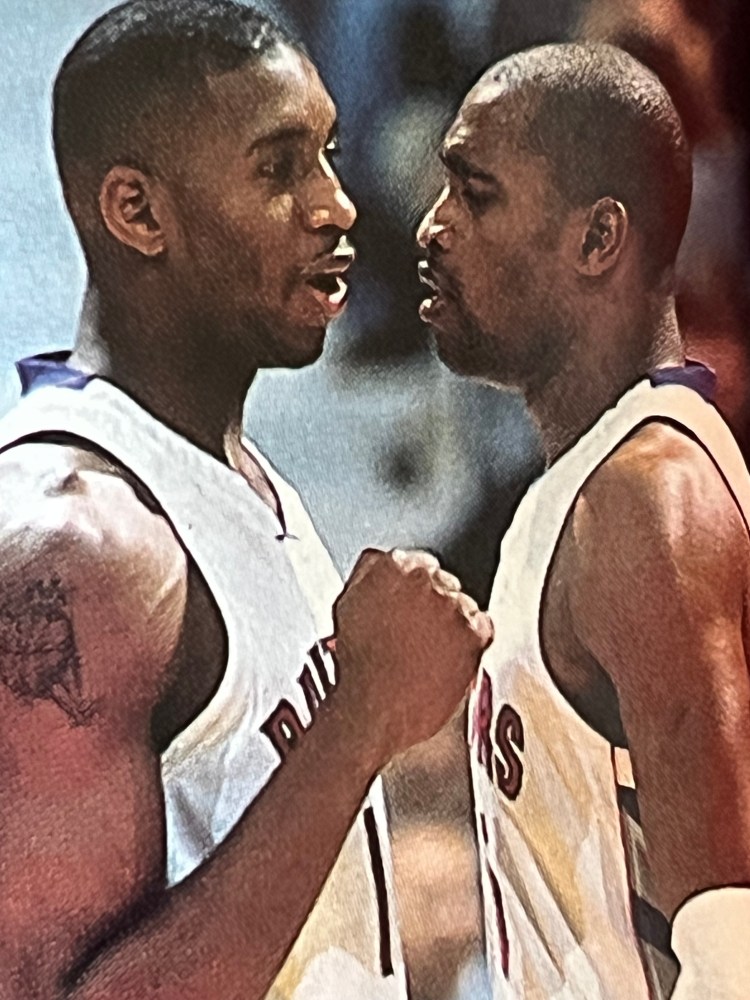
Prowling high school courts aside, Carter also spent countless hours watching his mom’s videotapes of his rookie season. “I think I watched the Vancouver game four times,” he said. “I watched the Milwaukee game and the Houston game, and it took me 10 hours to watch them. I wasn’t watching, I was studying. It was strictly me, in my room by myself, just watching over and over. It’s like going home to study and do homework.’
But as thousands of college film students can attest, watching great films and making great films are two different stories. For the Raptors and Vince Carter, whether or not those VCR remote batteries went to waste will depend entirely on how effective Carter can be during the 82-game season.
“What’s effective?” he asked. “Being able to make the extra pass out of the double-team. Getting the right rotation. Making the right decision. That’s being effective. I really don’t care if my numbers go down. I’m going to be vocal. I’m going to make plays on the defensive end, maybe only a tip, not even a steal. I just want to once again make a difference for the team.”
According to Oakley, Carter’s already done that. “Everybody knows him and knows Toronto, and he really did put the Toronto Raptors on the map,” Oakley said. “He’s like a book, and there’s no end to it yet.”
To follow along in what has been affectionately coined Oak-speak, if Carter’s a book, though, he should be made into a screenplay. Because the kid belongs on stage. Whether it’s his impromptu rapping with cousin Tracy McGrady at the team’s annual charitable dinner, his never-ending dunking performance at the preseason team scrimmage, his emceeing of the new uniform launch, or his playoff promise, Carter feels comfortable as the center of attention.
“Once I get started, I just keep going,” said Carter, who turned 23 on January 26. “I’m probably more comfortable in the public eye now than I was last year, but it’s always, ‘What you see is what you get.’”
And what you see is fairly consistent. You see a smile. You see an oversized kid who likes acting with oversized passion. You see an oversized desire to win and an oversized intention to entertain. And what you get is exactly what you wish for—fun.
“As a fan, just two years ago, I thought, ‘Man, they need some splash out there, some guys who can do this and do that,’” said Carter. “Michael [Jordan] brought a lot of flare, then Dominique [Wilkins], and a bunch of other guys. Now that I am here, I try to make the game more exciting. It’s what I do. It’s not something I practice or I’m trying to do, it’s just the way I play the game. I’d like to have fun, I’d like to feed the crowd, get them involved.”
And it’s that involvement that has Toronto finally talking about its playoff-bound basketball team. It’s the notion that you never know what new weapon or move Carter will unveil that has fans coming to Air Canada Centre to see Air Carter fly.
Perhaps what makes Carter so comfortable entertaining the city and its still neophyte fans is not the Player in him, but the Fan in him. Because for all these good intentions of showing the crowd a good time, he watches and loves the game as much as the paying customer.
“I like watching other people dunk,” he said. “I like spectacular plays, and I like hustle plays. Let’s say we are playing a team, and a guy’s hustling. If he jumps out of bounds to save the ball, down the court I’ll pat him on the butt and tell him he made a good play—whether he’s a teammate or not.
“I get caught up in the hype of the game. I’m a fan out there and I’m a player, all in one. When we were playing the Dream [Houston center Hakeem Olajuwon], I was enjoying watching him do his Shake. You grow up watching it, and now you’re playing him, so I want to see it. I’m out there playing, and I’m thinking, ‘Give him the ball!’ because I want to see the Dream Shake.”
And fans want to see more of Carter the same way he wants to see more of Olajuwon. As his oncourt stature grows, so do the off-the-court demands. “Here, there, everywhere, you’ve got to do this and that,” he said with the nonchalant candor of a veteran pro. “It’s probably more hectic than I think, but you get used to it, and it’s like everyday life now. You learn to compartmentalize your life. Every chance I get, I try to get my rest, to relax, call my friends, or do something for me. I try to stay the same kid as last year.”
No longer an unknown entity, last year’s “kid” has become this year’s hot commodity. His million-dollar smile winks at you from the cereal aisle at the supermarket, his competitive growl glares at you from city billboards, and his casual relaxation speaks to you from inside a limo in his ESPN advertisements.
He has become the prototypical player for the basketball fan of the future. He enjoys himself in action, and he makes sure you enjoy yourself watching him. So you’d think all that’s left for him to do is win and make the playoffs. Of course, that would work. But it is too simple for someone who works so hard at making the fans smile.
“Alone by myself on a fastbreak this year,” he said, “I’m going to lay it up. The whole world expects Vince to do a flashy dunk. I could just see it . . . it’ll just be a layup. They might be surprised, and I might get some boos, but I don’t mind. It’ll be something different. Of course, I couldn’t do that all the time.”
That would only disappoint the fans. And that, as Toronto and all the NBA has learned, is not Vince Carter’s way.
 From Way Downtown