[Most diehard basketball fans, age 50 and older, can rattle off the names of New York’s vintage playground legends, from Herman the Helicopter to Earl the Goat. Exotic names celebrated for decades in magazines, books, and documentaries. Not so for the vintage playground heroes of yesteryear in most other American cities, and that’s a shame.
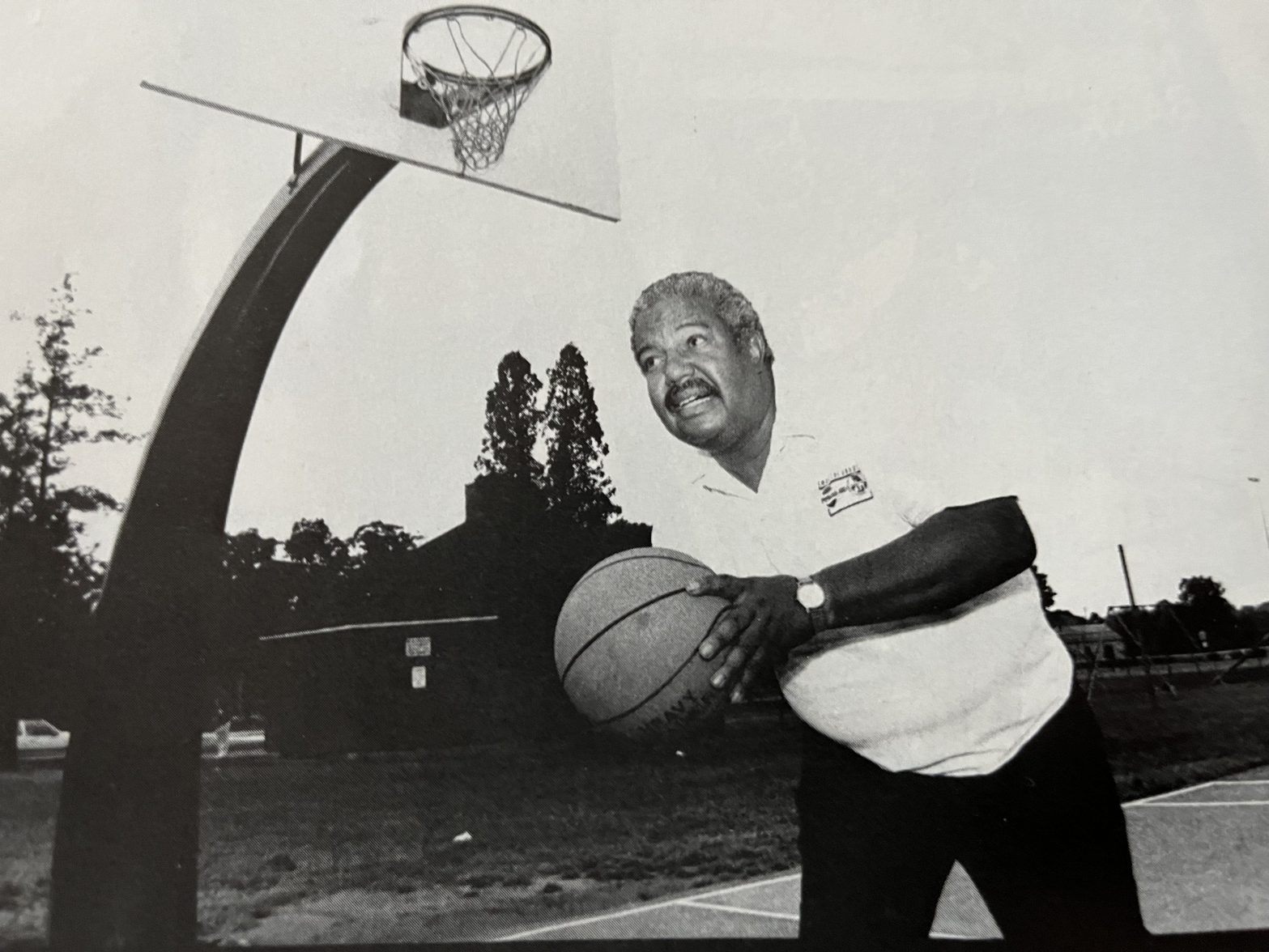
In this article, published in the August/September 1988 issue of the magazine Philly Sport, writer B.G. Kelley celebrates Philadelphia playground great Jimmy “Tee” Parham. As former Philly baller Kelley vividly flashes back, Parham, an ultra-confident pure shooter with quicksilver moves, was must-see playground faire in the city during the 1950s and into the 1960s. Here’s Parham’s story, recounted with his help. By the way, Parham is still with us and beloved at age 89.]
****
It was 1959, a July night in the hot down of summer in the sweltering heart and soul of North Philly, 25th and Diamond Streets to be precise about it. Inside the building of the Moylan playground, the famous Philly 1950s group, the Bluenotes, were harmonizing soulfully, but it was outside on the basketball court, where things were really hissin’. That’s where Jimmy “Tee” Parham was kickin’ it out on the hot asphalt.
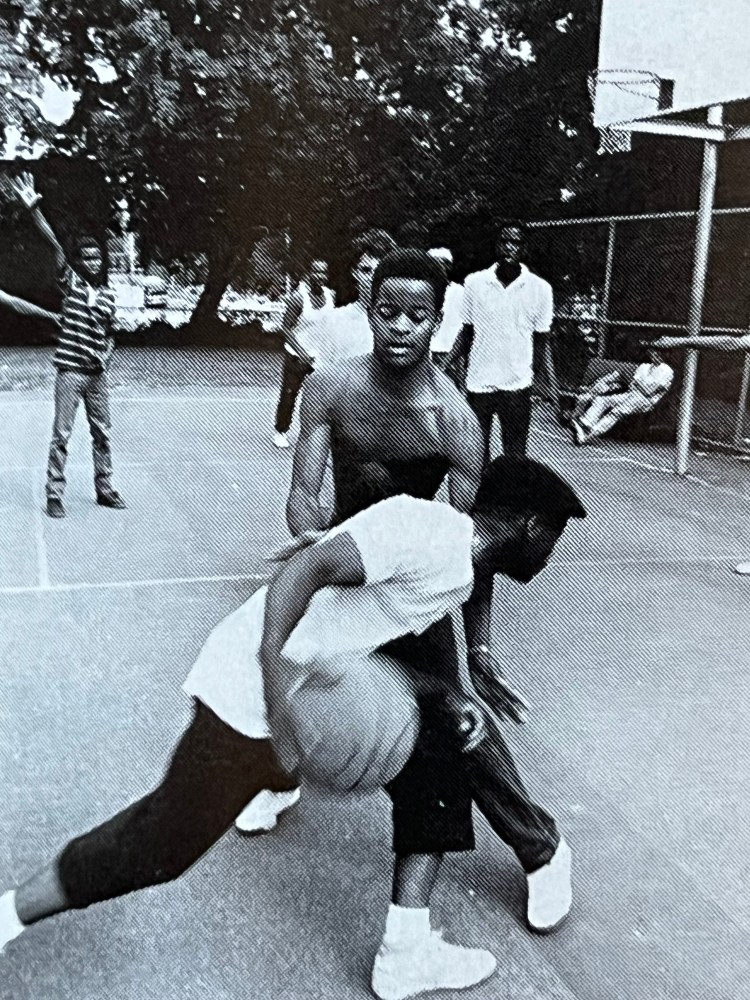
On this particular July night, Jimmy Tee took an outlet pass, blew by one defender with a snappish crossover dribble, then powdered the pill—thwack, thwack, thwack—downcourt, stutter-stepping yet another defender right out of his Chucks before taking it tough to the hole. Double-pumpin’ in mid-air to avoid the ready hand of a 6-foot-6 dude looking to stamp rubber tread on his forehead, Jimmy Tee flipped up the damndest runnin’ hook you ever saw.
Swish.
****
Does Jimmy Tee remember?
“I set a record that night,” Jimmy Tee says, setting me straight. “And we won the game. That was the thing, man. I was always a winner.”
Let’s set one more thing straight: Jimmy Tee Parham was the ultimate Philadelphia playground legend. His forte—to take the college boys with the big “reps” and bring ‘em down from their dizzyin’ heights. Not just anycollege boys, the serious dudes—guys like Bobby McNeill, the St. Joe All-American and Bill “Pickles” Kennedy, the Temple All-American, and Alonzo Lewis, the LaSalle All-American. Jimmy Tee Parham, you understand, was no college boy, but he knew how to educate.
“I didn’t give a damn about reputations,” Jimmy Tee testifies. “I told ‘em all to leave their press clippings at home, ‘cause man, press clippings don’t make it on the playground.”
Jimmy Tee’s rap is no idle street jive. I played against Jimmy Tee Parham for two summers in the legendary A and Champlost (A&C for short) League in Olney, Penn. I can tell you flat out that when Jimmy Tee Parham’s team—the Spike’s Trophies—was on the card those hot summer nights, you had to show up two hours early just to claim a good seat. There were nights when the devoted hoopsters would number more than 3,000.
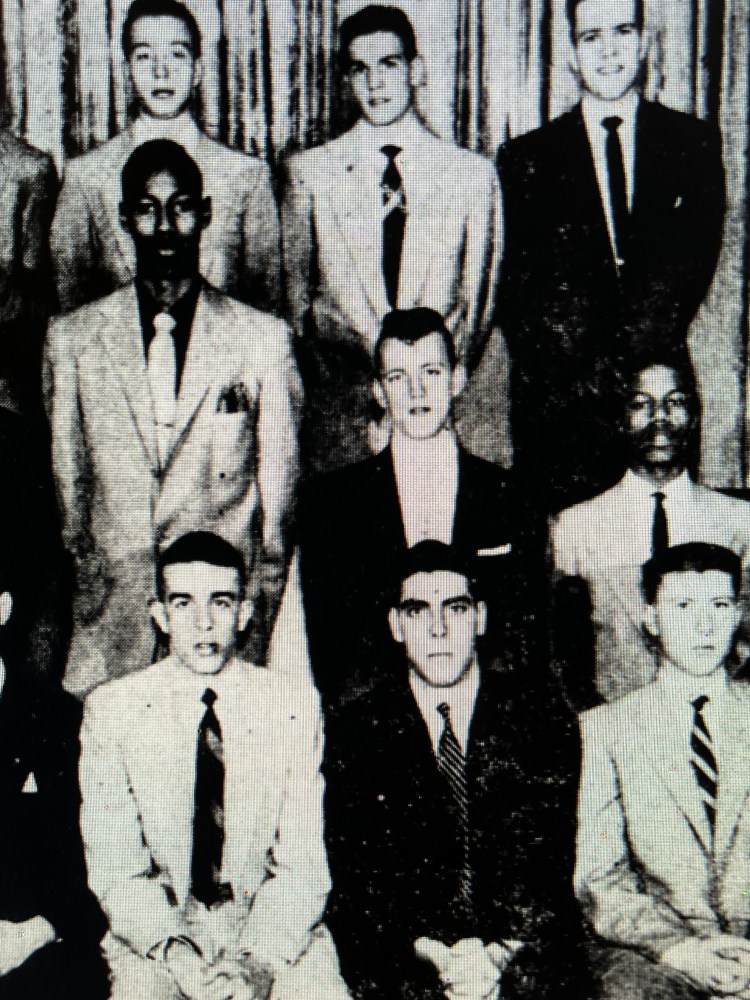
The A&C League was basically a white player’s league, which meant that in the beginning, Jimmy Tee wasn’t as well known—or as well respected—as white players like McNeill, Kennedy, Bruce Drysdale, Bob “Herky” Herdelin, Joe Gallo, Jack “Nails” O’Reilly, and Buddy Houck. In the beginning, Tee had to prove his stuff.
Man, that was like grillin’ ribs over fire.
Right from the go, Tee wowed ‘em with his game. There was the night he took a rebound, reversed a 360 past a belly-up defender, kicked it out downcourt, looked one way, then whipped a behind-the-back pass to a teammate for a driving deuce. Next time down the court, Tee took the pill again, flashed to the hole with a quick-as-a-snake-bite first step, stopped on a dime in the lane and double-clutched a leaner off the boards. So much for Tee’s introduction to white boy hoops.
****
Jimmy Tee was 22 years old then, full of fight, full of steam, full of basketball fancy, a fire-pluggish 5-9 ½, 155-pounder who moved around the court with an easy, rhythmic puissance and laid-back style that made him seem genetically immune to pressure.
But then again, maybe Jimmy Tee’s basketball prowess was environmental: He grew up on the streets of North Philly, around 27th & York, where he got the street name of Tee. (“There were too many guys named ‘James,’ so the boys called me ‘Tee.’”) Tee did leave the playgrounds of North Philly long enough to become a two-time All-Public player at old Northeast High: “Harry Litwack, the Temple coach, told me to go to Temple Prep, and then he would see what he could do about getting me a scholarship, but my grades never came up to par.”
So Tee returned home to the playgrounds, where he continued to carve up opponents while carving out a basketball essence all his own. For Jimmy Tee, there was an inexorable rightness about making the perfect pass, about stripping his man clean, about taking the dribble between his legs. But mostly his days were measured in accurate Js. Jimmy Tee could rain ‘em down.
In those days, Tee went anywhere—everywhere—there was a good run, a good show to put on: South Philly, West Philly, Germantown, Olney, Chester, Atlantic City, even New York. In the 1950s, the playgrounds were where the real players took their games. “Hell,” remembers Jimmy Tee, “if you couldn’t bring your game to where I was playing, you didn’t have a game.”
Little wonder. Read the roster of names that Jimmy Tee went to war with and against back in those halcyon days: Wilt, Chink Scott, Jay Norman, Hal Lear, Guy Rodgers, Sonny Lloyd, Sonny Hill, Andy Maddox, John Dews, Russ Gordon, Herb Janey, Alonzo Lewis, Hubie White, Wayne Hightower, Vince Miller, Wali Jones, Walt Hazzard, and John Chaney. About Chaney, Tee is succinct: “He was the toughest sonofabitch to ever play the game. He played the way he coaches. He beat the shit out of you.”
****
In Jimmy Tee Parham’s day, basketball was war, pure and simple. Back then, the game was played for bragging rights. It was turf against turf: North Philly vs. West Philly, South Philly vs. North Philly. “We’d set up a game at Haddington—in West Philly—and five of us would jump in a car,” says Tee about the old days. “It was usually Guy Rodgers’ car, ‘cause he was the only one with enough dough to own one. We were loaded. We had to be. We knew the guys from Haddington would be loaded. You didn’t care how hot it got. You sucked it up, drank some water, and got right back at it.”
When the game was on the line, the pill always—always—seemed to end up in Jimmy Tee Parham’s hands. In the white heat of playground b-ball—when braggin’ rights and turf pride were both at stake—everyone on the court knew who to go to for the deciding bucket. “I always knew,” he says, “when I stepped onto the court, that all things equal, I was going to win the game.”
Jimmy Tee played his last game in 1963. At the age of 27, he finally had to get on with raising a family. But before he hung up his hightops, he had long ago put his signature on the hot asphalt of the city’s playgrounds. When he quit the game, it was not as if he was leaving it. The memories of Tee’s moves could never be blurred by the change from player to non-player.
Today, Jimmy Tee Parham is 52 years old, greying perceptibly, and 70 beefy pounds above the weight of his playground days. Tee now lives in Roslyn, a Montgomery County suburb, with his wife of 30 years. He also has a son, Keith, who played at Temple in the late 1970s and early 1980s, and three daughters, one of whom played on the Virginia State University basketball team that won the Central Intercollegiate Athletic Association championship last season. At the moment, Jimmy Tee is out of work, having recently sold his grocery store in North Philadelphia.
One of the last times I saw Jimmy Tee play, the game was tied. There were 12 seconds left. Jimmy Tee’s man was pitchin’ jive at him—“You ain’t takin’ your game by me, baby.” Jimmy Tee looked at him with the eye of the tiger, then took the dribble. He shaked and baked, then jumped and pumped, and bang, it dropped down the hole, it was doosh, it was game. That part of Jimmy Tee is forever.
[As a bonus, here’s a more recent video version of the Tee Parham story, also with Tee’s help.]
 From Way Downtown