
[From Way Downtown highlights pro basketball in select, mostly hard-to-find print media from the 1940s through the 1990s. The latter decade takes readers up the first rumblings of this newfangled thing called the World Wide Web. Below is one of the first articles to unveil NBA.com, “the league’s new Web site” on Netscape, no less.
The article, published in the December 1995 issue of the Golden State Warriors’ in-house print magazine called Playbook, touts the wonders of dialing in from home on your modem to access NBA.com online. The league originally controlled its entire online presence, with each of the NBA’s 29 teams having their own subpage, or “home court,” on NBA.com. Writer Ted Brock does his best to envision where all of this online stuff could take fans in the future. But it was impossible then to predict the rise of Smart phones and all of the advanced gadgetry that’s now the new normal.
As an added bonus, after the end of the article, I’ve added the transcript for a live chat with the Warriors’ star guard Tim Hardaway. According to Playbook Magazine, Hardaway “made NBA history November 6, 1995 when he was the first player to take part in a chat room on the league’s Internet site.” Most of the questioners have “edu” addresses, which makes a lot of sense. The Internet 1.0 got its start, in part, on American campuses that were progressive enough to connect to it. And with that, let’s crossover again to the first article and imagine for a moment that we reside in Spokane.]
****
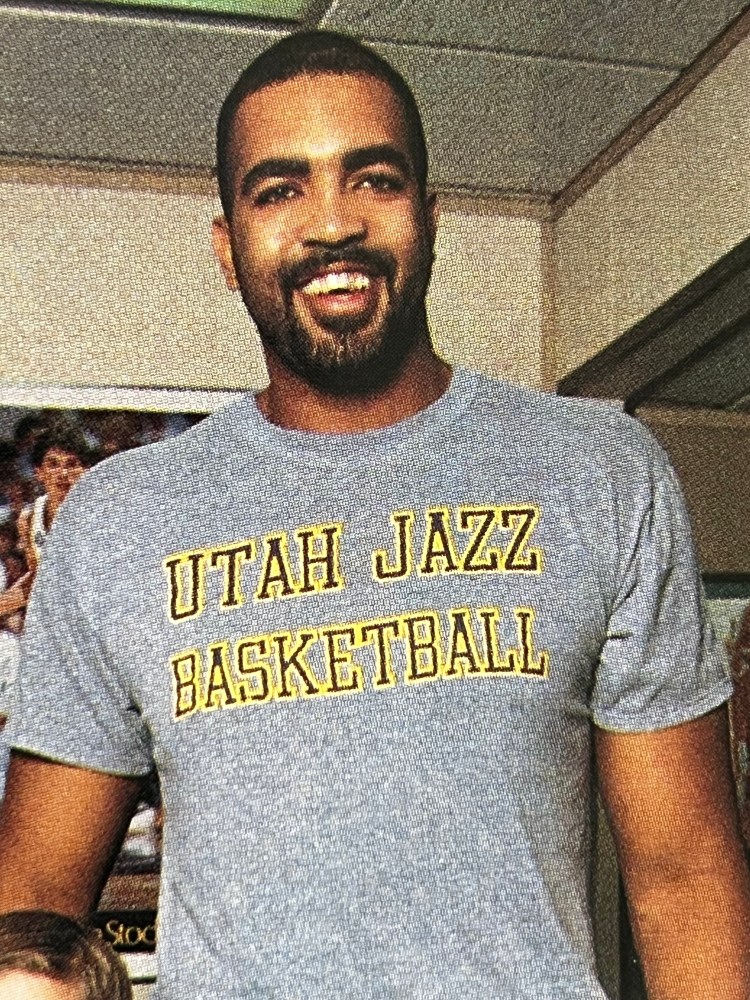
It’s game day. You’re planning to watch the Golden State Warriors play host to the Utah Jazz. You click on your official NBA customized scorecard, print it out, and by tip-off time you’ve got a scoring grid, team rosters, updated records and statistics, and player bios. And you were afraid moving to Spokane would take you out of the loop.
No way.
Feeling the urge to go interactive, you e-mail NBA Inside Stuff hosts Ahmad Rashad and Willow Bay: “What’s up with Utah’s Felton Spencer and his ruptured Achilles tendon? I thought he’d rehabbed it by now. The Jazz could have used him, but I doubt anyone could have stopped the Warriors’ Joe Smith.”
You are hooked up, you are hooked. Welcome to NBA.com, the league’s new Web site. For starters, the site offers Internet users the basics:
- Latest news and notes from around the league,
- Scores, standings, and league leaders,
- Complete game and broadcast schedules,
- Feature stories on the league’s hottest players and teams,
- Factoids, history, and trivia,
- An NBA team merchandise store.
And those are just the broad strokes. Each team has its own “home court,” with a steady stream of news, rosters, player biographies, and services such as a full-color arena seating chart and up-to-date ticket availability.
The NBA is the fourth of the major sports leagues to venture into the Internet, but no other sport can match these connections: NBA.com is generated by Seattle-based Starwave, a company founded in 1992 by Paul Allen, owner of the Portland Trail Blazers and cofounder of Microsoft.
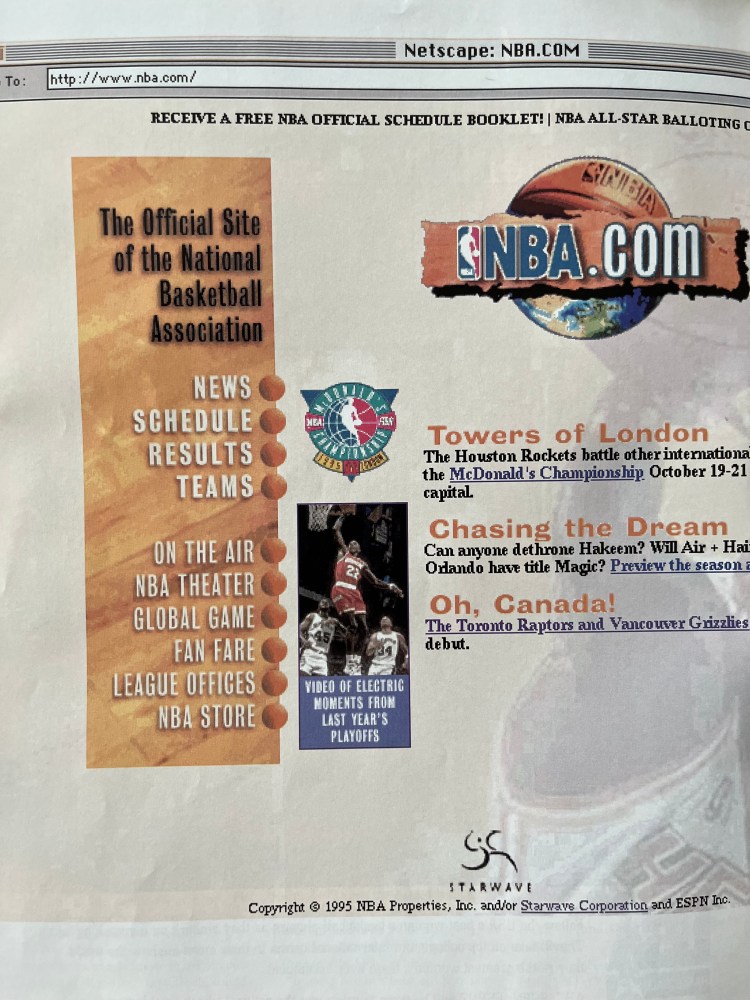
Add to that the background of NBA.com publisher Geoff Reiss, who came to Starwave two years ago when the company began publishing ESPNET SportsZone, a product Reiss reports is “the most successful Web site of its kind, in terms of subscriber usage, ad sales, whatever objective measure you could apply.”
“We’d been impressed with ESPNET and were confident that (Starwave) would do high quality work for the NBA,” said Jamie Rosenberg, manager of the NBA’s Interactive Programming.
“What’s cool about NBA.com is that it’s entertaining and interactive,” he says. “We’re going to be doing all-star balloting on the service and will have an NBA.com Player of the Month, in tandem with the official player of the month. And along with the on-line merchandise catalog, the Store on the Net, we’re looking at the possibility of selling tickets on-line.”
Rosenberg also is excited about plans for French and Spanish selections on the site, providing a home for international fans where they can receive weekly reports on the NBA as well as news from the Spanish, French, German, Italian, and Greek leagues.
Reiss says the NBA.com effort is divided into three threads. First, there is Starwave’s own team of editors and designers who generate the content and look of the Web site. Second, is the league itself—its public relations and creative services divisions, which already are geared up to produce its ocean for print and electronic media.
Completing the picture are the 29 NBA teams. In the beginning, Reiss says, “They’ll be participating at significantly varying levels. Some teams are putting tremendous amounts of resources, others are passive—for now. It’s just as you could go to 29 people in the street, and you’d have 29 levels of enthusiasm.”
Rosenberg isn’t worried. “With any new endeavor, and especially one that involves new technology, you’re going to find different levels of reaction,” he says. “We’ve tried our best to educate teams. We’ve sent them a lot of materials on the Internet and the site itself. We have sent them a very flexible system, where we can create their basic site.”
“Like some people, some NBA teams are just not as far along in the learning curve,” Reiss says. “To the uninitiated, NBA.com will be a daunting product. It is Starwave’s job to make it less intimidating. When (teams) see what kind of bond their fans have with this product, they will understand.”
Understand: The Warriors are in this thing big-time. Mike Nelson, the team’s media relations manager, says, “We’ve provided Starwave so much they may not be able to get everything up by the early part of the season.”
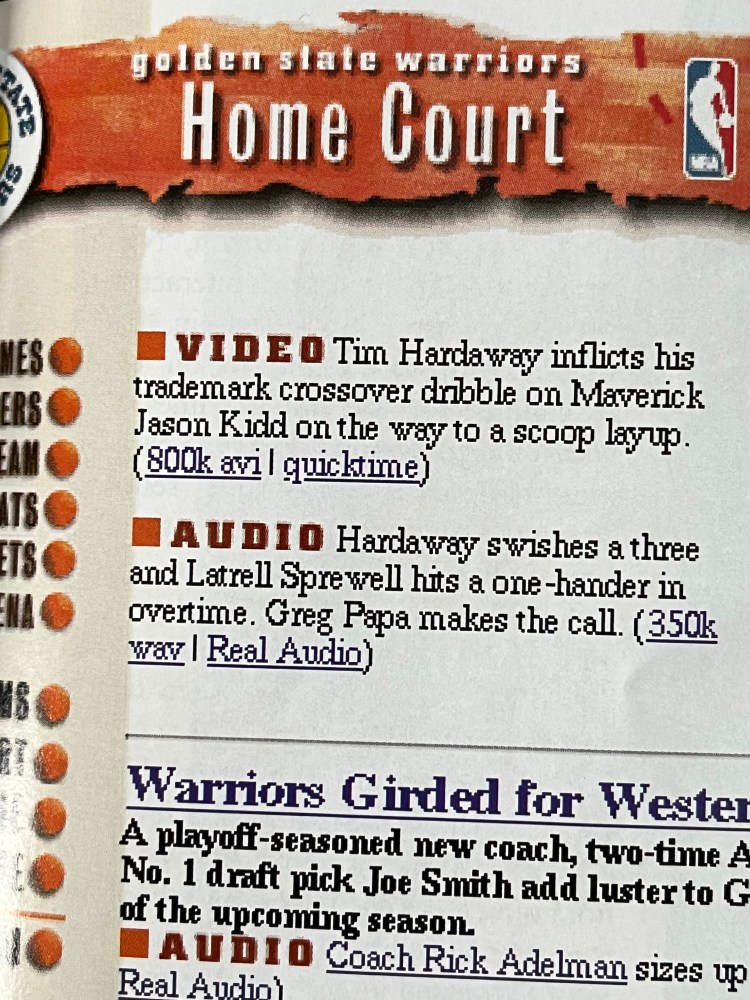
The Warriors are committed to updating their Web site on a daily basis, Nelson says, and in some cases it will be updated more than once during the day. There’s more information, pieces of trivia, fan facts than can fit in a newspaper—not to mention portions of [the Warriors’ own] Playbook Magazine that will appear on the site, as well as updated information on tickets.
Warriors fans will be able to listen to audio clips of coach Rick Adelman, hear updated highlights of announcer Greg Papa calling games, and see video plays of the week. As technology evolves and high-speed modem lines and cable systems are in place, with information moving at light speed, Nelson says, “It still hasn’t sunk in what we can do.”
Nelson also feels the Warriors’ local constituency is a perfect fit with NBA.com. In fact, discussions at the club level were underway a year ago. “Living in the high-tech capital of the world, we knew it was inevitable we’d be on the Web,” Nelson says. “We paid attention to what other sports teams in the Bay Area were doing, and we had seen they had ventured onto the Net.
“Although no one knows how big this form of communication is going to become, we felt it was obvious there was tremendous potential from a marketing and communications standpoint, not only to serve our fans in the immediate Bay Area, but to make contact with Warriors fans around the globe.”
In that respect, the eye-opener for Nelson came in October 1994, when the Warriors played in Paris and Barcelona. “I was impressed with how excited fans were to see the NBA in general and the Warriors specifically,” Nelson says. “Our staff and players were impressed with how much (European fans) knew and how much more they wanted to know. The league had done a lot to create interest over there and thirst for more information than newspapers, radio, and television can bring them.”
And Nelson’s imagination starts working overtime when he looks at the interactive possibilities from the media-relations standpoint. “We see the day when we’ll be able to have press conferences on the Internet, where a player can sit down at the keyboard and do interviews with reporters from Amsterdam to Zaire,” he says. “In the past, there have been only so many one-on-one interview requests you could accommodate. It could get messy putting together a conference call.”
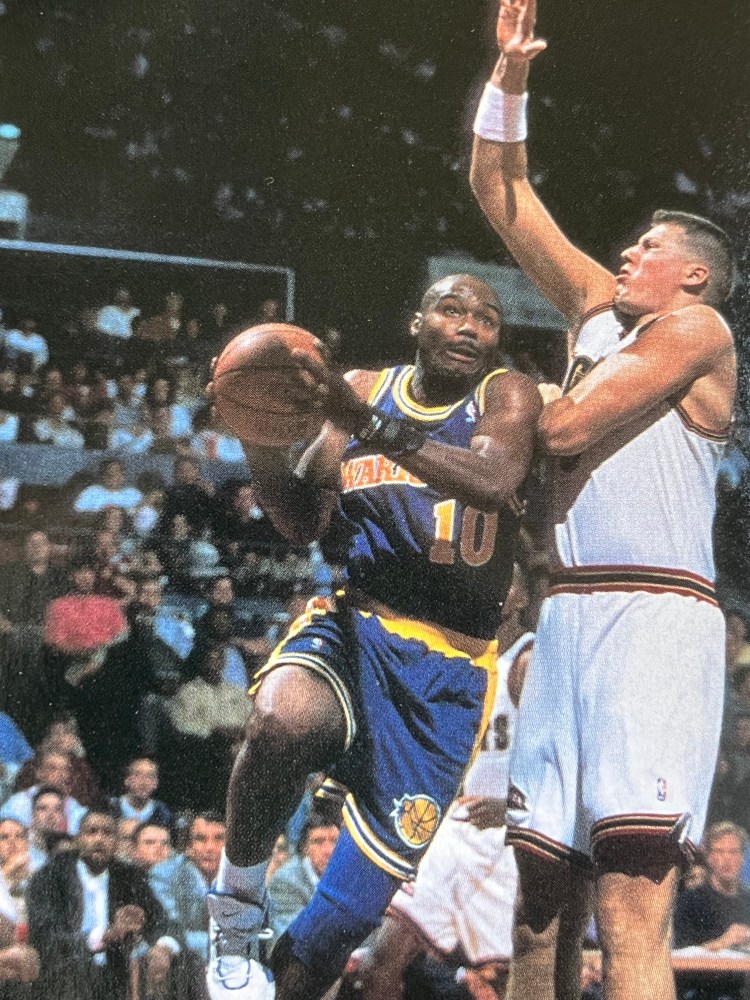
The Warriors’ Tim Hardaway made NBA history as the league’s first cyberspace visitor on November 6. Hardaway answered fans’ questions via an interactive chat room, drawing an impossible-to-answer-them-all 697 questions.
“That’s really exciting, because there’s no way Michael Jordan, Shaq (O’Neil), or Chris Mullin can answer all his fan mail,” says Nelson. “This first-hand relationship with players is going to be exciting for a lot of fans.”
On the short-term horizon, Nelson says, will be an attempt to interact with fans who are interested in being informed up-to-the-minute on ticket availability for individual games. The Warriors, going into the 1995-96 season, had 270 consecutive sellouts. Down the road, one way or another, the team will be playing in a larger arena, and the Warriors hope to develop an e-mail mailing list of fans who have said they’d like to be notified when tickets become available.
“For one reason or another,” Nelson says, “we have to hold back a few tickets for each game. If we know they are not going to be used, we could shoot out a mass-message to however many fans have expressed interest, saying there are 100 prime seats available.
“All of the teams in the league tend to copy good ideas,” says Nelson. “We’ve got 28 partners, a 500-person-plus league office in New York, and the resources of Paul Allen and Starwave.”
By the same token, the NBA enjoys the advantage of hooking up with Starwave’s built-in market research component. “More than 90,000 people a day are coming through ESPNET SportsZone,” Reiss says. “Compared to Prodigy and other large on-line services, that’s not a large number. But it’s more than all of Time Warner’s on-line magazines: People, Entertainment Weekly, Time, Life and Money.
[The editors at Playbook Magazine committed the ultimate lay-out blunder. They went to press missing the story’s final paragraph or two. The story just stops at the bottom of the page in mid-sentence. So, rather than do the same, I’ve end the story here, which is not a bad ending point. Let’s move on to the bonus content: Tim Hardaway’s history-making live online chat, November 6, 1995. The headline: Hardaway Goes to the Net]
Q: Where did you groom your basketball skills while you were growing up?—CHRIS FROM UCHICAGO.EDU
TIM: On the South Side of Chicago, over by South Shore High School. CVS, over there by the Lakefront.
Q: What is your prediction, besides the Warriors, for the NBA title?—DUWAYNE LOBLACK FROM CSTATEU.EDU
TIM: I’d say Houston is tough still. Indiana or Chicago or Orlando will come out of the East, but I think once Shaquille comes back, Orlando will have a good shot.
Q: How long did it take you to develop the famous killer crossover?—JAKE FROM YALE.EDU
TIM: It took me a couple of months. I developed it at UTEP just after practice one day, just working on the moves.
Q: Name the three toughest NBA players you’ve played against?—Allen V. FROM VIRGINIA.EDU
TIM: Michael Jordan, of course; Magic (Johnson) of course; and I’d have to say Charles Barkley.
Q: Did you start your freshman year in high school?—SERGIO FRANCIS FROM INTERRAMP.COM
TIM: Yes, I did—off and on.
Q: How hard is it to stay at peak performance year-round? Are you continually working out in the off-season or what?—MARK FROM UMR.EDU
TIM: It’s hard, very hard, to go out and maintain where you’re at, to take your skills to another level is very hard every year. I do work out during the off-season. I run about three miles a day and lift weights with my lower body.
Q: So, how do you think the Warriors will do this year?—VIDA BEARD FROM UIUC.EDU
TIM: We started out 0-2, but we still look good. We all have to work together, offensively and defensively. Hopefully, we’ll make it to the playoffs, not at the eighth or ninth spot, but at the sixth or fifth spot and go from there.
Q: Besides Oakland, what is your favorite arena to play in?—JOE BENTHAM FROM OREGONCOAST.COM
TIM: Chicago, Dallas, Houston, but I think the one I like most of all is a tossup between Orlando and Charlotte, because they have the best crowds right now.
Q: How tough is Jason Kidd? Or have you taught him a thing or two on the court?—JAKE FROM YALE.EDU
TIM: Every time I go out on the court, I try to teach the other guard a thing or two about me. Jason is a good player. You have to stay in front of him. You can’t let him beat you on the transition. You have to try and contain him. If he has his shot going that night, you can bet it’s going to be a long night for you. But if he doesn’t have his shot, then you can try to contain him.
Q: What up Skillz? Quick question. How much has your knee injury affected your game? Does it affect your crossover?—E-RIDE FROM HSC.EDU
TIM: Last year, it affected it a lot, because I couldn’t do it. This year, my knee feels back to its old self. I feel the burst of quickness now. I feel when I come down the court, I can do what I used to do two or three years ago. The crossover is back.
 From Way Downtown