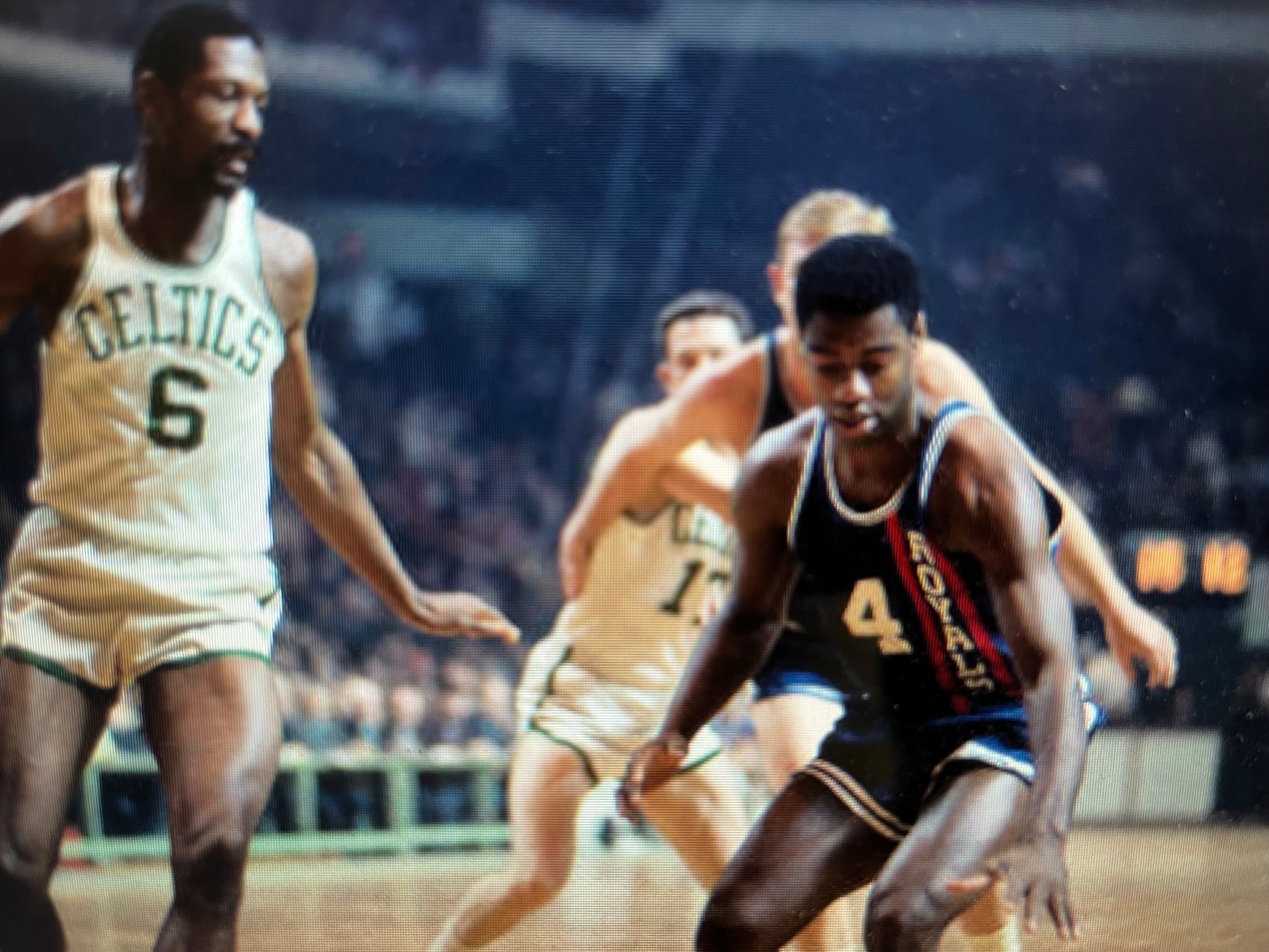
[Oscar Robertson wasn’t always on the best of the terms with the local news guys while he played for the Cincinnati Royals. Or, better stated, there were some local reporters whom he didn’t respect—and probably vice versa. Barry McDermott of the Cincinnati Enquirer was one of those vice versas. Robertson obviously had his reasons, including an insensitive, race-baited story filed by McDermott that was later singled out in his autobiography, The Big O.
But McDermott wasn’t a bad reporter. He covered the Royals for several years, knew the league inside and out, and had access to many an NBA player and coach. That’s why I’m posting this article, published in Sports All Stars 1971 Pro Basketball magazine. McDermott may not have nailed down all of the details—and twisted a few—but his “real story” in sum is still worth reading all these years later for one man’s opinion of the oil-and-vinegar relationship between Robertson and his new coach Bob Cousy and the botched trade that nearly sent the Big O to Baltimore in 1970. Most of this story originally ran in the Enquirer as an opinion piece.]

Confusion and mystery, which is nothing alien to him, surrounded Oscar Robertson during his first days with the Cincinnati Royals.
Robertson’s route to the Milwaukee Bucks was a circuitous one, filled with talk flavored with inuendo and bitterness.
It all began late in January, a few days before the National Basketball Association trade deadline. It was a tough weekend for Oscar. First, the Royals broke his heart, then Pete Maravich broke his college scoring record. First, it was money, then pride.
The Royals tried to trade Robertson to Baltimore—but Oscar had a veto clause in his contract, which gave him the right to make the final decision on any trade involving him. It was an insignificant clause when it was negotiated three years before. But those were other times.
Now, Bob Cousy was the coach, and Robertson had been given his chance to do what Cousy felt was necessary. Like the hidden tug of a tide, Robertson resisted, and Cousy reacted.
It was not this way in the beginning, before the breakup of the shotgun marriage between the much-publicized pair. At the press conference when Cousy was announced as coach of the Royals last spring, Bob’s wife, Missy, walked up to Oscar and said, “I hope we can win.”
“I think we will,” Robertson answered.
Cousy’s first act as a coach was to sit down with Robertson and Jerry Lucas and emphasize the contribution they could make to the team. He also talked about the need to heal past differences. Letting bygones be bygones is important.
During training camp, Cousy went so far as to ask newspapermen to write nothing that might upset Oscar, to overemphasize his help to the team. He was trying to reach the man they call the. “Big O,” trying to change his attitude, but it turned into a futile effort.
For years, Oscar privately scorned the Royals’ management; he ridiculed Cincinnati and its fans; he knocked other players, both on his team and others; he was never willing to pay a compliment. He is, has been, and probably will grow old, a bitter man, convinced it’s all a plot.
Eventually, the rest of the team grew tired of racing downcourt, only to see Oscar dribbling, cleverly refusing to turn the ball loose. Oscar would not change—and if he did not, the Royals would never be a running team.

The reports of a feud between Oscar and Cousy began to filter out. Cousy denied the reports. Oscar side-stepped them, following the theme he had taken with the reports of disharmony between he and Lucas. He would not deny or confirm, thereby letting speculation fester. There was no feud, but Oscar refused to say that, and the story grew.
Finally, in January, what had been fiction started to become fact. Bob Cousy knew he had failed with Robertson. He was the only player on the team that he could not reach, the only player who refused to submit to his will.
It killed Cousy to look onto the floor and see Connie Dierking, a 33-year-old ballplayer, giving 100 percent, playing with a broken hand and a broken nose. He watched Johnny Green, a 36-year-old and an NBA discard, playing with determination, relentlessly racing up and down the court.
He saw Tom Van Arsdale, playing on a wrecked knee, a knee that some doctors said should be operated on immediately. There was Norm Van Lier, a scrawny, gutty rookie with scarred knees, wrenched, horribly swollen elbows, and a bruised body.
And he looked at Oscar Robertson and saw a man who played 10 years without a floor burn. You can just bet Cousy was burning.
Cousy’s patience came to an end midway in the season after the team won seven of eight games to pull even with the .500 mark. Then, they lost games against Milwaukee and Phoenix. Oscar played lackadaisically in both losses, following his mood of recent years when he would unaccountably take it easy for a few games. Afterwards, sitting in his motel room, following the Phoenix loss, Cousy muttered, “If he thinks he can call my bluff, he’s mistaken.”
The losses kept mounting, and after the sixth-straight defeat, a New York newspaperman [Milton Gross of New York Post] interviewed Robertson in Philadelphia. The resulting story carried the headline: “Impossible Situation, Cousy’s Methods Confuse Oscar.”
“I don’t like it,” Oscar was quoted. “But Bob’s trying to create unselfish play.” Earlier in the story, he said, “I’d be foolish to think the possibility of me being traded wouldn’t come up . . . I don’t want to be traded, but it happens, it’s something I would have to live with.”

And when the Royals told him that they had traded him to Baltimore for Gus Johnson, Robertson exercised his option and vetoed the deal. But it wasn’t out of loyalty to Cincinnati. It was because he felt Baltimore would not come up with his $700,000 asking price. Spread out over three years, that figures out to $2,845 a game—or figuring his career average of 40 minutes a game, the sum of $4,268 and 83 cents per hour of playing basketball.
Then the deals started.
Oscar and his attorney began calling clubs, both in the NBA and the American Basketball Association. The Royals were on the phone also.
Meanwhile, the season continued, although Robertson developed a “groin injury.” Oscar played almost the entire game on a Wednesday, was told on Thursday (an off-day when the team did not even practice) that he was to be traded and reported next day that he had a groin injury.
He stayed out a couple of games, then indicated that he wanted to come back. Cousy ruefully told him to take a couple of weeks off to let the injury fully heal, and Oscar played only the last 14 games of the year.
Finally, the thing narrowed down to Milwaukee, Phoenix, and, ironically, Baltimore. Now that he realized the Royals were determined to deal, Oscar was willing to approach the Bullets more realistically in regard to money.
All parties were reasonably satisfied when the Bucks swapped untried Charlie Paulk, a 6-feet-8 forward, and Flynn Robinson, a good shooting guard, in exchange for Robertson. “The Royals never asked me if I was interested in staying or what I would want if I did,” Oscar complained at the time of the trade. “The coach, Bob Cousy, told me in midseason I was going to be traded because there weren’t going to be any raises for any ballplayer on the whole club and, therefore, he felt I would have to go.
“He never asked me if I wanted a raise. He just said he thought I was going to ask for one, a big one, and they were going to meet the situation in advance by trading me. I never intended to ask for what he suggested I would, and when he popped this on me, I kept my mouth shut.”
“I would think he would be happy,” Cousy said. “He has always said he wanted to be with a winner, and that you need a big man to win. Now, he has Lew Alcindor, the best big man in the game. Plus, he has his money.”
Money and big men. These are the things woven into Robertson’s career, a career of disappointment with the Royals.
He was a perpetual hold-out with Cincinnati. Partly because of this, he talked to Indianapolis of the ABA in 1967. He was turned down, but the Royals were alerted and tried to deal him to New York for Willis Reed. It is interesting to speculate on where the Royals and Knicks might be today if the deal had gone through. [BlogNote: Indiana didn’t turn down Robertson. He rejected Indiana when its GM inexplicably sent him a lowball contract offer.]
In the fall of 1967, Oscar was a holdout when news leaked of the attempted trade. “Naturally, I’d like to stay here,” he commented. “But, if not, it’s like any other business.”
Some fans criticized the Royals for trading the “Big O.” They said the city owed him something. It made others wonder. Did people move to Cincinnati because of Oscar Robertson? Did industry locate there because of him? The University of Cincinnati owed him something, but it did not pay his salary. The Royals did.
The thing about the big man was another issue. People said Oscar could not be faulted for the Royals’ losses, since the team did not have a big man, a man like Bill Russell, formerly of the Boston Celtics. Boston did not have a losing season or miss the playoffs in the six years before Russell and Tom Heinsohn joined as rookies in 1956. Boston won the world championship that year.
The next year, the Celtics lost to St. Louis in the playoffs, despite the addition of Sam Jones. But Boston was unbeatable after that, adding K.C. Jones, Tom Sanders, and John Havlicek among others to the team.
The Royals had five winning seasons in 10 years with Oscar. They won four playoff games in the last six years. They lasted past the first round of the playoffs only twice, 1963 and again in 1964. They were losers.
Even with Russell, Boston did not win the regular-season title his last five years, but it won in the playoffs. The Celtics were winners; they played with injuries; they had no holdouts; and they had no stars, but they refused to lose.
A big man for the Royals was not the answer, and Bob Cousy knew that he could not win with individuals. “I’ve never knocked the town,” Oscar said defiantly when he was traded. “The fans were driven away. The Royals never made a draft choice that helped the team. Only two of their No. 1 draft choices remained around for a while, me and Lucas.”
“I believe I’ll fit into Milwaukee’s plans real well. I think I can help them.”
And then Oscar Robertson walked out; for all purposes out of Cincinnati and to a new town, where finally he may find fulfillment, something alien to him before.
[And, of course, Robertson, Alcindor, and the Bucks found their fulfillment. They won the NBA title in 1971.]
 From Way Downtown