
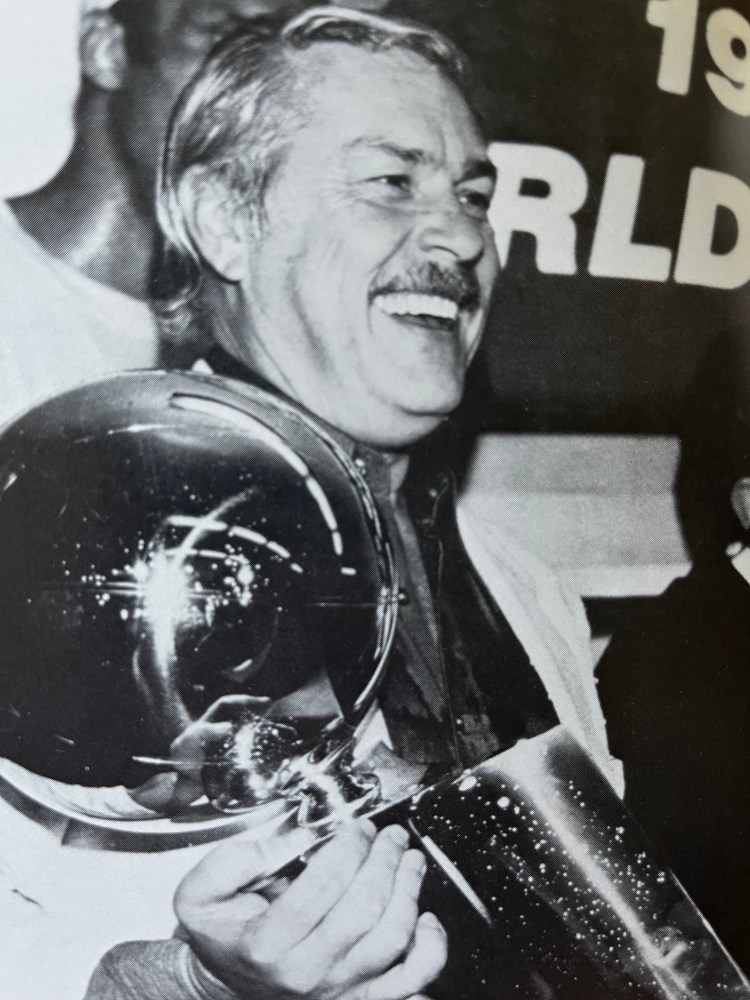
[Entering the 1980-81 season, the Los Angeles Lakers were the NBA’s defending champions and, like all upper-tier teams, ready to repeat. They didn’t, going down in the first round of the playoffs to the upstart Houston Rockets. But Magic Johnson’s star continued to rise, and Laker owner Jerry Buss rewarded him with a then-shocking $25 million payday. All that money later prompted this classic headline : Blunder Buss Takes Shine Off Johnson Magic.
Yes, as now satirized on HBO’s Winning Times, the Lakers were about to become one, big unhappy family. Or, Johnson said, “The game is no longer fun. I not been happy all season. And, there were some very public blowups like this one:
This past week, it happened. During a game in Utah, Magic’s coach told him twice during timeouts to shut up and listen . . . When the game was over, Magic announced that he wanted to be traded from the Lakers. Under questioning, Magic admitted he probably would relent and remain with the Lakers if the coach, Paul Westhead, were fired.
But in the article below, published in the magazine All-Star Sports 1980-81 Basketball Issue, Magic, Kareem, and the Lakers still are mostly one, big happy family after winning the NBA championship. Magic remains all smiles, and he and Westhead remain civil. More important, Magic has developed a good rapport with the introspective, All-Everything veteran Kareem Abdul-Jabbar. And in this article, from writer Emmett Farrell, there’s still no stopping the Jabbar-Johnson magic in 1980-81. Note, the article is a little repetitive in places; but, for me, the Norm Nixon quotes are worth the read.]
****
When Kareem Abdul-Jabbar tossed in one of his skyhooks at the buzzer to give the Los Angeles Lakers an opening game victory over the San Diego Clippers last season, rookie Earvin (Magic) Johnson rushed to the big center and gave him a huge bear hug. The show the motion was quite unusual for the Lakers, a dullish club in past seasons whose vendors should have a been equipped with No-Doz pills.
Abdul-Jabbar, entering his 11th NBA season, was somewhat taken aback by Magic’s enthusiastic response for the first triumph of an 82-game schedule. A standoffish-type, the 7-feet-2 Laker center sheepishly hugged Johnson.
“Gee,” said one of the Clippers, “you’d think they just won the championship.”
That was to come later.
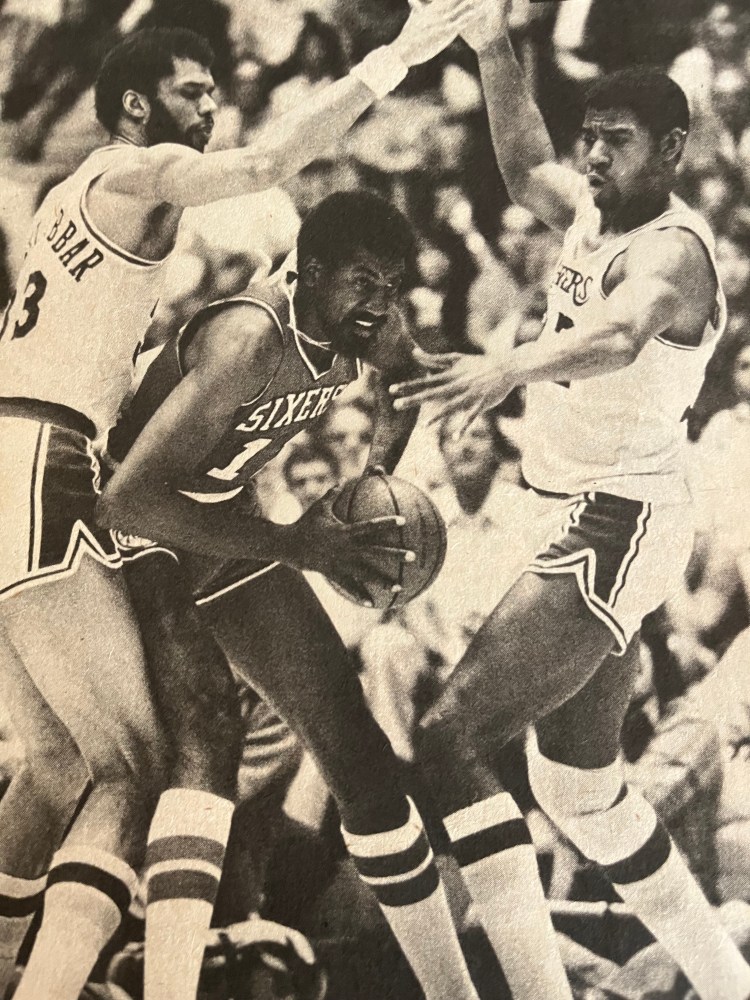
Despite making Johnson their No. 1 draft choice for the 1979-80 season, the Lakers weren’t that high on the Michigan State All-American. They figured it would take time for him to adjust. After all, he had played only his freshman and sophomore years at Michigan State before turning pro. Granted, they shelled out a $600,000, two-year contract, but that was the going rate in these inflated times for first-round picks.
Magic captured the nation with his effervescent personality, flashy smile, and dazzling ability which allowed the Spartans to the NCAA title. Yet, the scouting reports on the 6-feet-8 ½, 215-pound Johnson questioned his shooting, running, and jumping ability, which were rated fair to poor despite his All-American credentials.
Critics said the demanding NBA schedule would take the magic out of Johnson, and that the blasé attitude of the pros in general—and the Lakers in particular—would wipe the smile off Johnson’s face. But his smile lit up everybody. He became the Magic Man in the NBA, too. He is the best thing to happen in the league in years.
There were fears that Johnson would clash with Abdul-Jabbar, the introspective center who had won the league MVP award five times. Magic has done much more than was expected. Even Abdul-Jabbar came out of his shell and enjoyed perhaps his best season ever. “Magic had been the key to the team,” Abdul-Jabbar said in midseason after Johnson became the first rookie named to a starting birth on an All-Star team in 12 years. “We’re all playing off Magic on offense. The pass starts the break, and break is what has made the wins possible this year.”
Utilized as a point guard despite having the body of a power forward, Magic is a pleasure to behold. Watch him on the break. He lopes downcourt with huge strides, glances left, and suddenly whips a pass to a teammate on his right. His teammates learned to keep their eyes open at all times.
When you think of his nickname, “Magic,” you think of Bojangles and all sorts of fancy stuff. But he’s as much a bread-and-butter guard as he is a passer. He’ll take the ball down the lane in traffic, and he’ll also rebound. That’s why he is so respected by his teammates. He gets down in the trenches, but he also can make the Bob Cousy pass.
Johnson’s magic even rubbed off on Kareem and the normally passive Laker fans. The reasons for Abdul-Jabbar’s rejuvenation could have been a combination of a new owner (Jerry Buss), new coaches, new personnel, and a big, new contract worth $1 million per year. But the main reason was the presence of Johnson, a mere 20-year-old.
The 33-year-old Kareem gives much credit to Magic. “He makes my job a lot easier. When he has the ball, people pay attention to him. I had no idea how well he’d work out with everybody. I’ve seen a lot of young kids with potential come into this league, and they’re not around anymore. Magic is a unique talent.”
But the season wasn’t all peaches and cream for the Magic Man. He suffered a sprained knee, swollen testicles (from an accidental kick), a pulled leg muscle, and three stitches in the head from an errant elbow.
He also had some poor games and showed deficiencies on defense. And then, there was the problem concerning Norm Nixon, who had established himself as the Lakers point guard in the previous two seasons.
“The year I had last year (1978-79),” recalled Nixon during the playoffs, “I felt that I had been so effective that Magic—being a rookie and all—naturally should have been the one who had to adjust. I had been running the team for two years and thought I had played well enough to establish that I was the point guard. For them to take the ball away from me, I thought they were crazy.”
Nixon had tied the NBA record for steals in 1978-79 with 202, collected 737 assists (10 fewer than Jerry West’s club record), and had the best field-goal percentage of any guard in the league (54.2), while averaging 17.1 points. Nixon was rewarded with a new contract, plus a new Mercedes Benz from Buss.
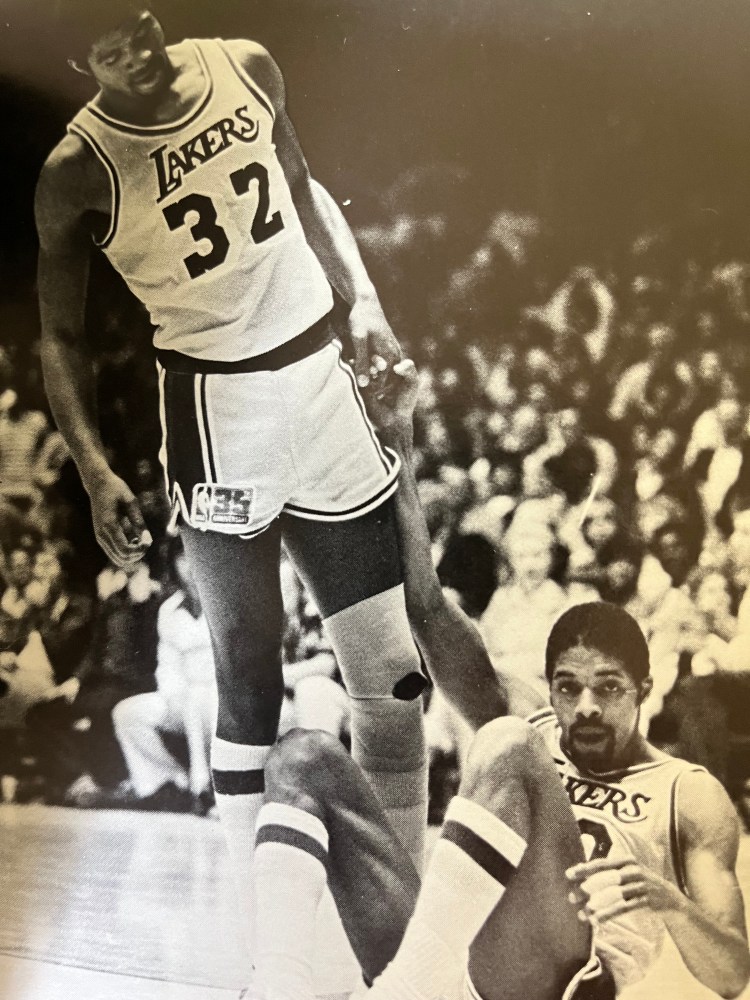
But when Magic showed up in training camp, complete with smile, adoring fans and a never-ending procession of media, coach Jack McKinney (later to be injured in a bicycle mishap and pushed aside for Paul Westhead) told Nixon that Johnson would be the point guard.
“There were points early in the season when I was really angry,” Nixon said. “There was some logic in making me the off-guard because I was a better shooter, but we hadn’t learned to share the ball and complement each other.
“When we would blow out the weaker teams, a lot of times I would be running up and down the court for 42 minutes, hardly seeing the ball. It wasn’t anything selfish on Magic’s part. It was just we were so strong that we played like I wasn’t needed.
“When we did try and work together, it was like bumping heads. Then, when we were faced with a [top] team like Seattle, I was needed. All of a sudden, it was as if Nixon doesn’t play, well, we don’t win.
“But, in the meantime, I was losing my feel for the ball, my shooting, and my passing touch. I like to win tough games, but, hey, I wanted a piece of those blowouts, too. All I was looking for was to feel totally involved.”
(Contrary to Nixon’s feelings, the former Duquesne star led the league in minutes, played (39.4), paced the team in assists (642 to Johnson’s 563), and averaged 17 points per game.)
Nixon added, “Magic and I create in totally different ways. He has his height and passing ability, and I have my passing and ability to blow by people. We know when to go to each other’s strength. And both of us know that Michael Cooper comes in and creates with his defense and speed. Above and beyond that, we’re smart players.”
Johnson said there were minor problems working with Nixon at the outset and added, “We felt each other out and learned to work well together.” As for Kareem, Magic said, “I love playing with him because he does everything. I get fired up when I make a nice pass and see him dunk it. Jabbar is the man, the best . . . the best passer, the best shooter, the best rebounder. Look at how smooth and agile he is. He’s always good. And when he’s rolling, he’s got to be the best.”
Last season found Abdul-Jabbar dribbling to the basket for electrifying slam dunks. He even dove for loose balls. Statistically, it wasn’t Kareem’s best season. In fact, his 25-point scoring average was the second lowest of his career, three points below his 28.6 career mark. He did shoot a career high 60 percent from the field, led the league in blocked shots, and was the No. 2 center in assists. However, his rebounding total dropped below 1,000 for only the third time in his career.
“Kareem has never played better,” said Bill Sharman, the team’s general manager who coached the Lakers’ previous NBA championship team in 1971-72. “And Magic is the only one who makes me think of Bob Cousy.”
Westhead said, “Magic and the Lakers were a perfect marriage. The team needed a lift, a little pizzazz, and he gave us that. He is like that aftershave—you know, the cold slap in the face. But in a basketball sense, his game blended perfectly with our personnel. He is a great passer, and we have guys like Kareem and Jamaal Wilkes who only need a half-step to score.
“With Magic running our offense, the guys hustle that much harder. They know if they get open, he’ll get them the ball. You can see the effect it’s had on Kareem. It’s entirely positive.
“People wondered how Kareem would handle it with Magic coming in and getting the spotlight. Well, if you know Kareem, you know he doesn’t enjoy the spotlight. He’s happy to have somebody here to take some of the pressure off him. This past season, he just concentrated on playing basketball.”
Magic lived up to his preseason billing by averaging 18 points per game and shooting 53 percent from the field during the regular season. (As a collegian, he shot only 43 percent.) He also averaged 7.7 rebounds per game, the top rebounding average for a guard in the league last season. However, it should be pointed out that the versatile Johnson was also used at forward.
“He’s the NBA’s only combination point guard-power forward,” said Westhead, who took over the team on an interim basis but found himself with a fat, new contract after the Lakers won the title.
Pat Riley, Westhead’s assistant, said of Magic, “Everyone thinks he’s up there riding on the wagon, throwing roses to everyone. But I’ll tell you what. When the game is on the line, he’s in the action. He’s not really a guard or a forward. He is what you would just call a player, a complete player.”
“I don’t think there’s ever been anyone quite like him,” said Sharman.
Only three Lakers—Abdul-Jabbar, Nixon, and Wilkes—returned last season from the previous year’s squad. In addition to Johnson and Michael Cooper, Jim Chones and Spencer Haywood, (subsequently suspended in the final playoffs) at power forward formed the nucleus of the Lakers, who compiled a 37-4 record at the LA Forum during the regular campaign.
They won the Pacific Division title, then beat Phoenix and defending-champion Seattle to gain the championship round against the Philadelphia 76ers, led by Julius Erving and Darryl Dawkins. The Lakers were made the underdogs.
In the series opener, Kareem collected 33 points, 14 rebounds, and blocked six shots in leading the Lakers to a 109-102 triumph. Dawkins, the 76ers’ man-child inside, tried to contain Abdul-Jabbar. He got into early foul trouble and fouled out after only 18 minutes of action.
The 76ers evened the series with a 107-104 win, despite 38 points by Abdul-Jabbar. The Lakers reduced a 23-point deficit to one point twice in the last three minutes. Los Angeles bounced back in Game Three with a 111–101 victory, as Kareem scored 33 points and Magic scored all of his 16 points (he also had 11 rebounds) in the second half. “Even though I didn’t score a point in the first half,” said Johnson, “I enjoyed every minute of it. I did all I could out there, getting the ball to the shooters. That was all I needed to do.”
The 76ers bounced back again to take the fourth game, 105-102, as the Lakers missed a couple of last-second shots. Johnson took command with 28 points, while Kareem collected 23. Philadelphia’s Bobby Jones was impressed by Magic saying, “Magic goes to the hoop as well as George Gervin. It must be nice for a guy that tall to control his body like that. And he learns fast. He reacts to the pressure and starts hollering around. He can move.”
With a little more than four minutes to play in the third quarter of Game Five, with the score tied at 65-65, Kareem tossed in a shot. But when Kareem came down, he bumped into the 76ers’ Lionel Hollins. “I told Kareem to hustle back if he could,” Johnson said. “He didn’t say much, but he was groaning a little.”
The Lakers center was hobbling on his left ankle, but he played as long as it took Wilkes and Philadelphia’s Caldwell Jones to exchange baskets. Kareem was taken to the trainer’s room, where the ankle was taped. Meantime, the Lakers carried on without him. “Kareem’s injury made us play harder and help each other out a bit more,” said Magic. “With Kareem out, we had to run a bit more.”
It was time for the Magic Show. Johnson, dribbled, faked, wheeled, dealed. By the end of the third period, the Lakers were in front, 81-73. The Forum crowd went wild, but the response was even louder when Kareem walked back onto the court for the final period.
With a little more than five minutes left in the game, Philly’s Dr. J put on a show of his own. He scored 13 of the 76ers last 17 points, the last two free throws tied the score at 103 with 43 seconds remaining. Magic now had the ball at the top of the key and lofted a pass to Kareem, who converted it into a stuff shot. The 7-feet-2 Laker, fouled in the process by Erving, made both shots for a 106-103 advantage with 33 seconds left.
Dr. J tried to drive around Abdul-Jabbar, but he couldn’t and tried to cup the ball and lay it in. The ball rolled off the rim into the hands of Kareem. Nixon later added two free throws for a 108-103 win.
“Kareem was our Mr. Everything,” said Johnson. “He’s Mr. Offense, Mr. Defense. You’ve got to go to the man when you’ve got to get it. Kareem is our money man, and Dr. J is theirs. Our man just had a little more.”
Kareem had 40 points, 14 in the fourth quarter, while Erving had 36 points, 16 in the fourth. X-rays showed no break in Kareem’s ankle. It was diagnosed as a sprain and was to be re-examined the next day in Philadelphia to determine the big guy’s status for Game Six.
But Kareem never left Los Angeles. He wound up watching the game on TV, his left leg propped up on a table, as his teammates, battled the 76ers. In addition to the loss of Kareem, the Lakers didn’t have Haywood, suspended after Game Two for “activities disruptive to the team.”
When the Lakers boarded the plane for the flight to Philadelphia, Magic sat in the front row, left aisle—the seat usually occupied by Abdul-Jabbar. Magic looked back at Westhead and said, “Guess you have a new Big Fella, Coach.”
How right he was. Westhead played Magic at center that Friday night. The 76ers pulled to within 103-101 with 5:44 left. Johnson tipped in a miss by Wilkes. Chones blocked a shot. Wilkes, who finished with 37 points, scored on a three-point play.
Maurice Cheeks scored for Philly, but Nixon stole a pass from Erving and fed Johnson. Magic muscled over Dr. J for a three-point play that gave the Lakers a 111-103 lead. Johnson then added a stuff shot.
The Lakers went on to win, 123-107, and take the NBA title. Johnson had 42 points, 15 rebounds, and seven assists. Magic said: “The only thing I can say right now is hello to Kareem. We send our love out to him. Get up and dance, Big Fella. I know your ankle can’t hurt that bad. Dance the night away.”
Caldwell Jones, the 76ers center, said of Magic, “What’s his real first name? Earvin? I don’t know. Honest. Magic is a better name. Either that or Houdini.”
When Johnson came to New York to receive his MVP award for the championship series, he said, “It should’ve gone to the Big Fella.”
Westhead recalled, “My mind immediately goes back to our opening game of the season when we won at the buzzer. Magic ran to Kareem and lifted Kareem off the floor. When we beat Seattle (in the Western final), it was Kareem who ran to Magic and lifted Magic off the floor. There is something special between them.”
 From Way Downtown