
[Here’s another look back at the Boston Celtics, the greatest sport dynasty in the world. This article is pretty good for its numbers and sourcing, and it comes from a reporter named Vic Horton, whom I know nothing about. Horton’s story ran in the magazine Popular Basketball/Special Playoff Edition, 1976. Bottom line: If you like the Celtics, you’ll enjoy this article.]
****
Early in the 1974-75 season, the Los Angeles Lakers flew into Boston for a game against the Celtics. As is his custom, Lakers coach Bill Sharman, an all-star Celtic guard during his playing days, had his team go through a light pregame warm-up that included calisthenics.
As the Lakers did sit ups, Sharman noticed second-year forward Kermit Washington lying motionless on his back, staring at the 9-feet by 15-feet championship flags strung in a row along the Boston Garden ceiling. On one end was one flag that read: Boston Celtics: World Champions, 1957. Next to it was one ending with 1959, and next to that were 1960, 1961, 1962, 1963, 1964, 1965, 1966, 1968, 1969, and, finally, 1974.
Sharman approached Washington and asked, “Something wrong?”
“Uh-huh,” replied the young Laker, his eyes still riveted to the ceiling. “I just never realized how many timesthey did it.”
Eleven world championships in 13 years. The only dynasties in the history of major professional team sports to rival—not equal—the Celtics’ fabulous reign were the 10 World Series won by the New York Yankees in a 17-year span between 1947 and 1963, and the 12 Stanley Cups captured by the Montréal Canadiens in a 21-year span between 1952 and 1973.
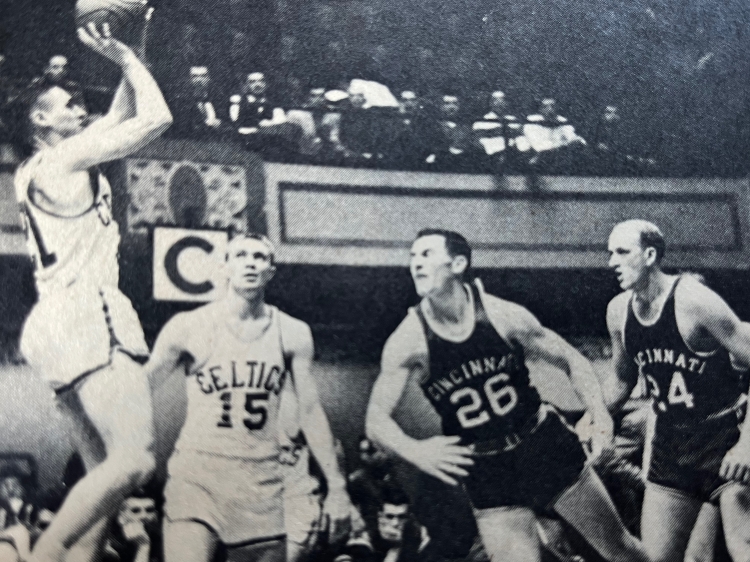
Numbers are usually boring, but not in the case of the championship Celtics. In those 13 years in which they dominated the NBA, the Celtics won 716 regular-season games and lost 299, a winning percentage of .705. Their record in playoff competition against their top opponents was 108-59, a winning percentage of .646. The pros themselves will tell you the hardest thing in sports is not winning, but staying on top once you’ve won. The Celtics obviously had tremendous staying power.
Why? What were the Celtics doing other teams were not? Obviously, they had great ballplayers, headed by perhaps the greatest winning force in the game’s history, 6-feet-9 center Bill Russell. In general manager and head coach Red Auerbach, they had one of the shrewdest judges of talent the game has ever produced, a deft psychologist with a knack of getting more out of a player than even he knew he was capable of, a fiery, inspirational leader, and a peerless tactician. Finally, at the top of the pyramid was owner Walter Brown, a beloved father figure whose warmth and beneficence, proved the perfect counterweight to the acerbity of Auerbach.
In short, the Celtic organization was solid from top to bottom. Players, coach, and owner somehow defied natural law and produced a sum greater than its parts. The Celtics enjoyed a special togetherness, a belief in the concept of the team that bordered on the religious and created a powerful mystique over the years felt by Celtic and foe alike. It was as hard to define as it was to defeat, though lots of people tried to do both.
“When you talk about the Celtics’ tradition, it’s more than just a matter of winning,” Auerbach once said. “We didn’t just play the best. We also wanted to look the best, dress the best, act the best. It was a certain championship feeling . . . The Celtics aren’t a team. They’re a way of life.”
Corny?
“Maybe,” said Tom Sanders, a Celtic forward and valuable defensive specialist (1960-1973). “But it’s quite true. The things other people laughed at, the Celtics believed in.”
In a victory celebration after the Yankees had won one of their many baseball world championships, manager Casey Stengel was moved to say, “I couldn’t have done it without my players.” Auerbach couldn’t have either, and it is no coincidence that the Celtic dynasty began the year that Bill Russell joined the club from the University of San Francisco and ended the year he retired.
Easy Ed Macauley, an outstanding offensive center for the Celtics (1950 – 1956), had been traded in the spring of 1956 to the St. Louis Hawks for the draft rights to Russell. Macauley was playing forward for the Hawks, with seven-foot center Charlie Share in the pivot, when Russell, fresh from leading the United States to a gold medal at the Olympic games in Melbourne, Australia, made his pro debut. He will never forget it.
“I drove off a pick and stopped just inside the top of the circle for an easy 18 or 19-foot jumper,” Macauley recalls. “Now there was no reason for Russell to be anywhere near me. He was someplace else guarding Share. So, I went up for the shot, and there was no problem. Except that Russell came out of nowhere and slapped the ball directly over my head. My momentum carried me towards the basket, but I was still in the air. And so was he. I landed and turned around just in time to see him take one step and stuff the ball into the Boston basket with both hands! I still don’t know how he did that.
“Understand, I was a shooter,” Macauley explains. “Carl Braun was a shooter. George Yardley was a shooter. Neil Johnston was a shooter. That was our main function. Shoot the ball. But to be a great shooter, you must be able to concentrate. When you go up in the air, there’s only one thing on your mind: the hoop.
“Now this is where Russell came in. Certainly, you had to concentrate on two things: the hoop, of course, and also where is he? And the thought distracted you as you went up. The result was, Russell stopped many shots that he never laid a hand on. Instead of immediately going up with a shot, you are inclined to stop a split second just to see where he was, and then continue with your shot. But in a split second, some other Celtic was able to catch up with you. That was Russell’s biggest asset, the element of distraction.
“There can be no doubt that he was the key to all those championships,” Macauley says. “The success of those great teams was built around him. Heinsohn, Cousy, Sharman, the Joneses, and all the others were great, great ballplayers. But if you had taken any one of them away, the team still could have accomplished everything it did, even though it would have been more difficult. But not if you would take away Russell. Then it would have been impossible.”
En route to being named MVP a record five times and an all-star 11 times, Russell averaged 22.5 rebounds and 15.1 points per game. But it was his unprecedented, intimidating, shot-blocking defense, and uncanny ability to play at his best when it counted most that was the heart of the championship Celtics.

Bob Cousy, perhaps history’s greatest playmaking guard, had been an all-star for five seasons with no championships to show for it when Russell joined the team. His backcourt mate for five of those also-ran years was the fiercely competitive Sharman, five times an all-star, one of the game’s great pure shooters (17.8-point career average) and the best free-throw shooter in NBA history (88.3 career percentage).
That first championship meant a helluva lot more to the veteran Boston guards than it did to Russell. The latter had just led San Francisco to two consecutive NCAA titles before heading the victorious Olympic team and thus knew of nothing but winning championships when he joined the Celtics.
“I’m sure Russ couldn’t have appreciated what was happening as much as Sharman and I did,” says Cousy, whose happiness was complete when he was named league MVP at the conclusion of that 1956-57 season. “He wasn’t able to draw comparisons to what had happened in the preceding years. All of a sudden, we were the top dog. After six years of watching somebody else do all the winning, we were finally at the top.
“And you can give Russell the credit for that. He made the game so much easier to play. You could gamble, knowing he was there to cover your mistakes. More important, knowing he had the willingness to help. All the sudden, I didn’t have to be perfect. There was less pressure now. And that meant my own playmaking instincts could express themselves better. If you have the opportunity to do your thing, you’re going to do it better when everything’s loose, when everything is flowing.
“It was so beautiful going into a game, knowing we could win. It must be the way Muhammad Ali feels going into the ring, knowing he can just toy with an opponent. That was the kind of confidence we had by the end of that season.”
But no other player can win an NBA title alone, even one as great as Russell. He had help, plenty of it. First, there was the great Cousy, 12 times in all-star. Forget his 18.5 point-per-game career scoring average. Cousy became one of the game’s legendary figures by setting up other shooters.
“You can talk about Jerry West, and Oscar Robertson, and all the rest of them,” Auerbach says, “but I’d still say give me Cousy. Not that Jerry and Oscar weren’t great. If you analyzed all their skills, Cousy would probably rank a close third. But for the type of game the Celtics played, Bob was the greatest guard I’ve ever seen in my life. He could make plays and see the court better at full speed than anybody who’s ever come along. I’ll always remember one trip we made to Morocco for the State Department. Cooz was out on the court with the other four guys, but he wasn’t shooting, and he wasn’t making any fancy passes. He simply kept hitting the open man, time and time again. All of a sudden, the crowd began to realize what a fantastic thing he was doing, and they all stood up to cheer.
“As great as Bob was, I don’t think he ever got the full credit he deserved. Oscar was a dominating force, always controlling the ball, and West had only Elgin Baylor to share the spotlight with. But Cousy played on a team with so many outstanding stars there was no way he could stand out as much individually, except for those times he’d bring them to their feet with a great pass.”
“He was the leader,” says Frank Ramsey, who became pro basketball’s first “super sub,” coming off the bench to provide the Celtics with a shot of instant offense from 1954 through 1964. “Whenever the situation was tense, you wanted Cousy to have the ball. If you broke into the open, he’d get the ball to you. And if you just wanted to kill time, you knew he could freeze it all night if he had to.”
“Cousy was an absolute offensive master,” recalls Tom Heinsohn, a powerful, high-scoring forward for the Celtics from 1956 through 1965, and the club’s current coach. “What Russell was on defense, Cousy was on offense. A magician. He deserves everything that’s ever been attributed to him—and more. When you were moving towards the basket, Cousy never took his eye off you until he figured you were no longer a threat. You never got the ball from him unless you had a good opportunity to score. Except, of course, when time was running out. All you had to do was keep moving. Cousy would find you.”
The offensive and defensive leaders of the Celtics had a memorable supporting cast. At forward, there was 6-feet-7 “Tommy Gun” Heinsohn, a 18.6 point career scorer, Rookie of the Year for the 1956-57 season, and four times an all-star. At the other forward from 1955 through 1964 was “Jungle” Jim Loscutoff, a 6-feet-5, 230-pound intimidator who paid back in spades anyone with the temerity to get rough with the Celtics. And when the Celts’ offense was lagging, in would come Ramsey, a point-a-minute clutch shooter with a 13.4-point career average.
How did the Celtics stay on top? By replacing their stars before they had lost their effectiveness. For example, when the forwards of the mid-1950s to mid-1960s began to get a bit old, Auerbach, drafted Sanders, a 6-feet-6 mini-Russell on defense, and traded for two fine shooters, Willie Naulls (1963-66) and Bailey Howell (1966-70). Ramsey’s replacement came on the scene two years before he retired, a 6-feet-5 perpetual motion machine named John Havlicek, who elevated the sixth man to all-star level. When Heinsohn retired, Havlicek took his starting spot. Auerbach then traded for Don Nelson, who immediately became the Celts’ supersub.
At guard, the replacements for Cousy and Sharman were Celtics years before the two veteran superstars quit. Sam Jones, a quiet 6-feet-4 sharpshooter, wound up with a 17.6-point scoring average and three all-star designations in a distinguished 12-year career that began in 1957. With Sam Jones on hand, the Celts lost little firepower when Sharman retired. In 1958, Russell’s backcourt teammate at San Francisco, K.C. Jones (no relation to Sam), came to Boston for the start of a nine-year run that eventually saw him replace Cousy as the team’s playmaker.
The guiding hand behind those brilliant personnel decisions was, of course, Auerbach, the feisty, little, self-proclaimed “dictator” of the Celtics, who is still the club’s general manager and still producing winners. There is no longer a dynasty in Boston simply because no new Bill Russell has come along—and probably never will.
 From Way Downtown