
[There are plenty of magazine articles to be had on the great Pete Maravich. What follows, however, is one of the stranger ones you’ll find. It was featured in the Sunday Magazine of the Atlanta Journal newspaper way back on November 22, 1970. Today, most big-city newspapers have ceased their Sunday magazines. But when Sunday magazines were big, one of their main selling points was the high quality of the writing. In some cases, writers would push their prose to the journalistic limit, and that’s the case here.
The writer is Keith Coulbourn. I didn’t recognize the name, and so I did some digging. Coulbourn, who died in 2013, was a WWII paratrooper in Europe turned army journalist in Japan. After his military service, Coulbourn came home and wrote for several newspapers in the South, eventually landing in Atlanta. In 1981, he quit journalism to become a mystery writer and pursue his passion for sailing around Biscayne Bay in his native Miami. Coulbourn also was a competitive chess player and an avid lover of animals. Long story short: Coulbourn wasn’t your typical sportswriter. But if you like Maravich, this story is for you. It hones in on Pistol Pete’s rookie debut as an Atlanta Hawk.]
****
Did you see Pete Maravich the first time he got the ball in a regular-season pro game? He went in at the end of the first quarter when the Hawks, who had total possession of their own backboard, were ahead of the Bucks by about 10—a perfect time for the celebrated rookie from LSU to make his debut.
There’d been considerable speculation before the game about how much time Pete Maravich would actually play. You don’t pay a reputed five-year salary of $2 million to an athlete and then not play him, of course. Coach Richie Guerin had estimated before the game that Pete Maravich would get to play about 30 minutes; more if he played well, less, if not. Pete Maravich actually played 22.
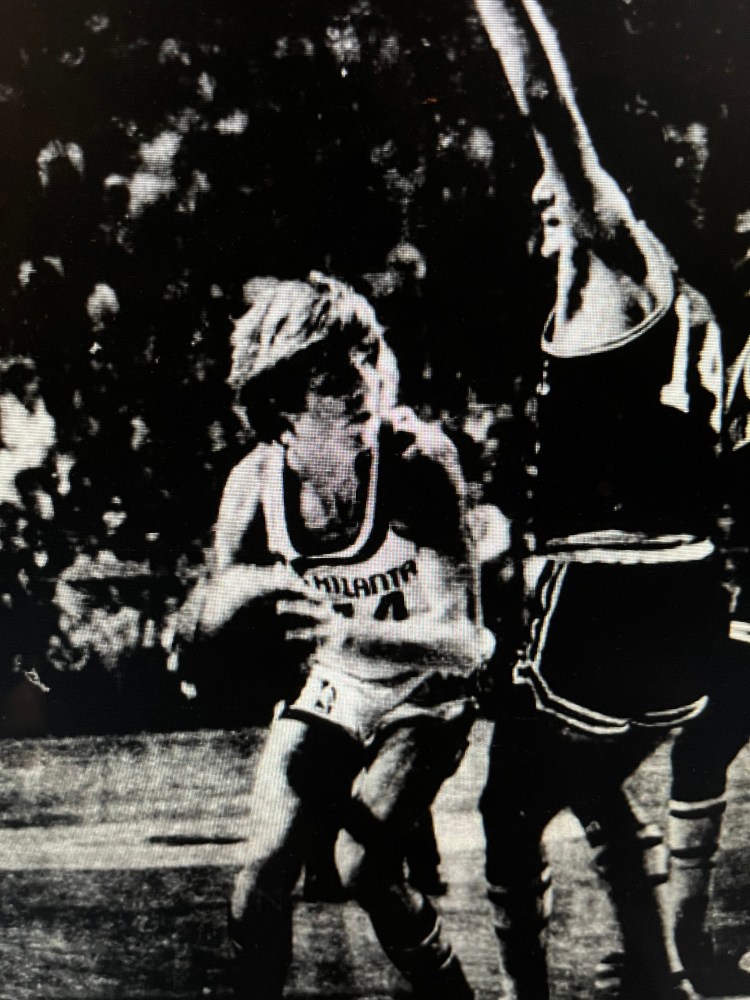
Now Pete Maravich had played in the preseason games like everyone else, and like the other Hawks—all but the sensational Walt Bellamy—he had no reason to be particularly pleased with his performance. Pete Maravich had been too tight, all the critics said. In college, he made nearly half his shots; in preseason games with the Hawks, he made about a third. So Pete Maravich, despite the great expectations, was still not expected to lay low the Bucks in one great blow, especially not the Bucks because they’re the Big Team this year.
Thus, Pete Maravich sat on the bench.
He was still wearing his warm-up togs, in fact. He’s a tall (6-feet-5 ½), slim (200 pounds), bony, and bow-legged, mop-haired 22-year-old who’s built on the scale of a growing 13-year-old. Or better: if you look at him straight on and close up, so that his big eyes and floppy hairdo fill the picture, he has the hungry and predatory look of a baby hawk. Which he is, of course. He’s been sitting with the Hawks’ other talented rookies, John Vallely of UCLA on one side, Herb White of University of Georgia, and Bob Christian of Grambling on the other, and occasionally, he’d brush the mop of his hair with his fingers, while a score of squatting photographers seemed intent on recording that instead of action on the floor. But for the most part, Pete Maravich followed the game almost sleepily. He’s not very good at sitting on the bench.
When the quarter ended and Coach Richie Guerin put Pete Maravich in the game, a small cheer went up from the crowd. He floated around rather lost at first, going one way and, finding himself obviously in the wrong place, then trying like crazy to get where he belonged. But the moment he got there, it seemed as if he belonged somewhere else.
Coach Richie Guerin was trying to help from the bench. “Over! Over!” he yelled, waving Pete Maravich to one side or the other. “Come in!” he screamed; then, “Go back! For God’s sake, Pete, go back!” And when something awful would happen, Richie Guerin would dramatically crash, his jeweled fist into the empty plastic seat next to him. He’s almost as good a show as Pete Maravich.
****
So Pete Maravich, trying to psyche out the opposition himself and follow the backseat orders of Richie Guerin, was drifting around like amateur night. Oh, occasionally he’d be passed the ball as Bill Bridges or Walt Bellamy would claim it from the backboard, and the Hawks began their fastbreak. But it was nothing, really. Lou Hudson and Walt Hazzard were hot, so Pete Maravich fed them the ball whenever he got hold of it, and once was zigging instead of zagging, Pete Maravich collided smack into Lou Hudson, the two of them bouncing off each other like a pair of Keystone Kops.
Now perhaps it was because of this, Pete Maravich’s being slightly out of position, that his first real contact with the ball occurred. As a guard, he was crouching and weaving and making all sorts of athletic gestures just short of the foul line, plugging several gaps in the defense, and the Bucks were bouncing around and trying to work the ball into someone closer to the basket when the ball went zipping suddenly inward. The crouching Pete Maravich had no time to think, which is when he’s at his best, but his big left hand went up, the long arm flashing out like a rattler, striking, and snagged the ball.
For that instant, it was a tableau in which everything was a blur of elbows and kneecaps, heading toward the Hawks’ basket, except for Pete Maravich, who was now a blur heading the other way with the ball. There was a hole up the middle, and then off to one side. It drew the dribbling Pete Maravich in one quick burst down the court to the Bucks’ side, by which time everyone else had recovered and had begun their own pursuit. But no one was open yet, so Pete Maravich, 18 ½ feet from the enemy bucket, put on his screeching sneakers (an off-balance Buck went sailing past him), leaped straight up and—swish!—two points. The house almost came down with the cheering.
He tried it 12 other times during the game and made it only twice, but so what? Anyone who thinks only of winning has lost his humanity. Pete Maravich is the sort of athlete you cheer, even when he misses. And that’s the most interesting thing about him. Pete Maravich himself is not the best person in the world to talk about Pete Maravich. Oh, he talks, all right; but that’s not his thing at all. He sounds as if he’s rather bored by talking. He relies almost totally on what may be called “the pat answer.”
****
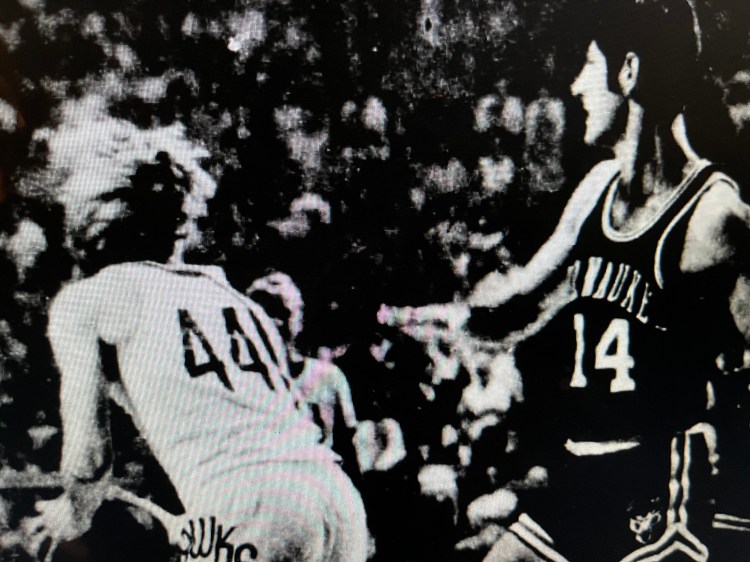
Therefore he was asked a rather complex question aimed not only at getting his own estimate of his progress in the pros, but also breaking through the stifling and witless pat-answer pattern. He’d already successfully blocked an attempt to get him to name “the greatest pros” in basketball today (he says they’re all great, or they wouldn’t be in the pros. But obviously not all are equally great), so he was asked to compare his own ability as a pro player—not with other pro players, but with his own capacity.
Q. I mean, Pete, on a scale of 100, which is the best any pro can be, say, where are you right now? About 75 or 80?
A. (He’s sitting in the empty bleachers near one end of Georgia Tech’s Coliseum. He’s wearing his practice basketball togs and gazing rather wistfully at several other Hawks bouncing around out on the floor. He’d forgotten the appointment and was an hour late, so he says now that he can spare five minutes: “You just ask your questions and don’t worry about me, because I’ve got the answers.” He thinks for a moment, however, in comparing his own ability with a hypothetical “greatest pro” who would be rated 100.)
I’m about 60 percent.
Q. What is your capacity? Do you think you can get up to about 90 or maybe 100?
A. I can get to 100, yes.
Q. How high will you get this season?
A. (Smiling slightly, still gazing at the basketball court.) Well, this is kinda funny because this scale of yours is entirely fictitious (now shrugging his shoulders and glancing at the questioner) and I really couldn’t say.
Q. Do you think you’ll be around 70 or 75 the season?
A. (Very seriously and looking back to the court.) I hope to be better than that.
But this is still not what everyone wants to know about Pete Maravich. People are fascinated, yes; but what causes it? It’s surely not his record as a college player. That he holds scads of basketball records—11 in the NCAA, 16 in the Southeastern Conference, and 22 at LSU—is not fascinating in the least; nor is the fact that he’s college basketball’s all-time high scorer with 3,667 points, an average of 44 per game. No, the fascination is something quite different than that. Could it be his mop-headed haircut?
Q. I’m sure a lot of people are really quite curious about what sort of hair tonic you use.
A. (An incredulous look almost broke through Pete Maravich’s habitual dull gaze of an expression) What kind of hair tonic I use?
Q. (Trying to sound matter-of-fact) Yes.
A. (Trying to suggest that on an asininity scale of 100, this question was surely more than 99.44 percent pure stupid) Well, I never use a hair tonic.
Q. (Incredulously) You don’t?
A. No, I don’t.
Q. (Laughing sharply) Of course, this may do you out of a lot of hair-tonic commercials in the future.
A. Well, I just did one for _________ (naming a big hair-tonic company), but I don’t consider _________ (naming the brand) a tonic. I don’t grease my hair down (glancing at his questioner’s greased-down hair), if that’s what you mean.
Q. But you do put something on it, though, is that what you’re saying?
A. (Long pause while he fiddled thoughtfully with his floppy socks) No, I don’t put anything on it.
Q. (Another sharp laugh with confidential wink) Commercials to the contrary, hey? Now, finally I’d like to ask you . . .
A. I might put something on it if the price is right.
Q. I see. Now, speaking of whether the price is right, do you think there’s any athlete living today who’s worth $2 million?
But he’d apparently been asked this before, and he delivered one of his pat answers that carefully avoid saying anything much, particularly about what so fascinated everyone in Pete Maravich. Perhaps a bit of recent history and introspection will provide the clue.
****
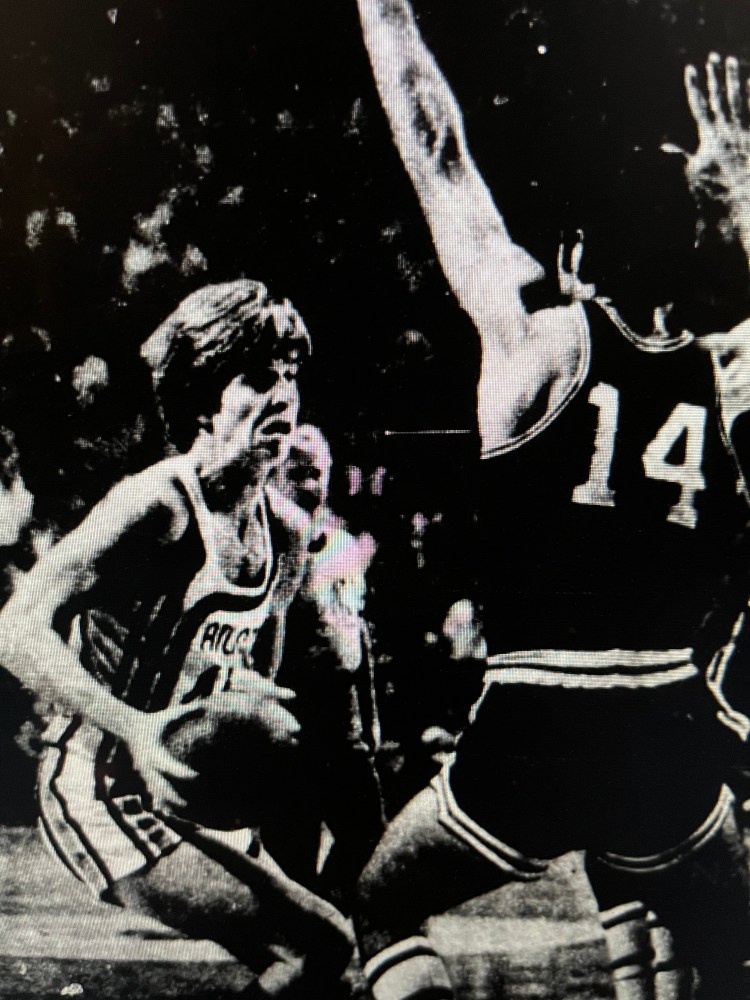
Basketball has changed dramatically in the past 20 years. Old-Style basketball of the 1950s was chiefly mechanistic. Players saw the game, including themselves and even the ball, as part of a machine, the main spring of which was the set-shot artist—like John Vallely, for instance. The set-shot artist had certain spots on the court where he simply could not miss, and the whole object of the Old-Style basketball was to pass the ball around until the set-shot artist could get to one of his X-spots on the floor and take aim with a Norden bombsight sort of accuracy, then let fly with a high-arching and preferably game-winning shot that would crisply swish through the net. They ran and dribbled in those days, too, of course—or they thought they did until New-Style basketball came in.
New-Style basketball is basically a contribution of the 1960s from the Black neighborhoods of the North. While Old-Style basketball was oriented to the eye and separated everything into parts (individual stars, X’s on the floor, and a mechanistic relationships of parts), the New-Style basketball was quite different, being oriented more to space, its special sensory equipment, seemingly located mainly in the skin and muscles and becoming for the first time a truly team sport.
Indeed, New-Style basketball is organic in the sense that the ball itself had become the seat of all consciousness, the players becoming its arms and legs and driving force, serving it with an intense and quite old-fashioned ethos, like that of the late knight errant who might go through all sorts of rather beautiful and strange contortions for the favor of one flashing two-point smile. It’s basketball’s romantic period.
Now where is Pete Maravich in all this? Well, Pete Maravich is perhaps the next revolutionary development in basketball, and in small part, like any other new development, it’s reactionary, going back for its roots to some primitive gene in Old-Style.
****
But first, a little mystery. Anyone who has watched Pete Maravich play, either with his old LSU team or with the Hawks, knows there’s something different about it. It’s not ability, though. Pete Maravich probably has more ability in certain tricky techniques and in showmanship (if not ham-manship) than anyone in pro basketball this side of the Harlem Globetrotters. But this hardly qualifies him for membership in the organic union of the Atlanta Hawks.
Then what is the difference? Charisma? No. Walt Bellamy has charisma, and so does coach Richie Guerin. But Pete Maravich has something else, mainly because with charisma either you’ve got it all the time or you simply ain’t got it.
And Pete Maravich is quite an ordinary fellow ordinarily. Not only doesn’t he have charisma, but he lacks the New-Style genius of Lou Hudson, the brooding romanticism of Bill Bridges, and the artful cunning of Walt Hazzard.
Pete Maravich by comparison is rather unexciting.
Until he gets the ball.
****
And then something happens. Pete Maravich gets the ball and though a moment before he’d been one with the complex of feints and thrusts and probings of weak spots, the squeaks of sneakers and the waving arms, now with the ball he’s full of a non-discursive meaning. And-ah!—a lurid meaning it is, if you note it carefully, for the ball is no longer a center of consciousness in the hands of Pete Maravich; it’s an appendage of some sort, an extension of the Pete Maravich will, if you please; and more, obviously, for on his face, usually so placid and glazed-over, now is the awful look of an animal need. Pete Maravich is full of lust. And we’re fascinated by it, for somewhere in this near-indecent exposure, stirs the recognition that we’re entering the age of basketball sex.
Oh, not blatant sex, of course. But sex, nevertheless; sex in that most general sense of one thing’s devouring another, as one of his behind-the-back passes or between-the-legs dribbles quite destroys a whole phalanx of enemy maneuvers, all this wonderful fooling around arising, if not from simple joy or love or art, at least without the cross utilitarianism involved in merely making a basket. And thus, we cheer whether he makes it or not.
Q. What about your style of basketball, Pete?
A. My style is definitely different from a lot of players.
Q. So you have a name for it, perhaps?
A. No, I don’t have a name for it.
Q. How does it differ, then, from that of other styles?
A. Certain things I might do with the basketball that other players might not do.
Q. Ballhandling, you mean? Is it an attitude toward the whole game, do you think?
A. It’s sorta that. It’s something that I think the game of basketball in the future will become more and more like. Back in the 1950s, everything was a straight chest shot—and then you move. And when you move into the 1960s, you might’ve seen a little bit more of this. You might have seen somebody go behind their back, and the crowd reacted like it was something out of the ordinary. And today, certain individuals like myself, when I do that, I don’t get any “hoos” or “rahs” because they know it’s common for me, whereas, if somebody else might do it, they might give them a “hiss” or something.
I think the game is moving into this phase. Faster, players are getting stronger, taller, better, and the kids are beginning to realize that there is an extraordinary amount of money that can be made from any professional sport. Why should any individual, if he can make his whole life in the sport of basketball, why should he be looked down upon by others? Like the educational problem, for example, you have so many envious people of me, because . . . but it’s none of their business in the first place, because I’ve worked my entire life on this game of basketball, whereas they might have worked their entire life on becoming a lawyer or something.
Q. Are you sure you don’t put anything on your hair?
A. I’m quite sure.
 From Way Downtown
Thanks.
LikeLike