
[James Silas was one of the all-time ABA greats and one of the best to lace-‘em-up during the 1970s. It’s too bad that today Silas isn’t remembered as warmly as he should be. As George Gervin, his more-celebrated Spurs teammate once said: “He [Silas] is the man.” This article, pulled from the February 1981 issue of the magazine Texas Sports explains why. At the typewriter is journalist Jim Hutton.]
****
Amid frantic motion, leaping giants, and outstretched arms, the inbounds pass finally settled into the steady hands of James Silas. With 20 seconds remaining in the game and trailing by a single point, the Spurs—or rather, Silas—had the opposition right where he wanted them.
Slowly, Silas turned his back to the basket and his defender, then he glanced back and forth at the 24-second clock and San Antonio head coach Stan Albeck. As his defender applied illegal hand-checks that no referee dared call so late in the game, Silas slowly backed up his opponent, who grudgingly gave ground. The rim was 18 feet away and getting closer.
Swiftly, Silas gave a body fake left, then a head-fake the same direction, and instantly he was wheeling to his right. His right foot spang off the floor like an ejection seat, and with his body almost parallel to the court, Silas launched a 15-foot bank shot. The backboard and the rim accepted the offer like an unexpected Christmas bonus . . . :02, :01, buzzzzzz.
Captain Late was on time once more.
****
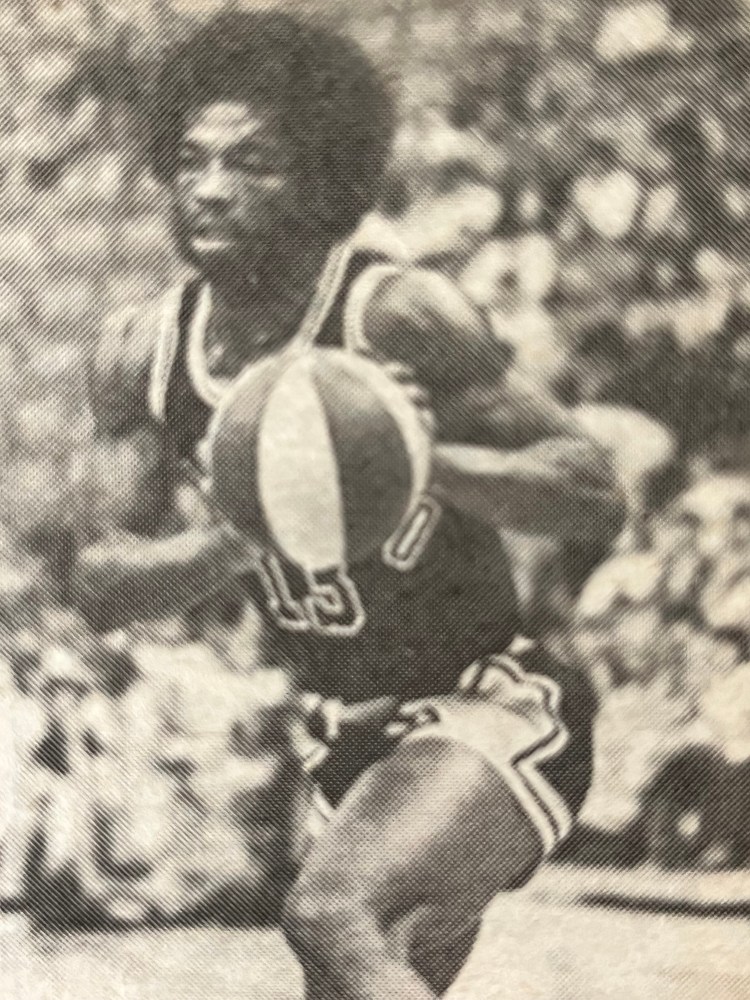
Casual basketball fans might Believe this incident could not be commonplace. Not when the Spurs have the NBA’s three-time scoring champion, George Gervin, to apply the coup de grace in the waning seconds.
But, as everyone in the NBA knows, in the final, critical seconds, Gervin is merely a safety valve. An incredible safety valve to be sure, but nothing more. The Spurs, you see, have the Amazing 24-Second Man, James Silas.
The final 24 seconds or less is like a shot of Chivas Regal to Silas. It’s time to savor the suspense, the pressure, and the challenge of the moment.
Over his nine-year pro career, Silas has earned the nickname, “Captain Late.” Without question, he is one of the few NBA players who is repeatedly called upon to produce the last-second shot, which can register victory, cinch defeat, or generate overtime. “I like being the man on the spot,” said Silas. “It’s a role I’ve received and accepted. Working in pressure situations brings the best out in me.”
Gervin, the man who draws 80 percent of the Spurs’ national publicity, knows what Silas means to the Spurs. “He is the man,” said Gervin. “He is the man who pulls us through.”
This season, Silas has surpassed two records in his already distinguished career. The Stephen F. Austin ex climbed over the 10,000-point pinnacle and also achieved the recognition of performing in 562 games, the most played with the franchise, dating back to the American Basketball Association days in Dallas.
The point record was the first to come Silas’ way and arrived while the Spurs were performing in the HemisFair Arena. The night was November 5, and a crowd of 12,358 in The Arena watched the Spurs dismantle the Phoenix Suns, 114-84, with a defensive showing that produced 17 steals and forced 29 turnovers.
All this could have left Silas’ record-setting performance under a night-light, but the crowd would not stand for that. Captain Late blitzed the Suns for 30 points in 23 minutes that night on 10-of-14 from the field and 10-of-11 from the line. With 3:07 remaining in the first period, Silas launched a 15-footer off the right side of the lane and over Suns rookie Kyle Macy to score his 10,001st point of his career.
The game was halted as the Spurs honored their captain amid a standing ovation. Captain Late
acknowledged the response with a conservative wave. There was a little expression on his face. Mainly, there were signs of relief. “I never thought I’d play long enough to make 10,000,” said Silas. “I wanted to get it done and get on with the game. I was a little nervous because I was thinking about the 10,000 points.
“This is the greatest thrill of my life. I can’t fully explain the feeling, though. It would be like trying to explain the feeling of the knee injury to someone who never had one. (Captain Late missed much of his first two NBA seasons because of knee surgery in 1976.)
“I do remember my first two points, which came against the Kentucky Colonels off of a layup over Artis Gilmore. Maybe I’ll go for 15,000 now,” Silas laughed.
It was only 10 days later that Silas added another laurel to his impressive career, which has included six 1,000-point seasons. Again, the timing was perfect as the Spurs entertained the Utah Jazz on November 15 in The Arena. On hand that night, along with his wife Hazel, was Captain Late’s father, Herman, of Tallulah, Louisiana, who frequently visited San Antonio.
Against the Jazz, Silas played in his 562nd game as a Spur, surpassing Coby Dietrick’s mark for the most games played with the franchise. An Arena gathering of 13,612 watched the Spurs throttle Utah, 120-104, but surprisingly, this record-setting occasion came off with minuscule fanfare. Silas collected 17 points in that victory with 6-of-16 from the field and 5-of-5 from the line.
Mention of Silas’ accomplishment was made during other announcements prior to the start of the second half. The attention, however, was completely lacking as compared to the 10,000-point celebration. Silas did not respond to the obscure handling of this achievement. But several Spurs players mumbled that they could not understand how a franchise shaper could be so overlooked. Silas is the last original Dallas-San Antonio player still with this franchise.
Sadly, that night was the last one, Herman Silas, would ever see his son play. The 74-year-old Silas became ill that weekend, was admitted to Community Hospital, underwent triple bypass surgery, and died five days later. James remained in San Antonio with his father and family during the illness while the Spurs were on a road trip.
****
James’ most-recent tributes undoubtedly have come as no surprise to Herman. After all, the 31-year-old Silas had been regarded as the premier guard in the ABA, and there were those who considered him the top backcourtman in the game. Atlanta Hawks coach Hubie Brown once said: “Silas was the best guard in the ABA and perhaps both leagues (before his knee injury). He possessed not only playmaker skills, but second-guard shooting abilities, too. He could beat you inside or outside.”
His 1979 coach, Doug Moe, said of Captain Late: “When time was running down, you just had to give the ball to Silas, and you could almost guarantee yourself a victory. When the pressure is intense, Silas is something to behold.”
“I would like to think I was the best in the ABA,” said Silas. “I was at a point where I could do what I wanted against whom I wanted and when I wanted. Today, I’m as close to my old self as ever, and I never thought I would be the same.”
Hazel Silas agrees. “I’m so happy to see him playing with enthusiasm again. I credit Stan (Albeck) with that.”
Spurs general manager Bob Bass has viewed Silas’ development through his six- year tour with the Spurs. “When I first saw Si, I thought he was conservative offensively,” said Bass. “He was not taking enough shots, beating and jumping over his man. Now, he knows exactly how to beat his man.
“He plays like Walt Frazier. The ball goes thump, thump and then he jumps over the guy. You could be in great defensive position just like it says in the book, and he’d still back you down and hit a high percentage of his shots.
“Over the last six years, you could see the confidence every other Spur had in Si,” stressed Bass. “During timeouts when I was coaching, guys would keep saying, ‘Let’s go to Si.’”
Albeck knows plenty about Silas, too. As an assistant coach under Brown with the Colonels, Albeck caught Silas’ heroics both in Louisville’s Freedom Hall and in The Arena. “James Silas and George Gervin formed one of the most devastating twosomes in the ABA,” said Albeck. “When the merger came about, and you reflected on the great guard combinations, you’d have to put them with the likes of Jerry West and Gail Goodrich.”
Silas’ greatest strength then was not the one he processes today. “Back then, he had tremendous jumping ability,” continued Albeck. “Here was a 6-feet-3 guy who was jumping over people. Since then, he’s lost a little bit of that.
“When I coached against the Spurs, I remember the sinking feeling I’d get near the end of a close game. You knew if you double-teamed him, he’d still get the shot or pass off.”
Last year, Silas compiled his best NBA season in minutes played, scoring, shooting, and assists. The owner of half of the Spurs’ free-throw shooting records, Silas began the current season with a 16.5 career point average off 50 percent shooting.
Albeck, realizing what role Silas plays both as a starter and as a finisher, also realizes that Silas isn’t as young as he once was and is trying to conserve Captain Late’s playing time. “I wanted to cut down on his playing time in order to extend his career,” said Albeck. “I planned to always save him and keep him fresh for the last five to six minutes of the game.”
Silas never went through the rigors of two-a-day preseason drills, and when the Spurs have three consecutive games, Captain Late sees minimal exposure in the third game. The surgical knee, which nearly terminated his career before NBA crowds could view his game, simply cannot withstand the beating.
“Si may have lost some of his physical ability, but now his court demeanor, poise, and headiness make up for it,” said Albeck. “He’s much above the playmaker tag people give him. He’s not a true playmaker because he scores so many points.”
Silas is unassuming and never has let the publicity drain his enthusiasm for his profession. Though he exhibits a confident gait, cockiness never ruled his dealings with fans or the news media.
“Si rarely says a great deal,” agreed Albeck. “He is iike two different people. All his mannerisms are reflected on the floor. His personality shows out there. He is one of the fiercest competitors I’ve ever known.
Whether Silas will ever attain his 15,000-point goal remains to be seen, but after all these years of seeing him from the other side, Albeck is most thankful to coach him for a change. “James Silas and the final seconds have become a trademark of the Spurs,” said Albeck. “You always knew where the ball would go.”
And Captain Late rarely has been tardy in the waning seconds.
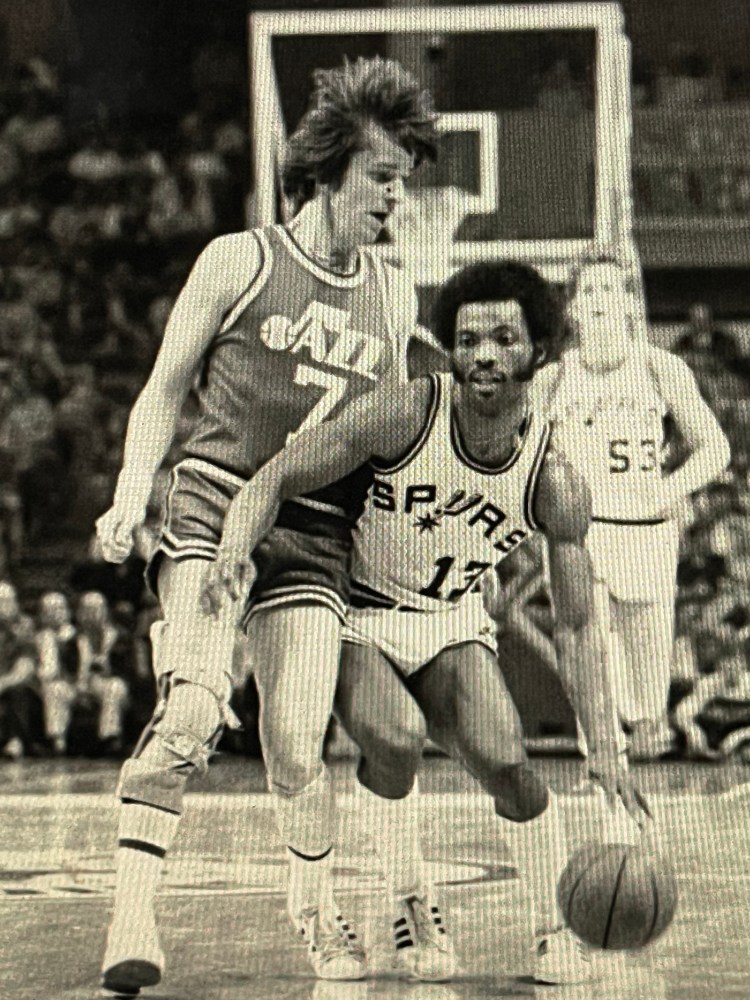
[At the end of the 1980-81 season, Silas was traded to Cleveland, where he spent one season before retiring. His career point total was: 11,038. In the January 1982 issue of Basketball Digest, Silas recalled his most-memorable game as a pro. As a bonus article, here’s what he had to say.]
I have gained a reputation in professional basketball as a player who performs last-second heroics, who quite often hits the late basket or foul shots to win a game. It is a reputation of which I am very proud. Not that many players like to take the last shot when the game is on the line. But I am confident I can score, and I enjoyed shooting when the pressure is greatest.
However, I have done it so often in my nine years as a pro that it has become quite commonplace. Therefore, it is not a winning shot—or even a winning game—that stands out above the others as my most memorable moment in my ABA or NBA career.
Instead, it was a game the Spurs played against the Denver Nuggets in San Antonio on November 28, 1975. The 1975-76 season was the last for the American Basketball Association, and my best as a pro. I scored exactly 2,000 points that season, nearly a 24-point average, and made the ABA All-League team.
Denver games always were special for the Spurs. The Nuggets had beaten us more times [51] than any team in the league during the ABA’s first eight years of existence, including eight victories in 11 games over us in the 1974-75 season.
In the 1975-76, the Nuggets, the Western Division champions the previous year when we finished second, had improved greatly with the addition of David Thompson, then a rookie, and the acquisition of Dan Issel from the Kentucky Colonels.
Since Denver was one of the best teams in the ABA, we wanted to play well against them—and beat them. On this particular night, Thompson and Ralph Simpson, one of the better guards in the ABA at the time, took turns guarding me. But neither could stop me. Every time I saw Thompson, my eyes lit up.
I was the point guard then, and I controlled the ball. The Nuggets even tried double-teaming me and trapping, but nothing worked. I like it when I’m controlling the plays. I’m super like that. I always get the job done.
Against the Nuggets that night, I started a little slow, hitting only five points in the first quarter. But Larry Kenon and George Gervin were hot and kept us in the game. We trailed only 32-30 at the end of the quarter.
But midway through the second period, the Nuggets started out running us and ran up an 11-point lead, 52-41. At that point, I felt we had better not let the game get out of reach, and I started shooting more. Over the final six minutes of the quarter I scored 12 points, cutting Denver’s lead at halftime to four points, 62–58.
It took us nearly the entire third period to get even, but we finally managed it in the closing minute, tying the score, 93–93. In that quarter, I had 11 points for a total of 28. In those days, most everything was based on points, and the fans at the San Antonio Convention Center Arena were yelling and screaming nearly every time we scored. We gave them a lot to cheer about in the fourth period when we built a 10-point lead with two minutes remaining.
But the Nuggets then started firing from long range—and connecting. First Thompson, then Simpson, and finally. Byron Beck with two seconds remaining. All hit three-point field goals, and Denver had tied the score at 128 at the end of regulation. I picked up 13 more points in that period and now had accumulated 41.
I also scored the first three points in overtime, but again we couldn’t hold the Nuggets. With Thompson and Beck each scoring four points, Denver outscored us 12-8 in the extra period and won the game, 140-136.
I got one more field goal and finished with 46 points—my career high in the pros. I was glad to be able to perform like I did. Of course, I would have been much happier if we had won. But that game overshadows all the other games I have ever played in the ABA or NBA, because scoring so many points is such a rarity, whereas last-second winning shots have happened so often.
Only once have I ever scored more points—49, when I was in college against San Angelo State. But they didn’t mean as much, because I was the best player and everything depended upon me. Scoring 46 in the pros was more significant because the caliber of players at that level was so much better.
 From Way Downtown