
[Here’s a nice period piece about the rising Moses Malone in Houston. The future Hall of Famer is putting up big numbers in the NBA and turning heads. But he’s still got more work to do on his game. Writer John W. Wilson explains more in an article that, though structurally choppy in places, remains worth reading if you like Malone. Wilson’s article ran in the February 1981 issue of the magazine Texas Sports.]
****
Del Harris, coach of the Houston Rockets, has a complaint. “No one, in all the stories I’ve read about Moses Malone, has captured the real Mo,” he says, standing in his small office in the back of the Rockets’ dressing room. “When they write the definitive article on him, they’ll catch his sense of humor.”
Perhaps, Harris claims Malone can tell “Mary Had a Little Lamb,” and you’ll laugh. But Malone said nothing about Mary or her lamb during our discussions, although, to tell the truth, I never asked. Nor did Malone cut loose with many zingy one-liners. Still, one evening after the Rockets had dispatched the Lakers, he did enter into a rather lighthearted give-and-take with teammate Major Jones that does serve to tell us something about Malone.
It started when Malone, sounding like a seven-foot Richard Pryor, began dissecting Jones’ game. Jones is Malone’s closest friend on the team. “I’m trying my best to help Maj on some of his pet shots,” says Malone, “hittin’ the backboard like he’s building a brick house. Now, why he’s takin’ those shots, I don’t know.”
“Aw, man,” countered Jones. “What about that hook shot tonight? It went to the free throw line! And one you threw to an usher. That’s my boy. And what about Fonde?”
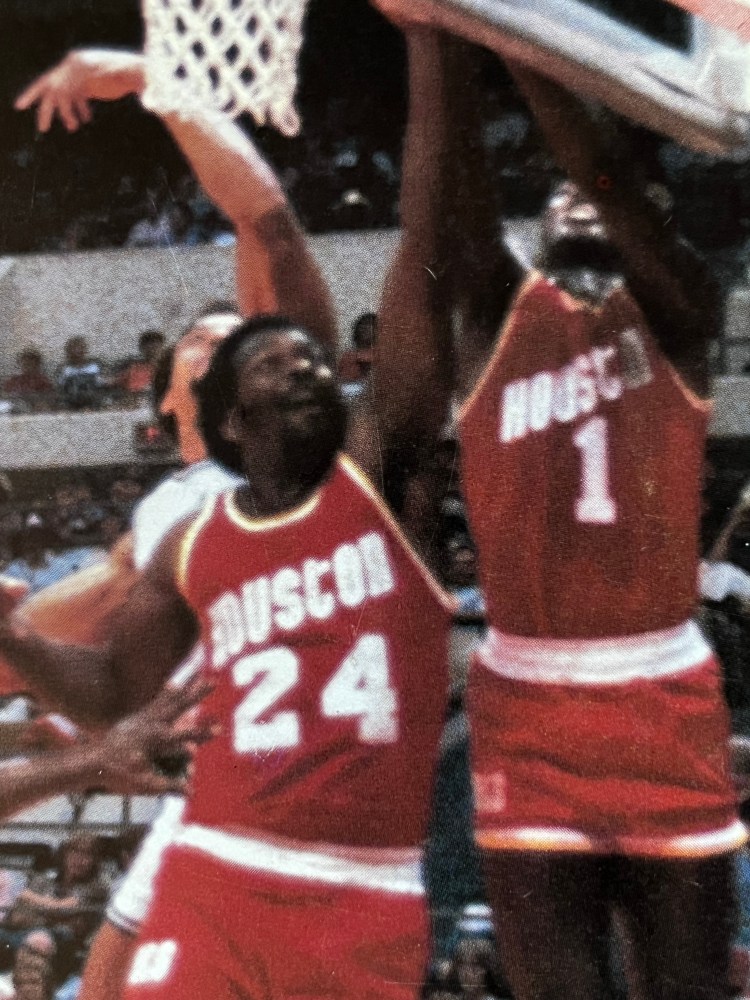
Fonde is the city of Houston’s recreation center, just to the west of downtown on Memorial Drive. During the summer, on Monday and Wednesday nights, local professionals, college players, and a few outstanding high school kids spend their evenings playing basketball. It’s known as the pro-tour.
“I’m the baddest guy near Fonde,” says Malone. “They call me The King. I take ‘em all one-on-one and show ‘em I’m The King.”
“Who beats you down there?” asks Jones.
“How many times you beat me?” says Malone, turning on Jones. “How many times?” Malone repeats those three words several times. Jones suffers the repetition of the question in silence.
“Aw, we play so many games,” says Jones finally.
“He beat me one time,” says Malone.
“Man, I ran you out the place!”
“When?”
“This summer.”
“I beat him so many times,” says Malone. “And then one time he came back and beat me, so I came back to show him that even when I was tired . . .”
“Y’all ever get tired of lyin’?” says Calvin Murphy, laughing.
“The man knows I’m the baddest at Fonde. When I come through, they bow to me.” He makes a curt bow. “Mister Malone.”
“No one wants to play me, though,” says Murphy.
“That’s why you won’t show up,” laughs Jones.
“Major knows I’m the man down at Fonde,” says Malone. “I show him a little trick or two to get him ready for the real thing. I let him embarrass me a little bit sometimes, but it’s my show.”
“Hold it, hold it,” says Jones in an injured tone.
“When Major plays me one-on-one . . .”
“All the friendship shit goes out the damn window,” says Jones.
“Well, he plays me tough,” says Malone. “But when the game gets down to the money, it’s mine.”
It’s difficult to tell if the preceding exchange will appease Coach Harris. So, let’s pass on to what it says about Malone: he likes to play basketball. It would be fun to watch him jiving around with his friends at Fonde when the pressure is off and he can showboat a little, because during the season, Malone does not—will not—smile.
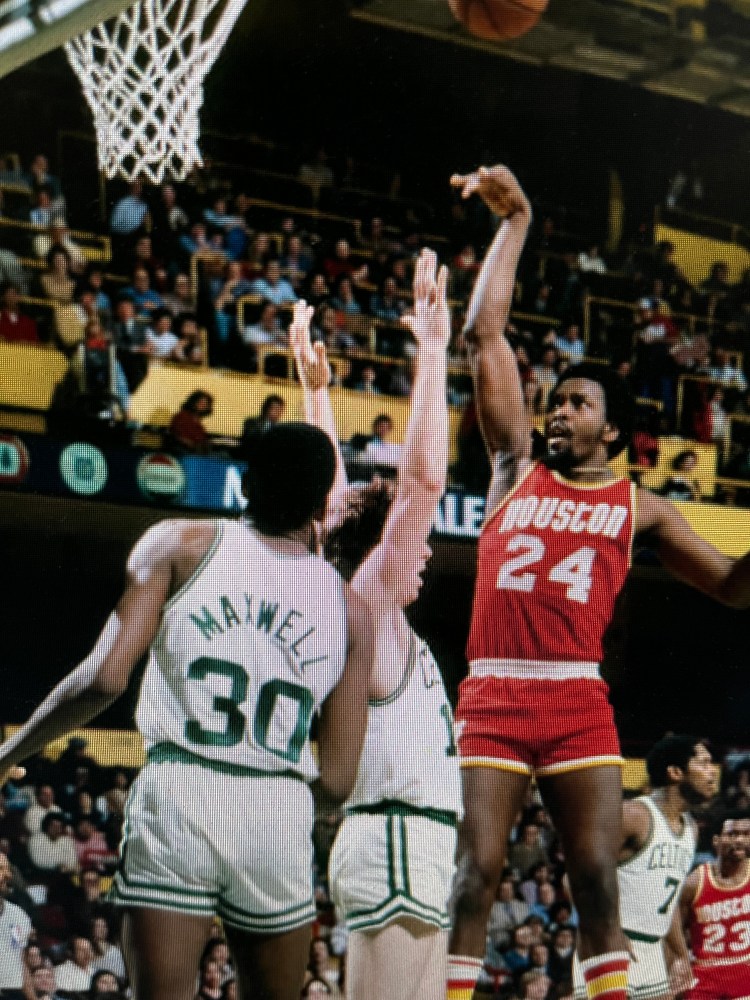
When there is money on the line, big money, Malone fails to see the humor in the situation. This was particularly evident the night the Rockets played the Lakers. This was before Laker guard Magic Johnson had knee surgery. Now Johnson is an effervescent player, all smiles and high hands when he performs his feats.
During the game, the Rockets were in the process of trimming an 18-point deficit on the way to a stirring win. At one spot late in the fourth period, Mike Dunleavy, who is nearly as intense as Malone but in a gritty, bantam-rooster way, lofted an alley-oop toward the basket. Malone rose high above the startled Lakers and stuffed the ball through the net.
The team lit up. The crowd lit up. The reporters even lit up. On the way back down the court, all Malone had to offer Dunleavy was a cursory slap on the hand. If Malone lit up, he hid the light under a basket.
This even-tempered style of basketball is a little disconcerting in a flamboyant game full of Chocolate Thunder, Dr. J, and All World. It almost looks as though Malone wishes he were somewhere else, especially when you consider his rather pedestrian style of play. His inside shot is reminiscent of a man toting a load of shingles up a ladder. No skyhook here.
“Malone has his own style,” says Harris. “He’s got a decent hook shot and a decent jumper. He’s not famous for it like some have been famous. In fact, you seldom realize how good a game he’s had.”
Harris begins to warm up to his subject. “Just remember. They don’t judge you by style. They don’t give nothing for style—how it looks. What counts is the bottom line, and I think he’s one of the five most-effective players in the league.
Malone’s explanation for his unemotionalism is simple and direct. “It’s not my style.”
“That’s right,” says Jones. “He wears the same expression whether he makes a great play or a turnover.”
****
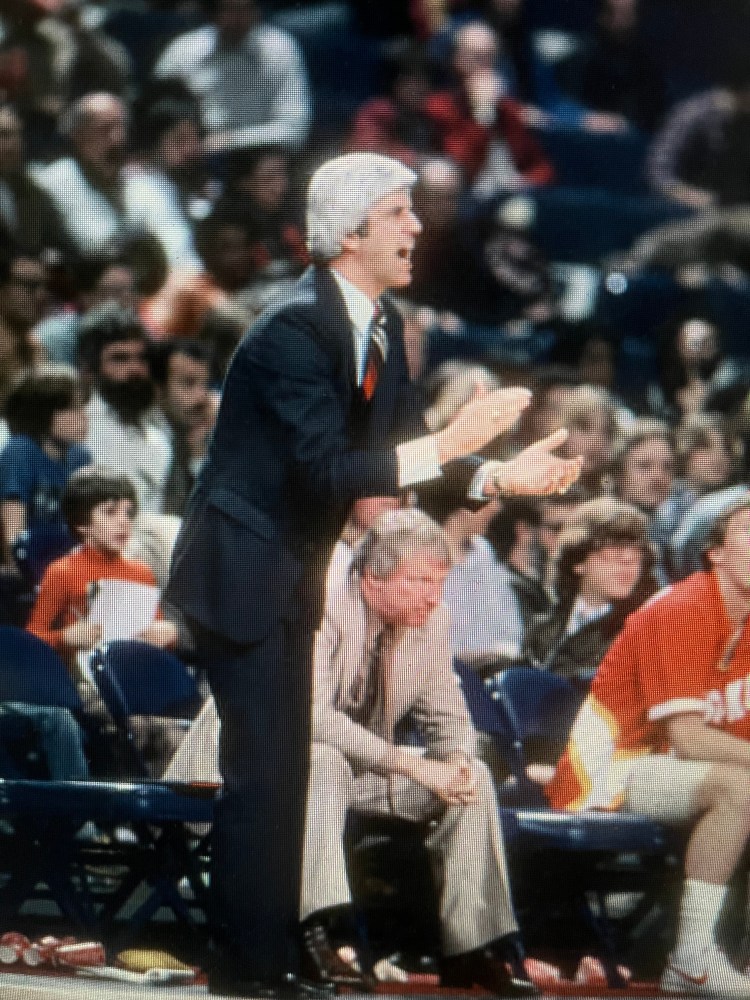
Most great teams tend to jell around the team’s dominant personality, usually the center. Malone is so dispassionate on the court, it’s difficult to imagine the Rockets ever looking to him for feedback and inspiration. “He leads by example,” says Harris. “He doesn’t try to get anybody to conform to anything other than just play ball. He doesn’t try to assert any domination over anybody.”
It should be noted that Harris is talking only about the Rockets. Malone does like to intimidate opponents, although he does it in the same quiet manner in which he plays offense. No shot-blocking miracles. First of all, the Harris theory of defense says stay on your feet; you can do more on the ground than you can hanging from the rafters. And secondly, again, it’s not Malone style.
Instead, Malone plays an intense brand of basketball consisting of subtle blows to the body. This style rises out of Malone’s personality. Unlike Kareem Abdul-Jabbar, Malone is unlikely to turn and fire on a player after a long night of being leaned on. “Mo’s just not gonna do that,” says Jones. “He just takes it to his defensive player. He beats him up, and the guy guarding him gets the foul. He’s knocked out a tooth already this year and blacked another guy’s eye.”
Malone, in a characteristic bit of understatement, says, “I love to make my defensive man work.” Malone does this by capturing more than his share of offensive rebounds. As Harris notes, “He was born to rebound. He thinks that when the ball is shot, it’s his personal property.”
The records bear this out. Last season, Malone grabbed 1,190 rebounds, finishing second in the league to San Diego’s Swen Nater. In the 1978-79 season, Malone finished on top of the league with 1,444 rebounds. In 1977-78, playing only part-time, he collected 888, after picking up 1,072 in 1976-77.
In all of those years, Malone led the league in offensive rebounds, outdistancing the field by almost 400 rebounds. Legendary centers like Wilt Chamberlain and Bill Russell gathered in rebounds with amazing regularity. In fact, Malone’s best year was outdistanced by Chamberlain in his last season when he picked up 1,526 rebounds, and by Russell’s 1,448 in this last year. We could get into a whole other argument about shooting percentages, then and now, and available rebounds. But the point is: their teams, especially Russell’s, won championships or came close. So, it’s easy to see how the defensive rebound became so prominent. Russell was noted for his defense, while Chamberlain was always slated for his supposed lack of defense.
Even Harris, in his book Multiple Defenses for Winning Basketball, admires the defender: “Opponents will always respect the good defender and defensive unit. Athletes may look with awe at the fine scorer, but they reserve their respect for the rebounder and defender.”
Unless, of course, there is an offensive rebounder around like Moses Malone. Then Harris says, “I think the offensive rebound is the single most-important statistic in basketball. First, it gives you the ball back so that you don’t have to have a good shooting percentage.
“Second, it helps your defense by disallowing what would have been a defensive rebound that could have ignited a fastbreak. You don’t have to execute as well, you don’t have to shoot as well, and it helps your transition game.”
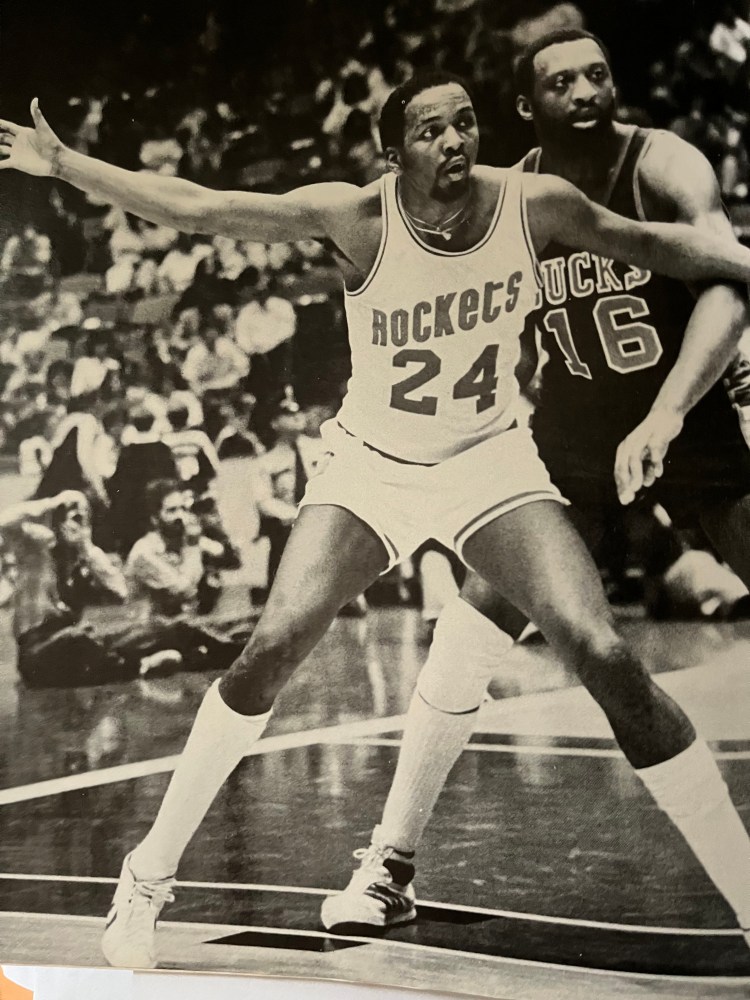
Some would carp that this describes the Rockets’ style of play exactly, but that’s really beside the point. Besides, Malone happens to agree with Harris. “Defensive rebounds are the easiest rebounds, and offensive rebounds are the hardest,” says Malone. “You’ve got to put a lot of work into it. A lot of players can defensive rebound, because that’s all they want to do, but I think of both boards.”
This makes sense. An offensive player is usually out of position for a rebound. The nature of defense calls for the defender to be between the offensive player and the goal. So, for Malone to be grabbing as many offensive rebounds as he does is outstanding, because it means he has to have an uncanny sense for the ball and be able to get to it without fouling the defender.
Of course, if Malone would raise his defensive rebounding numbers to anywhere near his number of offensive rebounds in relation to the rest of the league, even the stats of Chamberlain and Russell would pale by comparison. So why doesn’t he? It is, as he noted, relatively easy to grab a defensive rebound. Consider something else Harris wrote: “It takes quite a bit of mental maturity and determination to play a consistently rugged game of defense.”
****
Moses Malone, a six-year veteran of the NBA, is only 25. By way of contract, rookie Calvin Garrett is 24. Malone was the first player to go directly from high school to professional basketball, signing with the Utah Stars of the ABA. In his first year, he averaged 18.8 points per game and 14.6 rebounds. In 1976, he went to Portland, then on to Buffalo before the Rockets picked him up in 1977. It could be that Malone, bolstered by continuing success, is just not ready to concentrate on defense.
This is not meant to denigrate Malone’s obvious talent. But skipping college places a great deal of pressure on him, and he has responded by constructing a strong defense mechanism based on his current statistics. “You have to realize when you come out of high school and don’t go to college, things are going to be different. People are gonna look at you like you don’t know what you’re doing. But a lot of ballplayers go to college, and they don’t learn nothing. I know more than they know,” says Malone.
Still, despite his experience and credentials, he is a young player who makes young player mistakes. At least four times in the Rockets’ game with the Lakers, he received the ball inside, either from a pass or a rebound, and dribbled before taking it back up. Each time, when he put the ball on the floor, he lost it.
Harris, naturally, is loath to criticize his young giant publicly. “I’ve never coached a professional team where Moses didn’t play,” says Harris. “So, I’ve seen him go to war a number of times. He’s developed steadily as a player, but it comes in spurts. He’ll go along as the same old Moses, then suddenly he’ll change, improve.
“Last year, for instance, he became a better all-around player. He and Murph were the only consistent things we had. We couldn’t count on anybody else. He became a better passer and a better shooter. You can’t give him an open shot from 15 feet now, he’ll make it.”
In a way, this seems to imply that Malone’s talent is there waiting to be discovered by Malone, sort of a natural process that the coach can’t affect materially, as though it will suddenly occur to Malone in his sleep one night that a head or shoulder fake underneath the basket would be preferable to a dribble. That’s what it implies. But Harris knows coaches are important. They do make a difference, especially in the pros. They see the bad habits. They realize what a player ought to do to perform better. Of course, the player has to listen. Teams lust after kids with raw talent who, in the sports vernacular, are coachable.
Harris believes Malone is coachable. “He’s not gonna listen to everybody, because he doesn’t need to. After all, he’s been successful as is. But if you can show Moses where a particular thing will help, he’ll do it.”
There is a suspicion here, probably unwarranted, that Malone might be slightly reticent to change. He has had some public disagreements with Harris, all of which the coach dismisses. “When you’ve been together as long as we have, it’s nothing to have disagreements. This is a business. We’re not in high school or college. What kind of business is there where people at the top level don’t sit down and say, ‘I don’t think we should make that deal.’ And the other guys says, ‘You dumb-ass, that’s why we didn’t make any money last year.’
“This game is just like that,” says Harris. “It’s not some snotty-nosed kid telling his coach off. Hell, the trouble Malone and I have had would be a drop in the ocean.”
It’s easy to believe. Malone does seem quite prepared to admit his shortcomings. “I make a lot of turnovers. It’s the weakest part of my game,” he says. “I think it happens because I’m trying to do too much with the ball.”
So, it’s quite probable that Malone’s problems are simply a case of his mind making promises his body can’t keep. This, too, shall pass. When it does, it could have startling implications for the rest of the league. On offense, for instance, Harris wants Malone to shoot 80 percent from the free-throw line and 55 percent from the floor.
If Malone had hit those percentages last year, he would have raised his scoring average to 28 points per game, and he would have risen from fifth to third among the scoring leaders. If he had hit 60 percent from the floor, as Abdul-Jabbar did, Malone would have finished second in scoring with more than 30 points per game.
There’s no reason to believe Malone can’t improve; he hustles on the court and in practice. He’s unrelenting. Several times during the Lakers game, the Rockets would start a fastbreak, and there’d be Malone, all 6-feet-10 of him, thundering down the floor as a trailer. It was wonderful to behold, especially when you compared him with Jabbar, who ambled up and down the court.
And Malone is durable. In an early season game against Phoenix, Malone had his legs cut out from under him as he went in the air for a rebound. He hit the floor with a shuddering thud, squarely on his back. The quiet was absolute. Slowly, Malone rose to his feet, took a deep breath, and shook off the pain in a ponderous motion, looking neither to his right nor his left. When was satisfied with his condition, he trotted down to the other end of the court to join his teammates.
“He’s incredibly durable,” says Jones. “He’ll never ask to come out of a game.”
This durability should stand Malone in good stead. He probably has 10 more years in the game before retiring at age 35, at which time he will probably be recognized as the best center in the game.
As Jones notes, “He’s only got one way to go—and that’s up.”
 From Way Downtown