
[In the mid-1960s, pre-ABA, the top NBA rookies broke into the league for about $15,000 -$20,000 per season. But in 1966, the New York Knicks turned the NBA upside down by signing Cazzie Russell, the number one pick in the college draft, for an astonishing salary of $200,000 spread out over a couple of seasons. Russell’s small fortune had NBA fans feeling dizzy and fully expecting him to transform the woe-begotten Knicks into a perennial champion. But Russell struggled as a rookie. A major reason being, at 6-feet-5, he was a classic tweener: too small to muscle inside with the bigger forwards and too big to keep up outside with the quicksilver guards.
In this article, from the March 1969 issue of Complete Sports’ Special Pro Basketball Issue, Knicks’ beat reporter Joe O’Day makes the case that Russell, entering his third NBA season, finally had settled in as a small forward, or cornerman. O’Day was correct until Russell fractured his ankle and wrist later that season, prompting Knicks coach Red Holzman to move the even-higher-paid tweener Bill Bradley into the corner. Bradley would keep the job, and Russell would eventually ask to be traded. But, in this article, Russell’s fractures are still in the future, and O’Day reminds us just how jazzy Cazzie was considered back in 1969.]
****
Limbo in its more mundane definitions is a state of being replaced midway between two extremes, and that’s precisely the status of Cazzie Russell of the New York Knickerbockers. At 6-feet-5 ½ and 218 pounds, Russell, in a sense, is Unlucky Pierre—being too tall for standout backcourt work and, perhaps, too small to stickout corner employment in the rough, tough National Basketball Association.
Jazzy Cazzie, who was a $200,000 Bonus Baby three years ago, came into the pros after a phenomenal career at Michigan—where he twice was a unanimous All-America choice. The scouts to a man applied the “can’t miss” label and tabbed him to superstar status.
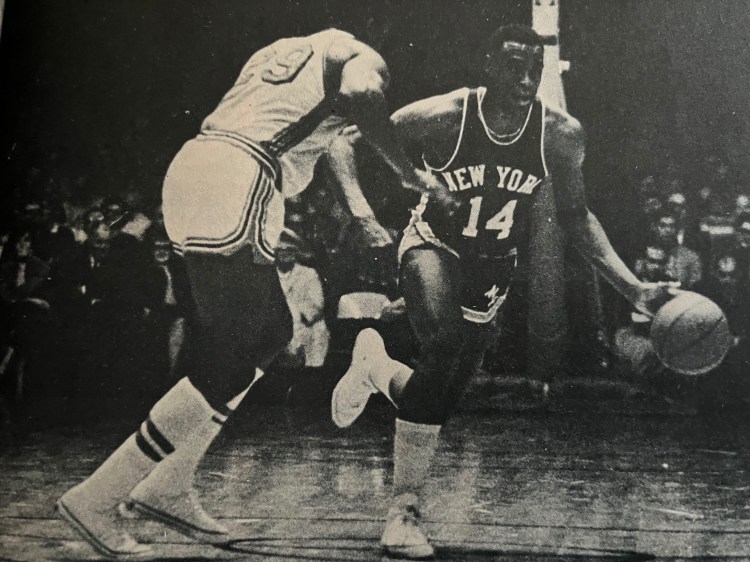
But reputations are quickly destroyed in the NBA. Russell, of course, was no exception, although he flashed brilliantly for a moment and alternately burned out like a comet in the night sky. Dick McGuire, then coach of the Knicks, nurtured Russell—first in the backcourt and then in the corner—in an effort to fit him into the Knicks’ offense.
That rookie year was a real trial for both McGuire and Russell. Mac was constantly berated at courtside as those same fans that cheered him as a playmaker in his earlier years with the Knicks now jeered him while Russell—despite the usual mistakes of a freshman—COULD DO NO WRONG!
“What are you doing, McGuire?” the hecklers asked and, in the same breath, answered their own question by shouting, “You’ve got to be saving him for something . . . the playoffs we hope!”
Mac took the verbal beating and said: “You have to be deaf not to hear it, but I don’t mind it at all. It’s part of the game, and you can’t help but resent it—particularly when your wife and children listen to remarks that were too personal to mention.”
Still, McGuire never lost sight of his goals—the playoffs (which he made) and the tutoring of Russell as a pro. “Cazzie is an in-between type,” Mac would explain. “He loses a step to those quick guards, but he also has a step on the big man up front. He’ll eventually score with anybody in the league, but we’ll both have to make adjustments.”
Then suddenly, the situation was resolved. Bill Bradley was signed for a record $500,000, and all was sweetness and light with McGuire and Russell. The Knicks had a plethora of speed and shooting in the backcourt with operators such as Dick Barnett, Butch Komives, Em Bryant, Freddie Crawford, and rookie Walt Frazier. So, with Bradley coming out of the [military] service, Cazzie was moved to the corner.
The self-effacing Cazzie realized his shortcomings in the backcourt, knowing he was easy on the pick off and something less than adequate on defense. But the determined Russell anticipated his move up front and spent the summer working out at the “Y” in his native Chicago against pros such as Jim Washington, McCoy McLemore, and Guy Rodgers.
Recalling that summer, Cazzie says: “I purposely worked as a forward, and, when I reported to camp, I was getting back faster on defense. I was ready for the challenge and hoped to make the most of the opportunity.”
McGuire noted the challenge and said: “Cazzie is more relaxed up front. He gives away some height, and that creates a problem because we can’t play him and Dick Van Arsdale (now with Phoenix) together.”
Van Arsdale, Walt Bellamy, and Willis Reed formed the upfront trio, but Russell was worked in as the pick-me-up man, and he did the job more than creditably. Now it was time for the acid test, and Cazzie proved his mettle.
It was the opening game of the last season, and the usual derisive chorus greeted McGuire as Van Arsdale, Bellamy, and Reed started against the San Francisco Warriors. This time, however, Mac worked in Cazzie judiciously, and the success was instant.
Cazzie left the near sellout crowd of 15,004 limp, as he put it all together—especially in a space of 50 seconds at the end of a hectic game. He came up with a key steal, hit with a short jump [shot] with 16 seconds left, and pumped in the game-winning bucket on a swing pattern as time ran out. Also, Cazzie deported himself in a rugged fashion—hitting the boards with behemoths such as Rudy LaRusso, Fred Hetzel, Clyde Lee, and Nate Thurmond.
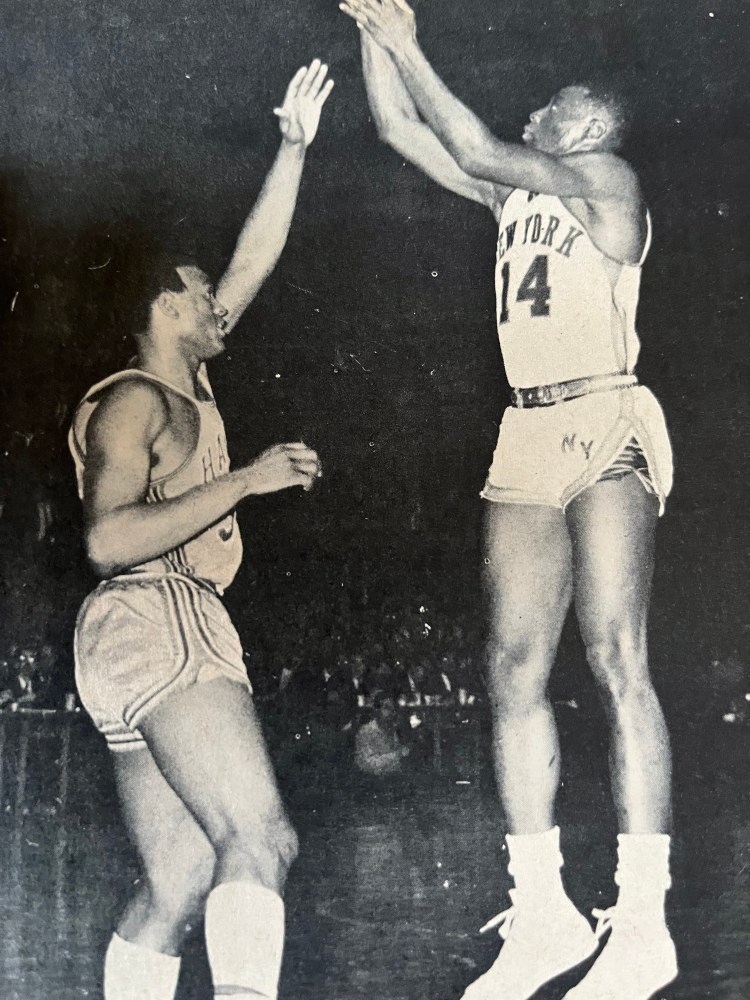
A real student of the game, Russell learned his lessons as he studied the moves of every top cornerman in the league. Explaining his head-to-head confrontations, Russell simply says: “It all comes down to one thing. I’ve just got to keep my man, usually bigger than I am, from getting a lot of points. But I’m ready for that, and it will be for me to execute it.”
Russell, to be sure, did that, and gradually McGuire gave him more and more playing time. “I know I still use him coming off the bench,” McGuire said shortly before being replaced by Red Holzman last December, “but Cazzie gives us depth up front, and he’ll start eventually— depending upon the matchups.”
True to his word, McGuire found the matchups but didn’t instantly put Russell in over his head too soon. “He’d play an Elgin Baylor if I asked him,” McGuire said, “but nobody can stop a superstar like him. You just have to learn to make him work harder for his points—making him take the bad percentage shot.”
Now an advance scout for the Knicks, Mac says: “I not only think he can play the corner, but he more than proved it a year ago. He has the determination to play defense and overall desire, and that’s what makes a star in the NBA.
“He’s a solid shooter, the streaky type—the kind that will hit six, seven, or eight in a row to bust the game wide open. Also, he is unselfish with the ball . . . working that pick-and-roll real good inside with Bellamy and Reed. There’s no question in my mind about his ability to play the corner . . . after all, he proved it last year both in the season and the playoffs.
“Yes, I think he can be a big star, and this season should prove it.”
McGuire, needless to add, is not alone in his prediction. Celtics’ general manager Red Auerbach is another vocal admirer, and Cazzie made a believer out of him a year ago. “Cazzie has the aggressiveness, talent, and guts to do it. I have no doubt he’ll develop into a top-notch player,” Auerbach says, as he views the Knicks as a threat this year in the Eastern Division.
Knicks’ general manager Eddie Donovan and Coach Holzman also figure Cazzie is on the threshold of stardom, but tend to give it the sotto voce approach less they put too much undue pressure on their prized charge. “He developed wonderfully last year,” Donovan is quick to point out, “and we have to think he will continue to mature. He learned a lot in one season in the corner and proved he belonged. But I have to say the Eastern Division is real rugged this year. Boston and Philadelphia are the teams to be beaten, but then don’t forget Detroit, Cincinnati, and Baltimore.
“They all have strong, cornermen and, in most cases, Cazzie will be giving away height and muscle. As a shooter, Cazzie can go with anybody, but that’s only part of playing the corner.”
Holzman, who finished third with the Knicks last year, nodded in agreement and declared: “He proved it last year in the corner and will do it again. He is our hot-handed man in most situations and, although he’s a cut below Dick Van Arsdale on defense right now, he’s a better shooter and will continue to improve.”
Asked if a 6-feet-5 ½ cornerman might tend to flatten out over the demanding pro schedule, Holzman added: “Not really. I know it looked like Van Arsdale wasn’t getting up there with the big guys at the end of last year, but he played most of the last month with a heavy cold that sapped his strength. I think Cazzie will hold up and then some. He’s the real strong type.”
This is the year that is supposed to be for the Knicks and Cazzie, who got off in brilliant fashion in an effort to fulfill those glowing predictions. The Knicks dropped the first two games to the Chicago Bulls and Los Angeles Lakers, respectively, and their confidence was visibly shaken both at the player and the front-office level.
The Knicks had a laugher going against the 76ers when suddenly Jack Ramsay threw a full-court press at the stumbling-all-around New Yorkers. The 15-point lead was wiped out in a matter of four minutes, but the Knicks rallied around Cazzie, who came back in to jam in three jumpers on his patented swing pattern off the corner.
A grateful Holzman said after the game: “It’s one of the best efforts. A lot of guys don’t want the ball in a spot like that, but he wants it. I don’t mind going down the drain with a guy like that shooting the ball.”
Cunningham, who was held to one bucket in 11 attempts by Cazzie, said ruefully: “You have to overplay him so he can’t get the ball. If he gets it, make sure he’s far, far away.”
It’s Cazzie’s Corner now, and the Knicks brass is so impressed that they are even experimenting with Bradley in the corner. A year ago, the Rhodes Scholar from Oxford, by way of Princeton, was as inept as Russell as a rookie. In fact, the speedy backcourtmen went by him so fast Big Bill may well have worn a thermal uniform to escape catching cold.
Can’t you just picture it, Russell and Bradley sharing a corner. Wow, $700,000 worth. Only a team like the Knicks can afford such a luxury.
 From Way Downtown