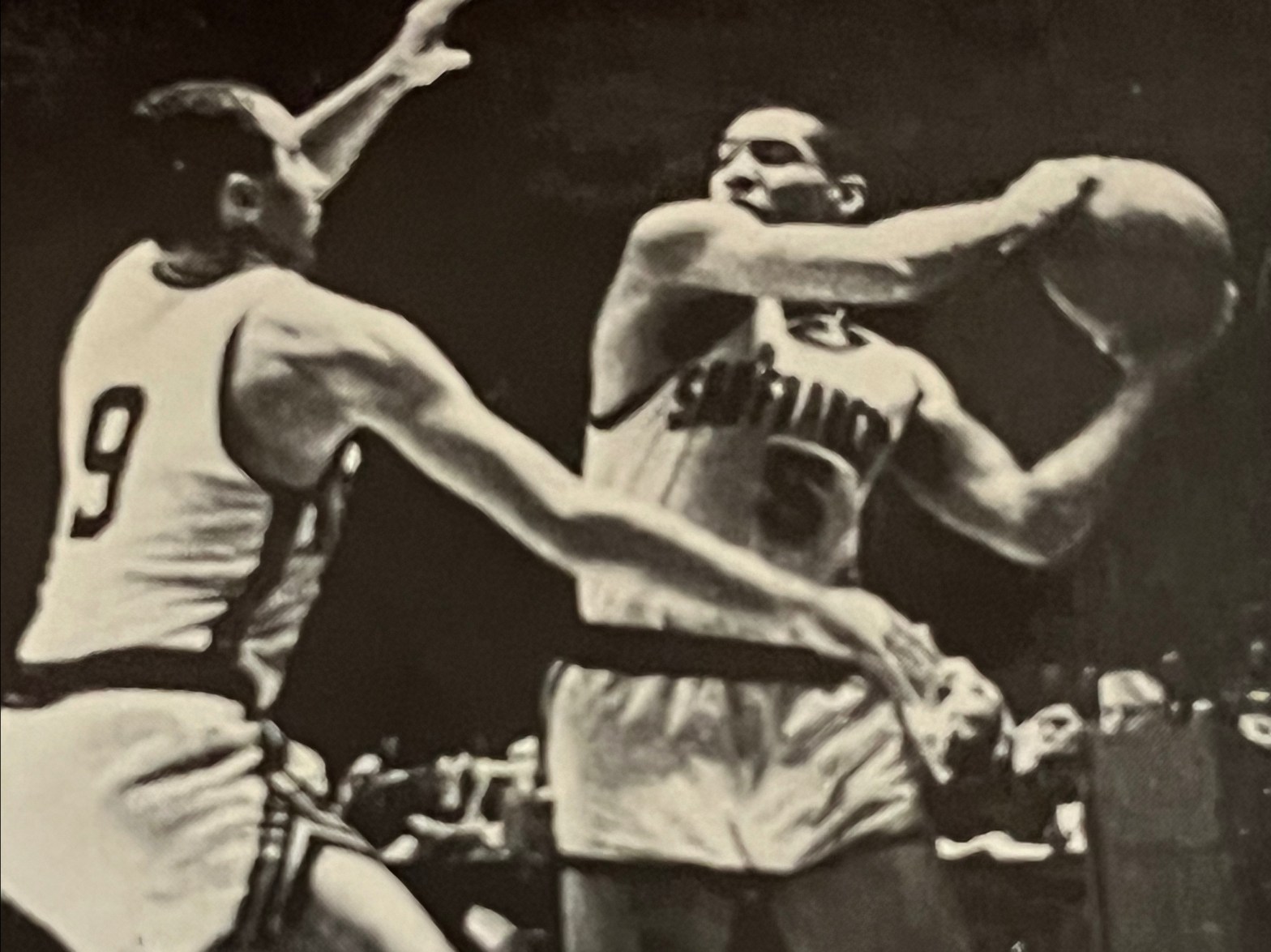
[In September 1964, Guy Rodgers signed his seventh one-year NBA contract with the Warriors., formerly in Philadelphia and now in San Francisco. The news release, without jumping into the terms of the new contract, headed straight for the claim that Rodgers is “described by many as the successor to Bob Cousy.” Rodgers always sidestepped the comparison, always diplomatically. But he was much faster than the thick-legged Cousy and better with the basketball in his hands. His game was very much his own.
That’s also the gist of this brief biography of Rodgers pulled from my dog-eared paperback Basketball Stars of 1965. The high praise for Rodgers is penned by Barry Gottehrer, then with the New York Herald Tribune. Gottehrer was better known for his boxing bylines; but as a native New Yorker, he definitely knew his way around a basketball court, too. A quick final thought on Rodgers. Though he would later average 18 points a game in back-to-back seasons, Rodgers was mired in the 30s from the field throughout his long NBA career. Times, of course, were different back then, and shooting percentages were generally lower. But if Rodgers could have upped his shooting percentage just a bit, popular opinion would have placed Rodgers in a star category all by himself. Nevertheless, he remains one of the game’s all-time great playmakers.]
****
Before Alex Hannum was named coach of the San Francisco Warriors, the team had the most simplified offense in professional basketball. The guards would bring the ball upcourt slowly, dribble a few times, maybe even work a pick, and then pass to Wilt Chamberlain, who, more often than not, would fire away at the basket. Chamberlain got a lot of points. Guard Guy Rodgers, who usually fed the big man, got a lot of assists. And San Francisco (and before that Philadelphia) didn’t win any championships. Under Hannum, Chamberlain still gets a lot of points, and Rodgers still gets a lot of assists, but finally, the Warriors are winning ballgames. Last season, the first under their new coach, the Warriors finished first in the Western Division, two games ahead of the St. Louis Hawks, before losing to the Boston Celtics in the NBA playoff finals.
Among other things, Hannum has made the Warriors run, and the man who makes the team’s fastbreak go is little (6 feet, 185 pounds) Guy Rodgers, who used to be called “Wilt Chamberlain’s caddie.”
“Rodgers is the best fastbreak man in basketball today,” says Coach Hannum. “He’s the guy who’s made our fastbreak a success.”
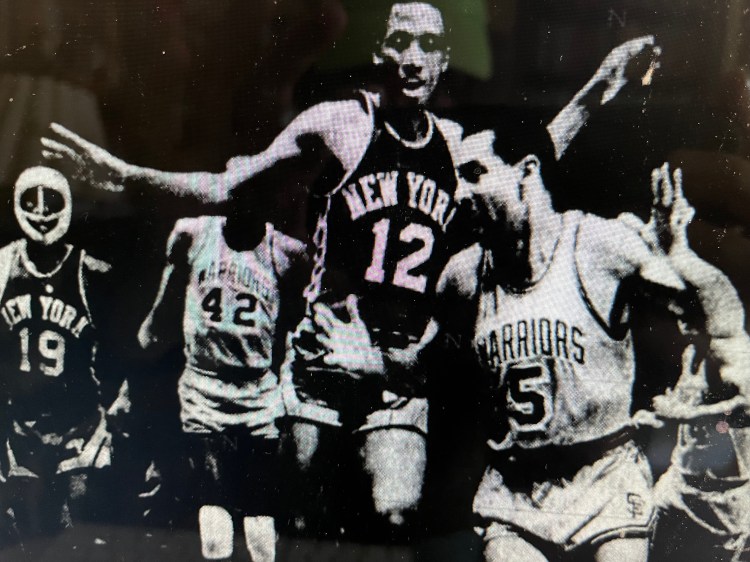
Watching the Warriors’ fastbreak is one of the pure delights offered by the NBA. It starts with Chamberlain or one of the team’s other big men—Wayne Hightower, Nate Thurmond, or Tom Meschery—pulling the ball off the defensive board and firing it to Rodgers, who invariably is in the middle of the court racing toward the other basket.
Changing hands and speeds, occasionally even dribbling behind his back, left-handed Rodgers is a thing of beauty in motion. Most of the time, he will fake a shot, drawing a defensive man out of position, and hit one of the big men with a quick, deadly accurate pass. Occasionally, he will shoot for himself, taking a short one-handed jump shot or driving all the way in for a layup. Last season, his sixth as a pro, was a typical one for Rodgers. He averaged seven assists a game, second only to Oscar Robertson, and 11 points, the fourth-highest average on the Warriors. He has scored more in the past (he had averaged 14.1 in 1962-63), and he has totaled more assists (he had averaged more than 10 a game in 1962-63). But never before had Rodgers been so important to the Warriors’ attack. Hampered by a ruptured blood vessel in his left ankle for a month, Rodgers still flourished under Hannum’s fastbreak and his shuttle system of guards—rotating three men instead of letting two play the full game.
“You know you can give 100 percent and someone will come in and help you,” says Rodgers. “I used to play 42 or 43 minutes a game and, let’s face it, somewhere you had to cheat a little and pace yourself. Now, I can go full speed as long as I’m in there.”
To his teammates and NBA opponents, Rodgers ranks right up at the top of the list with Cousy and Robertson when it comes to passing and dribbling ability. In fact, when he was a backcourt wizard at Temple University, one New York writer, more cynical than his competition, called Rodgers “the 310th college ballplayer to be billed as Cousy.” This was one time where the cynic was wrong. Yet Rodgers himself refuses to place himself in the class with the passing master.
“It’s great to be compared with the best, and Cousy and Oscar Robertson are the best,” he says. “But I do want to say there never was any time when I consciously tried to pattern myself after Cousy. I learned all kinds of things watching him and playing against him, but I wasn’t trying to pattern myself after him.”
Rodgers’ skill as a passing master began rather late. As a youngster in Philadelphia, Guy played considerable football and baseball, but until he was 14, not a single game of basketball. And, if it weren’t for the fact that a bunch of his friends didn’t show up for a football game one day, Rodgers still might never have played basketball.
”It’s kind of funny when I think back now,” he says. “I was supposed to play football with the kids one day and went out and waited for them. Some of them showed up, but we didn’t have enough guys for a game. So, I started home.”
On the way home, Rodgers just happened to walk by the playground. A friend, some five years his senior, just happened to be playing basketball. “He was shooting baskets and playing some,” says Rodgers, “and I asked him if he’d show me how to dribble and shoot. That day and later on, he taught me to dribble, to fake, and to shoot a layup. I really enjoyed it. I’d just dribble and pass and, once in a while, I’d take my little layup.”
It wasn’t long before basketball became something of an obsession for Rodgers. Day after day and hour after hour, even before he began to play in actual games, he would go off by himself and practice his dribbling and ball control. By the time he started playing competitive basketball in high school, he was already far advanced as a playmaker.
Though he also played baseball in high school, Rodgers concentrated fully on basketball at Temple, where he became one of the highest-scoring backcourtmen in the college game. He scored 278, 573, 581, and 603 points in four college seasons, picked up a record 20 assists in one game against SMU, led Temple to 74 victories in 90 games, and won the Most Valuable Player award in the college all-star games in Madison Square Garden and Kansas City. He was so good, in fact, that Kentucky coach Adolph Rupp jokingly offered to give Guy a degree on the spot from his university if he’d be willing to leave Temple before his senior season.
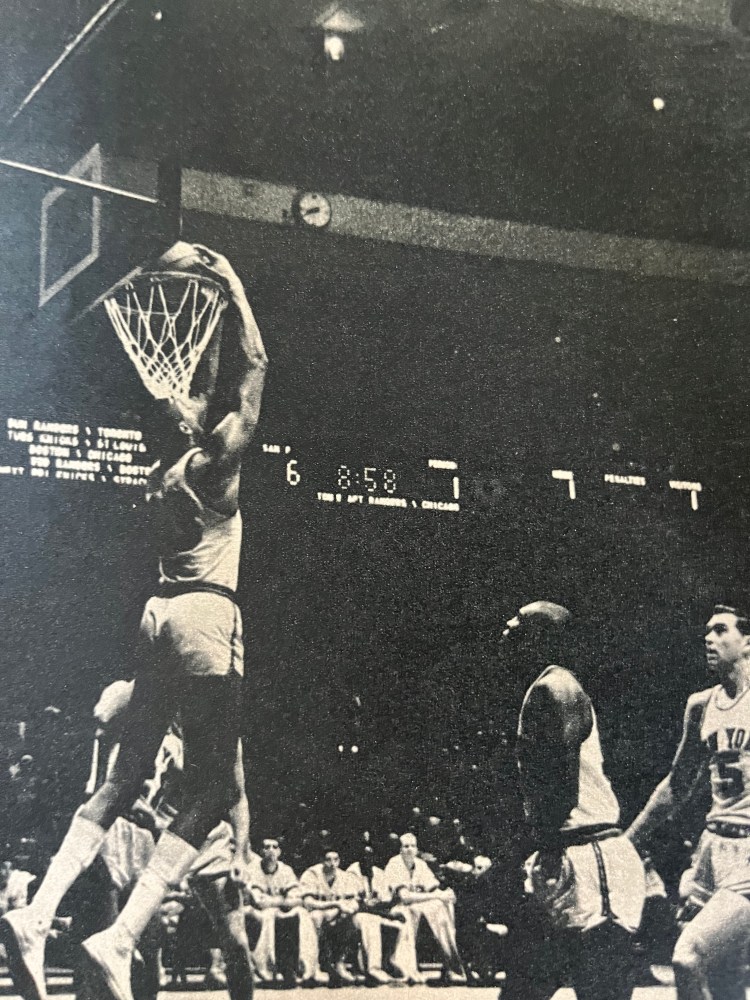
Bright, humorous, and articulate, Rodgers stayed at Temple long enough to earn his degree and frequently returns to chat with his former coach Harry Litwack. “In planning to become a coach, I want to know if Mr. Litwack agrees with some of my observations,” says 29-year-old Rodgers. “He’s taught me so much already, I am eager to see how much more he can help me.”
For Rodgers, the step from college to professional basketball was natural, and no one was surprised when he signed to play with his hometown Philadelphia Warriors. As a rookie in 1958-59, his first and last without Wilt Chamberlain as a teammate, Guy averaged 10.7 points a game and picked up 261 assists as the Warriors finished last in the East. By the next season, with Chamberlain playing professionally, Rodgers’ life and the NBA were both entirely different. “Wow,” said Rodgers the first time he saw Wilt, “a Watusi warrior.” Today, Chamberlain, and Rodgers are close friends, both well aware of the others special abilities. “Wilt’s the best,” says Rodgers. “He’s revolutionized the game.”
“You can’t realize how good Guy is until you play with him,” says Chamberlain. “All you got to do is get free, and he’ll get the ball to you somehow.”
Rodgers’ only disappointment as a pro came when the franchise was moved from his hometown, where he still lives in the offseason, to San Francisco two years ago. But now that the team is finally winning and a strong contender for the title this season, Rodgers is delighted he’s still a Warrior.
“I know we’ve got a real good club, and I know we can win,” he says. “Hannum is the greatest coach I’ve ever played for. He works us hard before the season begins and once it starts, too. But this is what you need if you want to be contenders. I’ve had a lot of fine coaches, but Hannum is the best. We all feel that way.”
So do a great many other basketball experts who picked the Warriors as the league’s coming powerhouse. Yet, even if they don’t make it all the way to the top of the NBA this season, it won’t be because of Guy “Flip” Rodgers. “Guy gets his job done,” says Hannum—and that more than anything else tells the basketball story of San Francisco’s little backcourtman.
 From Way Downtown