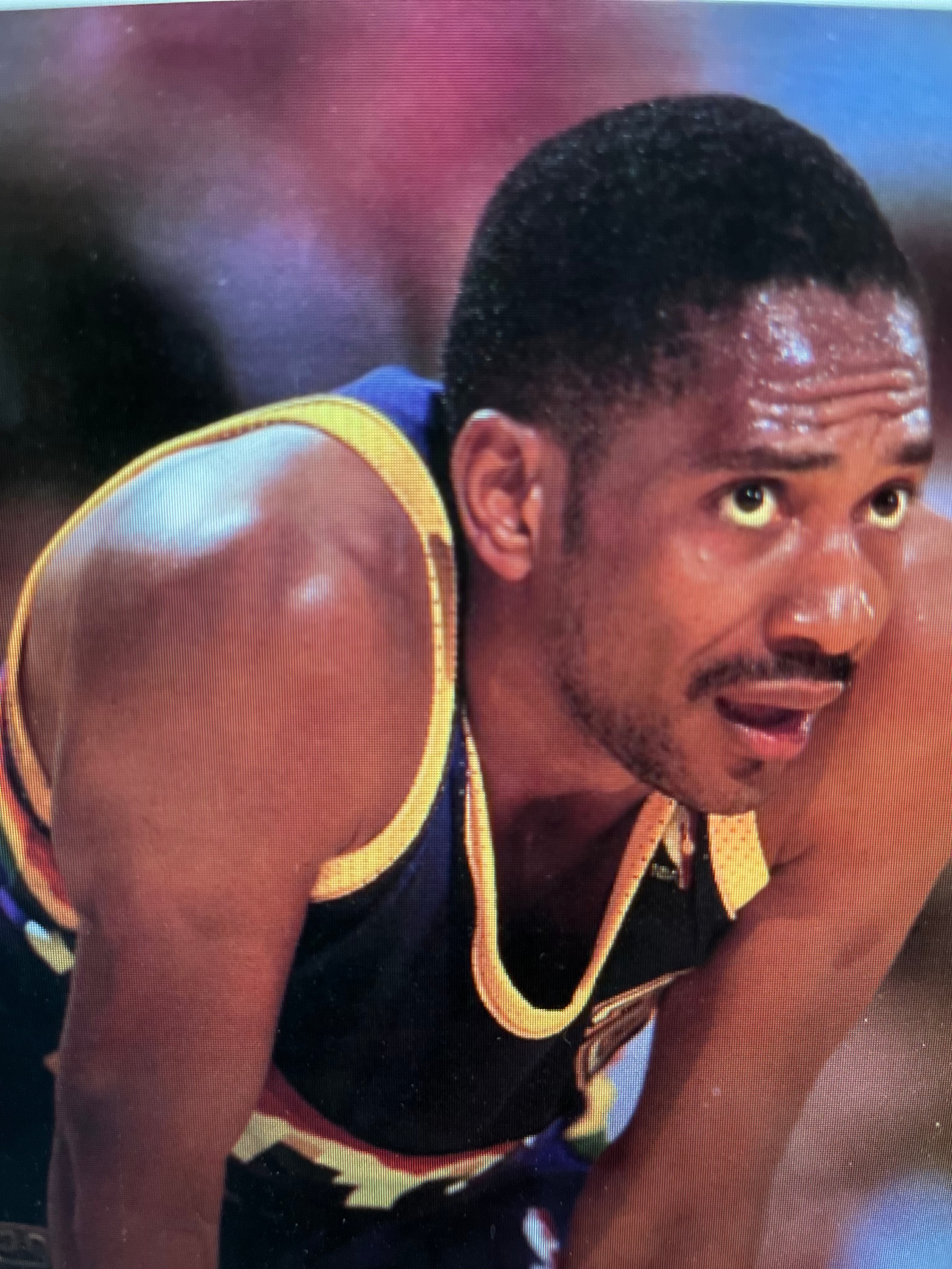
[I didn’t catch a lot of Alex English’s poetry in motion back in the proverbial day. Denver wasn’t on television much as I bounced around the country getting my college degrees. The little that I did see was long, lean, smooth, steady, consistent, graceful, athletic, potent from midrange, and just a unique player. In fact, little known to most, he was the highest NBA scorer of the 1980s. English also sounds like a first-class person off the court. The latter I’ve gleaned from this brief writeup, published in Street & Smith’s 1989 Pro Basketball Annual, by one of my favorite basketball scribe Fran Blinebury. He did such a great job writing these one-page NBA player profiles. Take a look. Tell me what you think about poetry in motion.]
****
At its best, the English language is poetry. At his best, Alex English is poetry in motion. Now you take the best of both, roll them together, and what you get is the sweetest of basketball players, whose unorthodox moves and off-balance jumpers would probably be best described in a rhymed couplet by Shakespeare.
Just how do you paint a word picture of English’s impact on the game? Gentle? Smooth? Quiet? How about enduring?
Indeed, more than anything else, it may be the way English has continued to produce and produce for such a long period of time as the hub of the Denver Nuggets’ always-turning wheel that deserves the most notice.
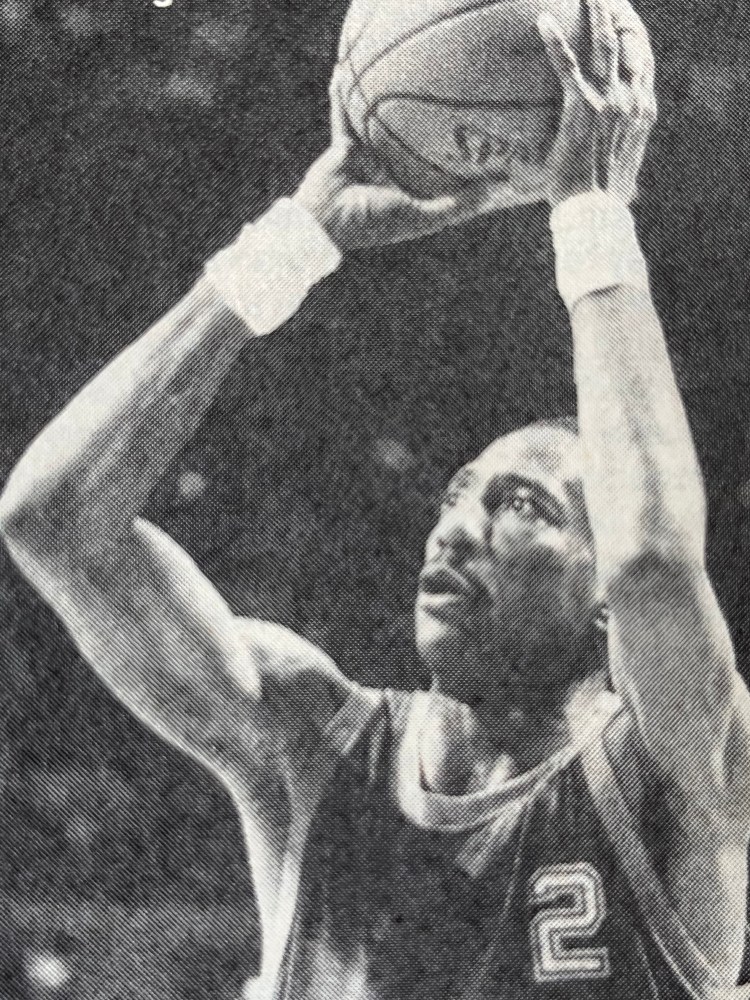
Last season, English became the first player in NBA history to score more than 2,000 points for eight straight years. The funny thing is that for about the previous five seasons, critics and impassioned observers alike were saying that English was too old to survive, let alone thrive in the fast-paced, high-pressure NBA.
“I can only think of a handful of players who have maintained [their] talent level for so long,” says Nuggets coach Doug Moe, who is hardly free with his compliments. “In that category, we’re talking about John Havlicek, Dr. J, maybe Jerry West. So many others have dropped off dramatically once they got older.
“To even be in that category, you have to have talent, durability, and the will to go on. Alex has all three. To tell you the truth, I can’t think of anyone who has maintained his level of excellence. Kareem Abdul-Jabbar was 41 going into his last season, but what Alex is doing now (at 35) is every bit as impressive.
“With our running game, Alex is playing at a pace that not many have played at. L.A. plays a running game, but since Kareem was a center, he didn’t have to get up and down the court as much.”
But English always seems to be there, filling a lane on the fastbreak, and knocking in a jumper from the wing, or popping up through an opening in the defense and hitting one of his leaning shots from the baseline.
English attributes his longevity to several factors, including diet, vitamins, stretching exercises, and avoiding injuries. He regularly takes an herb that he says builds stamina. But it is more than consuming the proper vitamins and diet that enables him to succeed.
“Maybe it’s my upbringing,” English says. “I’m a country boy from the South, and we keep driving to prove ourselves. Because of social influences that were not really positive, we just developed a kind of will. It became ingrained to work hard and keep working.”
And it became second nature to English to keep expanding his horizons. How many other NBA players do you know who have published books of their own poetry? How many other high-scoring forwards have starred in an anti-nuclear film?
During the offseason, when he isn’t keeping his jumper in shape or doing long-distance running to maintain his conditioning, you can find English spending time in English classes in elementary and high schools in and around Denver. He has his own crusade to promote literacy. English tells the students he meets of his childhood in Columbia, South Carolina. He informs them that he first became so interested in reading books, because it was the only kind of entertainment his family could afford.
“Believe it or not, I was once your size and age,” he’ll tell a class. “When I was young, I was also very poor, and I didn’t get a chance to go out to the movies, to go bowling, to go to Disney World. But the type of entertainment I found was real cheap and could take me anywhere: reading. Other than basketball, it was my escape.”
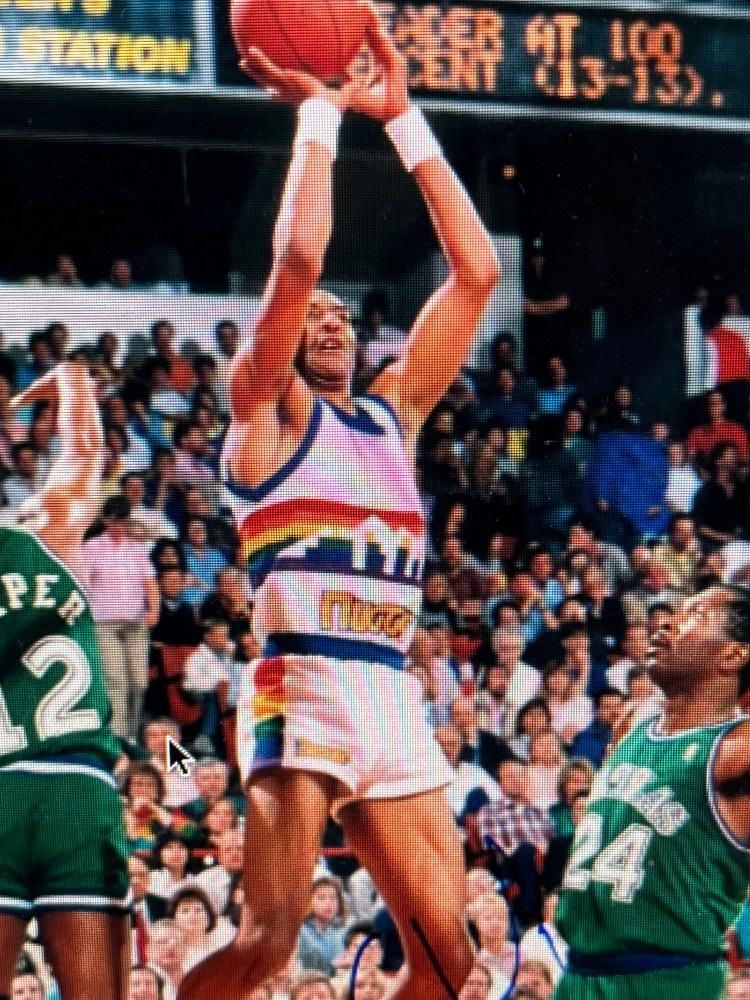
English majored in English at the University of South Carolina, where he developed an interest in the poetry of Robert Frost. From Frost, he says, he learned that no subject is beyond a poet’s reach. “I write about friendship, kids like you, and social issues,” he tells the classes.
Many of the works in English’s three published books of poetry are very personal. “I write when I’m inspired,” he explains.
And English plays night after night like he is guided by that inspiration, despite a slow start to his pro career. A second-round draft choice of the Milwaukee Bucks in 1976, English bounced first to Indiana and did not average 20 points a game until his fifth pro season when a trade for George McGinnis finally brought him to the Rocky Mountains. He’s been performing at a level that’s higher than Pike’s Peak ever since.
A couple of years ago, English broke another of the traditional athlete’s molds and starred in a Hollywood film with Gregory Peck and Jamie Lee Curtis. In The Amazing Grace and Chuck, English portrayed a star member of the Boston Celtics who gives up his pro career to protest nuclear arms.
“I read the script and fell in love with the story,” English says. “I was in L.A. for a playoff series and decided I would read for the part. About a week later, they called and said I had the job. It was that easy.”
Which is not something that often happens to English on the hardwood floor with a ball in his hands. He doesn’t dribble the ball as much as he babies it and caresses it to get just the right feel. He’ll weave and cut through Moe’s motion offense and, all of a sudden, you’ll see him all alone and spotting up for a jumper. Or the defense will have collapsed all around him, and somehow, someway, English will twist and turn and double-pump his body until he’ll be able to get off a shot with several people hanging from his arms. And it will go in. It always seems to go in.
That’s the amazing thing about English. His body with the arms and legs that look like pipe cleaners sticking out of a lean torso, doesn’t look like it would hold up in this very physical game. His stride is that of a sprinter who can easily beat everybody else up and down the floor. His shot—usually leaning to one side with his arms, looking like they’re already fully extended when he catches the ball—is not something that you would teach in a clinic.
But in the past eight seasons, English has never shot lower than .491 from the field, and his scoring average has never dipped below 25 points per game in the last seven seasons. He led the NBA in scoring in 1983 and looks like he might be capable of doing it again in 1993.
“In the NBA, there are so many different variables that can affect a team through a long season,” says Moe. “You have injuries and sickness, guys with personal problems, and guys who are in slumps. One little thing can throw your whole team completely out of sync.
“That’s why it’s so great to have a player like Alex. He takes care of himself and takes care of his job, so as a coach, that is one less thing that you’ve got to be concerned with. You know that every night when you show up at the game, Alex English will give you the same thing.”
Lots of points and poetry in motion.
 From Way Downtown