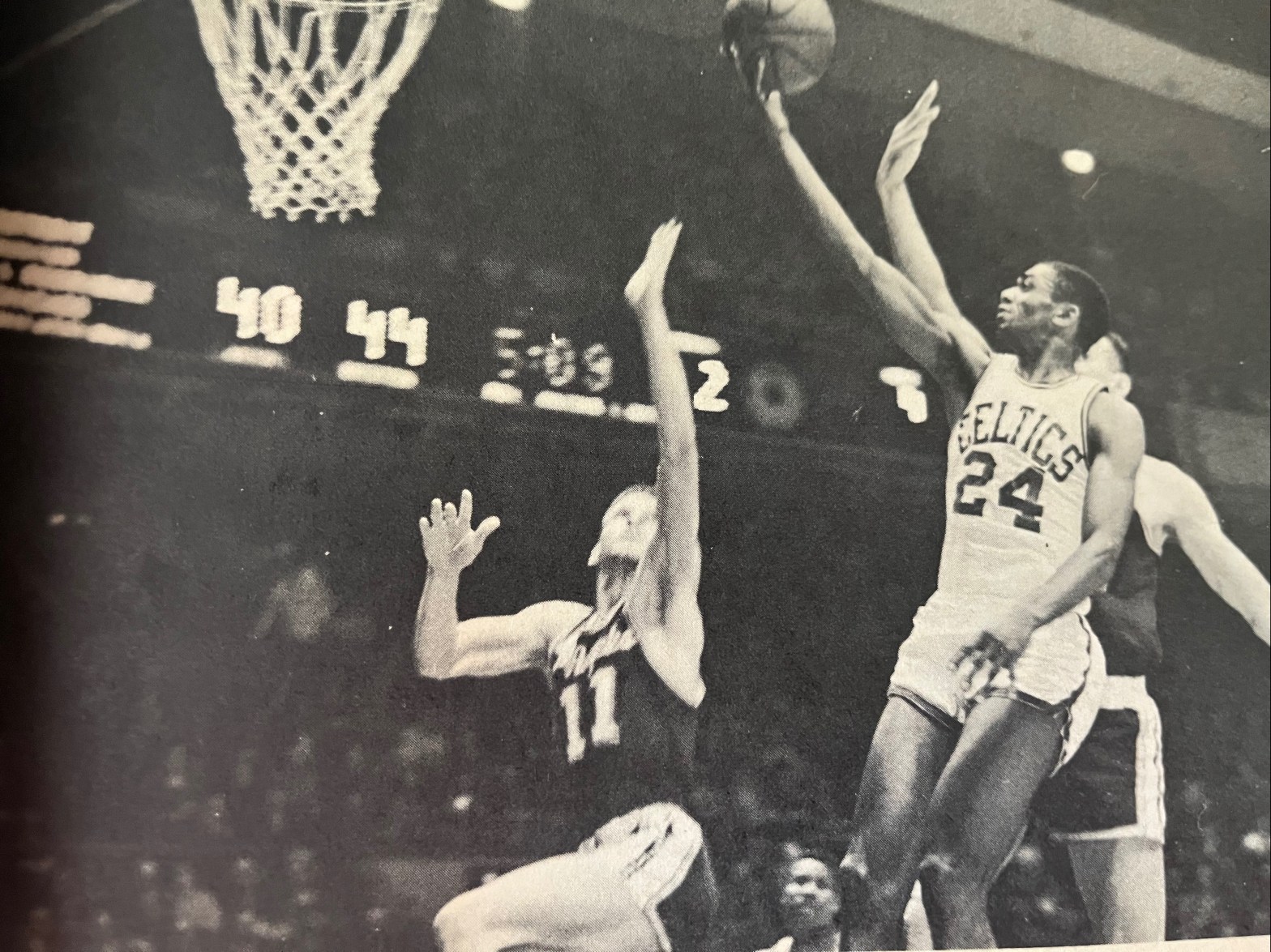
[Since my last post went way downtown to Bob Cousy, let’s keep going into some Sam Jones. He was something else. I can still vividly recall him banking in his 15-footers, part human, part machine. This opening vignette, which ran in the January 1966 issue of the magazine Dell Sports sans a byline, is admittedly too creative in places and a little mixed in its metaphors. Nevertheless, the vignette is still a fun read, and the writer does capture number 24 quite well in 600 words or less.]
****
Thirty years ago, Charlie Chaplin made a movie called Modern Times. In a classic depiction of the Machine Age madness, he was, in one scene, strapped to his place in the assembly line, while a contraption fed him lunch, so that his hands could be free to keep working. Inevitably, the gadget ran out of control and started pushing food into his mouth faster than he could swallow it—and when a couple of loose bolts landed on the plate, they were shoved in also, indiscriminately, along with the food morsels.
That machine, running wild, was also a prophetic description of Sam Jones shoveling jump shots through NBA hoops like a runaway cash register. Sam is the cash register of the Boston Celtics in several senses.
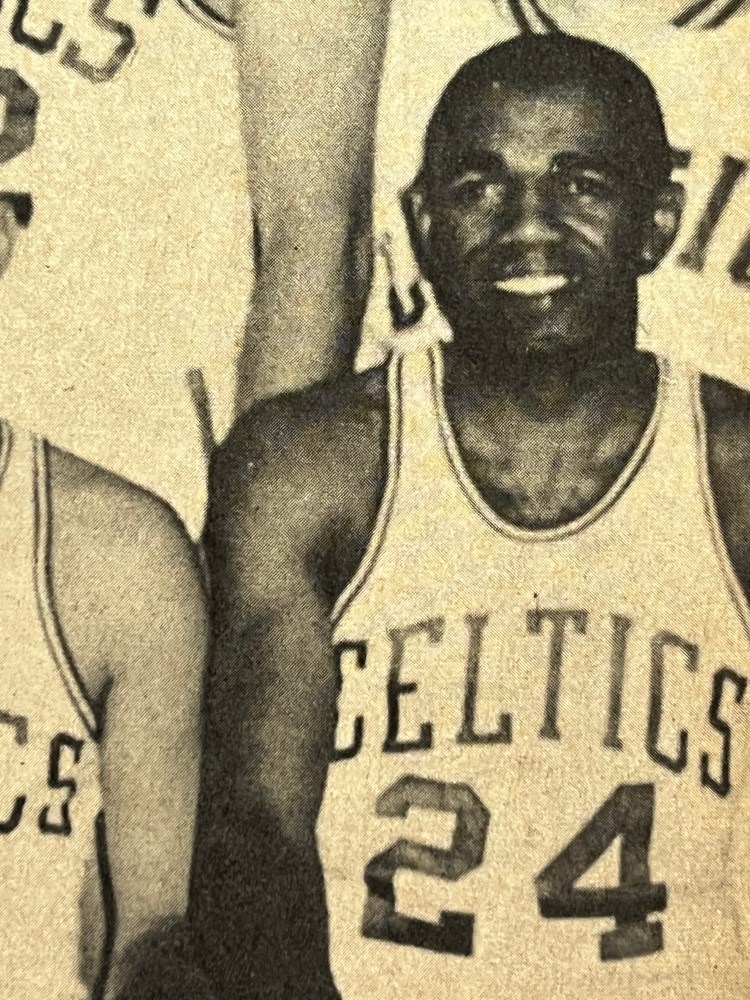
While everyone agrees that Bill Russell is the indispensable man to Boston’s string of championships, Sam has been pretty indispensable too the last couple of years. Of course, it’s vital to the Boston system to have Russell block shots and trigger the fastbreak. But it all comes to nothing unless someone cashes in the basket at the other end.
Well, Sam is the Celtics’ No. 1 casher-inner, a position he has acquired gradually. It used to be Bill Sharman and Bob Cousy. When Sharman retired, there were many people who were sure Cousy’s game would suffer and the Celtics reign would be threatened. But Sam moved into Sharman’s spot, and Cousy found him every bit as efficient a partner.
Then Cousy retired, and that was supposed to trip up the Celtics, because now they had no backcourt. But it turned out that Sam could simply play a few minutes longer, take a few more shots, push his per-game scoring average up a few notches (from the 14 level to the 19 level), and the Boston attack never noticed the difference.
Last year, Sam shifted into overdrive. He averaged 25.9 points a game, played in all 80, and wound up with 2,070 points, fourth in the league. And it is obvious he was cruising, since Boston won its divisional title by 14 games. Sam was needed for only 36 minutes a game; if he had played 45 minutes or so, he certainly would have averaged 30 points.
Unlike West and Robertson, however, Sam doesn’t have the all-round skills to the highest degree. He can’t set up plays the way they can or be as effective on defense. At his specialty, however, he is incomparable—and his specialty is putting the ball through the hoop.
Speed and touch, that’s all it takes, and Sam has developed these gifts to the highest degree by endless work and gradual improvement over an eight-year career. No one can break up a game more thoroughly in a short space of time, with half a dozen or more consecutive baskets on acrobatic jump shots (from short or medium range) and layups.
Sam is basketball’s best equivalent of baseball’s streak hitter. He catches fire, and his bursts are the backbone of Boston’s “big innings.”
Sam is 32 years old now, but there was no indication last year that his speed was diminishing, while his skills and confidence rose to new heights. As long as Russell remains to fire the gun, Sam will be the barrel guiding the bullet to its target—and the Celtics to more titles.
[On October 29, 1965, Jones went off for 51 points, reportedly tying Bob Cousy for the Celtics’ individual one-game scoring record. Unfortunately, the Celtics played in Detroit that night, and they lost. The coverage of the game in Boston was lacking, and the Detroit papers focused on a rare Pistons’ win over Boston. In short, Jones’ big night is pretty much lost in time and print. But I’ve pulled together this composite newspaper clip, which mostly builds off of the story filed by the Detroit Free Press’ great Jack Saylor. Other sources include the Boston Globe and the Associated Press.]

Twas the eve of Halloween, and the Boston Celtics’ treat turned into a trick Friday night. The Detroit Pistons were sour pumpkins.
Ray Scott’s jump shot with three seconds left gave the Pistons a comeback 108-106 victory over the world-champion Celtics before a howling crowd of 4,270 at Cobo Arena. The victory was the first for Detroit over the Celtics since February 24, 1964 and ended a frustrating string of 14 straight losses to the perennial champs.
It also nullified a 51-point performance by the Celtics’ Sam Jones. He meshed 21 of his 35 shots, while also going 9-for-9 from the free-throw line, in setting Boston’s single-game scoring record.
Since it was Halloween, the Pistons didn’t figure to have a ghost of a chance—especially with Jones “goblin” up points like they were going out of style. But the Pistons had a shooter, too. Eddie Miles tossing in his career high of 36 points—25 of them coming in the second half as the Pistons battled back to set the stage for Scott’s game winner.
It was a game in which fouls—especially two technicals—played a key role. Sam Jones thought he was fouled in the process of making two of his 22 points in the first half. He let referee Willie Smith know it and was tagged with a technical.
The call goaded Jones—and the Celts—into a 40-point second quarter that earned a 60-48 halftime lead. Jones finished with 16 points in the second period.
The Pistons, meanwhile, were carrying on a running feud with Smith’s running mate, Paul Ruddy, which concluded with [Detroit’s player-coach] Dave DeBusschere drawing a technical in the third period.
The technical left Detroit 15 points down, but the Pistons, over a series of bad passes and floor errors, started to play better and trimmed back the Boston margin. The Celtics, however, spurted again to lead by 13 early in the final quarter, but in the process John Havlicek and Satch Sanders fouled out.
A pair of baskets by Miles and another by Bill Buntin gave the Pistons a 103-98 lead. But it melted under the hot shooting of Jones. He hit two jumpers and teammate Willie Naulls made one to pull the Celts to within two.
Jones came through again with 16 seconds to go on a push shot from the left of the key that tied the count at 106-106 with 19 seconds left. Detroit called timeout Then Scott drilled home the big one that haunted the Celtics to the final buzzer.
 From Way Downtown