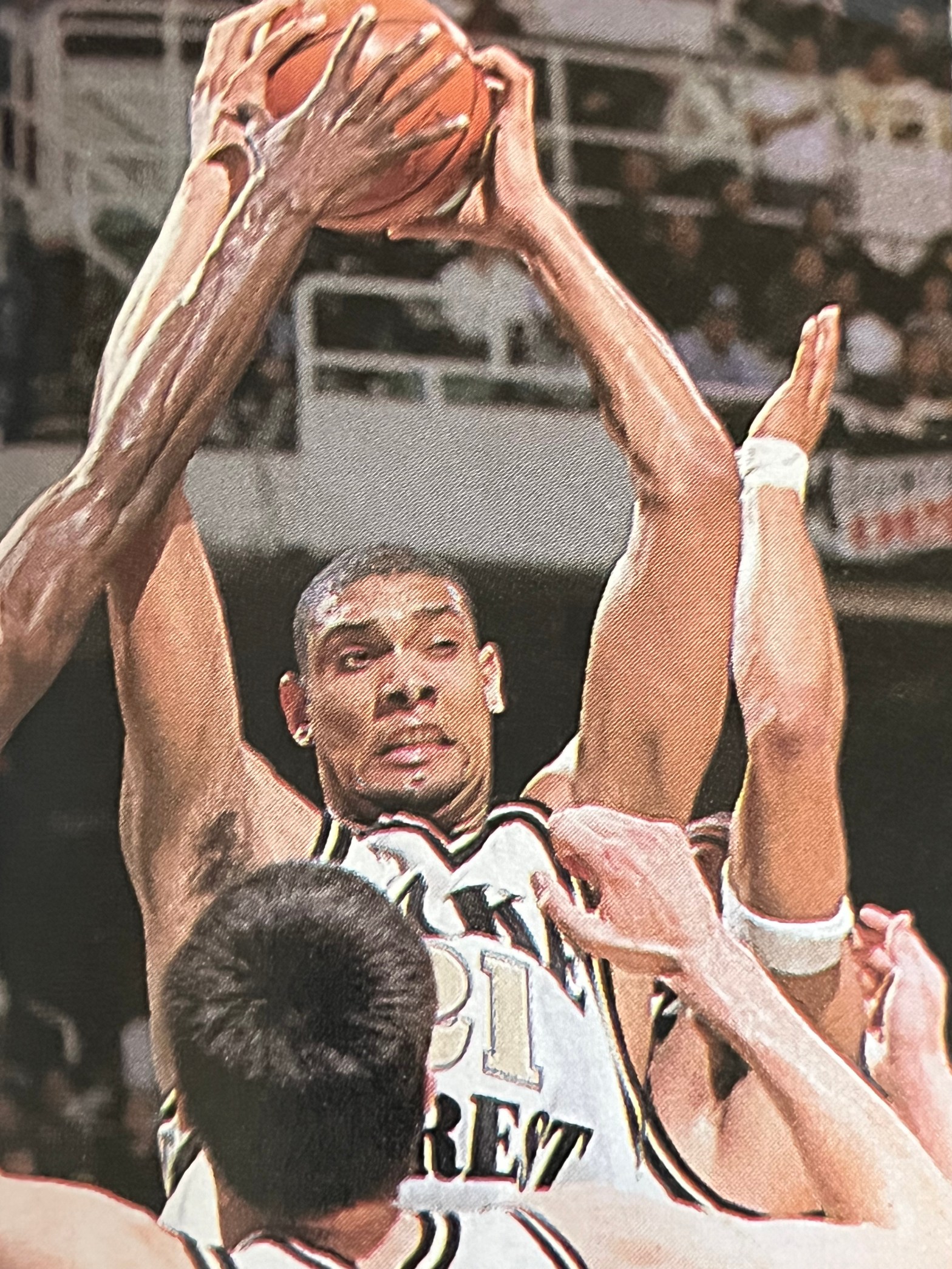
[No intro needed for the great Tim Duncan. Except to say this story, published in the July 1997 issue of SPORT Magazine, is real nicely done and well worth reading to remember Tim Duncan and all of the expectations awaiting him into the NBA as the top pick in the 1997 draft. At the keyboard is Darryl Howerton, who continued on covering the NBA and today runs a production company in Fresno. So, here you go. Tim Duncan, a few weeks away from becoming a San Antonio Spur. The Can’t-Miss Kid.]
****
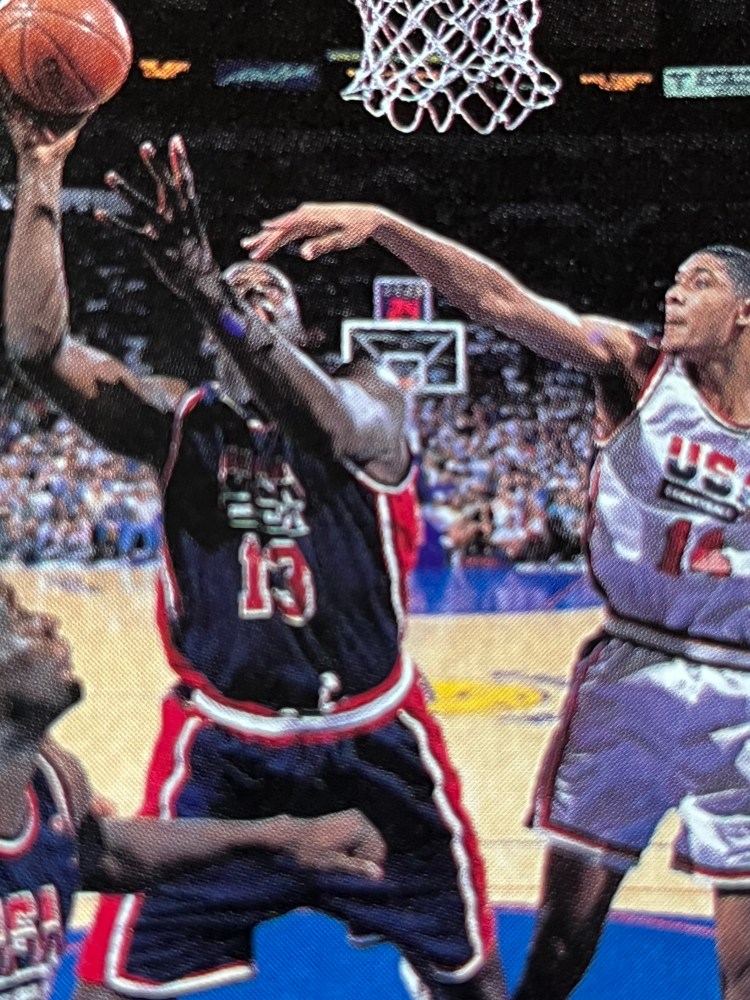
I’ll never forget the first time. Nor will anyone else forget the moment an 18-year-old boy named Tim Duncan first tangled with the NBA’s Goliaths. It was at the Oakland Coliseum on July 31, 1994, in an exhibition game set up by USA Basketball between a team of college all-stars and Dream Team II. That’s when a little-known 6-10, 230-pound kid with one year of experience at Wake Forest became not so little-known anymore.
With about 11 minutes to go in the first half, Duncan enter the game to match up with 7-0, 300-pound Shaquille O’Neal. Mismatch, you say? Only on paper. The hardwood told an entirely different story.
In a five-play sequence forever etched in the memory of those who saw it, Duncan made a five-foot jump-hook over O’Neal, blocked a Shaq shot (despite what the official stats read), drilled a 17-footer, grabbed a defensive rebound, and capped off the sequence with a perimeter lift-fake that not only sprung O’Neal skyward, but left a clear path to the hoop for an apparent Duncan dunk . . . until Shaq’s teammate Larry Johnson came crashing down on the airborne Duncan with a hard foul, sending the young center to the floor and the free-throw line.
That sequence was enough, as the deodorant commercial says, to make a good first impression on everyone. “He caught my eye,” Shaq said afterward. “He’s gonna be good,” opined Alonzo Mourning. NBA scouts circled the kid’s name in their programs. That summer night, Tim Duncan had arrived.
Nearly three years later, it’s revealing to go back in time and hear Duncan’s postgame interview.
What’d you learn?
“They have a lot of tactics. Just the little things they do. They’re so strong. Little moves they’re doing to keep you away from getting to where you want to go.
Like what?
Like maybe holding onto your arm when you were going through a screen, so you can’t roll. Little things. They’re so strong. I have to get a lot stronger. I know what I have to work for.
Do you think your life has changed because of this game?
“Uh, I don’t know. Whatever happens, happens. I’ll take it as it comes.”
****
Fast-forward to April 1997. Whatever happens, happened. Tim Duncan’s life has changed in a big way. On April 4 and 5, he flew coast-to-coast-to-coast, from Durham, N.C. to L.A. to Atlanta, to accept the John R. Wooden and James A. Naismith awards as the consensus best player in college basketball, closing the book on an illustrious NCAA career. On April 9, he opened the book on a soon-to-be illustrious NBA career, interviewing prospective agents in his Durham apartment to determine who will be his business partners for the next dozen-or-so years.
On April 10, he scheduled a Nike visit to determine his future footwear. On April 14, Duncan stopped by the Wake Forest sports information office to pick up numerous messages: There was a note from Spike Lee regarding an upcoming movie project; there was a request from a local comedian who wanted Duncan to appear in his act.
For the rest of April and most of May, Duncan waded through piles of requests. On May 25, he turned 21, legally coming of age. On June 25, exactly one month following his birthday, the Wake Forest center will come of age in a different sense as commissioner David Stern announces Duncan as the No. 1 pick in the 1997 draft.
If he hadn’t truly “arrived” back on that summer night in 1994, he most certainly has by now. No longer the wide-eyed, unassuming teenager from the Virgin Islands. Duncan just shakes his head and throws up his hands in amazement at what his life is becoming. The 21-year-old is asked how he got himself in a position to be the first player taken in the draft. His reply is simple yet telling: “It’s because of the little things.”
The little things.
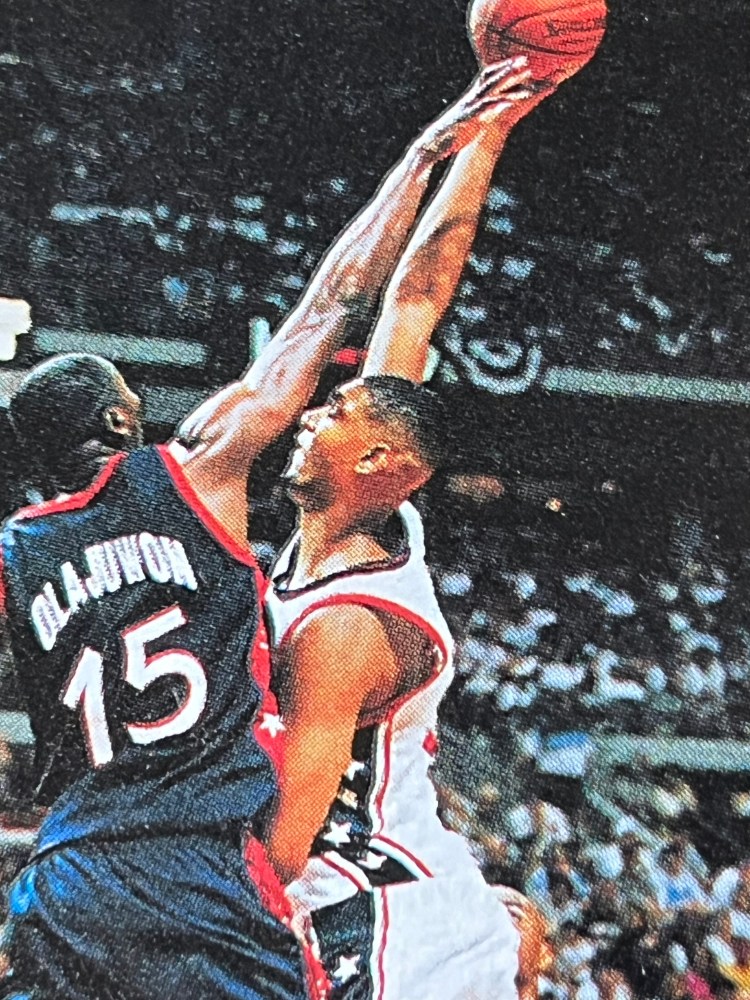
Past No. 1 picks who manned the post were great for one reason: They were big. They played big, acted big. The NBA drooled over incoming centers Shaq, David Robinson, Hakeem Olajuwon, and Patrick Ewing—all No. 1 picks—because they each cast an imposing presence due to the statures: Shaq was the humongous physical specimen; Robinson had height combined with incredible athleticism: Olajuwon coupled nimbleness with wingspan; Ewing had the intimidating build to match his menacing stare.
Duncan? His game Is more skill, more mental, more diverse. He has the little things. The sum of those intricacies makes him a great passer, rebounder, scorer, dribbler, and defender. Duncan won the NCAA Defensive Player of the Year award an unprecedented three consecutive times. Sure, he was listed at 6-10, 248 pounds at Wake Forest, a size that puts him in the same area code as Olajuwon, Robinson, and Ewing. But Duncan became such the force in college because, by doing the little things, he was able to mask his phenomenal skills in the role of an unassuming hero.
“Most fans have no idea how dominating he is in every facet of the game, simply because he doesn’t scream with every block, trash-talk with every point, or throw elbows with every rebound,” says Ed Gregory, Golden State Warriors director of player personnel. “Look at the stat sheet. He fills it up and does it unselfishly.”
Adds Toronto Raptors scouting director Jim Kelly: “It’s almost like Tim Duncan would rather keep his skills a secret and surprise you with little nuances of his game in the actual game he’s playing. And this from Sacramento Kings scout Scotty Stirling: “Take his height, for instance. He’s been listed at 6-10 since he was a freshman at Wake. You can’t tell me he’s not a legit 7-footer by now. He’d rather have opponents think he was still 6-10.”
Nonetheless, critics invent flaws in his game by claiming that Duncan either “doesn’t appear to be emotional enough” or that he “isn’t tough enough.” Therein lies the secret to Duncan’s success.
“When he gets you thinking that way, he’s got you fooled,” says a laughing Dave Odom. Duncan’s coach for four years at Wake Forest. “He has fooled a lot of critics. In my 31 years of coaching, I’ve never met a more fierce competitor, a player who gives you more every day than Tim—in every challenge, whether it be practice, game preparation through film and scouting reports, or the game itself.
“People don’t believe me when I tell them he never missed a practice. Never. The biggest problem I had with him, unlike other players of his caliber, was keeping him out of practice—trying to save his legs for the game. He thinks every minute not spent working on his game is a minute lost, and he’ll never get it back.”
Greg Newton of Duke got a lot of publicity in Atlantic Coast Conference circles by claiming he knew how to shut down Duncan. “You’ve got to be physical with him,” he’d say. “He can’t play physical.” Reporters would go cross-state to Duncan, relaying Newton’s quotes, hoping to start a verbal war that would proceed the physical one. Problem was, “Peace be to Greg Newton,” was Duncan’s typical response. When pressed for his opinion on Newton’s game, Duncan would reply, “I think he’s the best player I’ve ever seen.”
“He’d totally defuse the situation,” says Dan Collins, a Winston-Salem Journal reporter who covered Wake Forest. “He showed a maturity beyond his years off the court, then outplayed Newton on it.” Things got so bad for Newton in his head-to-head battles with Duncan that Duke coach Mike Krzyzewski only played his big man for six minutes in the last game between the rivals.
Discloses Rick Lowery, Duncan’s brother-in-law: “Timmy would only say: ‘Where’s Newton now? What did he do this year?’ He just faded out. Physical games don’t bother Timmy. And you can’t get to him with mental games either. People gotta realize Timmy’s a situational ballplayer. He’s not going to play your mental or physical games. His job is to get you in a situation that he’s comfortable with. Playing against the Dream Team centers the past few summers did wonders for his game in that area.”
Duncan, a psychology major, estimates that perhaps 80 percent of his game is mental. Much as pitcher Greg Maddux likes to keep a low profile on his knowledge of baseball, Duncan is equally low key. When asked about his propensity for blocking shots by feigning to be out of position, Duncan slightly smiles before revealing, “I block shots well, so sometimes, depending on who the player is, you can lure them in and get them to take a shot over you that you can affect in some way.”
Other secrets? He’s not talking. “It’s just a bunch of little things you learn day-to-day,” he says, “body, leverage, positioning, stuff like that.”
When pressed, he only offers this, “I know I needed to learn a lot more at the next level. A lot more. The more I watch experienced players, the more I realize, if I play like that, if I gain an advantage, my skills can allow me to do a lot more things.”
He’s learned that the jump-hook he gets off on O’Neal gets swatted by Olajuwon. He’s learned that to have a chance against Shaq, he must get his shot up quickly. He’s learned he must get quick, big men like Robinson off their feet before he makes his move. He’s learned he can compete with the big boys, but dominating them is a different story.
“Timmy sees the game differently than most,” says Odom. “That’s what happens to someone who studies and loves the game as much as he does. He is his worst critic. That’s why outside criticism never bothers him. I tell ya, Tim is a dream to coach because as smart as he is and as great as he is, he still realizes he has a lot to learn. You don’t see that too often in young players these days.”
 From Way Downtown
Tim Duncan is ans will always be my favorite bass player, hands down..I miss you Tim…all the best to you and your family..Angela
LikeLike