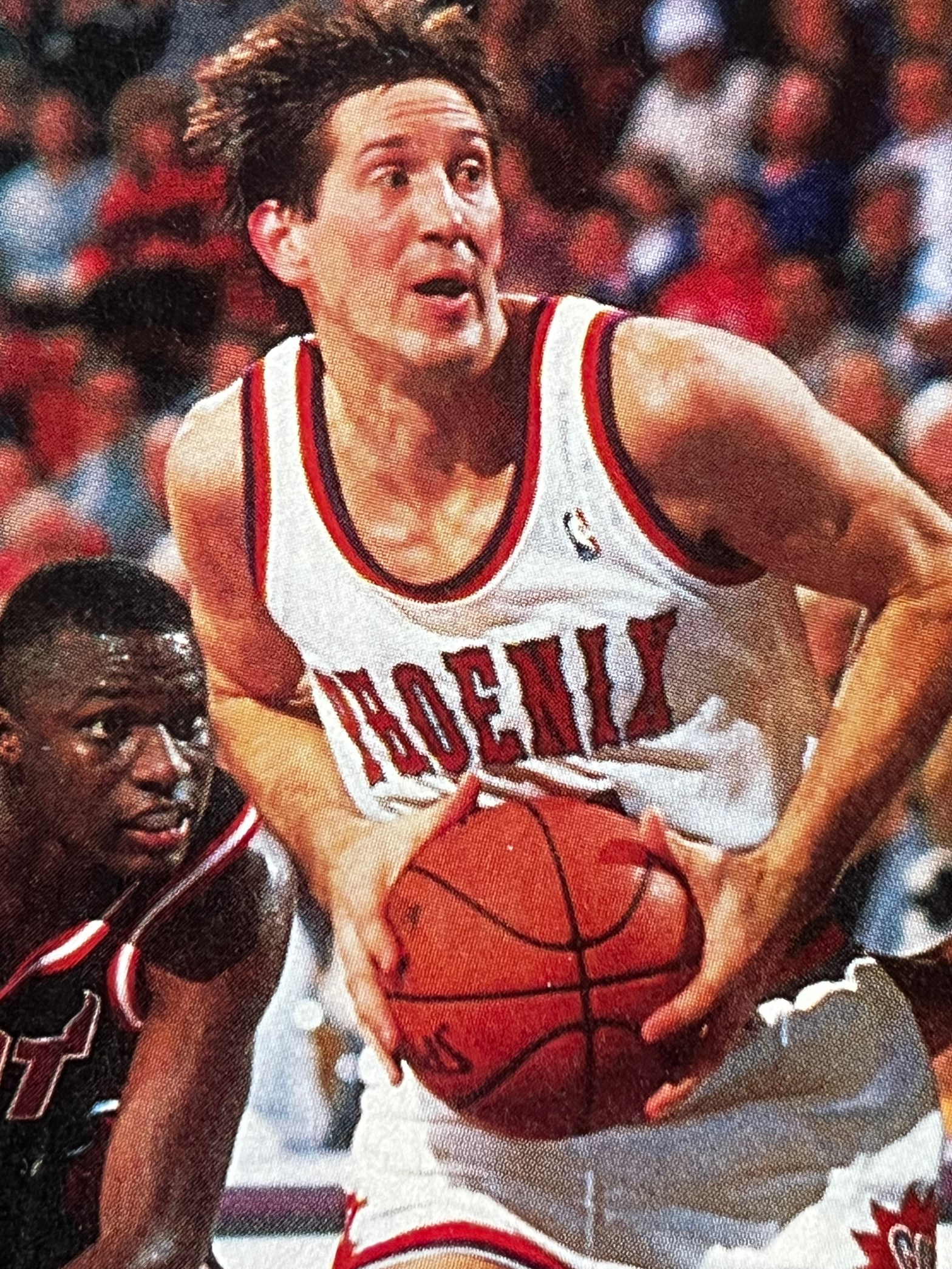
[Stockton to Malone . . . to Jeff Hornacek. Yes, Hornacek was a clutch midrange shooter and solid defender in Utah for seven of his 14 NBA seasons. That’s how I remember him. But before Hornacek landed in Salt Lake, he earned a groundswell of praise in Phoenix. “If not in the class of a Jordan or a Drexler, [Hornacek] certainly inhabits the same territory as a [Hersey] Hawkins, a [Reggie] Miller, a [Mitch] Richmond.” That was the verdict in Rick Barry’s 1991-92 Pro Basketball Scouting Report. The publication also suggested, though with a question mark, that Hornacek might just be the best “pure shooter” in the association entering the 1990s.
Sound about right? Well, here’s a little more information to ponder the question. It’s a brief profile of Hornacek from Street & Smith’s 1991-92 Pro Basketball annual. The profile comes from one of my favorites, Fran Blinebury.]
****
It would be easy for Jeff Hornacek to get lost in the crowd at most NBA games. That’s because he looks more like somebody who should be sitting in the crowd having a soda and a hotdog, rather than making his living on the court among the sky-walkers.
He doesn’t soar. He doesn’t glide. He can dunk. But he doesn’t often raise eyebrows by rattling the rims. Some of his teammates on the Phoenix Suns even kid him occasionally about looking out of place. Point guard Kevin Johnson says he looks like head coach Cotton Fitzsimmons’ paperboy. And Hornacek himself will even admit that he’s been known to spend three hours out mowing his own lawn on the day of the game. Unusual? No, that’s just Hornacek, a down-to-earth sort from Elmhurst, Ill., who has mowed down many long odds to make it big in the NBA.
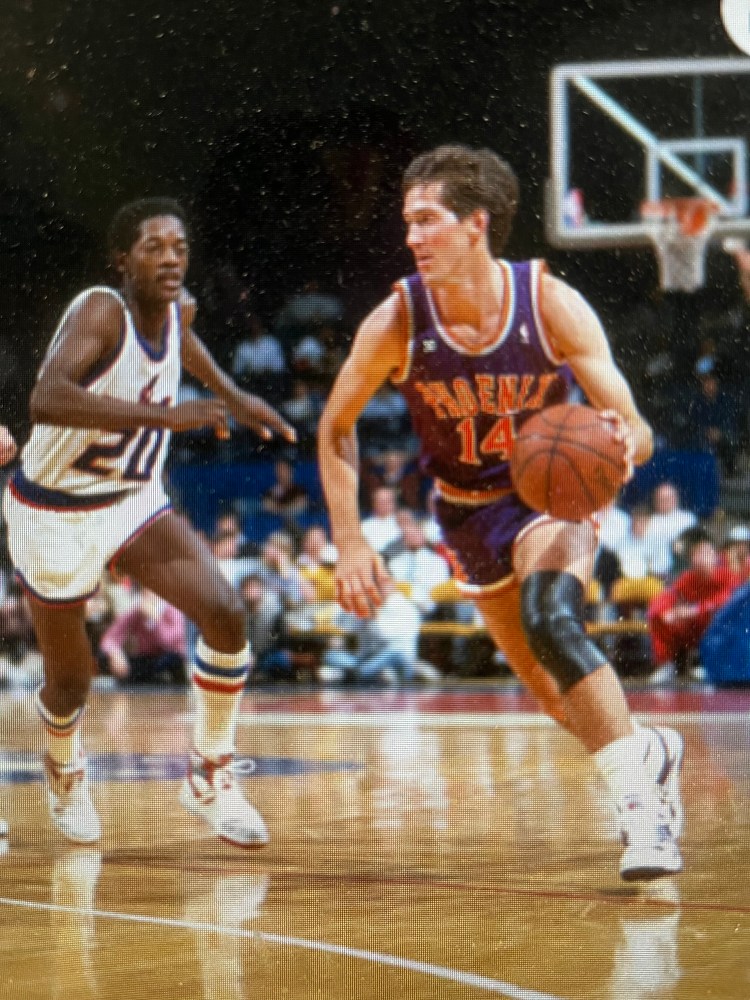
How big? Consider that on a team that features all-stars Tom Chambers and Xavier McDaniel, there are some who will tell you that Hornacek is the most consistent producer in the lineup. “Every night,” agrees Johnson, “Jeff comes to play with the same attitude and the same game. When you go out to start a lot of games, you’re never sure exactly what is going to happen. But with Jeff, we always know what we’re going to get out of our ‘2’ guard. He’s a constant in our league.”
But just the fact that Hornacek is still in the league, five years after the Suns made him the last of three second-round draft picks in 1986, is a surprise to many. As recently as 1988, Hornacek was tied with one other player as the lowest-paid members of any NBA team.
Certainly few people expected big things from Hornacek in light of the long-and-winding path he took to reach the NBA. For despite being a two-sport star in basketball and baseball in high school, he could not even get a scholarship to play at the Division I level in college. That was coming off a senior season where he averaged 19 points and four assists and led his team to regional and sectional championships, while being coached by his father.
“He has always been a big influence,” Hornacek says. “You kind of grow up in that basketball atmosphere when your father is a coach. I’ve been labeled as the guy who can read the court, and a lot of that I got while growing up. I’m able to read the court and anticipate a lot better than most guys in the NBA. That’s what helps me get by.”
But it didn’t help Hornacek on his search for a college. The only place that showed any interest was Western Michigan, and the last scholarship available there wound up going to another player. So Hornacek was ready to pack up and attend Cornell in the Ivy League, where there are no athletic scholarships. But at the last minute, he received an offer to play as a walk-on at Iowa State.
“I didn’t even know where the place was,” Hornacek recalls. “I had barely heard of it. But for the chance to walk on and maybe earn a scholarship, I jumped in my car and went.”
To the continuing surprise of so many, he went on to become only the third player in Big Eight Conference history to compile 1,000 points and 600 assists in a career. He set a Big Eight record for conference assists that still stands and was eventually named as an honorable mention All- American by Associated Press.
“I didn’t even think about the NBA until my senior year,” Hornacek says. “And it didn’t really become a possibility until halfway through that year.”
Hornacek first attracted attention as a junior when Iowa State made its first-ever NCAA Tournament appearance. Then he came back in his final year and averaged 13.7 points, 6.6 assists, and 2.0 steals, which earned him an invitation to the NBA pre-draft camp in Chicago. That is where the Suns made up their minds to give him a shot.
“I didn’t think he shot the ball very well when he came into the league,” says Suns vice president and former NBAer Dick Van Arsdale. “He didn’t think he’d ever be as good as he is now. He didn’t have any confidence.”
What Hornacek did possess was an ugly-looking, two-handed jumper that sent the ball squirting out of his delivery like a knuckleball, with very little rotation and very little chance of ever getting a favorable roll from the rim.
It seems Hornacek’s left thumb was getting in the way of his release. And so, at the suggestion of the Suns, he spent the entire summer practicing his shot with his left thumb taped to his hand. “It took me a while that whole summer to feel comfortable,” Hornacek says. “I didn’t really get used to it until the following season. But now, I guess it’s helped me.”
It’s helped Hornacek to build a career shooting percentage better than 50 percent and also become established as one of the most accurate three-point snipers in the NBA. Last season, he ranked third in that category.
Before reaching his current level, Hornacek had to survive difficult times with the Suns when coaches John MacLeod and John Wetzel were both let go, and then Fitzsimmons arrived and started a revolving door for players. In one year, only Hornacek, Armon Gilliam, and Eddie Johnson were holdovers from the previous season, and now only Hornacek remains from MacLeod’s last year in 1987.
“It was a tough time for me mentally,” Hornacek said. “But I concentrated on working on my own game to improve and hoped it would work out for the best.”
The pieces began to fall into place when the Suns acquired Johnson and paired him with Hornacek in the backcourt. While it has been K.J. who has received most of the notoriety in Phoenix’s recent rise from the ashes to become annual contenders in the Western Conference, Hornacek has been just as valuable.
He handles the point guard duties when Johnson is resting or is double-teamed. He knocks down the outside shots, and he usually draws the tough defensive assignments against the opposition’s big guard.
“Horny is the best shooter on our team,” Fitzsimmons says. “He’s also the kind of smart player you want in there making decisions when the game is on the line.”
“My whole career, all I’ve done is try to work harder than anyone else,” Hornacek says. “Maybe other players don’t have the drive that I have to work.”
Maybe that’s why Jeff Hornacek is standing out from the crowd in the NBA these days instead of sitting in the crowd and watching.
 From Way Downtown