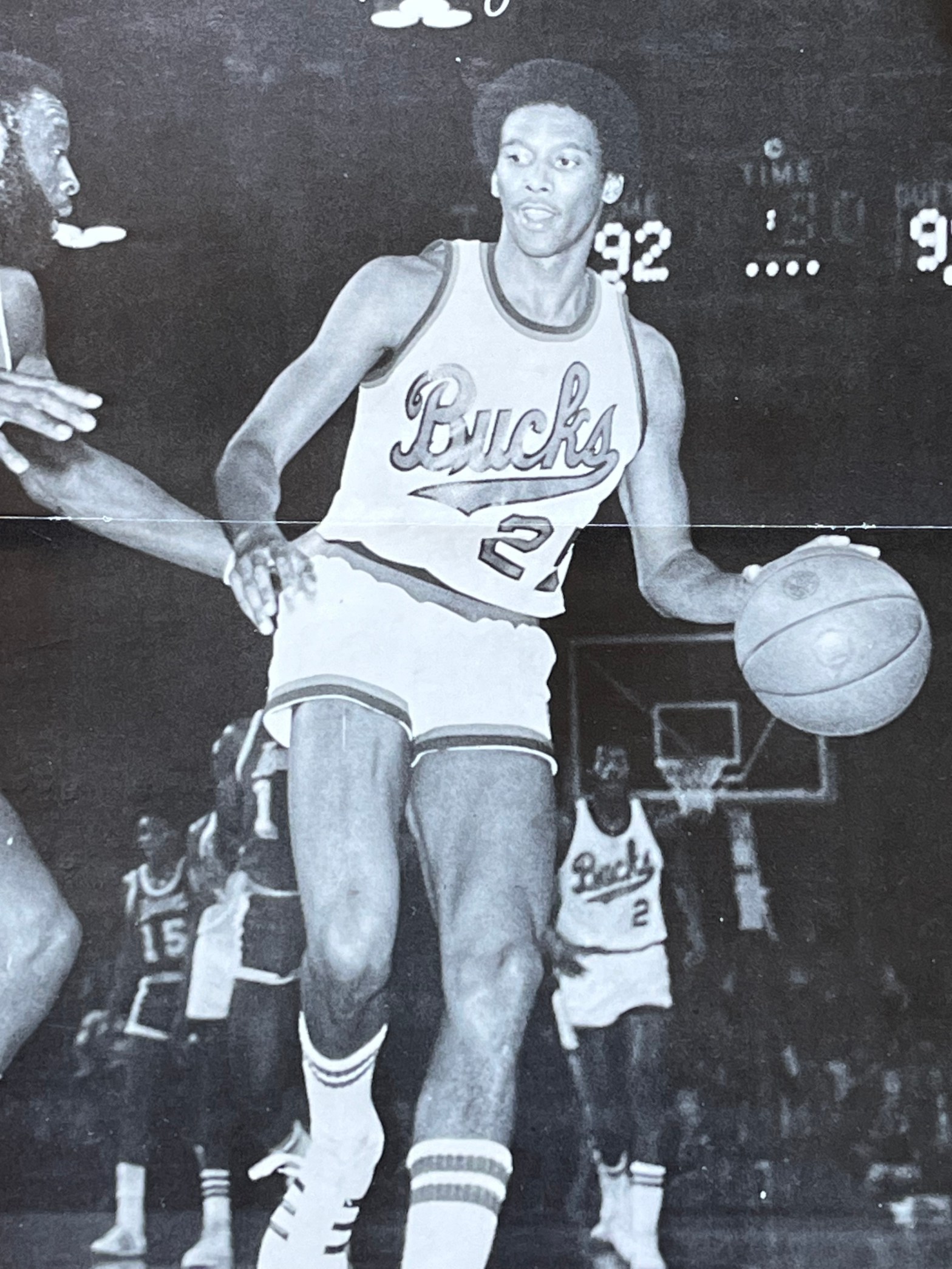
[Before there was Earvin “Magic” Johnson, there was Gary “Magic” Brokaw. He flashed onto the college basketball scene in the early 1970s at Notre Dame and, at 6-4 and 180 pounds, looked and played nothing like the other Magic and legend to come. What made Brokaw magical on the court was his fluidity off the dribble, his slick moves, his elevation, and his ability to make shots from seemingly impossible angles.
Brokaw’s magic figured prominently in the classic 1974 book, A Coach’s World, co-authored by then-Notre Dame coach Digger Phelps. Near the end of the book and his junior season, Brokaw pondered, “I think I could step right into pro ball. This is what I wanted since I was six years old, and I think I’m near that goal right now.” And so, Brokaw declared a year early for the NBA draft as a so-called financial “hardship” case, becoming the first Notre Dame basketball player to leave early for the pros.
“I tried to discourage him,” rued Rev. Edmund Joyce, Notre Dame’s executive vice president, hoping until the very day of the 1974 NBA Draft that Brokaw, a third-team All-American, would come to his senses and withdraw his name. As most academics and the general public then believed, trading a free college education for the uncertainty of a pro basketball career was shortsighted.
Brokaw kept his name on the draft board, lasting until the end of the first round when the Milwaukee Bucks grabbed him with the 18th pick overall. “It was a hell of a pick,” Milwaukee coach Larry Costello celebrated afterwards. “He can play with confidence, and he does a lot of things well.” Some onlookers began to speculate: Brokaw would soon replace the aging Oscar Robertson, who was hinting at retirement.
But Brokaw never did. He would last four seasons in the NBA, moving from Milwaukee to Cleveland, then on to Buffalo and landing back to Cleveland. Brokaw was finished by 1978 and working as a stockbroker. Here’s a quick retrospective of Brokaw’s pro career, starting with a peppy, but nicely written, blurb from a Milwaukee Bucks game program from the 1975-76 season.]
****
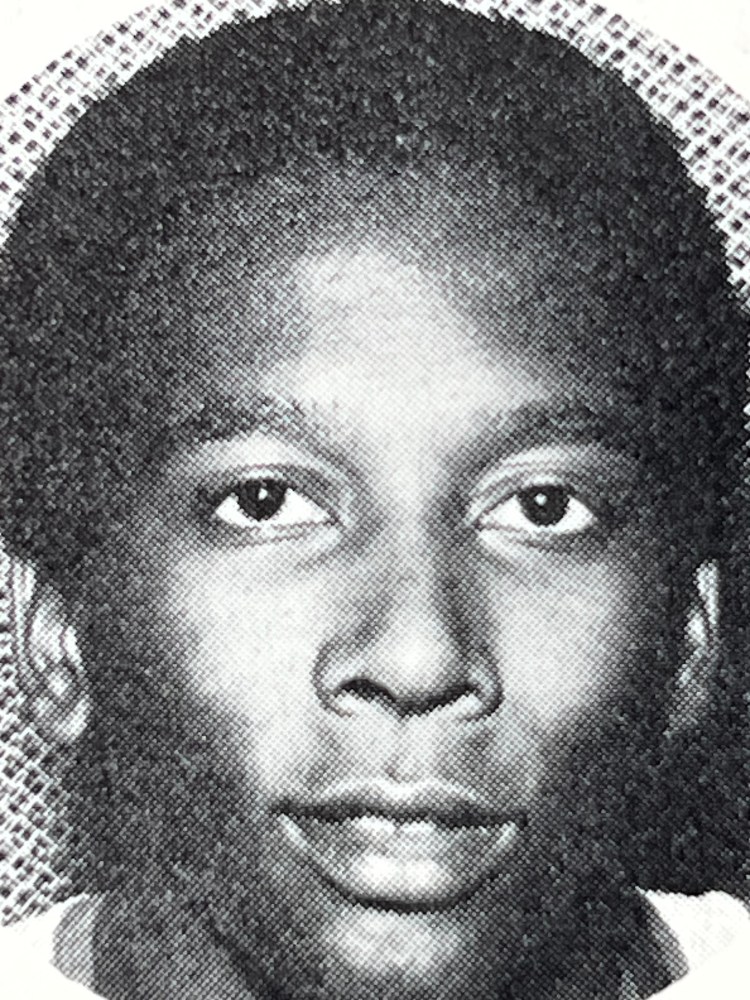
In September 1974, Gary Brokaw, at 20 years old, was the youngest player at the Milwaukee Bucks training camp. By September 1975, Brokaw was still the youngest player at the Bucks training camp, despite a number of rookies and free agents who had graduated from college the previous June. Brokaw, one could say, grew up in the NBA, and he will never regret his decision to go pro following his junior year at Notre Dame. It’s been an exciting, pressure-filled, unpredictable experience so far, and it can only become more enjoyable.
Brokaw was a first-round pick in the 1974 draft, a hardship case with top credentials. He impressed all in training camp that September and was catapulted into a starting spot early that season. At 20 years old, Brokaw was living the dream of others his age—the one-on-one matchups with Walt Frazier, driving up and over burly Bob Lanier, playing before the glitter set in the Los Angeles Forum while matching up against Gail Goodrich. All these experiences had to have an effect on the young speedster, and the youthfulness showed up early. A few turnovers here and there failed to dim Brokaw’s speed, shooting, and finesse. Here was a winner.
On many occasions, Brokaw will delight the crowd by driving past the big men—men like Bob Lanier, George Trapp, or Bob McAdoo. “I try to create something,” says the willowy New Brunswick, N.J. product. “I know if I can get past the big men, I’ll get a basket or an assist. I try to work a change-of-pace on them, so that they’ll slow up and I can shoot past them. I like the running game, it creates a lot of opportunity shots for us, and I feel comfortable playing it.”
A sociology major at Notre Dame, Brokaw plans to finish his courses to obtain a degree. He was a high school All-American at New Brunswick and a Helms All-American as a junior at Notre Dame. As a junior with the Irish, he helped beat Marquette on the Milwaukee Arena floor to break a long Warrior winning streak in July 1973. As a youth, Brokaw tried to pattern his play after Walt Frazier and Dave Bing. Little did he know that several years later, it would be Frazier and Bing that would be his workaday opponents.
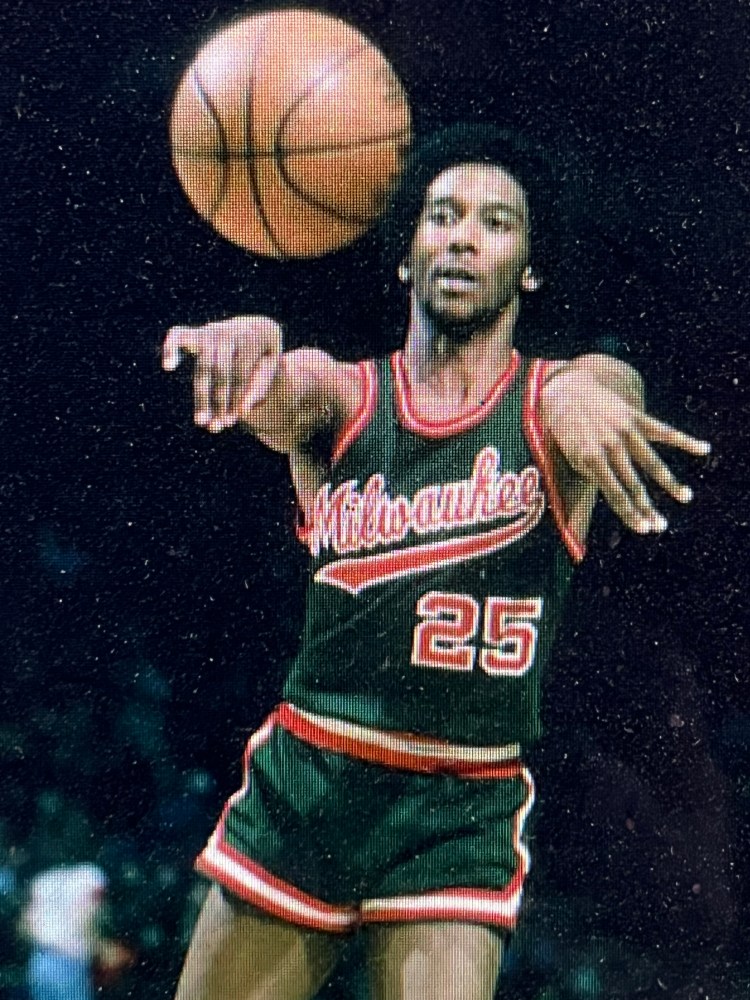
[In his final season in Milwaukee, Kareem Abdul-Jabbar called the rookie Brokaw “a one-man fastbreak.” Brokaw had some fine games that season and the next in Milwaukee getting up and down the floor. What follows is an account of probably Brokaw’s best outing as a Buck. It came early in the 1976 playoffs against the Detroit Pistons. To capture the moment, I’ve combined two articles from the April 14 issue of the Milwaukee Journal. The bylines belong to reporters Bill Dwyre and Bob Wolf.]
Gary Brokaw was a one-man heatwave for the Milwaukee Bucks at the Arena Tuesday night. After the 6-4 guard completed his demolition job on the Detroit Pistons in an opening playoff game in the National Basketball Association, you kind of expected a team of doctors and nurses to escort him from the locker room with his right arm wrapped in a heating pad for safekeeping until the next game.
Brokaw, a second-year player from Notre Dame, who has had most of the superlatives along the way attached to his potential, rather than performance, until the second half of the season, scored a career high of 36 points in the Bucks’ 110-107 victory.
He made 13 of 17 shots from the floor, 10 of 11 from the free-throw line. He was so hot that when he put up something that didn’t go in, the crowd of 8,912 looked like it had just had shock treatment. Ironically, Brokaw wouldn’t have started if regular starter Jim Price hadn’t turned an ankle in practice Monday and did not suit up,
Afterward, Brokaw’s teammates and his coach were lavish in their praise. “Gary was just super,” said Dave Meyers, the Bucks’ reserve forward, who contributed some important free throws in the victory. “He just kept going at them and going around them.”
Bob Dandridge, the Bucks’ veteran leader, said, “Gary kept us in the game early, when they weren’t getting much production out of me. He has the speed and quickness to score big against anybody in this league, and he certainly showed that tonight.”
And Coach Larry Costello said, “Gary just had a great game. He’s still very young, and he has a lot of talent. He has all the tools to be a great player. The thing is, he’s going to get even better.”
The game was the first playoff participation ever for Brokaw, something that could have been enough inspiration alone for his excellent performance. But Brokaw said it was something even more important than that that made him relish his 36-point night.
“My parents were here tonight,” Brokaw said. “That meant a lot to me. They are so far away that the only real connection they have with me is an occasional look at the box score in the papers the next day. The last time they came to a game was one against the Knicks in New York City, and I only played one minute in that one. That really irked me. So doing what I did tonight meant a lot, a real lot.”
His parents, Mr. and Mrs. John Brokaw of New Brunswick, N.J., were among a number of parents of Bucks’ players flown in for the game and a pregame dinner by the Bucks’ management, a nice gesture.
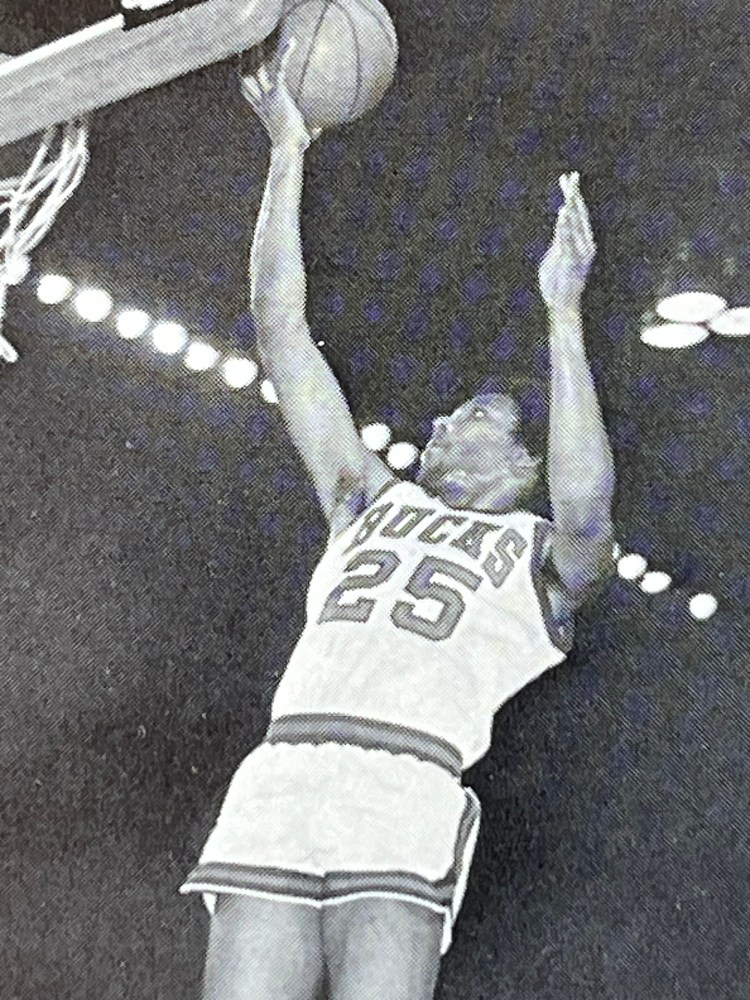
Somebody mentioned that his 36 points was a career high in the NBA, topping his previous best of 28, and Brokaw responded with a laugh. “It’s not only my career high in the NBA,” he said. “I never even had 30 points in any college game.”
Brokaw, soft-spoken but articulate, said that he had had some doubts during his first year in the NBA, and even during portions of this season, before things started to go better for him in the last few months. “I guess my main doubts involved the role I was to play for the Bucks,” he said. “One day, I was a shooter, the next a penetrator, the next the team leader. I didn’t really know what I was for a while.”
Brokaw said that he has found his role now, and that it is one of leader, creator, playmaker—whether it be as a starter or as an early reserve. “I arrived at the role through a combination of getting more playing time and getting more specific word from Larry (Costello). Sometimes, it was kind of a subtle thing, and other times I could tell that he was talking right to me, that he was saying to me ‘Go run the show.’”
Brokaw did more than run the show Tuesday night. He got Detroit’s Eric Money in early foul trouble, thereby limiting the swift Detroit playmaker to little more than token duty and all but negating the Pistons’ offense. Brokaw said afterward that pinning quick fouls on Money had been part of his personal game plan.
“We incorporated it into our offense,” he said. “It wasn’t freelance, but options in our plays. I would try to take Money inside and use my height advantage. I’m 6-4, and he’s 6 feet.
“Actually, it wasn’t anything different from what I’ve done all year. It’s just that I wanted to be more aggressive this time. When he went to the bench, it took a lot of the quickness away.
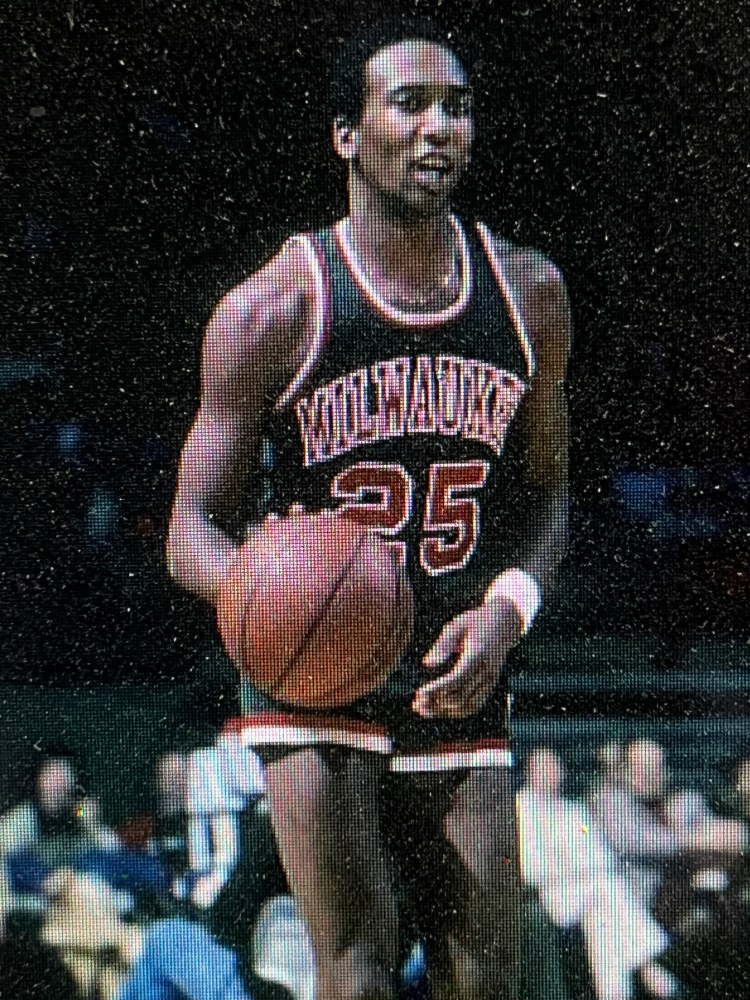
Brokaw also ended the game, for all intents and purposes. With the clock ticking down to 27 seconds and the Bucks in a fairly safe, but not insurmountable, 106-101 lead, Brokaw charged across the halfcourt line on one of his typical fastbreak sprees, pulled up at the top of the circle, and fired a jump shot with a man draped all over him. The shot banged through, the Bucks had a 108-101 lead, and the Pistons were one game down in the best-of-three playoff series.
The only surprising thing about Brokaw’s last shot was that there wasn’t smoke on the ball when it dropped through the net.
[The Bucks lost the best-of-three series, abruptly ending their season. Brokaw returned the next fall for his third season in Milwaukee now penciled in as a starter. By December 1976, the Bucks and Brokaw had gone to pieces. Here’s an article from December 12, 1976 that appeared in the Central New Jersey (New Brunswick) Home News, Brokaw’s hometown newspaper. Asking what’s up with New Brunswick’s greatest basketball hero is reporter Sam Freedman.]
Statistics only affirm the enigmatic performance of Gary Brokaw for the Milwaukee Bucks this season. Brokaw himself and the nine-game-old new coaching regime of Don Nelson and K.C. Jones are all looking for the words to explain, for example, why Brokaw’s shooting percentage is .357 instead of last year’s .457 or why he Is handing out less assists.
But in this, the New Brunswick, N.J. native’s third NBA season, the words sound uncomfortably familiar. And they are often tainted with rumors of an imminent trade. “The man’s just got such great talent—outside shot, inside shot, penetration,” K.C. Jones said of Brokaw, who went scoreless in Friday night’s 136-129 loss to San Antonio.
Nelson already has spoken privately several times to Brokaw and said last night he planned another chat soon. How can the Notre Dame star regain the kind of form that he had in the latter half of last season? “I don’t know,” Nelson mused. “Why don’t you ask him.”
But both Jones and Nelson agreed that Brokaw’s recent play betrays slipping confidence. He seems reticent, they said, to drive the lane in his slick fashion. “He looks hesitant, indecisive,” said Jones.
Brokaw maintains all the trade talk has not cut his confidence. “A trade is an occupational hazard, and this is my chosen profession.” Any trade probably will be made within the next month, when injured Fred Carter and forward Dave Meyers rejoin the Bucks’ roster.
Meanwhile, Nelson says Brokaw must regain his starting job in practice. “We just don’t have the team to carry him,” said Nelson—the kind of team which can win consistently and let Brokaw work out his problems and regain lost confidence with lots of playing time.
That’s because numerous injuries have sidelined starters Meyers, center Elmore Smith, and forward Bob Dandridge at various times this season, and the Bucks have plummeted to a 4-23 record, worst in the league.
Brokaw began the season starting at guard. As his own fortunes and those of the Bucks fell, former coach Larry Costello and then Nelson turned to rookie guards Lloyd Walton and Quinn Buckner in Brokaw’s stead. Then Carter arrived in a trade that did little for Brokaw’s confidence.
“I don’t expect confidence builders from pro ball,” said Brokaw. “I just expect to play my game. My playing time is inconsistent, and so’s my play. I can’t put the excuse on the team. My goal is just to work harder.”
Brokaw acknowledges he suffered from Costello’s habit of yanking him from games after a few mistakes. But he won’t pass judgment yet on Nelson, who is now 1-8 at the Bucks’ helm. “We’ve changed styles (under Nelson),” allowed Brokaw. “But it’s a matter of executing on offense and defense, and we’re not doing it.”
Friday night, for example, San Antonio slid through the Bucks defense almost at will, while the Bucks turned the ball over 21 times, often on promising fastbreak opportunities. What little satisfaction Bucks fans enjoyed came from Brokaw’s competitor at guard Walton.
Jones says he understands Brokaw’s plight from his own early years of bench-warming for the Boston Celtics. He later started on the Bill Russell championship teams. “With that kind of a situation, it has to bother you,” said Jones. “The best way to shake it is to go out there and get your best shot.”
Easier said than done for both Gary Brokaw and the Milwaukee Bucks in their highly perplexing third season together.
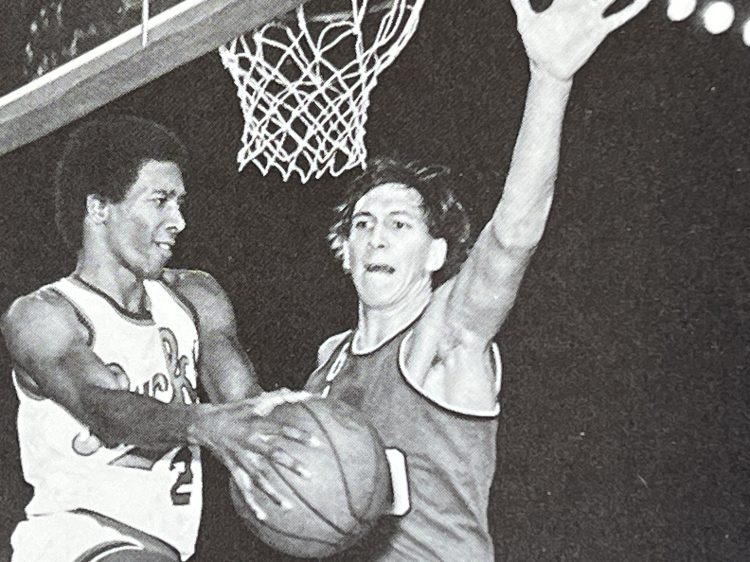
[About a month later, on January 14, 1977, Brokaw and center Elmore Smith were traded to Cleveland for reserve swingman Rowland Garrett and two first-round draft choices. “I look at Brokaw,” Cleveland coach Bill Fitch said after the trade, “as the same type of player that [Cleveland guard] Jimmy Cleamons was when he was watching and learning at Los Angeles. Gary can play both guard spots, but I’m not going to rush him.”
Brokaw wasn’t rushed, neither did he impress wearing a Cavs uniform. Matter of fact, a Cleveland newspaper wrote of Brokaw after the season. “Best years still ahead, but how good is his best? Very erratic. A backup guard at this point.” Another publication wrote: “Will he or won’t he. Is a great player from the neck down. Never got settled in Milwaukee. Has great quickness and jumping ability, and Fitch believes that with a training camp, he can be harnessed.”
Good fortune seemed to smile on Brokaw before the 1977-78 season. Tiny Archibald, now running the offense in Buffalo, got injured in the preseason. Buffalo traded for Brokaw to replace him. It was Brokaw’s job to lose that season, and he lost it in March 1978 when Buffalo waived him after signing guard Mike Glenn.
By the season, Brokaw was back in Cleveland as a free agent, hoping to earn a spot on the roster. Reporter Burt Graeff talked with Brokaw about his quest to hang on in the NBA for another season. His article ran on September 12, 1978 in the Cleveland Press.]
It is said there is nothing like a cold slap in the face, and for young Gary Brokaw, the cold slap in the face came last December. Brokaw, highly touted, highly paid, and the possessor of some immense talent, was placed on waivers by the Buffalo Braves. A once-promising career ahead bottomed out. Gary Brokaw, signed as a hardship case out of Notre Dame in 1974, was now unemployed.
Today, Brokaw is back in Cleveland, going through two-a-day workouts at the Coliseum, attempting to get a spot on the Cavaliers’ 11-man roster. Brokaw, many feel is what the modern-day professional athlete is all about . . . the athlete who is signed to a big bonus and guaranteed big money only to fall far short of expectations.
“I think the big money might have had something to do with my career,” admits Brokaw, a highly articulate youngster of 24. “No one, no matter where I was, ever questioned my talent. My moving around was largely due to economics, and economics is the bottom line in everything.”
Brokaw played two-and-a-half seasons in Milwaukee, where he averaged nearly 9 points a game. The Cavaliers traded for the 6-4, 178-pound guard in January 1977. He averaged 7.2 points in 39 games in Cleveland and was dealt to Buffalo last October.
Brokaw’s brief career here in Cleveland was marked by inconsistency. A superb game would be followed by a bummer. He says, “I think my biggest problem has been one of concentration. I have to get myself to concentrate on offense and defense all the time. If I do, I feel I can be as good as anyone.”
Brokaw contends that being waived by Buffalo may have been a blessing. “I think it has probably added maturity to my game and my life as well,” he says. “Right now, I am serious about every practice and will be serious about every game.
“Making this team means a lot to me. I’ve got a family to support and, while I know that I’m going to have to have a second career eventually, I know I can make more money right now playing basketball.”
Brokaw and wife Renee are expecting their second child any day.
“I had offers of more money to go to Chicago, Milwaukee, or New Jersey. I wanted to come here, though. I know the system. I know the players, and I loved playing in front of the Coliseum crowds.”
[Brokaw was cut by the Cavs about a month later. Either in training camp or after, Brokaw got hurt and called it a career at age 25. He took a job with the brokerage firm E. F. Hutton until the New Jersey Nets called in September 1979. They asked Brokaw to come out of retirement and try out for the team. “I’m healthy enough now to play,” he said, “and I’d really like to get back because I still like playing the game.” The Nets cut him. In the summer of 1980, Brokaw returned to Notre Dame to complete his final six credit hours to graduate and join the staff of his college coach Digger Phelps. “There are pluses and minuses on the decision to declare hardship,” he reflected while back at Notre Dame, saying “he had mixed emotions about the pro game.”
“If you go early, you miss a year or two of maturity. But then again, you might have a bad season your senior year or even get injured. If you step in an do well right away, you’re on top of the world like Magic Johnson. But if they decide you’re still two or three years away, you may be second-guessing your decision.”]


I’m really enjoying these posts, thank you for your work.
LikeLike