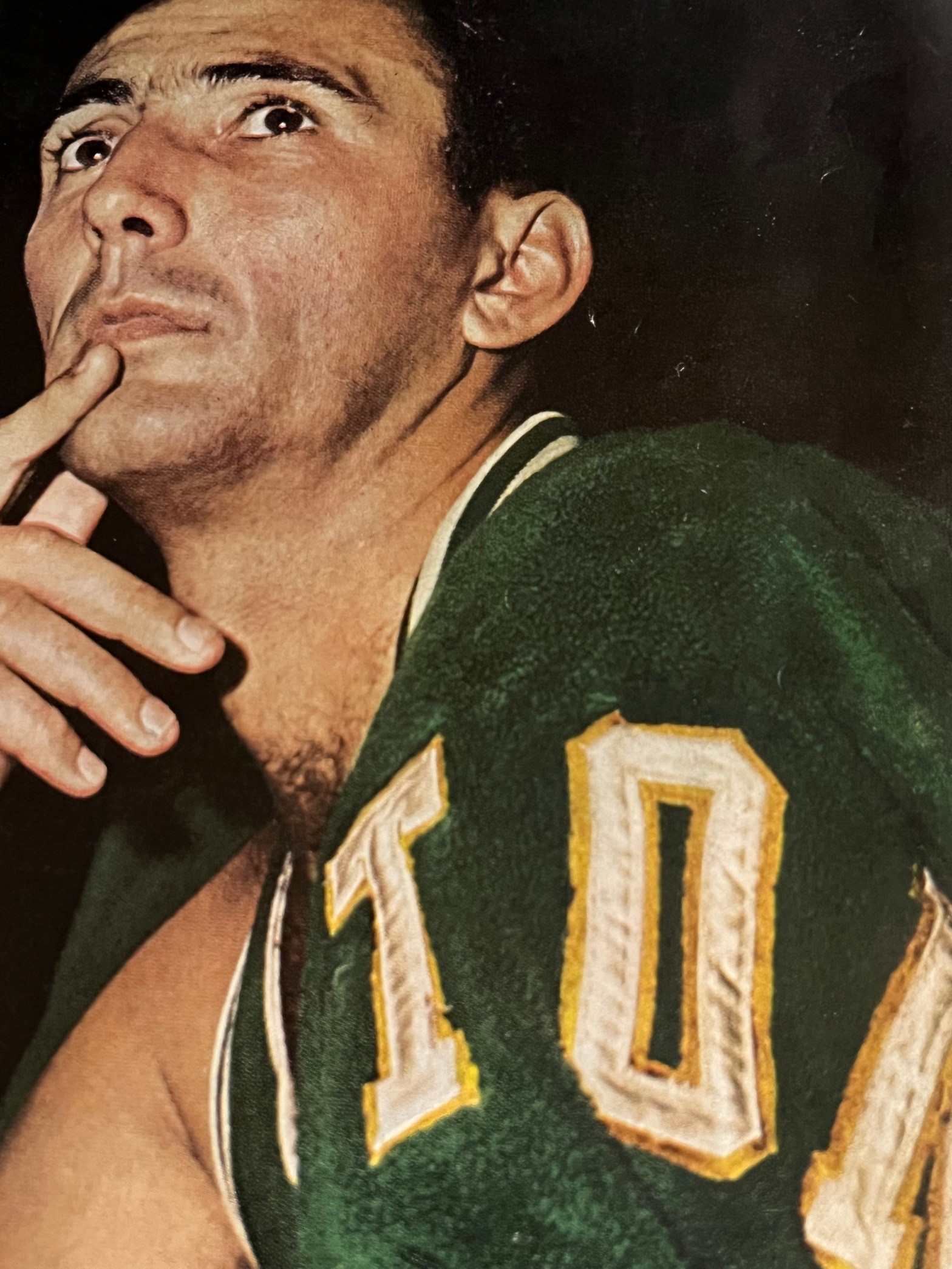
[Our last post featured an inside account of Bob Cousy’s final trip around the NBA in 1963. Here’s another hail to Bob Cousy during his final Celtic days. It comes from the Boston Globe’s Arthur Siegal on the occasion of Bob Cousy Day, highlighted in the previous post. Look for a longer story on the retiring Cousy to follow in the days ahead.]
****
It all began with Lou Eisenstein.
The unknown an unabashed balcony fan summed it up beautifully when he called during a 10-second lull, “We love you, Cooz.” For everybody at the Boston Garden on Sunday afternoon loved Bob Cousy of the Celtics, and the Celtics’ star loved everybody.
There were no stoics at the Garden. Men and women wept without shame and with pride and love. It was like that folk song line, “The tears flowed like wine.”
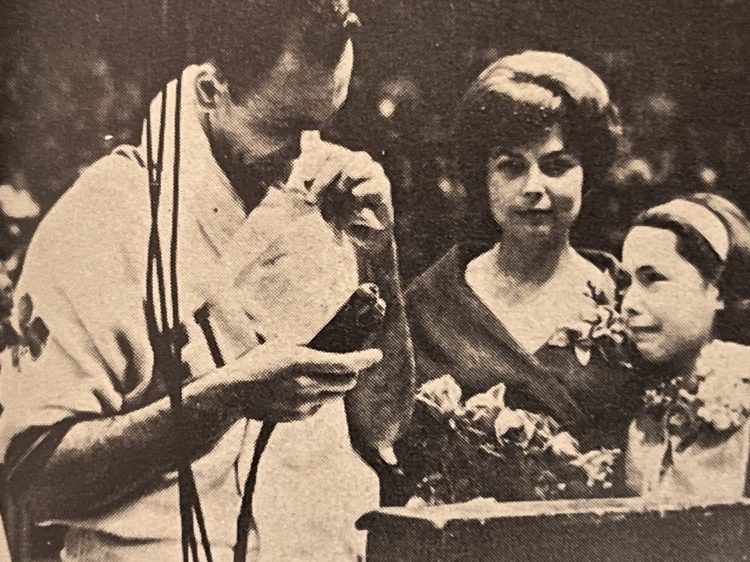
Little Martha Brady, the cystic fibrosis child, started the tears when, after being kissed by Cousy, she suddenly reached up and hugged him, as if she never wanted to let go. His own daughter, Colette, kept the tears flowing when she reached out and gave her father her own handkerchief so he wouldn’t have to dry his eyes with the towel. It seemed as if everybody was stirred beyond the control of emotion.
Yet there were men in the crowd who had a share in the Cousy life and were not on the presentation list. There was Doggie Julian, now coach at Dartmouth, who came to Boston for the Day. And Doggie told about Lou Eisenstein, who was perhaps the key figure in Cousy’s eventual arrival in Boston.
Eisenstein?
The basketball official?
So Doggie said, “I was coaching at Muhlenberg, and I gave Eisenstein a chance to work some of our games. I recommended him to other coaches, and he said if he ever saw a way to help me [that] he would. Just as I signed for the Holy Cross job, Eisenstein got in touch with me. ‘There’s a schoolboy on Long Island named Cousy and he’s only a sophomore, but he looks like something special. He is marvelous right now.’
“I made it a point to see Cousy and his parents. I also told Gerry Black of the New York Holy Cross Club to keep in touch with the boy, even if he still was two years away from college. Because we were interested in him before he became a star around New York, he came to Holy Cross.”
And that was the start of the Cousy legend.
Then there was Celtics’ co-owner Lou Pieri, who pointed toward the opposite side of the Garden and said, “There’s a man up there who made it possible for Cousy to be with us. He’s a Providence banker named Clarence “Bud” Gifford, a friend of mine and a sports bug.
“For three years, when Walter and I were short of money and in danger of having to drop out, he came up with the loans that kept us in business. If we had been forced to quit, Cousy would have wound up in another city.”
There was coach Red Auerbach, whom Cousy never calls anything but Arnold, although Auerbach’s wife calls him Red. So Auerbach told about his deciding to turn Cousy’s magic loose in professional basketball. “It was about the fifth game,” he said, “and we were playing the Rochester Royals. Cooz did the behind-the-back stuff and the fake shot. The Boston crowd loved it. This was the Cousy they knew from Holy Cross. Cousy changed the whole pattern of pro basketball.”
There is the memory of talking with Les Harrison, owner-coach of the Royals, who said, “That’s bush-league stuff, good enough for the colleges. I’ve got Bob Davies, who can do all those things, but I don’t let him. This is professional basketball, and you don’t make fools of the other pros. Besides, he won’t get away with it very long. The pros can take care of him.”
As he ends his 13th year of pro basketball, Cousy’s magic still works.
Then Easy Ed Macauley was on the scene, saying he just happened to be in New York and thought he might as well come to Boston for Cousy’s day. “After all,” said the handsome St. Louis resident, “I played against Cousy as a collegian and helped him become great as a pro with the Celtics. Not only that, but I made the Celtics a championship team.”
The boyish grin flashed. Macauley played for the University of St. Louis against Holy Cross in the Sugar Bowl Tournament in New Orleans. Then they were Celtics teammates. As for the championship part, Macauley meant his being traded to the St. Louis Hawks for the rights to deal with Bill Russell, whom the Hawks had drafted. Russell meant five championships in six years and may mean a seventh title this year.
And there was Cousy’s parents, who were to drive home to New York in a Cadillac, something they never had owned. They have their son’s 1961 model because he has a new Caddy, given him on Sunday. In the meantime, Cousy will keep using his regular number plate until the playoffs end and his career as a Celtic ends. The number plate is Celtics 14, including his uniform number. Walter Brown has Celtics 1 and Auerbach has Celtics 2.
But when Cousy steps into his new job, as Boston College coach, his car will have the number plate BC1. His wife’s car will have BC2. The initials have a double meaning of Bob Cousy and Boston College.
And it all started with a young basketball referee named Eisenstein.
 From Way Downtown