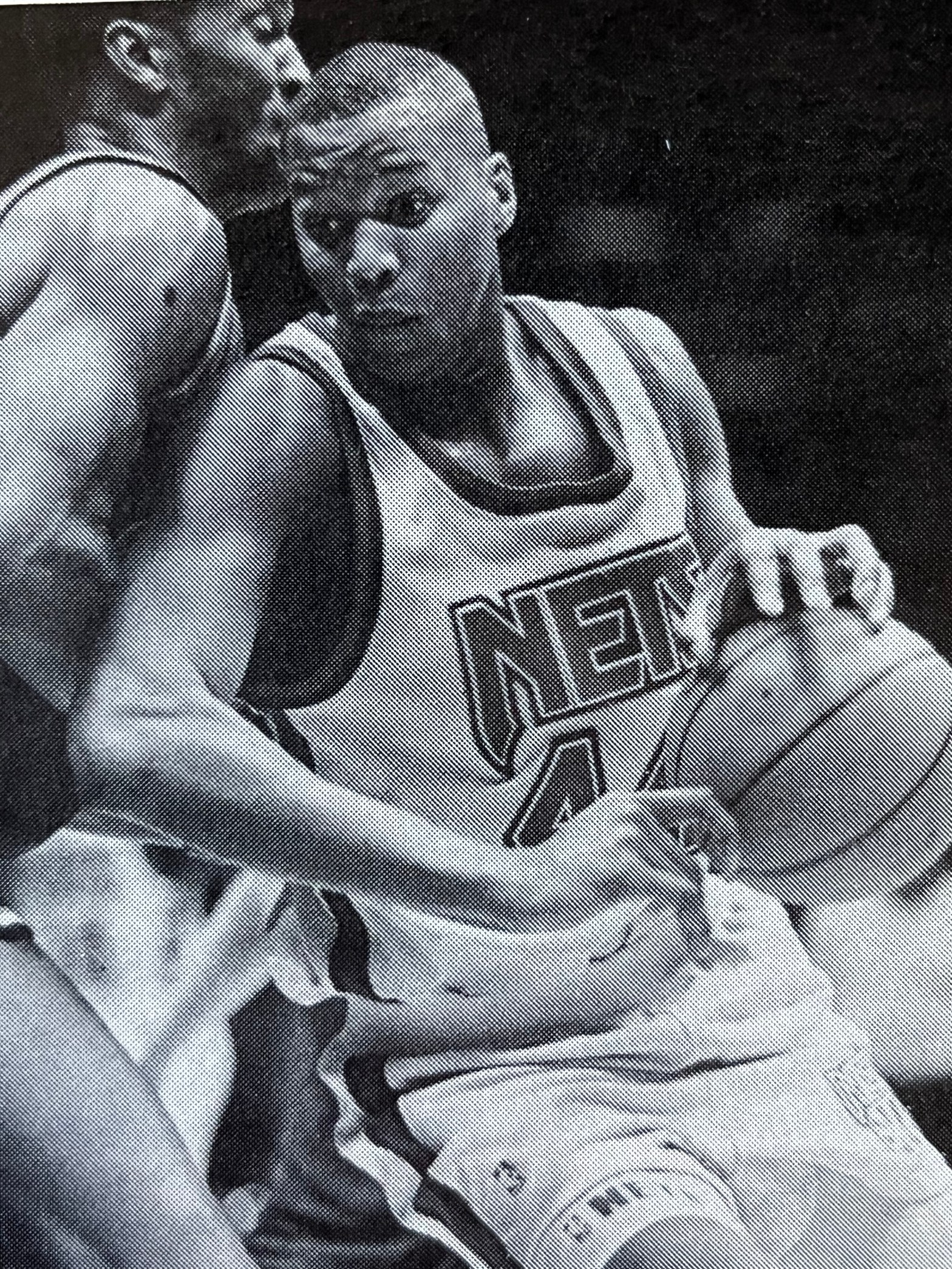
[Mention Derrick Coleman, and opinions are likely to differ widely. Take these two December 1994 letters to the editor from the New York Daily News. One reader wrote, “Derrick Coleman is the perfect example of today’s pampered, spoiled modern athlete . . . Derrick asked. They gave. If he didn’t get his way, he would hold his breath and cry out until he did.” Another argued, “Anybody in their right mind would be stupid not to want a Derrick Coleman. Straight up and down, he’s awesome, baby, a money primetime player.”
In the following newspaper article, reporter Steve Popper takes a closer look at the 6-foot-10 enigma called Derrick Coleman. Popper’s story ran in the Asbury Park (N.J.) Press on January 17, 1993.]
****
His head neatly shaved and trademark scowl in place, Derrick Coleman walks slowly off the court toward the New Jersey Nets bench at Meadowlands Arena. At times during his three seasons since joining the Nets, the walk has come under a rain of boos from the hometown fans who remember Coleman’s stand last year that many believe cost coach Bill Fitch his job. Or, they remember the interview in USA Today where Coleman’s quotes shredded Nets management, coaches, and players.
He takes a seat on the bench and places a towel over his head. The move may be to keep him from cooling down, but it also serves as a buffer from the crowd. After one particularly vicious attack last December from the hometown crowd, Coleman responded. “I don’t pay attention to that. They don’t write my paycheck. The same people will turn around and cheer you the next minute.” He then laughed and jokingly added, “They didn’t cheer Jesus Christ, did they?”
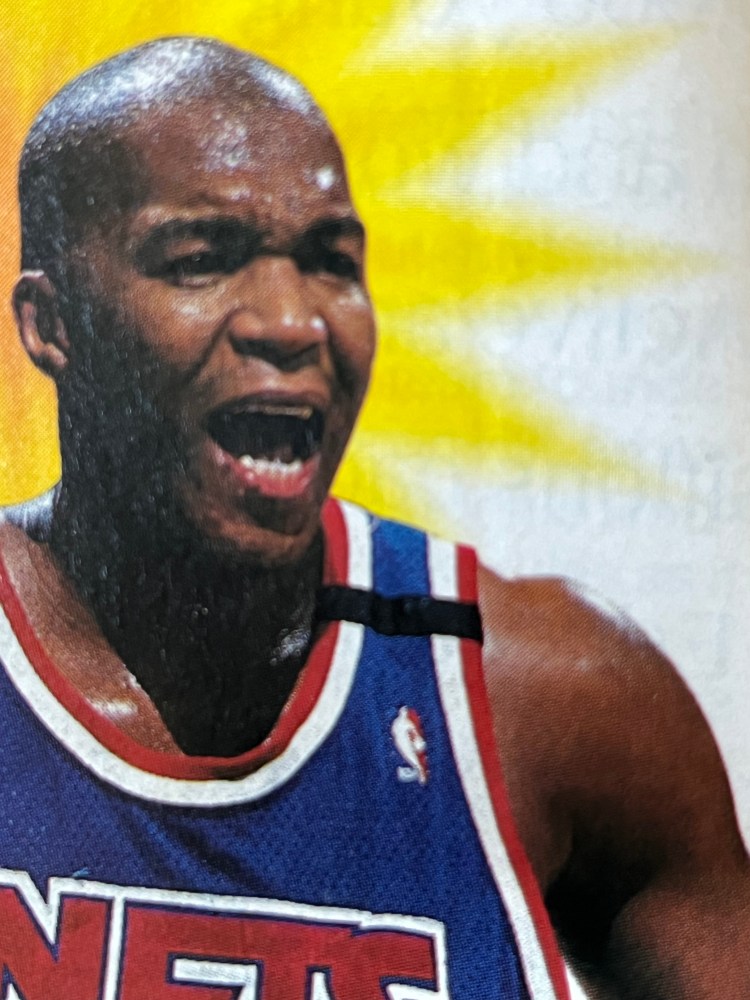
That’s all the fans at the Meadowlands see, because it’s all Derrick Coleman shows them. But is that all there is?
“I don’t think I’m perceived as a bad guy,” he said. “To me, I am the good guy. I don’t think there is a perception out there that Derrick Coleman is a bad guy. It’s something like Derrick Coleman speaks his mind. He’s not the type to shy away from anything. If you ask him something, he’s going to tell you straightforward.”
There is another side to Derrick Coleman. There is the Coleman who goes back home to Detroit in the offseason, where he still lives with his mother. There is the Coleman who spends his time coaching his former high school team in summer league.
And despite wearing a scowl on the court, instead of a smile like Magic Johnson, Coleman plays the game just as hard, just as smart, and with more finesse than just about any other power forward in the NBA.
“I think sometimes people take my intensity on the court—I guess because I’m always serious—as if I’m always the same way off the court,” Coleman said. “Once I step on the court, just because they don’t see you smiling, laughing, enjoying yourself, they see you one way. Well, you can’t do that when you’re losing. You’re trying to figure out a way—’hey, how can I get us a three-point play or something to get us back in the game?’
“That’s the same perception, maybe, that people get when you’re off the court. When I’m off the court, I’m a totally different person. I don’t try to go out and meet everybody, be everybody’s friend. I like dealing with guys I’ve known since high school because I feel they know the true Derrick Coleman.”
Said Chuck Daly, who has taken over the task of coaching Coleman and the Nets this year: “Perception is sometimes strange. The first thing I saw when I came here was that he was incredibly more talented than I thought he was. It’s hard to think of four players in the league better than he is.
“Because he looks like he’s 32 instead of 25. He’s got that shaved head, and he looks ominous. But he doesn’t have a mean streak. He’s a tough guy, but he’s got no mean streak. He’s got a gift. Other than just the basketball skills, he understands the game mentally, which is something few others have.”
****
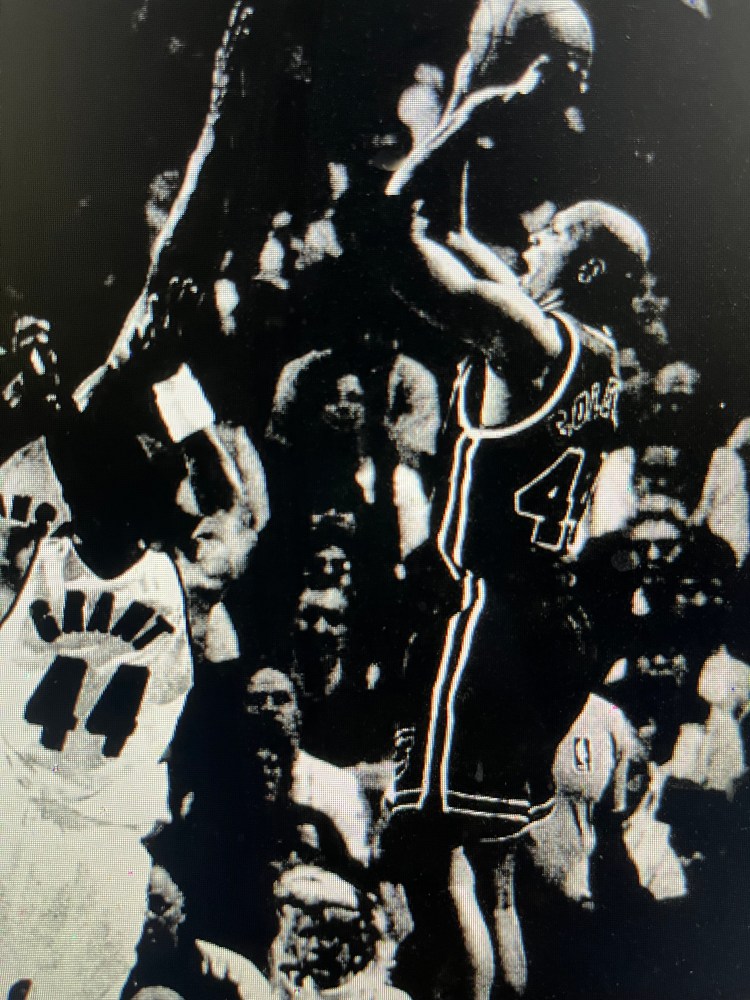
The reputation of Derrick Coleman began at Northern High School in Detroit, where Daly remembers watching him on television and seeing a player with the same type of talents that he shows now.
He departed for Syracuse University, where he established himself as one of the best college players ever. A four-year starter, he is recognized by the NCAA as the first player ever to record 2,000 points, 1,500 rebounds and 300 blocks. His 1,537 rebounds makes him the all-time NCAA leader. But he also established reputation as a headache to coach Jim Boeheim.
“When we scouted him and looked at him, nobody ever said anything good about him,” Fitch said. “They discouraged us about him as a person. But you use your eyes, and you see the talent.”
“I think everybody is going to have their own opinion of everything that goes on in the world,” Coleman said. “I mean, sometimes it bothers me because I don’t think things that are written are true. Like I said, one day it’s in the paper. The next day, somebody’s wrapping fish in it.”
The Nets had the NBA’s worst record in 1989-90 with just 17 wins, but the reward was the first pick in the draft. They opted for Coleman. After holding out through most of training camp, he reported to the team and proceeded to breeze to the Rookie of the Year Award, scoring 18.4 points and grabbing 10.3 rebounds per game.
The Nets got exactly what they expected in Coleman—a multi-talented player who at times could be, as the Nets’ Willis Reed referred to him once, “his old surly self.” Reed, who jokingly blames Coleman for his gray hair, says the thought of giving away the talented forward crossed the minds of Nets management.
“When you draft a guy No. 1, some teams have made mistakes,” Reed said. “We didn’t make a mistake on Derrick. I mean, we just have to make sure Derrick is ready to play. I think mentally and emotionally and sometimes physically, I didn’t think he was in very good shape.
“I understand it takes talent to win. Derrick is a talent. I understand, though, the talent has got to play with the rest of the team and be a part of that team. Part of his role on this team is to give us some leadership ability. That’s part of the maturing process, the time process that we all have to wait for him to go through.
“I’m not a panic-button person,” Reed added. “You’ve got to always know what you’re trying to accomplish. You have to make sure if you’re going to make a trade, be sure that this is the best situation for your ballclub. This is the best team we’ve had since I’ve been here, and Coleman is a part of that.”
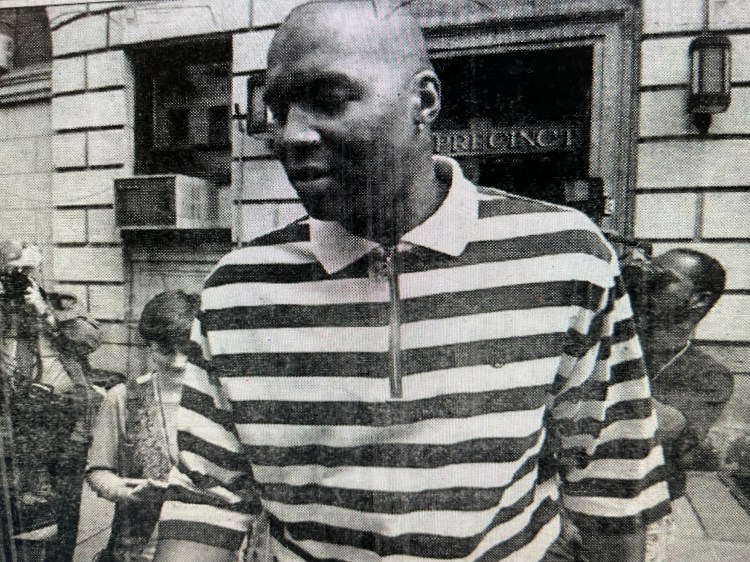
The numbers were similar last year (19.8 points and 9.5 rebounds per game) when Fitch named Coleman as the team co-captain, along with Sam Bowie. But a series of nagging injuries limited him to 65 games and, when he was on the court, the rift between Fitch and his star player grew.
While Coleman was not the only player with whom Fitch had problems, he was the one who would defy him openly on the court and openly criticize him to the media. The problems culminated in a late-season contest when Coleman refused to re-enter a game under Fitch’s orders.
The team improved from 26 wins the year before to 40 last year, earning its first playoff berth since 1986. But at season’s end, Fitch was gone, and Coleman was seen as the one who pushed him out.
“He did,” Fitch said. “I’m sure he told people to get rid of me. But I think the people that he asked, if they’d have come to him the next day and asked him, he might have said something different.
“Derrick was never a distraction. The distraction was all the other stuff about another coach coming in in December. If all the other crap hadn’t come along, the problems with him would have been even smaller.”
Coleman explained: “They’re going to single me out because, you know, I’m the main focus. I’m the center of attention on the team. I can deal with that. I can take all the pressure. It doesn’t bother me. It wasn’t as bad as people made it out to be. We just didn’t agree on everything. That’s all. He would make his point, and then I would make my point. That was it.
“Nobody has ever agreed with everything every coach has said and done, from me to Michael Jordan or Larry Bird,” he added. “You say, ‘OK’ or whatever, but you go out and do it the way you’re capable of doing. You might try his way first, and if it doesn’t work. Then, you’ll be like, ‘OK, well it didn’t work that way. I’m going to try it my way.’”
****
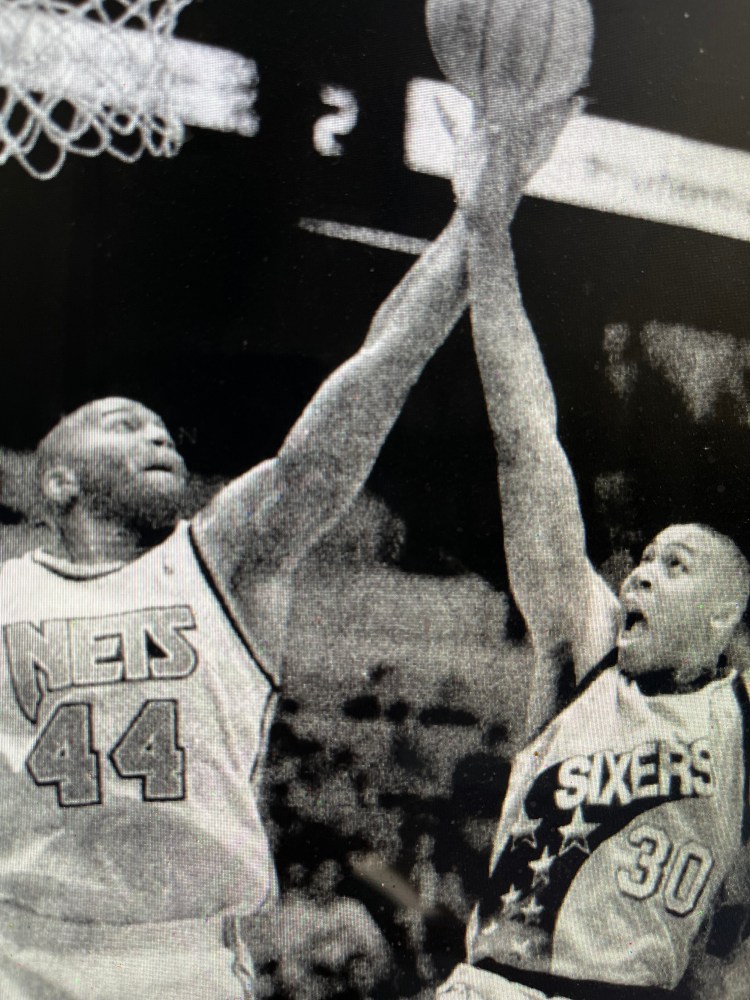
Despite the run-ins with Boeheim and Fitch and the hoopla surrounding him, Coleman is not the coach’s problem many perceive him to be. At 6-foot-10, 235 pounds, he can handle the ball like a point guard, dribbling behind his back on a fastbreak, throwing no-look passes, and tossing in three-point field goals with an accuracy second only to teammate Drazen Petrovic.
This versatility got him in trouble earlier this year. When he commented that he was more versatile than the Utah Jazz’s Karl Malone, a perennial all-star, Malone angrily fired back in the media. But Coleman never said he was better than Malone—and the fact is, he is more versatile than Malone.
“It’s true, except you let other people say those things,” said Nets assistant coach Paul Silas. “I’ve never seen a player with as many skills as he has, as big as he is. He’s probably the best power forward I’ve ever seen.
“He can pass, rebound, shoot, run, and defend. I watch him on post defense. When he doesn’t want a guy to get the ball, he doesn’t get it. When he gets in the guy’s face, he doesn’t get around him. Whatever he wants to do, he can really do.”
“I don’t want to be compared to anybody,” Coleman said. “I want to be Derrick Coleman, that’s all. Sometimes I am playing power forward, sometimes center or small forward. I’ve never been the type that just labels a person as, ‘OK, you are a power forward.’ You’re a player. When you’re out on the playground, nobody is labeled. You just take 10 guys and go out and play the game of basketball.”
But what draws the coaches in are not just the physical skills. Even after their problems, Fitch marvels today at Coleman’s knowledge of the game. “Derrick will realize the importance of practice as he goes on,” Fitch sad. “He’ll learn the little nuances. The thing is, he gets the fundamentals easier than any other player I’ve seen. So, he has to learn not to get bored with that.”
“He’s pure of heart about the game,” Daly said. “Selfishness frustrates him. He can do all of these things, so he’s not tolerant of someone who can’t. Losing frustrates him. He’s got a low level of frustration. All of these things combined in a 25-year-old’s mind are difficult.”
****
One thing that all of his coaches, the media, the fans agree on is that Coleman has the talent to be one of the best players in the NBA. But the consensus is also that he has to increase his desire to reach that level. “I sat down with him and told him what he could mean to this franchise,” Daly said. “It’s not only playing. He’s the star here. He’s the guy who could fill that role.
“He can be an MVP candidate every year if his talent and work ethic come closer together. I can understand why he wouldn’t (have the work ethic). If you’re as gifted as he is, who’s to tell you anything? I’ve seen him out hurt for two weeks, come back, and get 20 points and 10 rebounds. So, he says to himself, ‘I don’t need to work.’ It’s always happened for him.
“It’s recognition, like Alcoholics Anonymous. Everybody can tell him, but he’s got to decide for himself. Once he gets to the mentality of wanting to be the best, not just verbalizing it, when he says, ‘What can I do to improve my game?’ Then, he’ll decide ‘Do I want to be an MVP candidate?’”
Fitch said: “A guy like Derrick, he’ll want to be great. The longer he’s around, the better he’ll get. He’ll get the work ethic. I always felt that the only guy who can keep him from doing things is Derrick.”
“I’d really like to be on the Olympic team, win a championship, and be on the all-star team, things like that that you can cherish down the line,” Coleman explained. “But if not, hey, why cry over spilled milk? The game of basketball has been good to me so far. I’ve been good to it. I just come out and play hard and let everything else take its course.”

