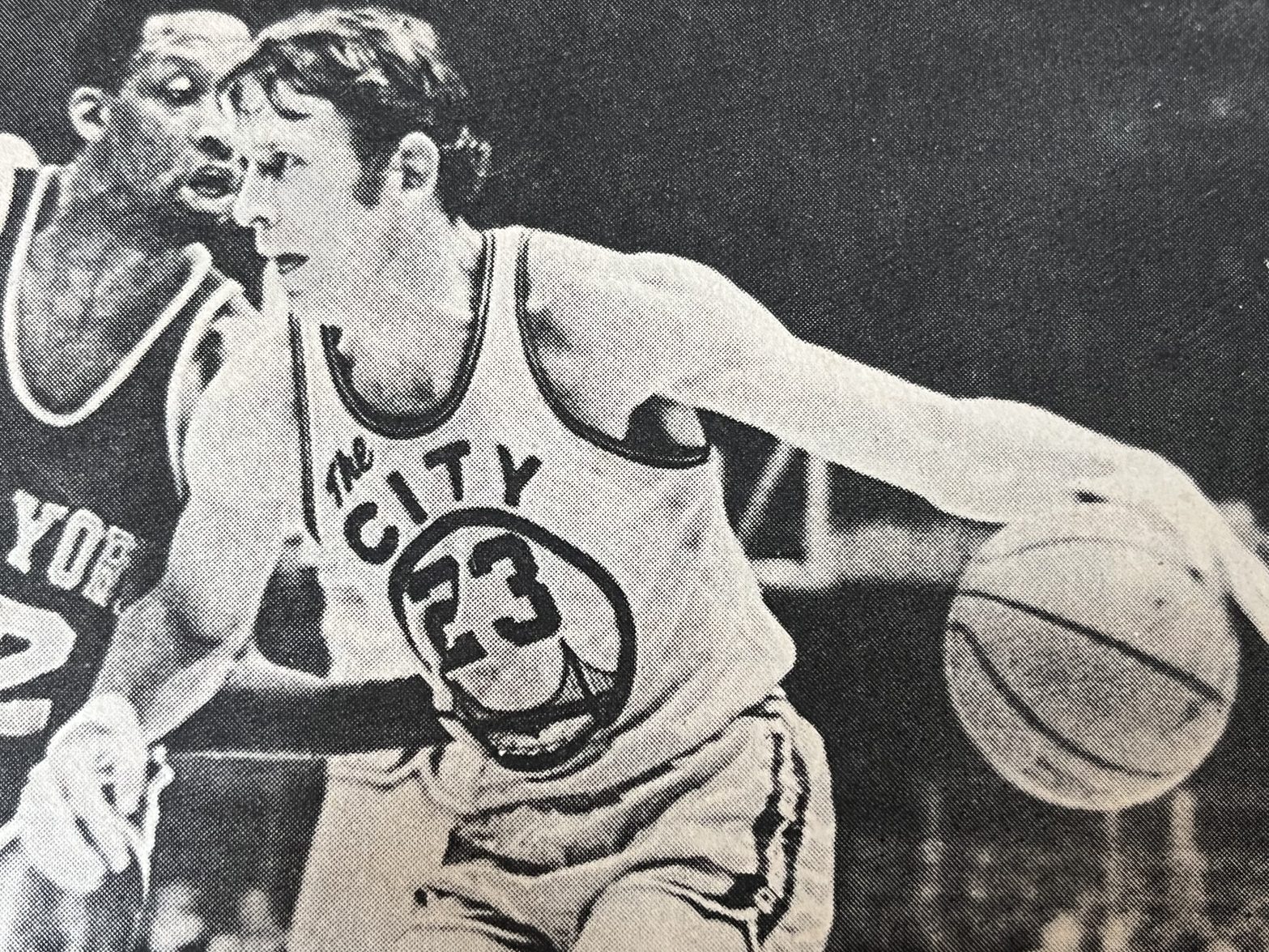
[On January 2, 1964, the American Broadcasting Company (ABC) aired the New York Knicks vs. the Baltimore Bullets. It marked the league’s return to American network television after the rival National Broadcasting Corporation (NBC) dropped the league in 1962. The Knicks-Bullets broadcast marked the first of its 11 scheduled weekly NBA regular-season games in 1964, plus the league’s annual all-star game, over an estimated national network of 60 ABC stations. Estimated viewership: 11 million.
By December 1970, ABC’s NBA Game of the Week aired over a network of 212 stations and included a minimum of 28 regular-season broadcasts, plus the all-star game. Weekly viewership: 18 million. Impressive growth? Well, not impressive enough for several prominent NBA owners, particularly L.A.’s Jack Kent Cooke, who believed the league’s broadcast future resided with cable, pay-per-view, and another network. In 1973, the NBA dumped ABC for the Columbia Broadcasting System (CBS), and raising the wrath and curse of ABC’s Roone Arledge.
But before Roone’s Curse, ABC was pleased as punch to be the television home of the NBA. Just ask former NBA great Jack Twyman, color commentator on ABC’s Game of the Week. Here is an article by Twyman, published in The Complete Televiewer’s Guide to Pro Basketball, 1970-71, that sings the praises of the NBA on ABC. This is a decent, though not great, article that’s heavy on self-promotion and puff. But the article is a keeper for its viewership stats and perspective on television’s hand in the NBA’s growth. Another brief Twyman article follows after this one.]
****
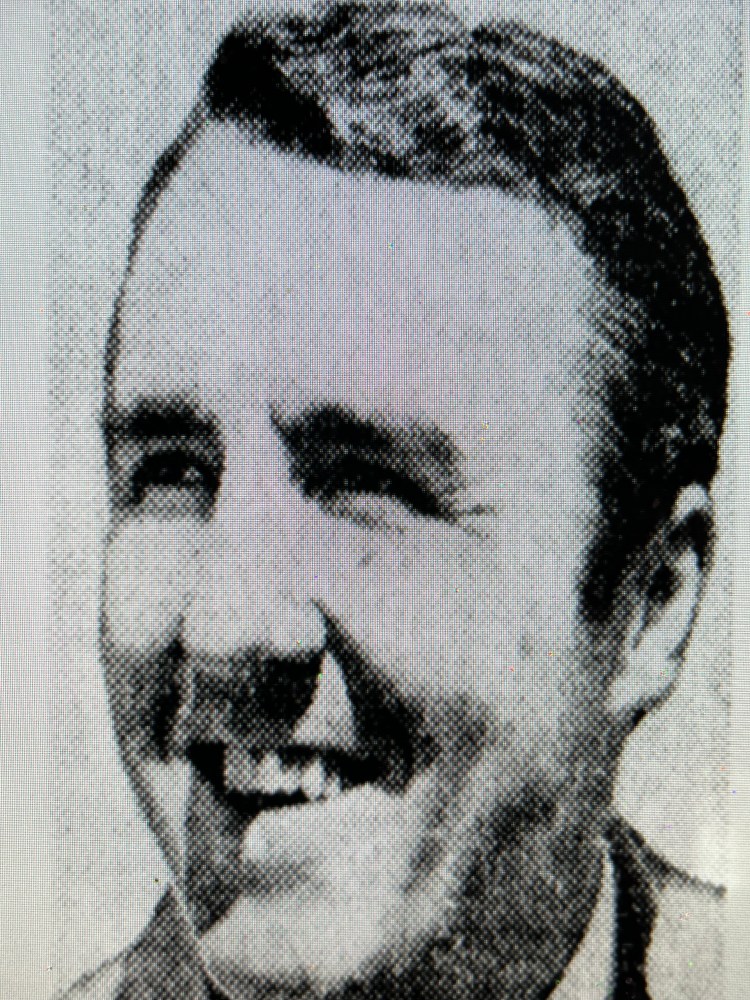
My coworker Chris Schenkel, that urbane and witty man who calls the shots for NBA basketball on television, was smiling when he said, “I don’t know how much the American Broadcasting Company is paying for this new contract, but last year I flew to all games first-class, and now I fly tourist.”
The assembled crowd of newsmen at Gallagher’s Restaurant in New York City laughed heartily. This was a happy occasion on the afternoon of February 17, 1970. ABC and the NBA were jointly announcing a new three-year contract, starting with this 1970-71 season.
This exclusive contract will increase the NBA’s television coverage from a minimum of 18 games annually to a minimum of 28. NBA telecast have become a real hot property, and I am just glad to be on the team that brings you the hot-and-exciting action, trying to give you an insider’s knowledge on what’s happening out there on the court.
I’m what they call “a color man,” and there’s certainly lots of color and excitement in today’s pro basketball. Interest has skyrocketed in recent years. Approximately 18 million people watch each Sunday afternoon, and the Boston-Phoenix telecast on Christmas Day, 1968 attracted more than 20 million TV fans, a record for any regular-season game.
Sometimes I wish I had been born a few years later so that I’d still be out there playing for the Cincinnati Royals, now that the game has grown so in popularity and promises to continue its gains. Some say, indeed, that pro basketball will be the Sport of the 1970s.
NBA commissioner Walter Kennedy has credited television with much of the NBA’s progress and advances in recent years. NBA attendance was up 11.6 percent last year; officially, 5,146,858 spectators saw the action in person, the first season that the attendance had gone over the 5-million mark.
“Our growth over the last five years,” Mr. Kennedy has been quoted saying, “during which we have doubled our attendance . . . was directly related to the telecasting of NBA games by ABC.”
Roone Arledge, president of ABC Sports, is just as delighted with the association. He had this to say: “The NBA’s three new markets (Cleveland, Portland, and Buffalo), the league’s constantly growing attendance, and the always-improving quality of professional basketball makes us at ABC highly optimistic about the next three years.”
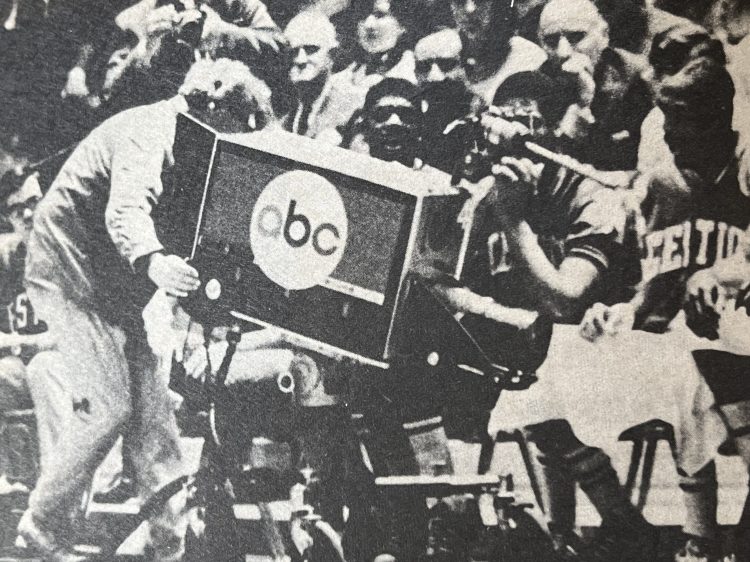
ABC-TV has disclosed that 17 regular-season games on Sunday will be broadcast in 1971. Completing the package will be the NBA All-Star game from San Diego, three games to be selected by ABC and telecast during the fourth quarter of 1970, plus seven playoff games, the majority of which will be shown in prime time.
In addition, “NBA Basketball” this year is being carried by a record number of stations—212—with a record station clearance factor at 98.6 percent. This means that 98.6 percent of all U.S. TV homes have the capability of seeing the action play-by-play.
It’s almost enough to make a man start stuttering on the air. It’s just unbelievable how far and how fast pro basketball has come. The National Basketball Association, which began in 1946, and is this season celebrating its silver anniversary, now threatens pro football for the top rating as the fastest growing sport among American fans.
This season, the NBA fans will have more reason to believe their game is No. 1. Three new expansion teams added to the league bring the number to 17. The new-look NBA will have four divisions: an Atlantic and Central (with teams located in the eastern half of the country) and the Midwest and Pacific in the western half. In the Atlantic will be the world-champion New York Knicks, Philadelphia, Boston, and the new Buffalo Braves. The Central Division will have Atlanta, Cincinnati, Baltimore, and the new Cleveland Cavaliers. The Midwest Division will comprise, Milwaukee, Detroit, Chicago, and Phoenix, while the five-team Pacific Division will include Los Angeles, Seattle, San Diego, San Francisco, and the new Portland Trail Blazers. So you can see the game is now nationwide indeed.
New divisions are not all the league will offer. The expansion draft and some surprisingly big trades will give a new look to the player personnel. Foremost, of course, is Milwaukee’s new look: In addition to the great Lew Alcindor, the Bucks will display veteran superstar Oscar Robertson, obtained in a trade that sent Flynn Robinson and Charlie Paulk to the Royals.
It will seem strange to me to see my old teammate suiting up in a uniform other than the Royals. Everyone expects the Bucks to make a real run for the title with Lew and Oscar together, and it’s something to look forward to, that’s for sure.
Then, there was the swapping of players between Chicago, Los Angeles, and Phoenix. Chicago got Phoenix’s 6-10 Jim Fox; Los Angeles picked up Phoenix’s guard Gail Goodrich, and Phoenix got 7-1 Mel Counts from the Lakers and Clem Haskins from Chicago. This was another big switch, and I look forward to the results eagerly.
The expansion draft turned up. A few surprises, too. The key personnel of the champion Knicks remained untouched, but Los Angeles gave up its first team all-rookie Dick Garrett to Buffalo. And Boston wheeled-and-dealed seemingly with abandon, but more likely with good reason. The Celtics turned seven-year veteran Larry Siegfried over to Portland (Larry was then traded to San Diego for Jim Barnett). They also let go 11-year veteran Bailey Howell (who was picked by Buffalo and then traded to Philadelphia!)
All of these trades and picks, plus the added TV exposure, will spice my interest in the 1970-71 season. You’ll read more about them, about other aspects of NBA play—and yes, about that other league, the American Basketball Association, too—in this book. Keep it around all season. You can refer to it while you watch us commentators do our stuff.
[And one more from Jack Twyman. This brief article, penned one season later, appeared in Zander Hollander’s Complete Handbook of Pro Basketball, 1970-71. The headline: Behind the Scenes on ABC’s NBA Basketball Telecasts. Like the previous article, Twyman does his share of self-promotion and puff, but the stats and perspectives are worth the read.]
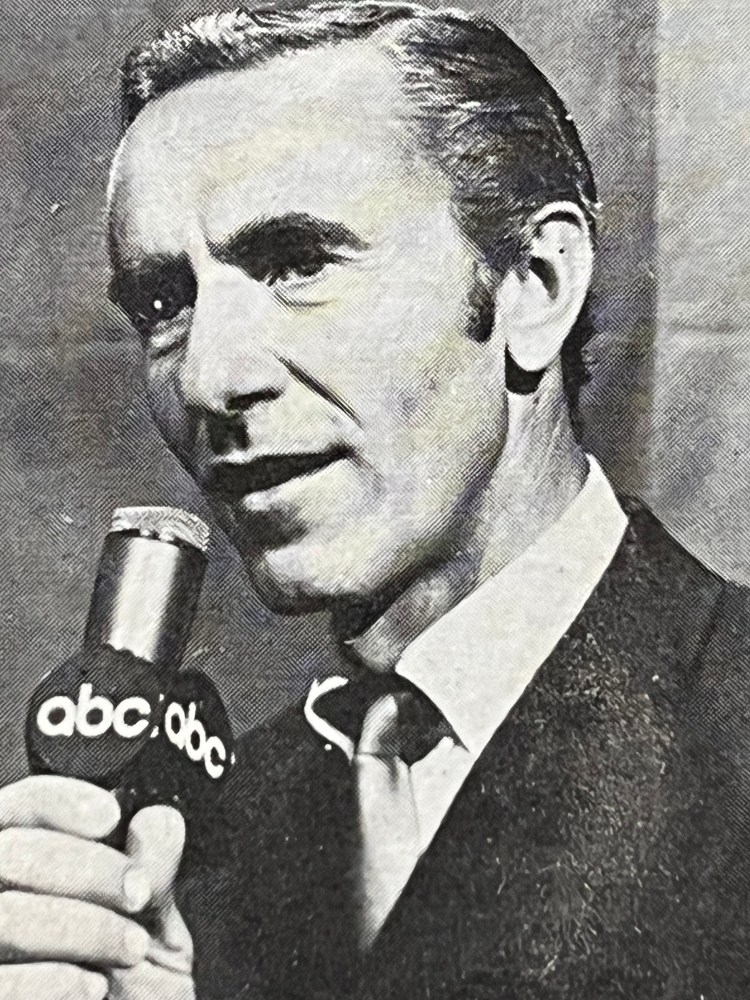
You may not know, Chet Forte, but you should. He’s the brains behind ABC’s NBA Basketball telecasts. A bit of a madman, he always seems to be shouting into the headsets you see Chris Schenkel, who handles play-by-play, and I wearing whenever we’re on your TV screen.
Chet is the producer and director of our show. He stands behind all sorts of television screens and electronic gadgetry, cooped up in a truck that’s usually parked in the hallway outside whatever arena we’re working out of for a given game.
If you met him, you’d know that Chet knows his basketball. You wouldn’t need earphones to get the message either. Chet talks a pretty good game. Once upon a time he played a pretty good game, too, setting all kinds of school and league records when he was an All-America at Columbia University in the Ivy League. He’s a short guy, about 5-9, and I think I could’ve taken advantage of him inside. He’s also got quite a paunch on him these days, but he still swears he’ll take anyone on in a straight-shooting contest and insists he could score 30 points a game in the ABA.
Anyhow, he’s the one who tells us to keep our little monologues short, to watch how “X” is overplaying “Y,” and we help each other in providing the most comprehensive and accurate coverage possible. Usually you have a producer and a director, but Forte does both. The producer’s in charge of the editorial content of a show, and the director’s job is to get the best possible picture on air to help tell that story. He cues me when he’s ready to focus on something special.
There are special problems in basketball coverage. Unlike football, there are very few opportunities for natural breaks, such as a huddle presents between each football play. So sometimes it’s difficult to isolate a great play or run a play back in slow motion, unless someone calls a timeout.
I’ve learned a lot from Forte since I first took the assignment as ABC Sports’ “expert” commentator five years ago. On one of the first telecasts, my old team, the Cincinnati Royals, were playing, and Oscar Robertson, one of the greatest and most exciting players ever to step on the basketball court, was injured. It didn’t seem all that serious from our table, so we kept telling everyone that Oscar wasn’t hurt badly, and he’d be back in action at any moment.
Well, at halftime, I checked around and found that Oscar was more seriously hurt then we’d suspected. As soon as the commercial ended and the second half was about to begin, I came on with my newfound knowledge and triumphantly told our viewers that Oscar was getting dressed and wouldn’t be back in the second half.
Chet’s agonized voice came through on the headset—loud and clear—and he called me a name, which I wouldn’t repeat on the air, and asked if I realized that I had misled some 15 million fans for almost half the game by not checking Oscar’s condition.
One of the toughest parts of the job is filling time when nothing much is happening, which is rare but it happens. One night in Milwaukee, for instance, the game had few fouls, practically no timeouts, and it just flew along. The network had us logged until 11 p.m., and here it was 10:18 and the game was over! We had 42 minutes to fill before we go off the air . . . so I started interviewing people.
After a while, Jon McGlocklin’s wife, Pam, is on with me, and I’d run out of clever powder, so I asked her what Jon’s routine was on the day of the game? Pam begins a fairly elaborate chronological sequence of Jon’s day, beginning with his wakeup time of 10 a.m., a walk outdoors, and his pregame meal at 2 p.m. With time dragging, the obvious question was: “And what does Jon eat?” It seems that Jon likes a steak, a dry potato, salad with oil-and-vinegar dressing, and a cup of tea with lemon. And, Pam said brightly, after a meal he likes his Twinkie.
“What,” I asked incredulously, “is a Twinkie?”
Stunned silence. Finally, Pam, a deep, rich scarlet, explained a Twinkie is a small, oblong cake with a cream-filled center. End of interview. Pam and I received thousands of Twinkies from fans and friends in the weeks that followed.
Speaking of unusual interviews, Wayne Embry, another old teammate, who is the administrative assistant and chief scout of the Milwaukee Bucks, had been after me for years to interview him at halftime or after a game.
You know the great year Milwaukee had last season. They were breezing past the Baltimore Bullets in the NBA playoff finals, leading three games to none and building a substantial lead in the fourth game. So early was the big lead that the game’s outcome and the series weren’t much in doubt. Celebration started early, and the champagne was flowing long before the final buzzer went off, and Embry was feeling the joy of the moment. For the postgame show, I went into the locker room of the Bucks to interview Lew Alcindor, Robertson, Larry Costello, and the other Bucks.
I spotted Embry and decided to have him say a few words as a reward for his patience after all his years of trying to get on the air. Embry is generally a rather articulate man, but he stepped in front on the microphone an obvious victim of hyper-celebration. When I asked him what he thought of the Bucks and their fantastic season, etc., he managed to come out with a loud, clear “duh.” I suggested he could do better than that and, so help me, he blushed!
I know what it’s like to sound like the village idiot in front of a microphone. When the New York Knickerbockers played the Los Angeles Lakers for the title in 1970, Willis Reed, the Knicks’ great center, was suffering with a severely injured knee and had to limp onto the court in an outstanding display of courage. He had his pregame injection of cortisone to help ease the pain somewhat, and I carefully mentioned that he had received a shot of 200 c.c.’s of cortisone.
Telephone calls, telegrams, and letters arrived for days. Politely (sometimes), violently (sometimes), and sarcastically (usually), they informed me that a herd of elephants would be stopped with 200 c.c.’s of cortisone, and that there wasn’t a man alive who could survive that amount. He had, of course, taken an objection of 2 c.c.’s—a slight difference.
It was a good indicator of the size of our audience, however. According to the latest Louis Harris Sports Survey, basketball is scoring solid gains and is drawing up to a point where the number of fans who follow the sport is beginning to rival that of baseball. The latest survey shows that 46 percent of all sports fans now follow basketball, up from 39 percent in 1970. Equally important, those who named basketball as your favorite sport jumped from 11 to 14 percent.
A key to the sharp rise in interest in basketball can be found in the fact that, by 77-16 percent, sports fans agree that “basketball is a great sport because it has a lot of action and is easy to follow.” Also enhancing the game, and this is flattering to the folks at ABC-TV, is the belief of 63 percent that “basketball is a great sport to watch on television.” Thank you, Louis Harris.
It’s fun broadcasting basketball, and lots of fans must find it fun to watch because our ratings continue to climb. When ABC first televised basketball in 1963, an average game drew 11 million viewers. By 1965, the number had risen to an average of 14.9 million total audience per game, and it has gone up steadily since, averaging 18.5 million last season.
ABC and the NBA are currently working on a multiyear contract, primetime telecasts are more in evidence than ever before, the number of games televised each year increases, and the ratings are up. The NBA has come a long way. Right, Chet?
 From Way Downtown
We do not need streaming services to interfere with our cable content today. When I was a kid, it was ABC, CBS and NBC. Now the impact of cable and this streaming business is a horrid invasion of our purchase of Comcast and NBC Sports, in my area, the Philadelphia region. I am sure this goes on nationwide. I like capitalism, but I also like consumers’ rights.
LikeLike