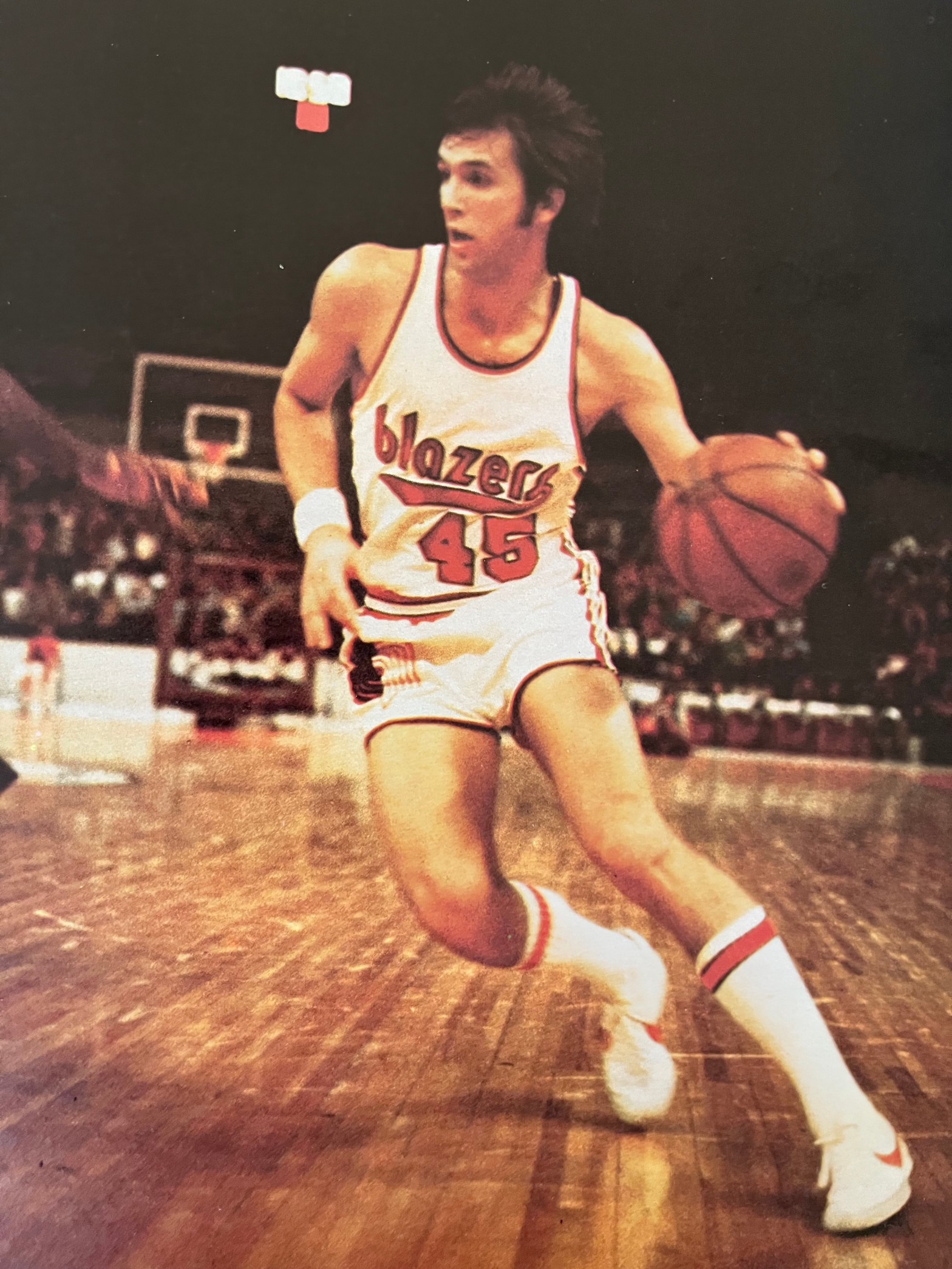
[The blog already has published an article on Geoff Petrie’s 1970-71 rookie season with the then-expansion Portland Trail Blazers. Here’s another one on that award-winning season. What’s different, though, this article goes much deeper into Petrie’s transition to pro ball and life in the rainy Pacific Northwest. It’s definitely worth the read if you have fond memories of “Pistol Petrie.”
Also of note, the below story’s byline belongs to Wayne Thompson. The name should ring a bell. Thompson spent decades covering the Blazers for the Oregonian newspaper and doing a damn- good job of it, too. Here, Thompson is new to his Blazer beat, but he shows the same curiosity and attention to detail that would mark his body of work. Thompson’s story was published on March 14, 1971 in Northwest Magazine, the name of the Oregonian’s Sunday magazine insert.]
****
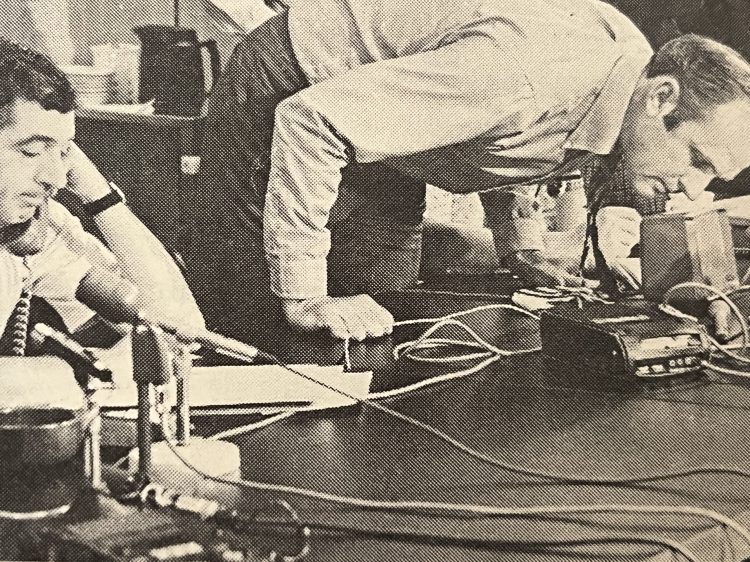
One day last June 1970, the Portland Trail Blazers, one of the three new expansion teams in the National Basketball Association, were holding a practice for their rookies as Lewis and Clark College, and Harry Glickman was watching but not seeing any of the action.
Glickman, the man most responsible for what was happening at Lewis and Clark College that day, was having a daydream—the kind he has had often for the past 12 years. The dream was interrupted briefly by a small, sneaker-clad youngster, full of curiosity and whimsy, who strolled up to Glickman and asked, “Heh, what’s a trailblazer?”
“If we’re lucky,” Glickman said, “a trailblazer is going to be the most exciting thing to happen to sports in Oregon in a long, long time.”
Glickman’s reply may not have satisfied a 10-year-old’s taste for information. But it was probably the most appropriate definition given to date for the Trail Blazers, who have electrified Oregonians on many a rainy winter night with their hustle, imagination, and technique in playing the game of basketball.
Glickman, 46, a native of Portland and perhaps Oregon’s best known and most successful sports promoter over the past 20 years, fulfilled a lifelong ambition in putting together a $3.7 million financial package last February that brought an NBA franchise to Portland.
One of the reasons that Glickman was so confident that the Trail Blazers would generate enough electricity to convert college basketball audiences in Oregon to the professional game was a 22-year-old, bushy-haired youngster from Springfield, Pa., named Geoffrey Petrie, a second-generation Scot whose basketball credentials were obscured at Princeton University, an also-ran team in the Ivy League. The name Petrie, like Agnew [as in Richard Nixon-Spiro Agnew], was no household word, especially not in Oregon, although all of the professional scouts would argue the point.
When Glickman announced last March that Portland had chosen Geoff Petrie from Princeton as its first choice in the annual NBA college draft, you could have heard a leaky spigot anywhere in Memorial Coliseum.
Portland’s afternoon newspaper on a deadline and pressed for research time went so far as to beg the question, “Petrie Who?” It was almost as if Richard Nixon himself had made the choice. The big sports stories of the day were that Detroit had drafted 6-foot-11 All-American Bob Lanier of St. Bonaventure. That Atlanta took Pistol Pete Maravich of Louisiana State. And that Boston had selected All-American Dave Cowens of Florida State.
Petrie who? Nobody seemed to be impressed, certainly not the national press, specifically not the Oregon press. This is an oversimplification, but the reaction of Oregon sportswriters and broadcasters, some of whom reside in a vacuum of provincialities and trivia, was this: “If he didn’t play in the Pacific-8 Conference, he’s an unknown.” Hence, Petrie who? And that’s not a great start for a $250,000 rookie.
That’s one of the reasons that Glickman was daydreaming a lot at Lewis and Clark College last summer. He was watching and admiring the basketball talents of an Ivy League graduate who was destined for great things in the National Basketball Association.
But would Geoff Petrie T-shirts sell at the concession stands at Memorial Coliseum? In Petrie’s case, it was not a question of talent, but rather a question of merchandising and marketing. To compound the problem of image and identity, Petrie did not play well at home in the opening months of the season. Yet, in the road games, he drew rave notices all over the league, particularly after a 35-point performance in a preseason game at Seattle in early October that gave the Blazers an upset 127-112 victory over the San Diego Rockets.
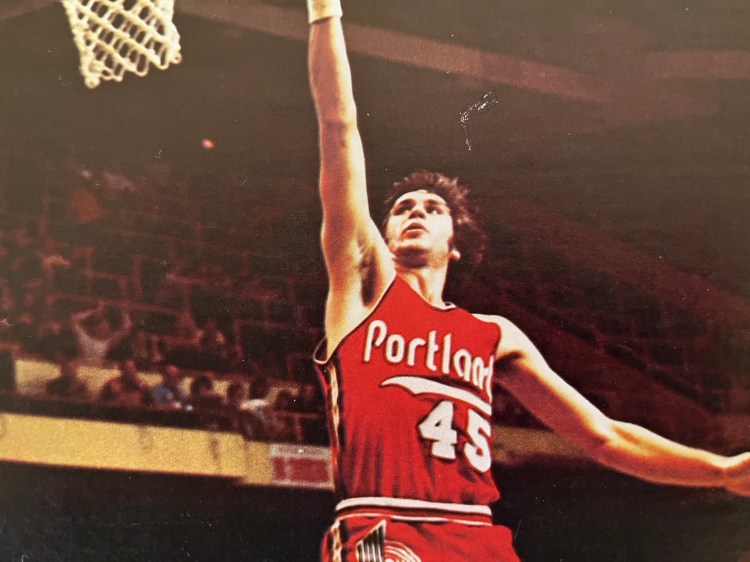
Three weeks later, during the regular season, Petrie exploded for 38 points—scoring 10 in the final 44 seconds—to almost single-handedly engineer an upset over San Francisco. But the effort fell short by three points as the Warriors survived the Petrie push, 118-115.
But by this time, people were beginning to talk, and the conversation was no longer “Petrie who?” but rather “Petrie how?”
“How does he do it?” exclaimed one Warriors fan who came out of the stands to proclaim the Portland rookie was the next “superstar” in the league.
“Who’s Pistol Pete?” the fan asked. “I’ll take Pistol Petrie,” he said after witnessing Geoff’s 38-point night against the Warriors.
What the Trail Blazers have in Geoff Petrie at this late stage in the rigorous 82-game NBA season is a leading candidate for rookie-of-the-year honors, who is averaging 23 points per game. “If he doesn’t make rookie-of-the-year, I’ll be very surprised,” said Seattle player-coach Lenny Wilkens recently after watching Petrie score a career-high 43 points against the Sonics.
“He has the moves of a Jerry West, a very quick shot like West, and stamina. All he needs is experience and polish. He has the poise,” said Wilkens, who is the coach of one of the 10 established teams that the Trail Blazers have beaten this year.
Dick Snyder, the four-year-veteran Seattle guard who is considered to be one of the better defenders in the league at a height of 6-foot-5, is also high on Portland’s man from Princeton. In his last three games against Seattle, with Snyder guarding him, Petrie has scored 109 points on a variety of 20-foot jump shots and stirring drives to the basket. “I played to the left at the beginning of the season, and it seemed to stop him. But he’s learned a lot since then,” Snyder said. “Now you can’t overplay him in any direction.”
The Petrie Fan Club, not large in Portland but growing nationally, includes Detroit coach Butch van Breda Kolff, who recruited Petrie originally at Princeton; Los Angeles coach Joe Mullaney; Philadelphia coach Jack Ramsay; and San Francisco player-coach Al Attles.
“He had the reputation of never having lost a one-on-one game at Princeton,” van Breda Kolff said. “He’s still doing it,” he added last month as Petrie scored 28 points to humiliate Detroit.
Ramsey liked Petrie’s style last July in Philadelphia’s Baker League, a summer playground league for many professional players. So much so, he offered Portland one of his own established stars, Archie Clark, to get Petrie. But Trail Blazer management was not moved.
Mullaney, on a recommendation from Laker great Jerry West, also made a bid for Petrie before the Portland rookie had played a professional game. Prior to the NBA expansion draft last April, Mullaney offered the Trail Blazers Mel Counts, the former Oregon state star, for Petrie and a future draft choice. But again, Portland said no.
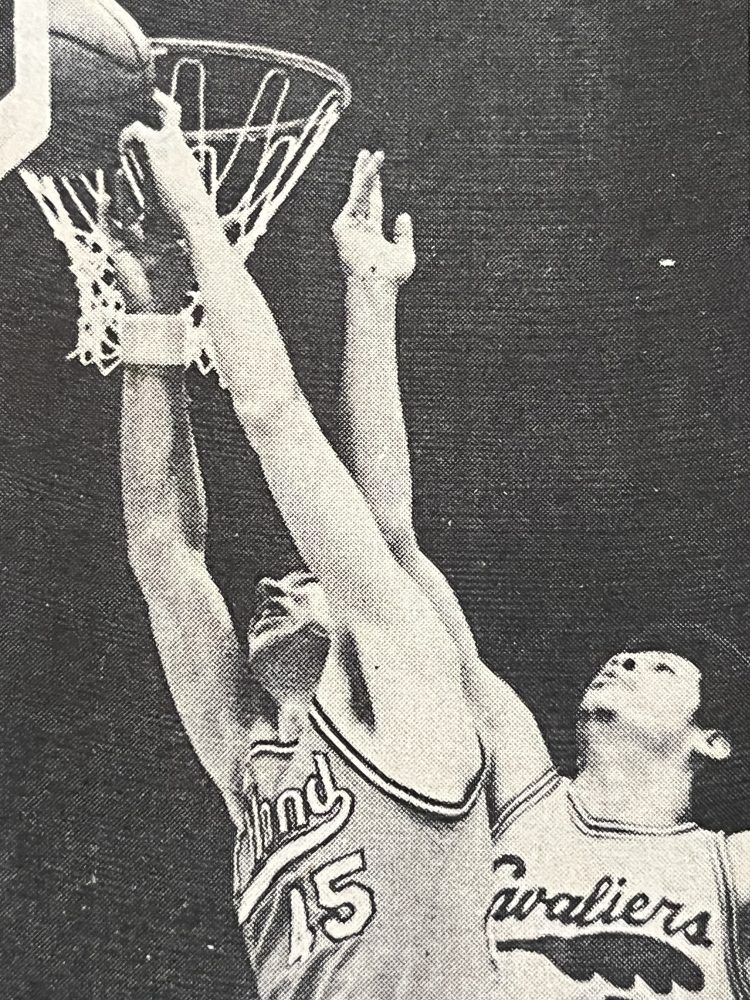
It was the kind of offer that is difficult for a promoter, like Glickman, to turn down. The Lakers were offering seven-foot Mel Counts, a state hero in Oregon with its heretofore-mentioned provincialities, for “Petrie who.” It had to be tempting for Glickman, a man trying to sell a new entertainment product locally. But he said no. Petrie made the decision look sound before 11,457 Blazer fans last month by scoring 36 points against the Lakers, in spite of everything the great Laker guard Jerry West could do to stop him.
The Portland fans, a growing group of enthusiasts who started as a hardcore 4,000 but have increased to nearly 8,000 recently, did not warm up to Petrie as quickly as they did to Jim Barnett, a known entity and former scoring champion at the University of Oregon.
But to the credit of the spectators, their loyalties have been based largely on performance. Barnett had played sensationally at home; whereas, Petrie had not. But this all began to change after the first two months of the season, and on December 4 against Phoenix, Petrie had his “coming out” party at Memorial Coliseum with 33 points, hitting 14 of 24 shots from a variety of angles.
After the Phoenix game, which showed the Oregon fans why Petrie is so highly regarded and brought meaning to the brilliant Petrie road performances against San Francisco, New York, Boston, and San Diego, Geoffrey himself felt he had overcome a large mental obstacle in the path of his development as a player. “I was beginning to think I’d never play well at home,” he said after the game. “I guess I was just mentally psyched by the fans here.”
The Geoff Petrie who achieved a B-plus average as a sociology major at Princeton is a sensitive young man of above average intelligence. He is more concerned with becoming a great basketball player than becoming a favorite bubble-gum card of the 10-year-old set.
“Sure, all that stuff, autographs and endorsements, are flattering, but I’m not motivated that way,” he said. “I think there is a tendency among professional athletes today to reach out for extracurricular income at the expense of their performance and their professional sport.
“I feel some of these endorsements and extras for public appearances interfere with the development of a player. And when they do, they’re not for me. I’m chiefly interested in becoming the best basketball player I can be,” Petrie said.
At 22, Petrie is old-fashioned in his lifestyle. “Greed ruins a lot of players,” he said. “I don’t want to go that route. I’m happy with my present circumstances—(which includes a moderately decorated apartment in Northeast Portland)—and anxious about my future. But I don’t think at my age, I have a great, big masterplan for my life,” he said.
Petrie and his wife, Cheryl, who met Geoff at Princeton, still suffer pangs of homesickness for family back East, but they both admit a growing fondness for Oregon and the voluminous outdoor pursuits available to a young couple. “We’ve enjoyed discovery of Mount Hood and the Oregon coast as only an East Coast native can,” Petrie said “you know, coming from an environment clogged with people problems, it is exciting to rediscover fresh air and open spaces,” he said.
“But we haven’t really developed webfeet yet,” he laughed, alluding to Oregon rain, which hasn’t impressed either member of the Petrie family.
On a recent rare and sunshiny day, the Petries took off for a drive over the West Hills scenic route in their sportscar with the top down. “I had almost forgotten we owned a convertible,” he kidded.
Petrie’s off-court lifestyle does not crave the lively nightlife of a Los Angeles or New York City setting. An evening at home listening to his stereo set, watching a television drama, or curling up with a good secret-agent novel will suffice. “We like to have people over, and we’d like to go out for dinner. But that’s about it,” he said. Cheryl, a part-time student at the University of Portland, enjoys decorating and redecorating their modern apartment with contemporary furnishings and stylings.
Petrie is monophonic, even if he does enjoy an eight-tract stereo system. “Basketball is my life, and that’s what I think about when I’m not playing or practicing. I wouldn’t want to mislead anybody. I sleep on a pillow, and I eat nourishing foods, and I drink lots of milk and fruit juices. But aside from that, I live basketball,” he said emphatically.
Like many rookies, Petrie has found life in the NBA to be a survival test of a young man’s stamina, durability, and mental toughness. In four years at Princeton, he played a total of 90 games of 40-minute duration in a span of 16 playing months.
This year with the Blazers, he will play 90 games of 48-minute duration over a six-month stretch. “It’s sorta like enrolling as a freshman in September, becoming a sophomore in November, a junior in January, a senior in February, and graduating in March.” Petrie said. “We play so many games in such a short time, I find it hard mentally to keep them separated.
“If you have a bad game in college, you have plenty of time to think about it and get mentally prepared to play your next game,” he said. “In the NBA, you have to get rid of the bad ones in the shower and come back out like nothing happened the next night,” Petrie said.
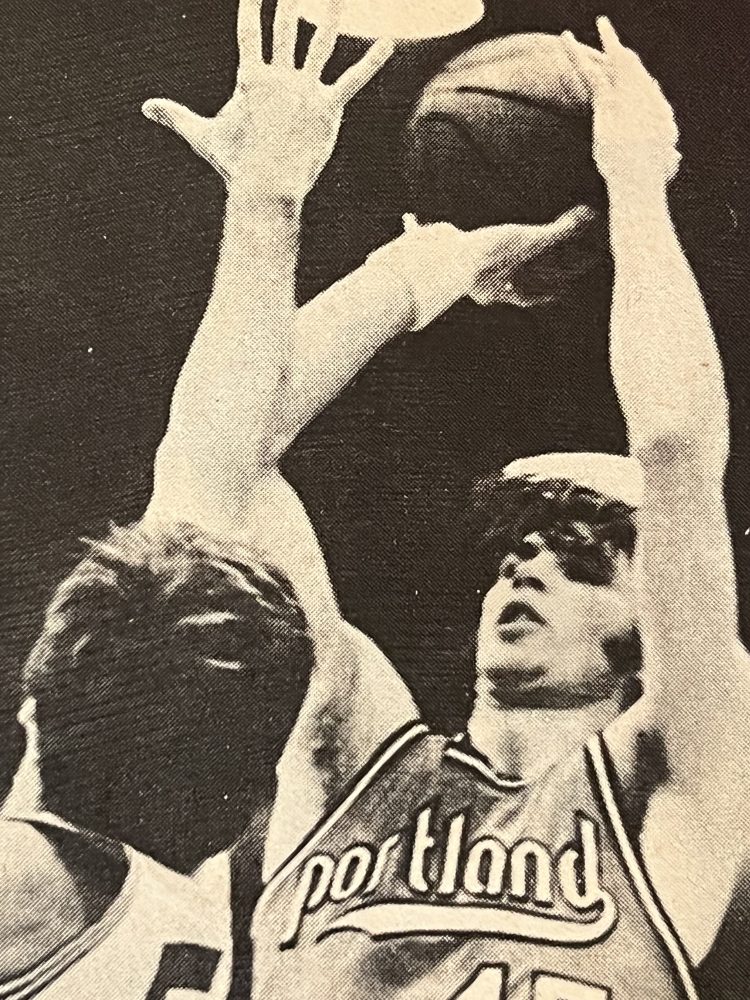
As for the physical challenges, Petrie, who averages 36 minutes of playing time each game, runs from six-to-eight miles each outing, while physically contesting grown men who often outweigh him by 20-to-30 pounds. The travel from city to city, from one time zone to another, is another form of physical taxation that takes its toll on an unsuspecting rookie. When the season is over March 23, the Trail Blazers will have traveled some 67,500 miles to 16 cities throughout the country.
“My problem is deciding which I hate the most—airplanes, airports, or hotels,” Petrie joked. “If you ever felt sorry for a Jack-in-the-box when you were a kid, then you can sympathize with basketball players on an airplane. When the airlines designed their seats, they must have used jockeys for models,” he quipped.
In this his first year as a professional, Petrie has developed a rather novel and loyal fan club in most every NBA city across the country. When the Trail Blazers show up in San Francisco, Los Angeles, Detroit, Chicago, New York, Philadelphia, Boston, Baltimore, Atlanta, San Diego, and elsewhere, groups of Princeton alumni gather to form a vocal cheering section.
“That’s the way Princeton is . . . it’s a state of mind, rather unique among Ivy League schools. It’s almost as if every student or alumnus at Princeton is a blood brother for life. I can’t really explain it; you’d have to be a Princeton man to appreciate it,” he said.
Petrie has a big following among youngsters, too. He gets about 10 letters a week from young fans—mostly in the 10- to-15-year-old age bracket—and most of them from the East Coast. Some of the letters are from youngsters Petrie tutored while he was a counselor at various summer basketball camps in the Pocono Mountains in Pennsylvania during the past four years.
This year, Petrie and Barnett plan their own three-week basketball camp at Pacific University in Forest Grove. “That’s one of the ways I learned to play basketball, and I strongly recommend it to any youngster who loves to play the game,” Petrie said. “But let’s be honest, the camp’s for me, too. It will give me a chance to play.”
Petrie’s discovery of the game of basketball paralleled a tragic event in his life—the death of his father. The same year his father died, Geoff was introduced to basketball in a rather unusual way. “I violated one of the grade-school rules by walking up a one-way flight of stairs the wrong way,” Geoff recalled. “This teacher who caught me made me go to the gym after school and write 100 times, ‘The stairway at the north end of the building is one-way down, not up.’
“While I was there, I watched the fifth-grade kids play basketball, and the teacher asked me if I would like to play. That’s how I got my start,” he said.
A year later, Geoff Petrie got his first and probably only rejection slip from a basketball league. “I was playing in this league with 12-year-olds, but when they found out I was only 11, they took my jersey away and kicked me out of the league.”
That was the last time anybody ever took a basketball uniform away from Geoff Petrie. Even at the NBA All-Star Game this year, in which Petrie was the only touted rookie selected to play, they gave him his uniform to keep after the game. When it was over, Petrie, who played five minutes in the game, was handed five $100 bills for being a member of the winning Western All-Star team. “Wow, that’s $100 a minute. Isn’t that what computers get paid?” he laughed.
Later, he said, “It was a thrill to be selected on the all-star team as a rookie, but I felt I was more of a spectator than a player. I’d like to go back next year as a player.”
Petrie’s college career at Princeton would be considered outstanding for most players, but in many ways, it was disappointing to Geoff himself. “We had winning teams at Princeton, but I never played on a championship team. If I have any goal, it is to be a part of a championship in Portland. A lot of people play basketball and play it very well, but only a few ever attain the distinction of being on a championship team,” he said.
At the start of his junior year in college, after averaging 12.9 points per game in an up-and-down sophomore season that brought Petrie to Portland for the Far West Classic, Geoffrey reached all-time career lows in motivation. “School had gone poorly—I got blitzed academically my first two years because the curriculum was geared to prep school, rather than public school, backgrounds—and my basketball game was deteriorating. I was really frustrated and depressed.”
So Petrie and a friend decided to leave school for a year, and they each purchased a plane ticket for Puerto Rico. But Petrie never went. A friend talked him out it. The friend was his roommate, 6-foot-9 John Hummer, who, like Petrie, was a first-round college draft choice in the NBA.
Hummer, a starting forward for the Buffalo Braves, is Geoff’s best friend and confidant. “Without divulging any team secrets, we’re in telephone contact every week. We divide up the telephone bills democratically, but that’s one of the reasons why my monthly phone bill is always over $100,” Geoff mused.
Another reason for the exorbitant telephone bills is Geoff’s brother George, a 6-foot-3 junior and basketball star at Lebanon Valley College, a small teacher’s college in southeastern Pennsylvania. “One of the liabilities of being a professional basketball player is that I’ll probably never see my brother play a game,” Geoff said. “But I definitely plan to bring George and John Hummer out here this summer for my camp. It will be just a super time for me,” he said with a smile, a warm smile that makes friends easily.
Geoff’s father was more of a baseball fan than a basketball follower, but the entire Petrie clan is athletic. His 13-year-old sister holds an East Coast record for the girls’ softball throw in Junior Olympic competition. “She’s almost as tall as Cheryl, and she’s only in eighth grade,” Petrie said proudly.
After the Puerto Rican plane ticket crisis, Geoff settled down to enjoy two great seasons at Princeton, while at the same time missing by two letter grades graduating with honors at the Ivy League school. When the professional basketball scouts began compiling their lists, many had Petrie rated above North Carolina’s Charlie Scott, the hottest property currently in the rival American Basketball Association, and some liked him better than Pistol Pete Maravich, the all-time leading scorer of college basketball.
Maravich, it turned out, went ahead of Petrie in the draft. But Geoff didn’t escape the eye of Portland’s chief scout and director of player personnel, Stuart Inman. “We think he could have been a starter with any team in the league,” Inman said. “He’s a floorleader, he’s intelligent, and he’s a shooter. He does it all.”
Inman said recently he couldn’t possibly imagine Geoff having a better season as a rookie than he already has had. Of the 204 active players in the NBA, only nine have enjoyed better rookie years statistically, and only two of those—Oscar Robertson and Earl Monroe—are guards.
Petrie typifies the kind of player Inman is looking for in forming the foundation for what the Trail Blazers hope to be in the future. “In both the college draft and the expansion draft, we looked for speed, quickness, character, and intelligence above all other qualities, and it shows,” Inman said.
After watching the Trail Blazers excite Portland fans with their hustle, spirited fastbreak, team defense, and amazing speed, Inman has no intention of scrapping the architect’s plan for building a winner in the upcoming March 29 college draft. “A fellow can make a lot of mistakes in this business of picking players,” Inman said. “But every time I make one from now on, I’ll think about the first one—Geoff Petrie—and that will make me feel better.”
In a ruthless and sometimes cruel business, professional athletes are bargained away, to and fro, like slaves. And new acquisitions are often disappointing. It is encouraging that Portland’s very first Trail Blazer is also Portland’s very best.
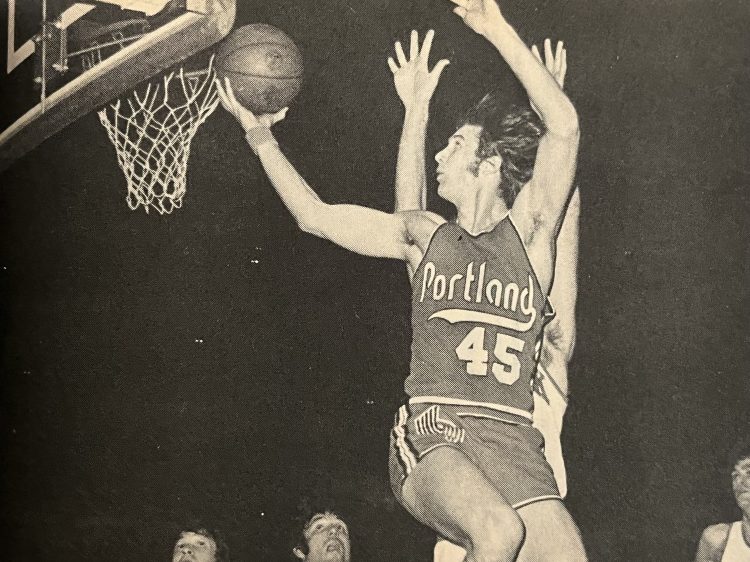
[Petrie would suffer through a terrible sophomore jinx during the 1971-72 season. As highlighted in another Petrie magazine profile, this one penned by New Jersey-based sportswriter Augie Borgi, the jinx kicked in when Petrie and the Blazers least expected it:
So Petrie became a pro, and all-star, and is being touted as a future superstar. There is no talk of any sophomore jinx in the Pacific Northwest. Petrie’s scoring exploits will rise in a direct proportion with rainfall in Portland.
But the start of the 1972 season threatened to make those rosy predictions turn sour. The arrival of heralded Sidney Wicks figured to cut into Geoff’s scoring production and make the Trail Blazers something less than a one-man show. That was all right with Geoff. Carrying an entire team on your back can become a chore.
What was worse was a training camp accident of uncertain origin that took Petrie out of action. “I tore up my knee in training camp,” Geoff remembers, “and we still can’t figure out how it happened. After practice, I felt pain in my knee and asked the trainer to treat it. He didn’t know what it was. He sent me to the doctor, and after an examination, he said he’d have to operate to remove some cartilage.”
Sophomore jinx?
“No!” Petrie insists emphatically. An accident. Could happen to anyone. But as late as Christmas, Petrie was still feeling the effects of the operation. After a game against the Knicks, in which Portland trailed by as many as 47 points (Petrie called the game “Godzilla Against the Boys Club”), he admitted he wasn’t coming along as well as he had hoped.
Petrie’s sophomore season would finish jinxed due to injury. He played in just 60 games, though his numbers remained pretty good on one leg. Petrie averaged 35.9 minutes per outing and contributed a healthy 18.9 points and 4.1 assists per game on a losing team that openly feuded. “I’d like to forget last season,” Petrie later said in the run-up to his third season in Portland, “and the best way to do it is make everybody forget it.”
Those words would prove prophetic. Petrie got both legs under him again and returned to his all-star level of play by midseason. Here’s the Oregonian’s Wayne Thompson for a taste of the healthy-and-improved third-year pro from Princeton. Thompson’s story appeared in the newspaper on December 8, 1972.]
Will the real Geoff Petrie please stand up? Dribble if you want, drive if you please, but keep the red-hot 25-foot jumpers going. This was the plea of the Portland Trail Blazers as they gathered in Houston Thursday afternoon for their only off-day of this current road trip.
Petrie, who must be suffering second-degree burns on his fingertips by now, took a nap. It had to be sweet dreams in Houston Thursday for it was nightmares only 16 days ago in Boston. But, oh, those 16 days—a flaming fortnight as the British phrase it, featuring one of the most spectacular streak performances of the NBA season.
Yet, Geoff doesn’t think of it that way. “I don’t think I’m doing anything different than before. It’s just that the layups and drive shots are going in, and I’m shooting with more confidence, maybe. Nothing has changed really,” he insisted.
But something has changed. Petrie’s scoring average has zoomed in the last seven games from 20.1 to 23.2, and his shooting percentage has skyrocketed from 42 percent to 46.6 percent. In seven games against Philadelphia, Cleveland, Detroit, Kansas City, Atlanta (twice), and Baltimore, Petrie has connected on 92 of 164 shots, converted 28 of 32 free throws, snared 33 rebounds, doled out 31 assists, and scored 212 points for a 30.3 average.
All this after scoring just three points in the Boston Garden on November 22, a nightmarish performance that saw him miss a layup, make a layup, and then miss 13 straight.
He didn’t really do anything drastic to break his slump. He just kept playing, doing the same things he has always done. Said Blazer coach Jack McCloskey: “For a while, I felt Geoff was more of a streak shooter than a pure shooter. But I may have been wrong. Streak shooters don’t usually put together their streaks against six different teams over a two-week period.
“But the encouraging thing about Geoff’s play during this period is not just his shooting. He’s doing everything well in the offense, and he’s improving every day at the defensive end.”
Petrie’s current assault actually began just after Thanksgiving in Philadelphia, a likely spot for origins since he grew up there. With his mother and brother looking on, he scored a modest 18 points against the 76ers. After that, it was 27 in Cleveland, 39 at Detroit, 23 at Kansas City, 30 against Atlanta in Portland, 39 at Atlanta, and 36 at Baltimore.
An interesting sidelight to his recent offensive explosion is that in three of the seven games, Petrie never went to the foul line despite close and often very physical guarding. In Atlanta earlier this week, the Hawks were talking to themselves about what Petrie did to Atlanta’s excellent defensive specialist Herm Gilliam, making 15 of 19 floor shots en route to 39 points.
That followed Geoff’s Saturday night against Gilliam in Portland—a 15-for-26 affair that finally sent Gilliam sulking to the Atlanta bench. “Nobody scores on Herm like that,” argued Atlanta coach Cotton Fitzsimmons. “Not Walt Frazier, Jerry West, Nate Archibald, Charlie Scott . . . nobody. Petrie has been simply unconscious against us.”
This current streak, which hopefully will continue for Petrie and the Blazers Friday night and their next road appearance here against the Rockets, is much like the plateau he reached during his rookie year in late December. That season, Geoff plummeted to his seasonal low after 28 games, averaging only 20.0 points per game on 40.2 percent floor shooting.
He held his own for 10 more contests, combining hot and cold performances. Then he caught fire the day after Christmas against Phoenix. In his first seven games, he posted totals of 32, 31, 40, 32, 39, 28, and 32 points—an average of 33.4 points per game.
But the most encouraging barometer of all in projecting Geoff’s current streak is this: his rookie streak that season on December 26, 1970, didn’t really end until March 26, 1971. In his last 54 games, Petrie averaged 27.1 and shot 48 percent en route to co-Rookie of the Year honors in the NBA.
Greatness relies on momentum. And Geoff Petrie is a case in points.

