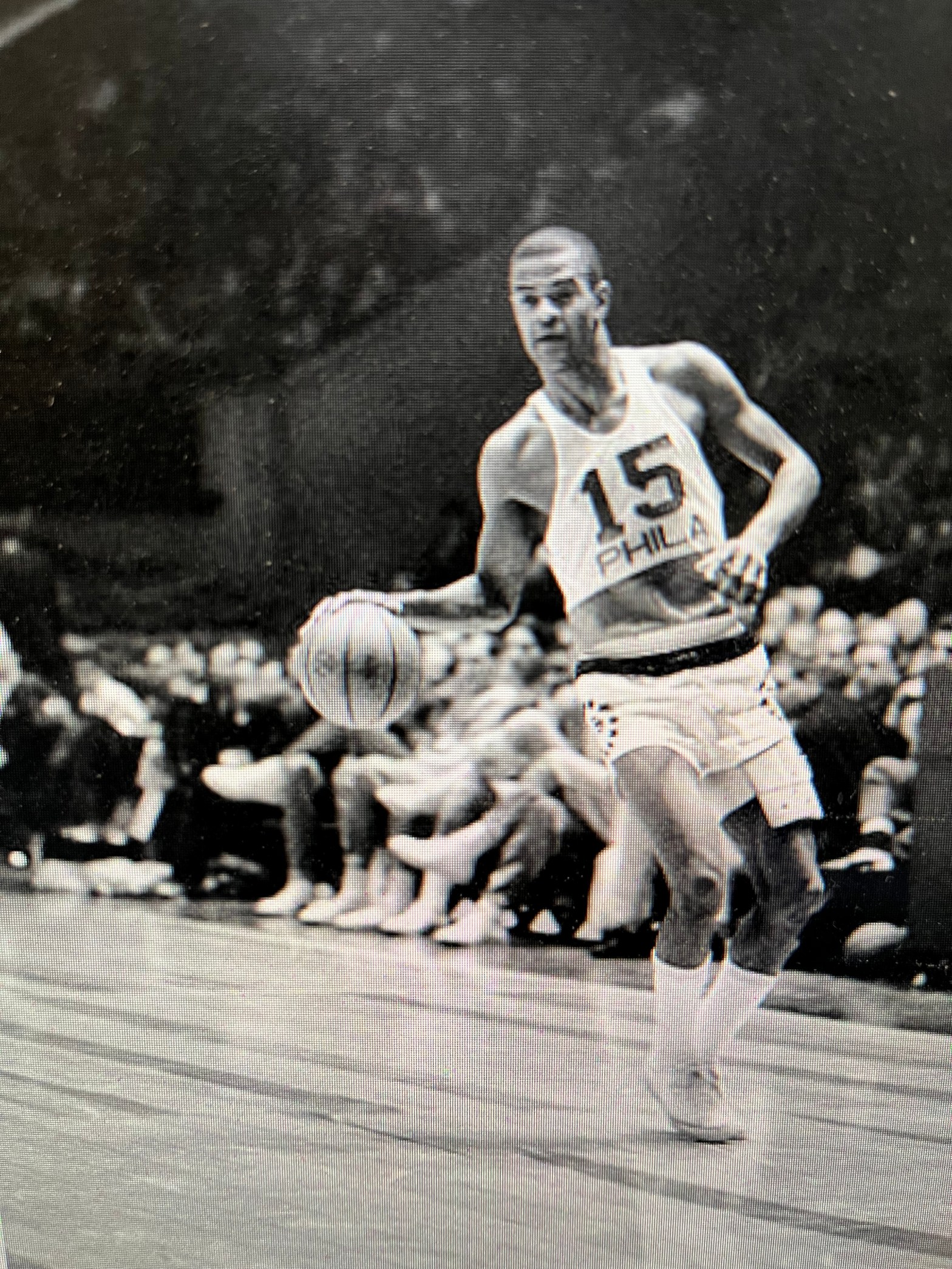
[Everybody has a few indelible basketball memories from their early childhood. One of mine was toddling out to the garage, where my father sometimes puttered on weekends with an overhead black-and-white TV tuned to the NBA Game of the Week. Boston and/or Philadelphia were always the featured acts, and I still can see Philly’s Hal Greer stopping, popping, and scoring. Over and over again. To give you an idea of how bright his green light to shoot could be, when Wilt Chamberlain was traded back to Philly in January 1965, Greer took 33 shots in Goliath’s 76er debut. In a surprising quote from his coach Dolph Schayes: “When Greer can get 33 shots, we’re going to win.” (Philly did take the game, though Greer connected on just 11 of his tries in a rare wayward night from the field.)
The 76ers rolled into the 1965 postseason and straight into a seven-game grudge match against Boston for the Eastern Division title. This shouldn’t come as a shock: the Celtics prevailed that year in seven. But, at the end of regulation in Game Four, Greer connected on a wing-and-a-prayer to send both teams into overtime and buy some extra time for Philly to even the series at two. What follows is an account of Greer’s controversial buzzer-beater. The account is mainly from Boston Globe reporter Clif Keane. But to fill out the story a bit, I’ve sprinkled in some quotes here and there from other accounts of the game that ran in Philly. All were on the newsstands on April 10, 1965. To dribble or not to dribble? That is the question.]
****
One minute to talk about it, one second to shoot the ball. If it goes in by some streak of good fortune, almost 10,000 people will go bats. If it misses—then count out the Philly 76ers almost for sure in their best-of-seven series with the Boston Celtics, ahead two games to one.
It went in . . . and Hal Greer had to talk for almost an hour about what happened with his 35-foot shot to tie the game in regulation at 118-118 and move the 76ers into an overtime victory.
If there is excitement at a crap game, it is quiet to what was going on around the 76ers bench with Adolph Schayes talking things over with his five men who were going to take this last ditch shot at the basket.
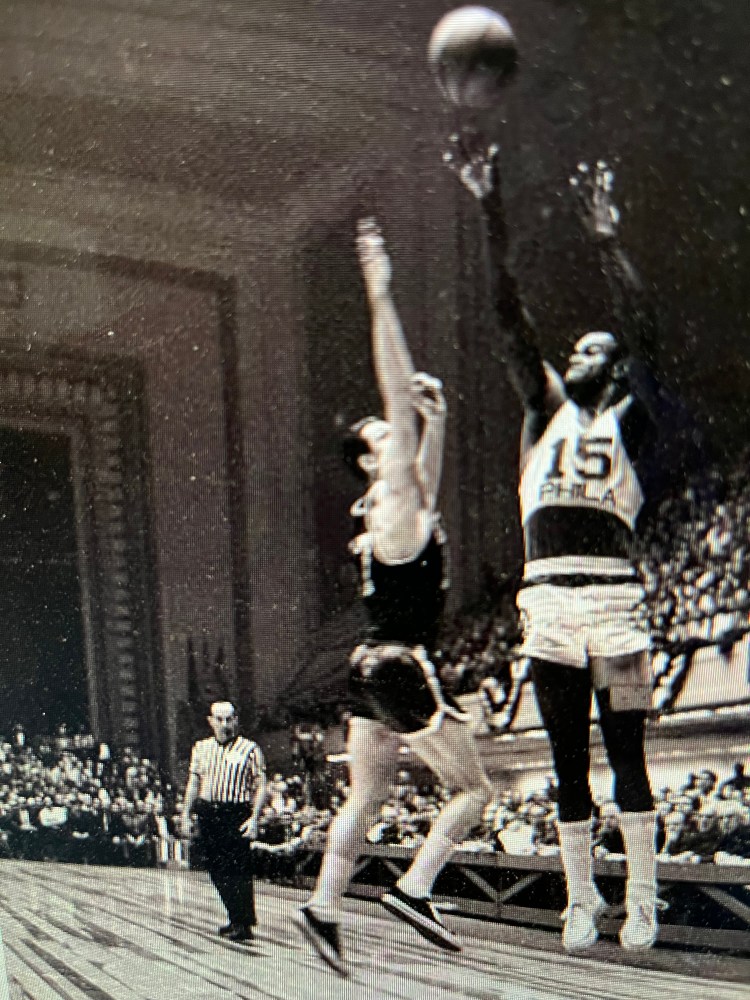
The obvious man to shoot the ball was the 76ers’ best shooter . . . Greer. Dolph knew that. “I told my men to line up four across the court just inside the offensive zone,” recalled Schayes as best he could in the wild 76ers’ locker room. “I am quite sure that Greer was the second man in from the end. And I know that Larry Jones was the guy who was going to pass the ball in.
“Now I told these guys to break in different directions. All but Greer. I wanted him to stay put, and I figured he’d be clear enough for this one desperate shot.”
The officials blew the whistle calling the men back into the court. Jones took the ball at the sideline. The whistle blew to start things again. Off went Wilt Chamberlain toward the basket. Chet Walker broke one way, and Lucious Jackson another. There was Greer all alone around midcourt waiting for the ball to come to him, and Jones sent it perfectly.
Greer takes over from there. “I felt I had just one chance, and that was to fire the ball at the backboard and hope it would bounce off and into the basket. I felt I had a better chance that way, since I didn’t have time to take dead aim at the rim. So, I just let the thing go, and it hit the rim and went in.”
“I don’t know how I felt when I saw it go through. Sort of tingly all over, I guess. Then I said, ‘Oh baby, we can’t lose this one now.’ And we didn’t.”
The Celtics said that Greer bounced the ball before he shot his half push, half throw. Greer says he did not bounce the ball. “I just turned and took the shot. I did not dribble the ball.”
Pictures will reveal whether or not he did. The Celtics certainly were miffed about it, feeling Greer could not get off the shot after a dribble with only one second left. Coach Red Auerbach continued to insist, all the time in a fair-minded mood, that “it’s impossible to catch a ball, flex your knees, jump in the air, and let it go all in one second . . . try it sometime.”
“Remember,” said Schayes, “there could have been nearly two seconds on the clock, you know . . . one second and a fraction or so, and Hal did it all in one motion.”
“I’ve been in a hundred finishes like that,” said Auerbach, “but I’ve never seen it done in one second. It can’t be done, that’s why. The most you can get out of one second is for the shooter to catch the ball and throw it.
“Greer caught it, bounced it, and threw it,” continued Auerbach. “If that clock started when the ball touched Greer, the game is over . . . I’m not saying the timer was dishonest, but I guess, rooting for the home team, he might hesitate.”
“Sour grapes,” Schayes responded.
The Celtics had a surprise awaiting them in the dressing room at the game’s conclusion . . . quart jugs of orange juice were in front of each player’s seat, along with one for trainer Buddy Leroux and Auerbach. All because Auerbach had complained of the “bush” treatment afforded his men in Philadelphia Tuesday night when only 10 soft drinks were doled out to his 11 players. A sign imprinted with “From the Philly 76ers, the second-best hosts in the league to Boston” was personally presented to Auerbach.
Over in the 76ers’ boisterous quarters, Dave Gambee hurled water at a reporter, while Greer explained his shot one more time. “All I saw was a blur of backboard. I shot at it and, at the same time, jumped into K.C. (Jones) to draw a foul. I didn’t bounce the ball, either.”
 From Way Downtown