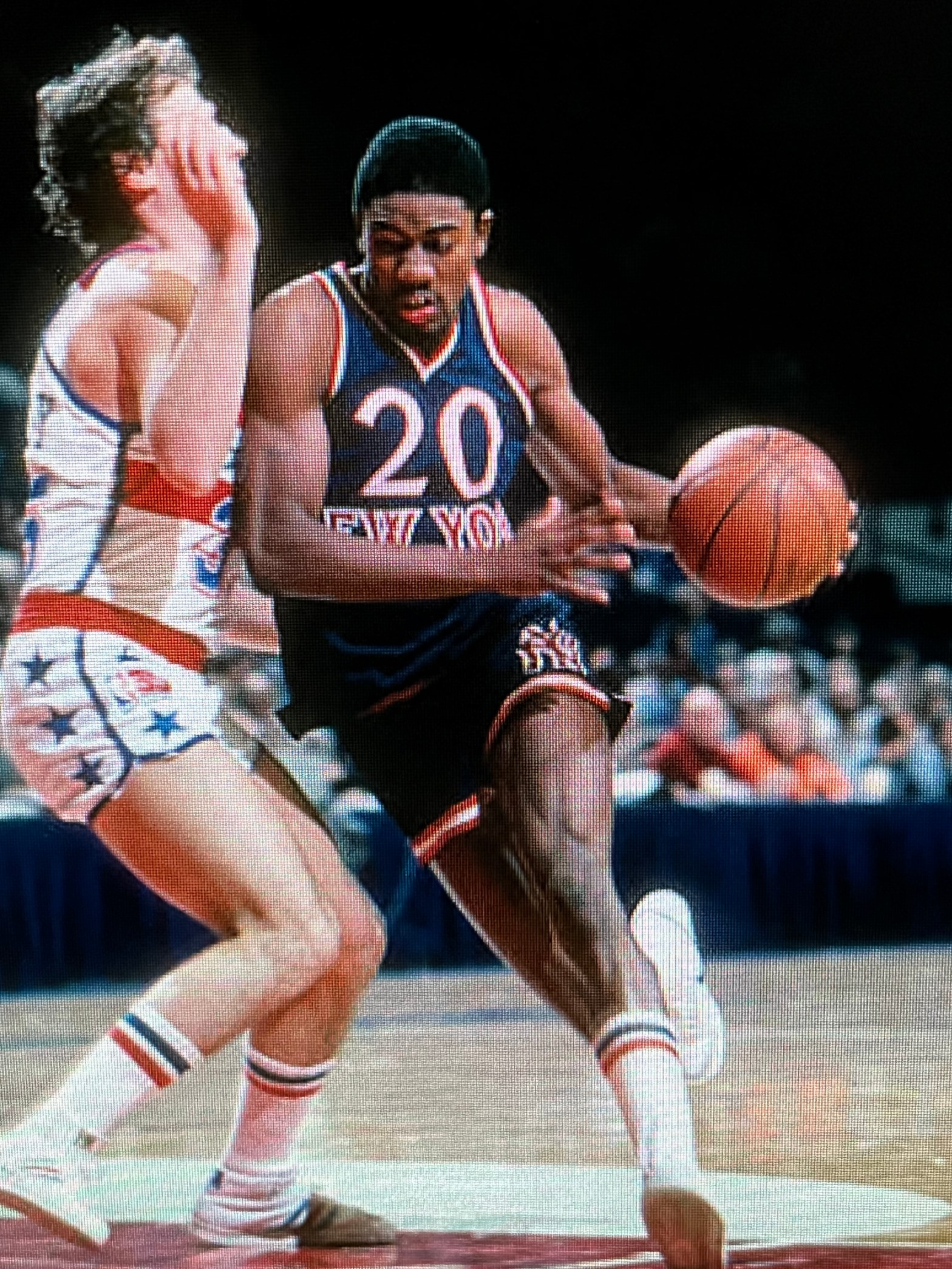
[In 1984, Sports Illustrated ran a then-shocking feature story about NBA star Michael Ray Richardson cycling through six agents, 16 cars, consuming large amounts of cocaine, and having little left to show for his NBA millions. “I don’t want any more part of the basketball,” Richardson told reporter Bill Brubaker.
Richardson quickly became a poster child for all that was rotten about greedy, self-destructive 1980s NBA athletes. Maybe Richardson deserved it. Then again, I shudder to think how I would have handled the NBA fame and fortune in my early 20s after four years as a hand-to-mouth college student. Probably not well. So, I prefer not to pass judgment on Richardson. His wasn’t an easy row to hoe.
However, I do like to comment on Richardson’s big-time talent. Because of the aforementioned drama to come, Richardson’s elite game isn’t remembered today with the oohs-and-ahhs that it deserves. Here’s a capsule description on Richardson after his third season: “Best in the East . . . The epitome of the all-round guard . . . Big, strong, quick . . . Plays solid defense (second in the league in steals), rebounds (second on the team . . . ), passes (fourth in the league in assists), and, of course, scores.”
Richardson wasn’t nearly as big as Magic Johnson, but he was the same type of one-man position-less band. He rebounded like a forward, ran the break like a point guard, and scored from anywhere on the floor. Richardson was just a nightmare matchup.
But before the accolades above, Richardson was considered a rookie bust. Here’s another capsule description, this one from after his rookie season: “Unfulfilled potential . . . Made just 41 percent of his shots and was fifth on his team in turnovers despite limited play . . . another who was prematurely compared with Frazier by the overzealous New York press . . . A better comparison is to [Ray] Williams as a rookie, undisciplined, and out of control.”
What follows is a profile of Richardson heading into his third NBA season. Our profiler is none other than the prolific New York Times reporter Sam Goldaper. Back then, Goldaper seemingly was everywhere with his NBA stories. This one ran in Sports Quarterly’s 1980-81 Basketball Special magazine, the young Magic Johnson and Larry Bird on the cover. Enjoy!]
****
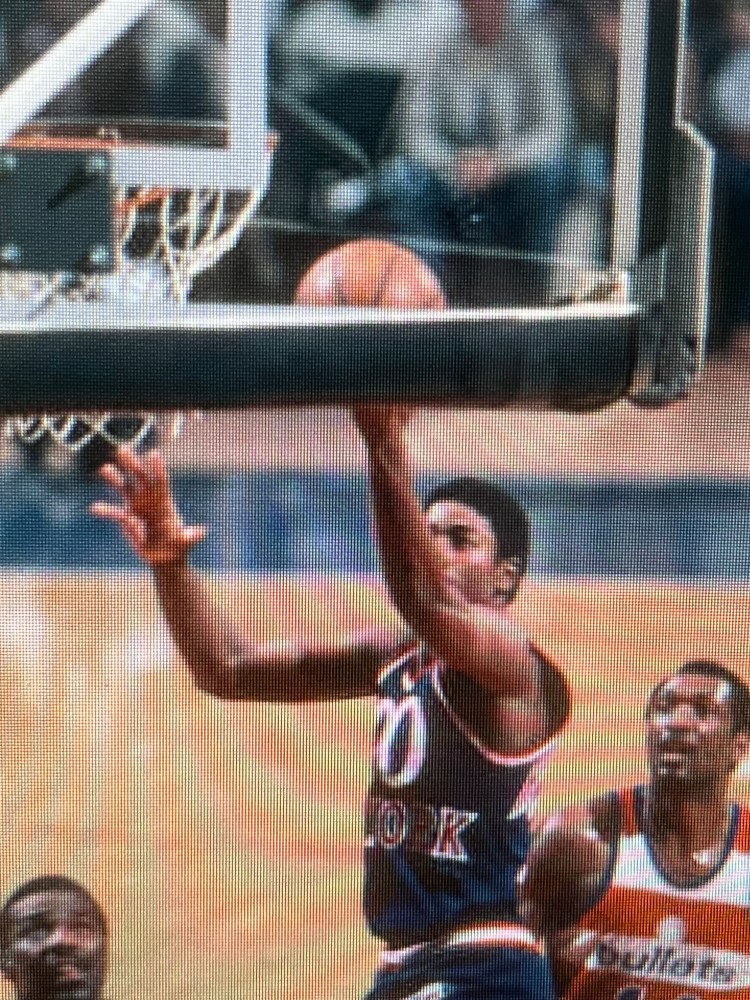
Several Milwaukee Buck players sat around a New York restaurant and rehashed a loss to the Knicks last season. Most of the conversation dealt with the improvement of Michael Ray Richardson, the Knicks’ playmaker. With the switch to an unbalanced National Basketball Association schedule last season, it was the first time the Bucks had played against the Knicks.
“That Richardson had an unbelievable line,” said Dave Meyers, the Bucks’ forward, since retired, alluding to Richardson’s 18 points, 15 assists, 12 rebounds, and four steals. “It’s hard to believe the difference in him in one season. Everybody has been talking about Bill Cartwright, but the big difference in the Knicks to me is Richardson’s improvement.”
Quinn Buckner, the Bucks’ playmaker, who had sat out the game with a pulled hamstring muscle, added: “He has given the Knicks, the court leadership they did not have last season. He’s developing into a proven passer, and he has that uncanny ability to sneak in for rebounds. His hands are lightning quick.”
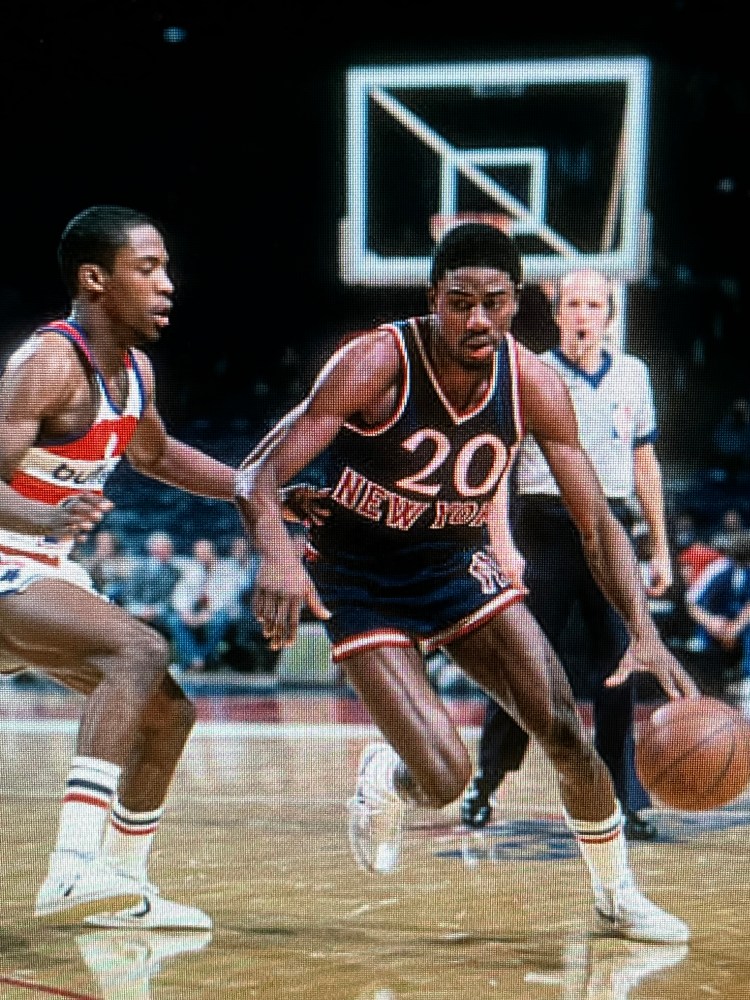
The Bucks were not alone in their praise of Richardson’s turnaround from a rookie bust, who ran without restraint and consistently turned the ball over, into an all-star who averaged 15.3 points a game and led the league in assists (10.1) and steals (3.23).
“Was Richardson in the league last year?” asked Paul Westphal, the Phoenix Suns’ all-star guard. Westphal’s remarks came after Richardson had 10 assists in the first half and 18 for the game against the Suns. “He looked terrific out there. He ran the fastbreak with poise, and he was all over the place on defense.”
As Richardson blossomed into stardom, Eddie Donovan, the Knicks’ general manager, recalled the 1978 college draft when the selection of the 6-5 guard drew responses of “Who?’ when the Knicks made him their first-round choice.
The place was the Plaza Hotel in New York, and Larry O’Brien, the NBA commissioner, was presiding over the first round of the draft. The Portland Trail Blazers with the first pick, had selected 6-10 Mychal Thompson of Minnesota; Phil Ford, the University of North Carolina playmaker, was then chosen by the Kansas City Kings; and the Indiana Pacers named Rick Robey, the 6-11 University of Kentucky power forward, since traded to the Boston Celtics.
Now it was the Knicks’ turn to pick. Willis Reed, then the coach, needed a big, strong forward, but when the slip of paper was passed to the commissioner, it read: “New York selects Michael Ray Richardson of the University of Montana.”
“Who’s he?” and “Why him?” were the immediate responses of disapproval from the small crowd of onlookers, who sat in the back of the huge hotel room. If Richardson was a strange name to the average basketball fan, he was not to Marty, Blake, who conducts a scouting service for the NBA, and Red Auerbach, the president and general manager of the Boston Celtics.
“Super pick, super kid,” said an enthusiastic Blake. “He’s got great quickness. I’ve seen him play a dozen times and have been tabbing him as a top prospect for several seasons. Blake, then flipped the pages of his scouting reports until he came to Richardson’s name. It read: “Played guard for the first time all season . . . extremely quick . . . good shooter, not great, but can make the jumper . . . quick release . . . needs work, but is not afraid to work at all phases of the game . . . could develop quickly with the right team.”
Later Auerbach, who had used the Celtics’ sixth pick for Larry Bird of Indiana State and the eighth choice for Freeman Williams of Portland State, was to say: “The Knicks made a good choice. If they had not picked Richardson, I would have. I like the way this kid plays.”
Richardson, recruited out of Manuel High School in Denver, had averaged 24.2 points in 27 games during his senior year at Montana. One of those games was against Northern Arizona, and Reed was there to scout him.
“I knew he was there,” Richardson was to say at a news conference a month later when the Knicks signed him to a four-year contract. “I recognized him from watching him play on television. I felt super that he came to see me. I had a good game that night. I think I scored 25 points and had seven assists.”
Reed came away impressed, but if he needed further convincing, it came as he watched the films of Richardson’s three games in the Alpha All-Star Classic in Hawaii, where the top seniors congregate each year to play against each other before the watchful eyes of hundreds of general managers, coaches, and scouts.
“I watched those films maybe 15 or 16 times before the draft,” said Reed, explaining how he had arrived at the selection of Richardson as the top choice. “He convinced me that he could play with anybody. He showed me that he could push the ball upcourt quickly, and that he had great anticipation. He has great quickness and a lot of the [right] qualities, passing ability, and defensive skills. We felt Richardson would give the Knickerbockers the big guard they have needed since Clyde (Frazier) began to age.”
Reed had selected Richardson without ever having met him. “You really don’t have to talk to the guy,” said Reed at the time. “You can tell on the basketball court if you watch everything he does on the floor; during timeouts, at the free throw line, after he makes a mistake. On a fastbreak when he can take a shot or give it up, what does he do? His basic character as a human being is exemplified by how he plays. He’s a good kid. He works hard.”
Reed suspected that Richardson’s attitude was forged when he failed to excel as a high school player, before he grew from the smallest boy on the team to the tallest. “Players who had to work hard sometimes become better,” said Reed, who underwent a similar situation in his growth to playing stardom.
Reed never got a chance to bask in the glory Richardson was to enjoy last season when his total of 812 assists broke the 1968-69 Knicks team mark of 665 assists set by Frazier in his second pro season. Reed, who had taken the Knicks to the second round of the playoffs in his rookie coaching season, was dismissed after 14 games of the 1978-79 season when he challenged management once too often. He was replaced by Red Holzman.
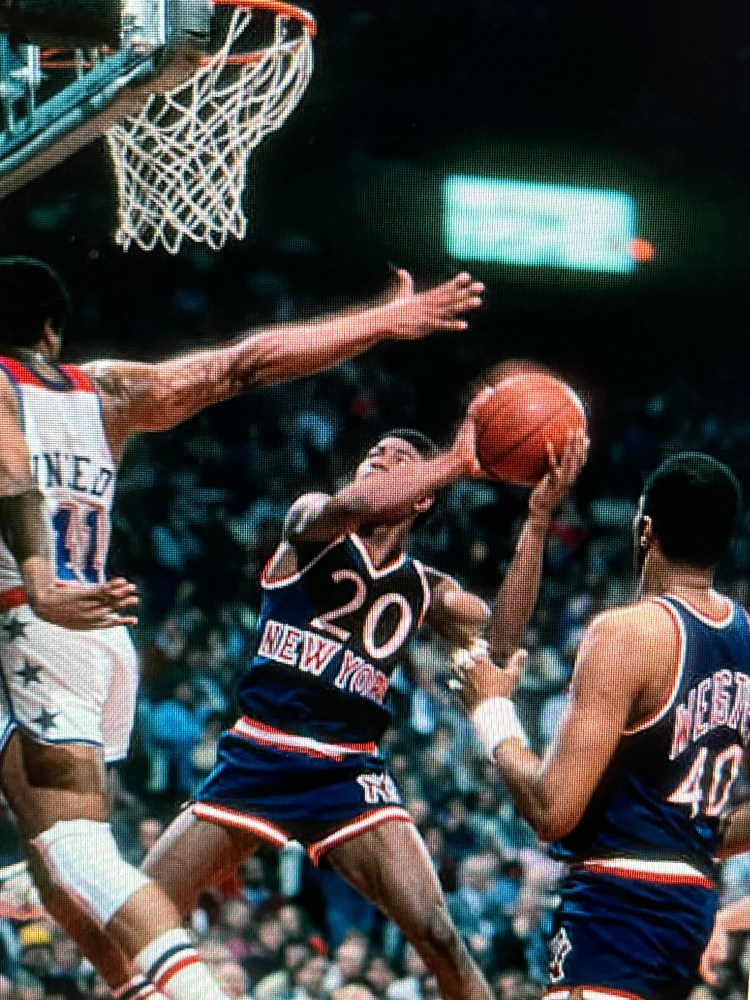
Richardson was a Willis Reed man. When Reed got fired, Richardson got nervous and played nervously. He spent much of his rookie season racing up and down the court, committing constant turnovers, taking bad shots, and playing one-on-one. Before his dismissal, Reed was more tolerant of that kind of play by Richardson. He excused it under rookie mistakes.
Holzman was less tolerant. He has always wanted his teams to run and play under control, and once Richardson failed to perform, his playing time was drastically reduced. One cold January night, while a frustrated Richardson sat on the bench and watched the Knicks lose to the Cavaliers in Cleveland, he made headlines by telling reporters: “I’m being mistreated. I want to be traded.”
By the time the Knicks returned to New York the next day, the 25-year-old Richardson had realized what he had been duped into saying. When the plane arrived at LaGuardia Airport, he quickly rushed to Donovan’s office at Madison Square Garden, where he broke down and cried.
“I knew I was wrong right away when I said it,” Richardson later recalled. “I didn’t go to Red because I felt he would be too upset with me.”
Holzman did not react to Richardson’s outburst. Instead, the Knick coach, in a psychological maneuver, just allowed a player who had not yet understood his own talents, expel harmless steam.
Although Richardson and Holzman understood each other better last season, the Knick coach kiddingly reminded Richardson, whom the Knicks nicknamed “Sugar,” of the Cleveland incident.
During a road game against the Denver Nuggets, Holzman spotted Richardson talking with reporters. Smiling, Holzman walked toward the group.
“Hey, Sugar!” Holzman said.
“Yeah, Coach?” Richardson said, turning his head.
“Don’t say too much to these guys, they’re bad for you,” Holzman said. “Besides, you know what’ll happen to you if you talk too much.”
“What’s that, Coach?”
“You’ll be traded.”
“Where?”
“Cleveland.”
“Awwwww, Coach, you’re not going to do me in like that!”
Richardson wound up his rookie season averaging 17 minutes of playing time in 72 games, 6.5 points, and almost three assists a game. Before returning to his home in Denver after the season, Richardson, still unable to understand Holzman’s ways, said, “Things were just bad from the start and stayed that way all year.”
Determined to show he could play rather than insist he should play, Richardson spent four hours every afternoon during the summer at the Red Shields Community Center, working on his game. Shooting. Ballhandllng. Mental things, as he called them. Game situations. He imagined himself back in the Garden. He was no longer the rookie bust, and he had the ball.
By the time he came to training camp, he was a different player, also a smarter one. “My game during my rookie season wasn’t what it should have been,” conceded Richardson in training camp. “I didn’t get my mind into it. I was worrying about a whole lot of things, what the media was saying about me, all sorts of things. And when I didn’t get playing time, I got frustrated.
“When I first came into the league, I thought everyone was Superman. I was shaky, but during the summer, I began to realize that the players are good and that I belonged here. I worked at being a playmaking guard. I worked on giving up the ball to the open man. Red is a defensive-minded coach, and my job is to get the guys involved on defense as well as an offense.”
Richardson’s words and ways quickly showed that Holzman had gotten through to him. Sugar Ray played Holzman’s kind of basketball: rebounding, ballhandling, defense . . . all the unselfish things that make up teamwork.
Perhaps, the recognition of Richardson’s new stature came in the quiet Holzman manner. After a full training camp plus nine games, Holzman was convinced that Knick guard Ray Williams hadn’t measured up as a leader. Some in Knick management argued that Williams should be traded. Others said he was too talented, and it was too early to give up on him. There was some question whether he was a better playmaker or a shooting guard.
After it was decided that Williams would stay, and with no one experienced to fill the playmaking guard role, the Knicks went to training camp looking again for Williams to assume the leadership mantle. Without ado, the process of transforming Richardson into a floor general began, with Williams reverting to the shooting guard.
“In the old days, especially before the 24-second clock,” said Holzman, who played the backcourt for the Rochester Royals and the Milwaukee Hawks, “every guard had to be a playmaker. He had to know how to dribble, pass, and control the ball. That’s no longer always so. There are specialties, and we think that Ray [Williams] is a better shooter and that he is more comfortable not having to run the offense.
“We now want Sugar handling the ball more. He has great quickness and penetration and the ability to push the ball upcourt quickly, so quick at times that the defenses don’t have a chance to set up. What Sugar needs is more control, to take better care of the basketball, and he has been showing and thinking control more of late. Very few plays work the way they are set up, that’s why there are usually options on every play.”
Richardson spent much of his high school and college career playing up front. He was not shifted to the backcourt until his senior year in college. “Having played the small forward in college has its pluses and minuses,” said Richardson when he moved to the point guard. “It helps with the rebounding, but when you go to the boards, there’s always the risk that you’re not going to get back on defense.
“Red wants me handling the ball. He likes the way I get the other guys involved. He wants for me to push it up quickly. I am thinking like a guard now.”
As the season progressed and Richardson began to pile up assists and pick us loose balls, Toby Knight, his teammate, perhaps best put the transition into perspective: “This year, Sugar is a new man.”
 From Way Downtown