
[Timing is crucial in journalism, but the old basketball magazines sometimes got skunked by their early copy deadlines and the lag time until the final product hit the newsstands. That’s the story with the January 1983 issue of the magazine Super Sports. It includes the following article about the newly renamed World B. Free and how he saved his pro career with the Golden State Warriors. Well, in mid-December 1982, the Warriors traded World B. to Cleveland, apparently to try something else.
“We’re grateful for the two fine seasons World gave us,” said Warriors coach Al Attles at the time, “but our offensive philosophy this year didn’t seem conducive to World’s game.” Right or wrong, Attles wanted to dump the ball inside to his young center Joe B. Carroll. Free’s offensive hijinks were no longer needed. Free’s response to the trade? “Whenever I go to a loser, it becomes a winner,” he said. “Why not Cleveland? Heck, if we win two straight games, it would be the greatest thing here since sliced bread.”
With that initial word of warning, this article from reporter Barry Janoff is otherwise a fun read. It does bog down toward the end, especially in light of the trade to come and its focus on Golden State’s prospects. But these magazines ran articles that often doubled as player profiles and team previews, and Janoff’s editors probably insisted that he do both. For the sake of time, I did cut a few paragraphs about the other Warriors.
In any case, enjoy. It’s a nice profile of one of the unique characters from the 1980s NBA.]
****
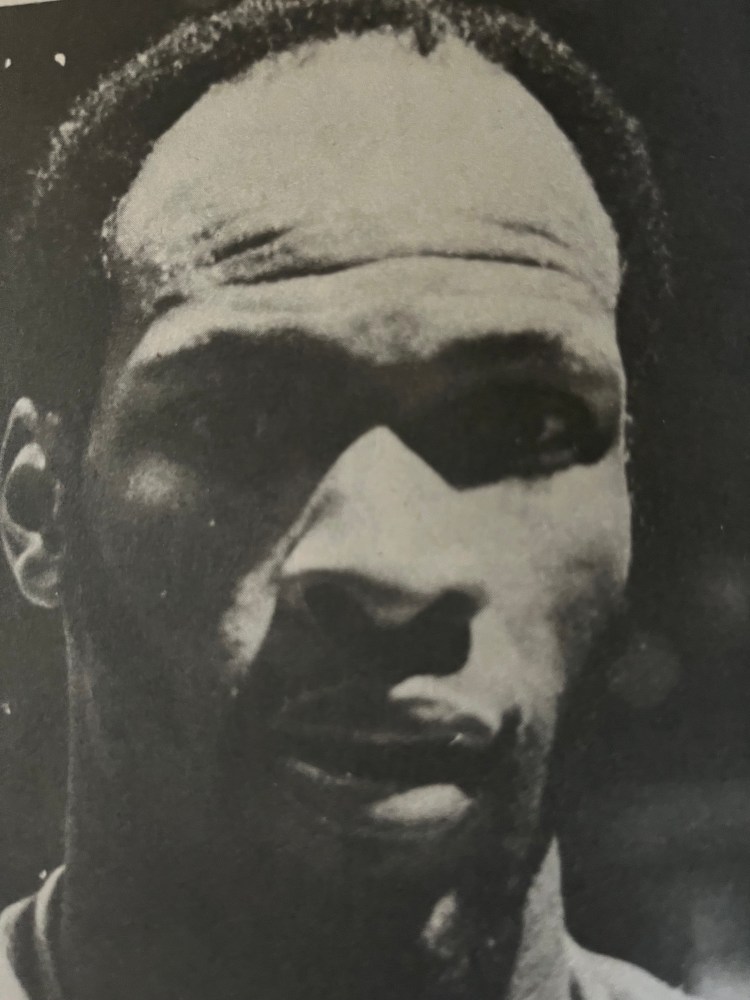
World B. Free didn’t much care for the fact that the reporter from a great metropolitan New York newspaper insisted on calling him Lloyd. Not one given to uncontrolled emotional outbursts—either on or off the court—Free responded to the name Lloyd with the best Clint Eastwood look of icy indignation.
“Lloyd, are you playing up to your expectations?” the reporter asked during an interview following a game between Free’s Golden State Warriors and the New York Knicks last season. No reply, save the sound of Free undoing his sneaker laces.
“Lloyd, do you feel that you’ve peaked as a player?”
Silence.
“Lloyd, have you changed as a player since you’ve come to California?”
Again, no reply.
“Lloyd . . .” The reporter was cut off in mid-sentence.
“Who?” said Free, still unravelling his laces.
“Lloyd,” replied the reporter.
“The name’s World,” said Free, looking at the reporter straight in the eyes. “World B. Free.”
The reporter thought for a moment. “World,” he said, starting from the top, “are you playing up to your expectations?”
A slight smile cracked World B. Free’s lips. The interview was smooth and productive. One small step for man, one large step for the World.
****
Lloyd B. Free was born in Atlanta, Ga., on December 9, 1953. His basketball reputation was nurtured on the playgrounds of New York City, where the nickname “All-World” was launched. Last year, a court of law acknowledged his request to be known as World B.
“It was like a quickee divorce,” says Free of his judicial change of name experience. “I flew into New York, I filled out some forms, and I paid some money.” Out went Lloyd; in came World B. legally, at least. But there were still obstacles to overcome.
“My mom was a problem. I thought she would kick the living daylights out of me. But she’s getting used to it, laughing when I told her that I’d name my first son World II and my second son Third World.”
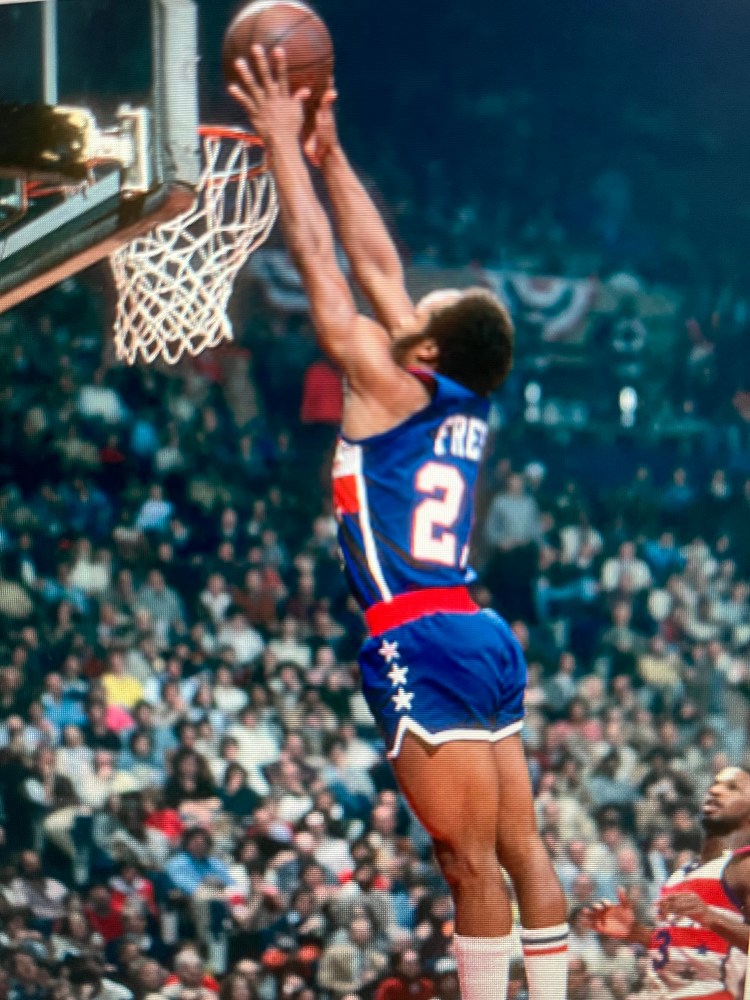
Free laughed, too, when he related the story. Pride had motivated the feeling. “The name means something to me, mostly because I got it from my friends back in Brownsville (in Brooklyn, NY).” They gave it to me for doing 360s and all the crazy slam dunks I used to do when I was growing up.
“We didn’t have much money, and we lived in what is considered a low-income area. But it was a great experience for me, because of the fact that I learned so much. It wasn’t a thing of being book smart, but I was street smart. The things I learned in the streets, you could never learn in school.
“Best of all,” he emphasizes, “it gave me a chance to learn to play basketball the way I play it.”
However, that is where a conflict has arisen for Free. Despite the confidence he has in his own abilities, a number of people in the NBA—specifically some people he met as a member of the Philadelphia 76ers—immediately were turned off by his All-World style of play. The task of being accepted into the NBA, which is normally difficult for any rookie, was that much harder for him because of his proclaimed reputation.
“It was rough at Philly,” he says of the team with which he played for three seasons. “I liked a lot of the guys on the team, but a lot of the guys just didn’t like young players on that team. I’m not gonna say any names, but they just didn’t like younger guys.
“I think it’s important to be an all-around player. I’ve always felt that way. But when I was with Philly, people misunderstood. The coach (Gene Shue) told me to shoot, and when the coach says to shoot, I shoot. If the coach tells me to pass, I’ll pass. But he wanted me to shoot.”
Free put up more than 2,400 shots during his three seasons with the 76ers, not a relatively large number, but more than enough to label him a gunner, who, according to one report, “would shoot it up from the locker room if he could see the basket.” In fact, Julius Erving attempted nearly 2,600 shots during the two seasons that he and Free were teammates at Philadelphia. The problem for Free, though, was that Erving was “The Doctor,” and Free was, well, just another young player trying to make an impression.
“Out here (with the Warriors), they respect me,” he offers. “But in Philly they didn’t because I was just coming to the team, and they would say, ‘How could any man come to a team with a name like World?’ A lot of the writers also singled me out because I said things like I deserve a starting role and because I was outspoken about the way things were being done. A lot of other guys were saying the same things I was saying on the team. But (management) had to find someone to pick out, and they said, ‘You.’”
From Free’s point of view, all he was attempting to do during his early years was to establish himself and to be recognized as a good player. And with teammates such as Erving, George McGinnis, Darryl Dawkins, Bobby Jones, Caldwell Jones, and Doug Collins on the squad, it took, from his standpoint, drastic measures to gain that recognition.
These factors notwithstanding, Free had another goal for himself. “There are a lot of guys around New York City, and especially from Brownsville, that made it and were in pro basketball. Two guys I played against in the playground, Fly Williams, and Phil Sellers, made it into pro ball.
“But I wanted very badly to outlast the other guys. That was my goal because guys back home were saying, ‘Well, he’ll be coming home pretty soon.’ I’ll tell you, that gave me a whole lot of incentive. I didn’t want to go right back home knowing that they were saying that.”
****
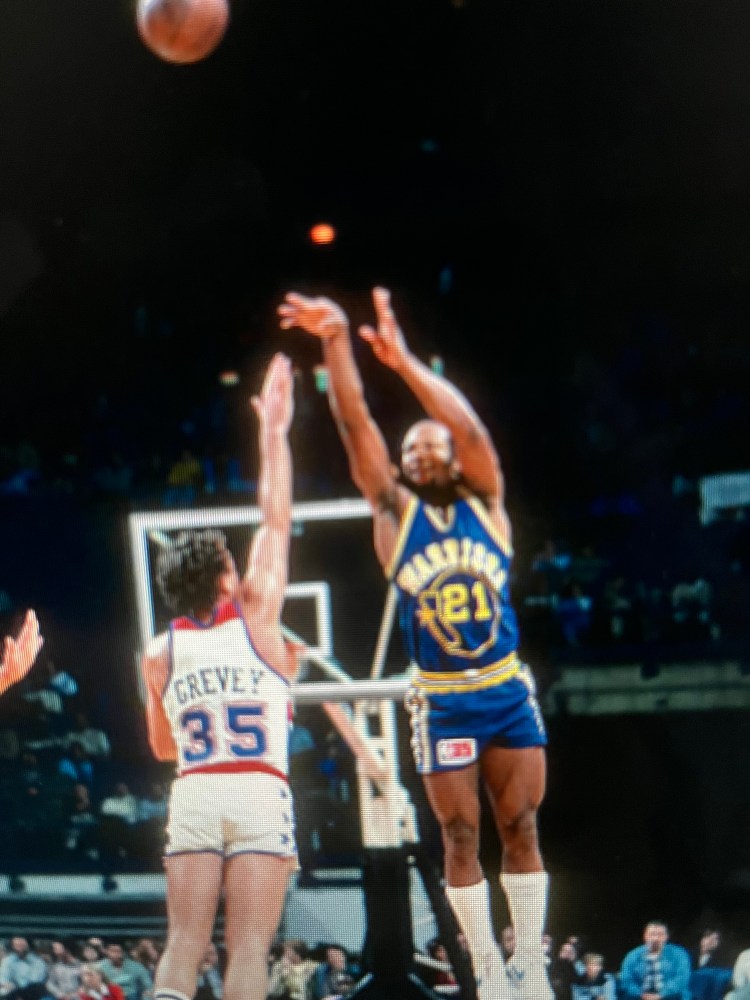
Free had finished his third year of a successful collegiate career at Guilford College in Greensboro, N.C., when he entered the NBA draft as a hardship case. He then became the 23rd pick overall in the 1975 selection process when the Sixers tapped him and his 23.6 collegiate scoring average in the second round.
The 6-feet-2 guard had a quiet season on the court in 1975-76, averaging 8.3 points in his role as a sub. But he was considered part of a foundation that would see the team steadily grow during his three seasons there.
Dr. J joined the squad in 1976-77 and immediately established himself as one of the league’s most-gifted performers. Concurrently, Philadelphia worked themselves into the NBA championship series against the Portland Trail Blazers, only to succumb in a six-game set after winning the first two games.
If, as Free says, he was told to shoot, then he accomplished exactly what team management was asking of him. He averaged 16.3 and 15.7 points, respectively, during the next two seasons, and even managed to dish out nearly 600 assists as the Sixers maintained their status as a formidable NBA power.
But shortcomings in postseason play, and specifically a failure to win the NBA crown—which still haunts the franchise—led team management to make some changes. And Free, with the now-acquired reputation as a gunner who could not, or would not, play defense, was shipped to San Diego prior to the 1978-79 season. His stock with the Sixers had fallen so far that all the Clippers had to send back to the City of Brotherly Love was a 1984 first-round draft pick.
Free spent two seasons in Southern California, where he was reunited with Gene Shue, who had parted company with Philadelphia early in the 1977-78 season. At San Diego, Free varied between: (a) savior and team leader, scoring just under 4,300 points for the weakly-manned Clippers and being named to the NBA All-Star second-team in 1979; and (b) scapegoat when the team remained fixed in the league’s lower division. Part of the problems stemmed from the fact that San Diego virtually had mortgaged the nucleus of the franchise as compensation for signing free agent Bill Walton. Walton played in only 14 games in 1979-80 and then missed the entire 1980-81 campaign because of a foot problem.
By 1980-81, Free was on the move again, in part because the team was re-restructuring its attack. And in part because he and new coach Paul Silas did not see eye-to-eye on Free’s role with the squad. The move wasn’t all that far logistically—some 540 miles up the coast to the San Francisco-Oakland Bay Area—but it was light years away mentally and spiritually for him.
“When I joined the Warriors (which had sent All-Pro Phil Smith and a 1984 first-round draft choice to the Clippers for his services), I could have fallen in with the rest of the team, and let someone else be the leader. Or I could have become a better player by taking over the leadership.” Spurred on by his being named as team captain by Coach All Attles, Free chose the latter, a role he still unflinchingly accepts.
“When I was announced as team captain, I knew that I would have to show the leadership. These guys on the team are very young. Our starting lineup averaged about 24 years old (Free will be 29 during the current season). But Al Attles has done a terrific job with these guys. He knows how to use the talent on the team to its utmost.”
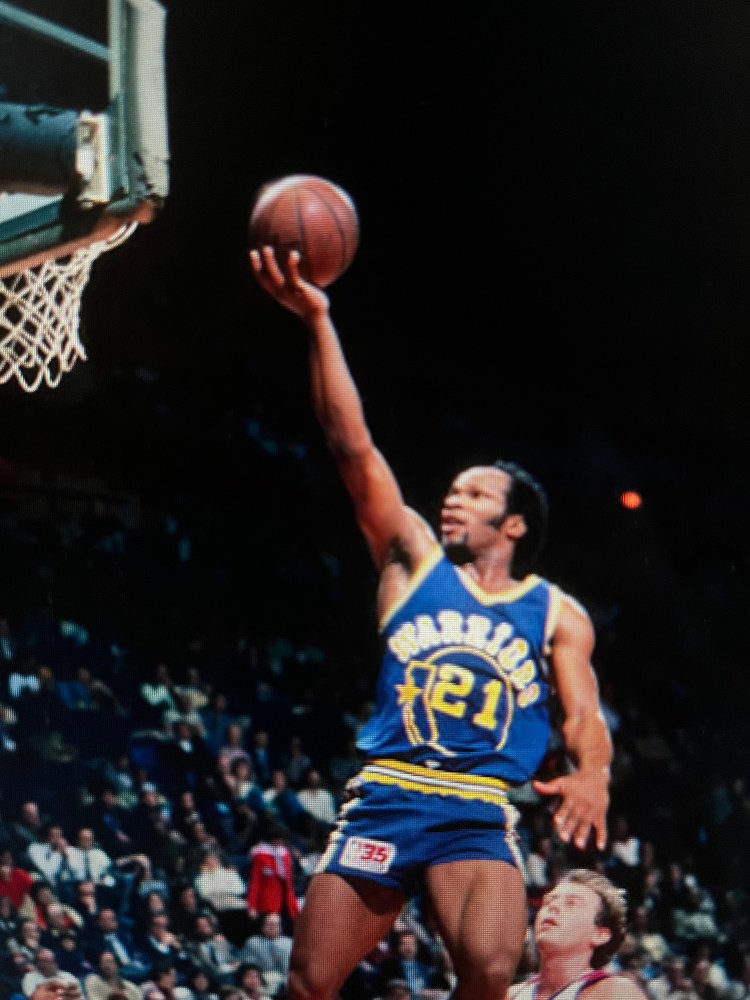
Free established himself as Golden State’s oncourt leader, but with the added responsibility came a new outlook on the game that he learned as a youngster in New York. Where basketball once had been a series of obstacles for him, mainly because of the self-induced pressure he felt to be the best-known player on the court, it now became less of a pressure situation and more of an adventurous journey.
“I don’t have to go out and shoot 30 times or score 30 points every game—I can go in and use my body and dish the ball off,” he says. His tone implies this is what he really wanted to do all along.
“We have guys on the team who can score. I wanted to prove that I could pass off more. And I did that very well. Coming into the situation (on the Warriors) was a chance for me to adjust myself and to adjust my game. I’m doing everything I can to become a complete player.”
Free’s attitude, the guidance of Al Attles, and the emergence of such talents as Larry Smith, Bernard King, and Joe Barry Caroll have combined to bring the Warriors closer to their status of the mid-1970s when the team captured the 1974-75 title and was winning with consistency. Things soured for them through the final season of the 1970s to the point where Attles, who has been with the franchise every season since 1960-61, was contemplating retirement. The teams revitalized spirit over the past two seasons moved the coach to rethink his plans.
“We have a team effort here,” says Attles. “These players want to learn. They want to win. And besides, I’m enjoying myself again. It was a struggle for a time, but the game is fun again for me.”
Attles has developed a reputation as being not only one of the NBA’s best coaches, but also one of its most-respected leaders. And there is a difference: good coaches do not always gain the respect of their players; in fact, some coaches are not concerned about gaining respect as long as their players produce. Attles’ players produce, and they also respect their coach for helping to make them better athletes.
“Do I respect Al Attles?” states Free. “I have nothing but respect for him. He’s done a super job with this team. And he’s giving me the opportunity to grow and to prove that the reputation I had (as being a selfish player) was wrong.”
With Attles at the helm, the key to the Warriors’ success this season will be much the same—a sort of Three Musketeers’ cry of all-for-one and one-for-all, which even now can be heard filtering through the Oakland Coliseum. What is needed is time and effort, and the players who are willing to give both.
“We’re like Jekyll and Hyde,” relates Free, whose career seems to have followed that same type of trend. “One night, we can be the best team in the league, and then we’ll be terrible the next night. Sometimes that’ll happen in the same game.
“We have to be consistent; we seem to like that at times. I feel the same way about my own game, that I’m not as consistent as I’d like to be. I’m working to improve all phases of my game because I feel it’s important to be an all-around player. You can be the league’s greatest player or be on the best team, and you’ll still lose if you’re not consistent.
“We’re in a tough division, but we’re looking to win,” he continues, sounding more and more like a man born to the role of team captain. “Last season we won 45 games and didn’t make the playoffs.” (At one point during the campaign, there were more teams in the Warriors’ Pacific Division playing over .500 ball—five—than in the rest of the league combined.) “And you know that the others (in the division) are improving.
“The biggest day in my life will be when we make the playoffs. I was in the playoffs with Philly, but I wasn’t a starter there. I wasn’t important. Here I am a leader. I’m important,” Free notes with a deal of pride.
There is a maturity about Free that had been missing before, partly because his Gus Williams-style balding pate, gives him a look beyond his years. But that maturity largely is due to his growth as an athlete, as a leader. And you have to believe that he is serious when he claims that, “We don’t want to watch the playoffs on TV this year. We as a team are determined to win,” even if the statement is being made by man named World B., whose future son may be called Third World.

