
[Eddie Johnson played in 17 NBA seasons, most indelibly with Kansas City, Sacramento, Phoenix, Seattle, and Houston. Whether coming off the bench or trotting out with the starting lineup, it didn’t matter. Johnson’s role was always the same: Let it fly from the perimeter. “You want the man shooting the ball,” read one scouting report on the 6-7 Johnson, nicknamed “Steady Eddie.” “Scorer’s mentality to the nth degree.” Or, as Johnson later put it. “I feel like I have a Ph.D. in shooting.”
In the clip to follow, Dr. Johnson puts his advanced marksmanship on display in recounting “The Game I’ll Never Forget.” His memory was published in the January 1991 issue of Basketball Digest. Take it away, Doctor—as told to writer Bert Rosenthal to wordsmith and fact-check.]
****
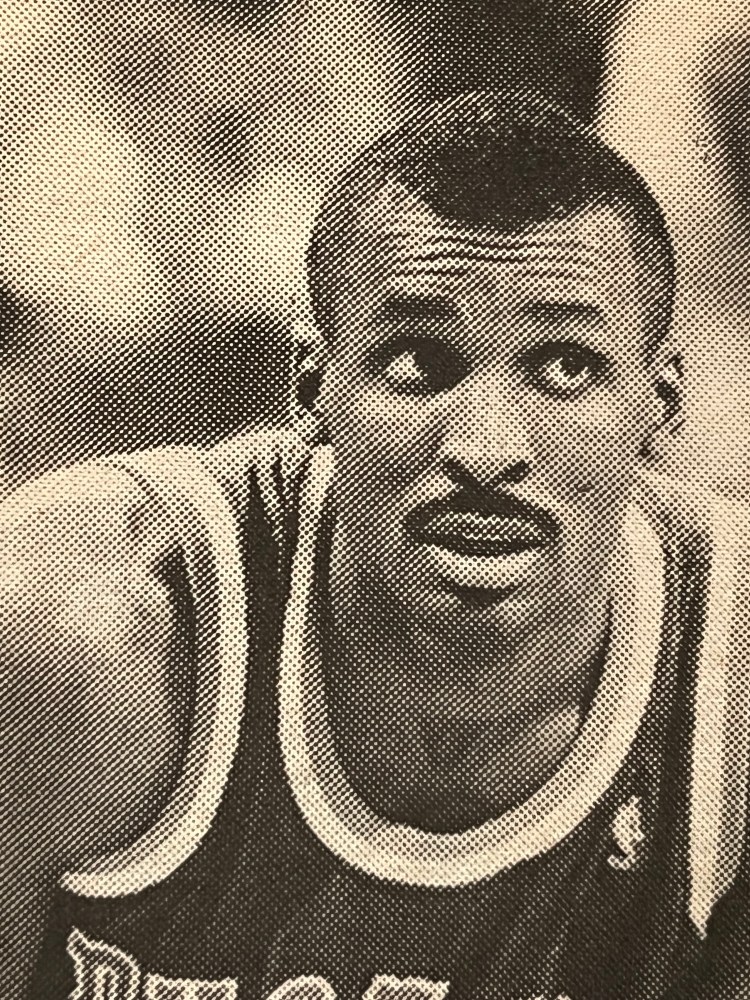
This being my 10th season in the NBA, I am familiar with the many arenas and courts in the league. Some you get to like, others you dislike. One of my favorites is the Los Angeles Memorial Sports Arena, home of the Clippers. Built in 1959, it is one of the league’s oldest buildings, but it also is one in which I enjoy playing.
The lighting in the arena seems perfect, the rims on the baskets are nice and soft, and the floor is real bouncy. It’s a shooter’s gym, just like the Boston Garden, a building that dates back to 1928 and is the oldest in the NBA. At Los Angeles in December 1987, I scored 43 points against the Clippers, helping the Phoenix Suns to a 121-102 victory. Nearly a year later, I had an even better game against the Clippers in the Sports Arena.
It was November 12, 1988, and it was the Clippers’ home opener that season. It was the first pro game for Danny Manning, the Clippers’ heralded rookie from Kansas, who had missed Los Angeles’ first four games of the season, all on the road. A near-capacity crowd was on hand to celebrate the occasion, and the Clippers treated the fans to a colorful pregame show. First, they dimmed the lights and introduced the Los Angeles players amid red, white, and blue spotlights. Then, when the lights were turned back on, red, white, and blue balloons were released from the rafters. To complete the show, a group of dancing girls performed.
Finally the game started, and despite my fondness for the Sports Arena, early indications were that it was not going to be one of my better games there. In the first half, I made only one of five shots and scored two points.
Guarding me was Ken Norman. He was a young forward from the University of Illinois, the same school I had attended from 1977 to 1981. We always talk to each other and have fun. Prior to that game, he had been playing very well, and he said to me, “Tonight, I’m going to give you 40 points.”
At halftime, he wasn’t on a pace to score 40, but he had eight, six more points than I had. So when the Clippers left the court for intermission with a 54-44 lead, he gave me a big smile. But the second half was a lot better.
In the third quarter, I hit six consecutive shots and scored 15 points—all within the first 5 ½ minutes—and that burst helped us to tie the score, 62-62. But then the Clippers, sparked by Manning, who hit their last three baskets of the period, took an 85-78 lead at the end of the quarter.
I stayed on a roll in the fourth period. Coach Cotton Fitzsimmons kept calling my number, and every shot I was putting up was going in, no matter from what angle I was shooting. During one stretch early in the fourth quarter, I scored 15 straight points. And for the first time since early in the game, we went ahead by as much as six points, 101-95.
But the Clippers, a young and aggressive team, kept battling back. Led by Charles Smith and Benoit Benjamin, they tied the score, 115-115, with eight second remaining when Benjamin grabbed a missed shot by Smith and flipped it in.
By that time, I had scored 23 points in the period and had a total of 40 for the game. But with a chance to win the game in regulation, I took a shot that bounced off the rim just before time expired, and we went into overtime. Unfortunately for us, they went wild in the overtime—their accuracy was absolutely amazing. They hit eight of nine shots from the floor, and they were perfect from the foul line, making all seven attempts.
So by outscoring us 23 to 12 in overtime, the Clippers won the game, 138-127. I scored five more points in the extra period for a total of 45, breaking my career high by two. My 43 points in the second half smashed the Suns’ previous record of 33 and were the most points ever scored by one player against the Clippers in a half. And my 23 points in the fourth quarter matched the club record.
I was in a real shooting zone that night in the second half, I was taking most of our shots. You usually only get that opportunity if you’re Michael Jordan. The zone I was in, Michael’s always in. I guess on this particular night, I was king for a day. Of course, it’s a shame that we lost the game. I hate to lose, especially when you have the biggest scoring game of your career.
I don’t know what turned me on. Probably one big factor was playing in my favorite NBA building. Possibly another was playing against the Clippers. They have a lot of young, cocky guys. I always enjoy going at them and having a good time. The third incentive might have been playing against Norman, the former Illini.
This was a game I don’t think he’ll ever forget. Afterward he said to me, “I can’t believe you did that.”
And it’s a game I’ll never forget. When I look back on my career, this was my outstanding game.
[Johnson may have had a smooth NBA stroke, but his childhood in Chicago’s notorious Cabrini-Green Homes was as rough around the urban edges as America unfortunately has to offer. To appreciate Johnson’s rags-to-NBA riches story (he attended high school in a converted candy factory), here’s a brief profile of him from S.L. Price, the then-fantastic Kings’ beat reporter for the Sacramento Bee. He profiled Johnson, then the Kings’ leading scorer, on October 20, 1985.]
And then there was the time the twin barrels of a sawed-off shotgun were pointed at his chest, and he was told to turn and face the wall. Eddie Johnson remembers that.
Ten years, 2,100 miles, and the wealth of the professional athlete now separate him from the past. But there is no escaping the feeling that Johnson, a forward for the Sacramento Kings, can never get too far away from where he’s been.
Johnson, reclines, smiling at the thought of his new wife busy in the next room, and the story comes easy, easier and smoother than a well-oiled trigger.
The five gang members asked why he hadn’t been at the meeting. Eddie shrugged and said, “What meeting?” Then they marched Johnson and his friends off the basketball court, and one pulled a gun from beneath his jacket. Johnson’s stomach dropped, and he started to shake. But he and his friends refused to face the wall—they figured they wouldn’t die without a struggle—and then something strange happened.
“What happened is they just let us go,” says Johnson calmly. “That usually doesn’t happen in Chicago. If they want to shoot you, they shoot you.”
He shrugs again.
****
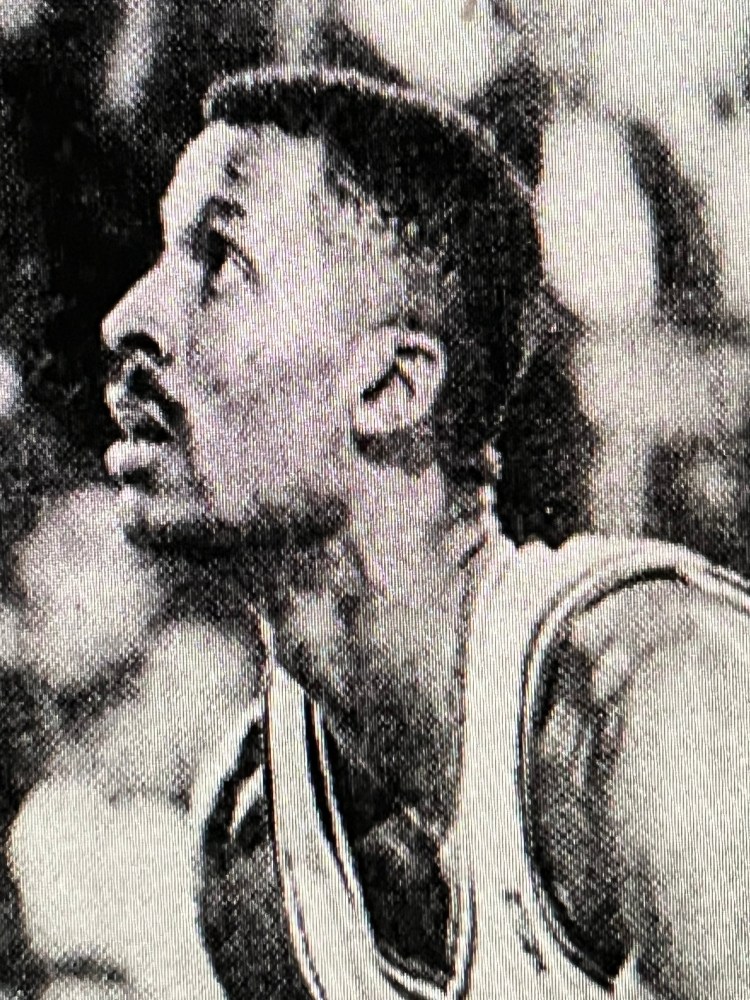
Life was like that in the projects of Cabrini-Green; some were lucky, some weren’t. Johnson sees himself as one of the lucky, but he knew plenty of the other kind, too. His closest brother, Philip, died of a brain hemorrhage when he was 25 and Eddie was 18. His cousin, James Strong, was killed in a shootout; the other guy now rolls around in a wheelchair.
“I had a friend who got shot in the head. They grazed him, and he played dead,” Johnson says. “And when he was laying there, one guy said, ‘Shoot him one more time, make sure.’”
Johnson stops talking and then laughs. “I know I couldn’t have laid there.”
His mother Doris knows, too. She doesn’t remember how many times it happened, but she does recall the sound of the siren and the resulting staccato of footsteps, and that frightened cry.
“Di, Di!” Eddie would yell in a mixed tone of panic and excitement. “The police is out there!”
“Eddie stayed away from everything that is trouble,” says Doris. “I think because his brother protected him from those things, and I think because of me, too, we kept him away from those things. He was a good boy, so he listened.”
Eddie Johnson, the Kings’ leading scorer, listened. He saw drugs rip up his brothers brain, saw the violence all around him, and he never forgot.
At first, Johnson says, “I just say I was lucky,” but he knows luck doesn’t have everything to do with it. “I’m stubborn. I just saw what it did to my brother, and I said, ‘I’m never going to do that—never do drugs, stealing, running the streets.’”
Eddie Johnson went the other way.
****
Using basketball to get into the University of Illinois, Johnson, then used his mind to get a history degree. Since then, he’s moved out. His parents divorced when he was younger, and there are six others in the Johnson family. But Eddie was always closest to Doris; so he moved her out, too, to a suburb known as Broadview.
“I go back to the neighborhood, I’ve stopped through,” he says smiling, “but not for long.”
These days, Johnson has a lot to smile about. He and his new bride, Joy, have recently moved to a new town where the populace has embraced them. The stereo console is complete; the refrigerator is always full.
So, although he is one of the most underpaid players in the league, Eddie Johnson rarely complains. There was a holdout two years ago, the one Kings general manager Joe Axelson called, “the funniest holdout in NBA history,” when Johnson sat out of training camp for one day and then felt so guilty that he came back without gaining any concessions from the club.
“There are a lot of people working eight-hour jobs that are not making nearly, nearly what I’m getting,” said Johnson. “I can’t really complain about that stuff, ‘cause I know. I know what it was like. Catching the bus every day; catching the bus was like being in Vietnam. Not wearing clothes, looking in the refrigerator and seeing not much is there.”
There is something always there now, and Johnson has earned it. Now in his fifth season with the Kings, Johnson has improved his output every year—from 9.3 points in his rookie year to a 22.9 average in the 1984-85 season—while always showing the tendency to make himself better.
****
For years, he’s been criticized as a one-dimensional player, a scorer who cannot, or will not play defense; but instead of ducking the talk, Johnson meets it head on. For the past two summers, he’d gone to Pete Newell’s Big Man camp in Los Angeles to work on rebounding and defense. And it has paid off slowly: Besides playing in all 82 games for the past three seasons—254 consecutive—he also has led the club for three years in scoring, field goals made and attempted, and minutes played.
But more important are the games that he hopes become more frequent, the times when he can keep the league’s top forwards below their own standards. He held Kiki Vandeweghe, Portland’s hot-handed forward, to just six points last Dec. 20 while he scored 26. And against the Knicks in New York on Nov. 10, Johnson scored a subpar 16 points, but held Bernard King— who won the scoring title last season with a 32.9 average—to 18 points.
“I have defensive weaknesses,” said Johnson, “so anytime I do good defensively, I get more pleasure out of it than scoring a lot of points.”
But more important to Johnson is this: “Taking the public bus in Chicago is a real joke, said Eddie. “With the gangs, there’s a lot of confrontation. I think the best I felt was when I taught my mother to drive this past year, and I got her a car. Now she can go places without getting on the bus; she never had any problems, but I was glad to get her off the bus.”
[Johnson’s memory for Basketball Digest’s “The Game I’ll Never Forget” was told, as mentioned, in 1991. But Johnson would play on in the NBA (with Seattle, Charlotte, Indiana, Houston) until 1998. Through those latter years, many more unforgettable moments came his way. Among them were many off the court as part of his total commitment to community uplift and helping kids succeed in life. Just like he did and continues to do long after his NBA career. As everyone knows in the Valley of the Sun, Johnson is a long-time voice of Arizona State, the WNBA Mercury, and the Suns. He’s also truly one of the good guys in pro basketball, with or without Ken Norman to torment.]
 From Way Downtown
Hello Bob,
Very interesting insights about Eddie Johnson.
What is your source that S.L. Price passed away? I had not heard that, and cannot find any corroboration on the internet.
Thank you,
David Friedman
LikeLike