[If you ask any middle-aged hoops historians to name their top-five favorite pro basketball books of all-time, I’d be willing to bet my pair of Classic Air Jordans that Loose Balls would make the list. Loose Balls is, of course, Terry Pluto’s history of the short-lived American Basketball Association (ABA), published in 1990 and reprinted several times. As oral histories go, Loose Balls is as good as it gets. I’ve read the book three times, randomly flipped through it on hundreds of occasions, and each time find myself placing its 437 pages back on the bookshelf wishing that Pluto would have gone just a little further here and a lot longer there.
Though I’ve never had the pleasure of meeting Pluto, I’ve heard that his 437 pages could have easily stretched to 500 or 600. He reportedly had many more interviews and many more fantastic stories in his back pocket. But his publisher drew a hard page limit at right around 437 pages. If true, it’s a typical publishing story, and one that’s had me wondering for years about Pluto’s library of old cassette tapes collecting dust somewhere and all those ABA sources that didn’t make the book, many of them now gone, and whose voices will never be heard.
All of that wondering, however, came full circle for me about five years ago. I’d just published Shake and Bake: The Life and Times of NBA Great Archie Clark, and there inside a cabinet in my office stood stacks of cassette tapes from sources, many of them now dead. On these tapes were prominent ABA voices telling me the behind-the-scenes, mostly unknown stories of the league and its nine-year business war with the NBA. Almost none of this valuable material got used in Shake and Bake. All of it brought to life the front-office intrigue that I’d wished Pluto could have folded into Loose Balls.
Also mixed in among my stacks of cassette tapes are interviews with prominent NBA sources, many now deceased. They told me their own versions of the interleague battle, and almost none of this material got used in Shake and Bake. Again, that’s a shame. To the best of my knowledge, both sides of the NBA-ABA War have never been woven together and retold in one book. Neither would it ever get done in fine detail, unless I went back into my cabinet and started relistening to the tapes, researching their claims, and writing another book.
And so I did. Almost immediately, I ran head-on into the same problem that reportedly confronted Pluto: I had way more content than traditional presses had book pages to offer. This might sound corny, but for the betterment of pro basketball research, I decided to veer off and take an unfamiliar—but more wide open—publishing route. I published the history on my own dime.
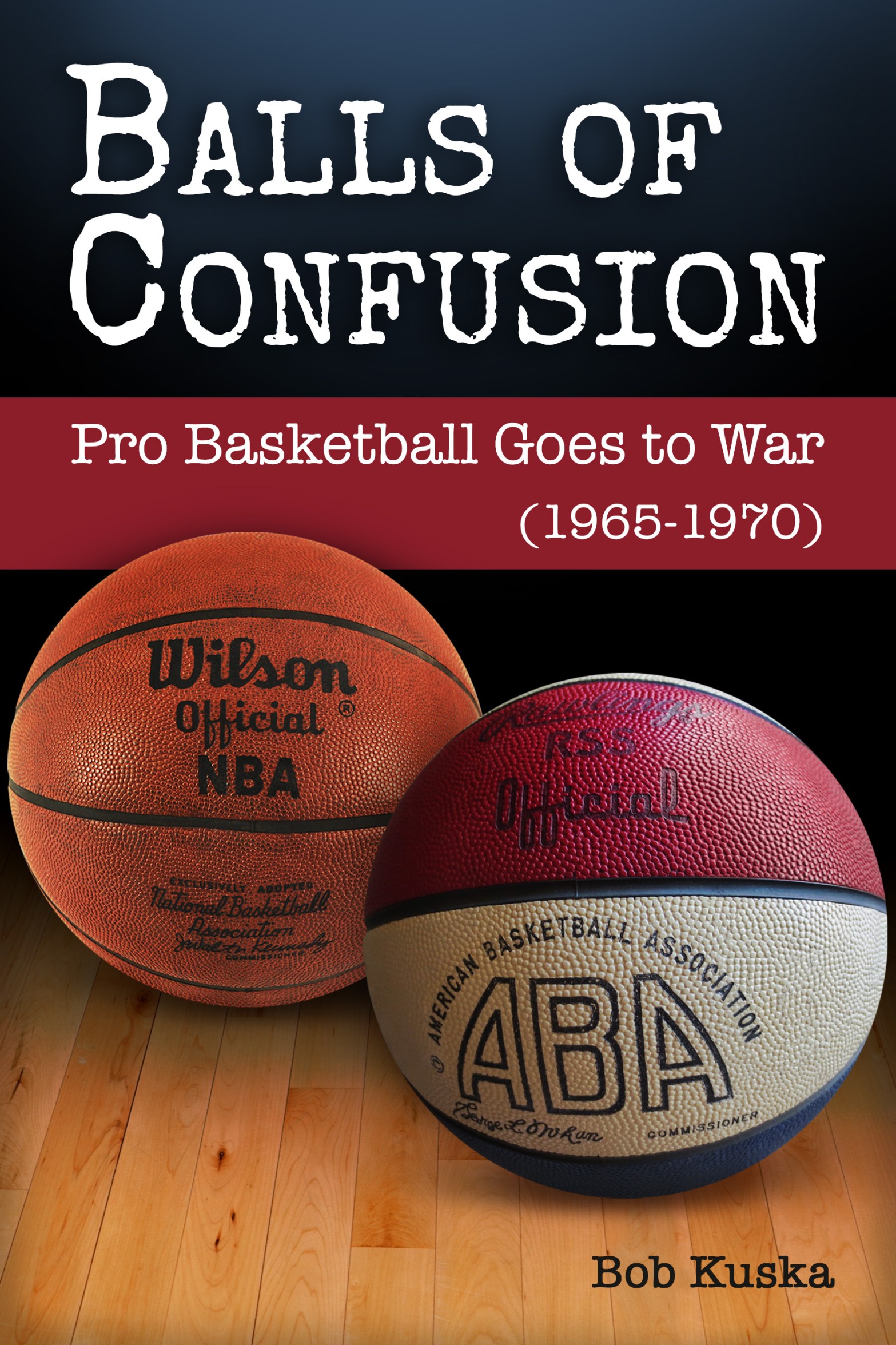
The result is titled Balls of Confusion, which riffs off the old Temptations song about the social upheaval of the 1960s. The title also fits perfectly the uncertainty and turmoil of the NBA-ABA War. To ensure that I don’t leave out anything good, I’m also publishing the story in two parts, volumes, whatever you want to call it. Part one—Balls of Confusion Pro Basketball Goes to War (1965-1970)—will be out in November 2024. Part two—Balls of Confusion: Pro Basketball Finds Peace (1970-76)—is already half-written and will be out as soon possible.
If you’re a fan of Wilt, Russ, Rick Barry, Connie Hawkins, Dr. J, and this critical era in building the modern game, you’ll definitely want to read part one when it drops in November. My suggestion is to pre-order or purchase ASAP. The book will have a very limited print run, and I doubt that I’ll reprint it. The best place to purchase part one is through my distributor. Or, if you must, Amazon works, too. An e-book will likely be in the works, but it will be a while.
To give you a flavor of the November release, here is a brief excerpt. It describes the first regular-season ABA game, featuring the visiting Anaheim Amigos and the Oakland Oaks. If you enjoy the vignette, get the book. You won’t regret it. In the meantime, if you have any questions, shoot me an email – bobkuska@yahoo.com – I’d love to hear from you.]
****
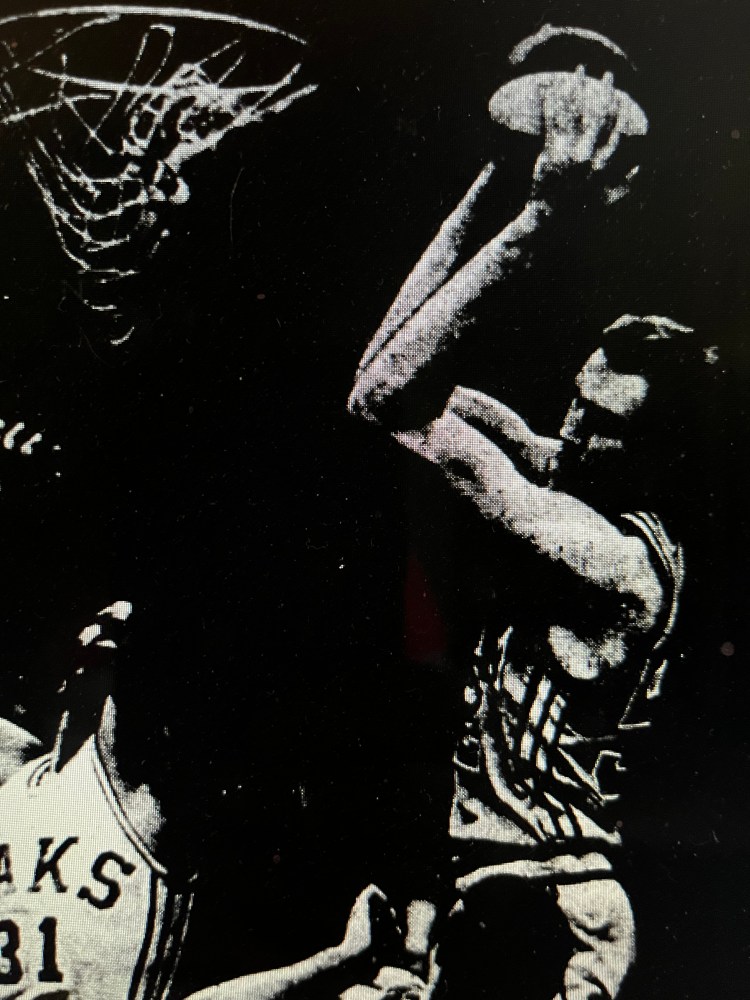
Oakland, Calif., Oct. 13, 1967—California governor Ronald Reagan sent his apologies. He and wife Nancy would not be attending tonight’s inaugural ABA game between the Anaheim Amigos and Oakland Oaks. No Gipper, no worry. There was still plenty of star power. Pat Boone, the popular crooner and Oaks’ owner, would belt out the national anthem. He’d also crown Miss Oakland at halftime, right after pop singer Toni Arden dazzled the house, alternating in perfect pitch between English and Italian.
All were assembled tonight in the Oakland-Alameda Coliseum on this Friday the Thirteenth. There would be no vampire sightings to spoil the fun, though seated courtside was the slightly ghoulish countenance of Charley Hinkle. He was Oakland’s 43-year-old publicity director and designated radio voice. Hinkle and his throaty Appalachian twang had a long and distinguished career behind the microphone calling harness races in his native southern Ohio.
When times turned tough in southern Ohio during the 1950s. Hinkle relocated to Pittsburgh, where he called races and moonlighted as the radio voice of Duquesne University basketball. But Hinkle started hitting the bottle, reportedly crashing an expensive car into a ditch and also struggling to stay ahead of his gambling debts. He needed out of Pittsburgh and sent audition tapes to, among other places, the brand-new Oakland Oaks; and damn, if he didn’t get the job. Now, through the grace of God and nothing stronger than an occasional beer,
he’d get his life straight out West.
Redemption was also the storyline for virtually all the tall guys warming up for tonight’s ABA opener. There was number 33, Willie Porter, cut by the NBA Cincinnati Royals and trying to find another team that paid. He was known as “Fang” for getting his front teeth knocked out during an earlier exhibition game. Number 34 was Lavern Tart, a.k.a. “Jelly.” The streak-shooting southpaw had bounced around the semi-pro Eastern League, hoping to reignite his pro career. Then Oakland called, and Jelly jiggled off to make some cash. Number 54 was the lumbering seven-footer Mike Dabich. Everyone called him “Frankie,” short for Frankenstein. He backed up number 42, “Jumbo Jim” Hadnot, a local kid who played his college ball back East. Jumbo Jim couldn’t crack the Boston Celtics’ roster after college, and the Oaks were his last shot at drawing a pro salary.
Oakland’s lone superstar Rick Barry was around the arena somewhere in street clothes. He would presumably join Jelly and the others next year after, judge’s orders, sitting out his NBA option season. Funny, that wasn’t the case for Anaheim’s number 40, Ben Warley. He played last season for the NBA Baltimore Bullets, then Seattle grabbed him and his expiring one-year contract (including the added option season) in the NBA expansion draft. Warley signed with Anaheim instead, drawing a distracted shrug from Seattle officials.1 And so,Warley and a few other low-value NBA ex-pats could play immediately, while Barry sat for a season never far from further legal jeopardy.
Hinkle was minutes away from gametime, while back in the Berkeley studios of KPAT (“1400 on your radio dial”) host Al Edwards wrapped up his “Sound of Music” program, the best of the 1940s from Dorsey to Sinatra. Now came the hard part. KPAT had never broadcast a live sporting event, and, fingers crossed, the hookup would hold. Edwards bid everyone a pleasant good evening, followed by the tick, tick, tick of KPAT’s iconic metronome to signal the next program, and then, presto, Hinkle was live with the Oaks and Amigos, Jumbo Jim and Jelly.
Hinkle read the starting lineups handed to him, and then “they were off” like the ponies. The first ABA game was up and down, back and forth, and occasionally side to side. Jelly to Jumbo Jim and out to Fang and Steve “Snapper” Jones. The Oaks scored 70 points in the first half and 134 for the game. That was good enough to edge the 129 points of the scrappy Amigos, led by their mad three-point bomber Les Selvage. He played last season for the Phi Beta Sigs of Southern California’s Interfraternity Negro League and reportedly kept his fingernails long to better control the ball. They audibly scraped off the red, white, and blue on each of his three-point hoists.
“They said we wouldn’t make it,” told-you-so’ed ABA commissioner George Mikan afterwards. “Well, we’ve waited a long time for this night, and it has been a fine one. I think it’s very good quality basketball and, like everything else that’s new, it can only get better.” Barry, after pointing out some defensive flaws and rookie mistakes, got with the effusive opening-night program. “That three-point shot is going to open the floor up because you have to defend against it, and that opens up the middle. Both these clubs run your legs off, and they’re both big.”
When Hinkle called races back home, his signature line was, “Here they all come,” delivered with a guttural flair and flourish. That line captured the awesome possibility on display tonight through the league’s opening week. The ABA’s 11 teams finally galloped forth, though mostly greeted by empty seats. In addition to the roughly 1,000 free admissions tonight in Oakland, just 4,826 people paid the two bucks to pull up a Coke and a hot dog and be a part of basketball history. Still, it was a start. Hinkle signed off from courtside, and KPAT returned to its regular programming with host Walt Jamond and his “turntable twirlings” until 6 a.m.
 From Way Downtown
Is e-book going to be available?
LikeLike
Thanks for your note, Randy. The quick answer is eventually. I’ve got to make arrangements to upload/format the e-book, and that could take a while. But I will get there. Thanks again for asking.
LikeLike