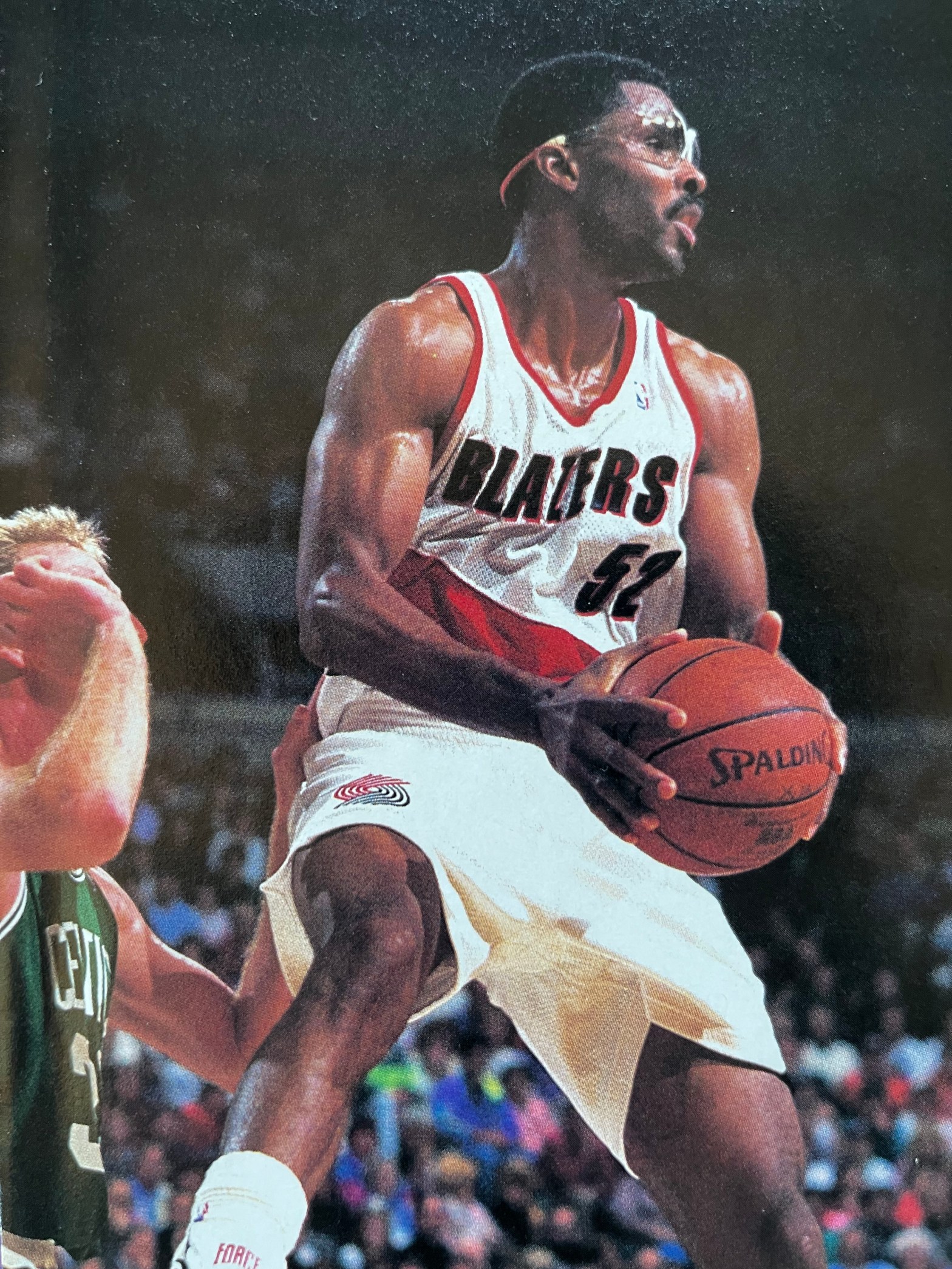
[There’s a lot of good things to write about Buck Williams, one of the NBA’s all-time great rebounders. Rather than fumble after all the right adjectives, I’ll leave the high praise to an NBA publication from the early 1990s that succinctly said of Williams pounding the boards for Portland: “Perhaps the ultimate dirty-work guy in the league. Just wants to win. Accepts the challenge every night. Doesn’t miss games.”
Kerry Eggers, the dean of Portland sports, elaborates further in a real nice catch-up piece on Buck Williams from 2023. It’s part of his My Favorite Blazers series:
Williams was the missing link that provided the impetus for the Blazers’ three-year run from 1989-92 in which they averaged just shy of 60 regular-season wins and twice reached the NBA Finals. Teaming with Clyde Drexler, Terry Porter, Jerome Kersey and Kevin Duckworth in the starting five, Williams coagulated the group into one with synergy and purpose capable of beating any opponent on a given night.
Of course, Williams started his 17-year pro career punching the clock for the wayward New Jersey Nets. In this article, published in the 1990-91 Street & Smith’s Pro Basketball Annual, our favorite NBA writer Fran Blinebury explains why eight seasons with the Nets was more than enough for Williams and why he was SOOOO happy to bring his special brand of synergy to the Pacific Northwest.]
****
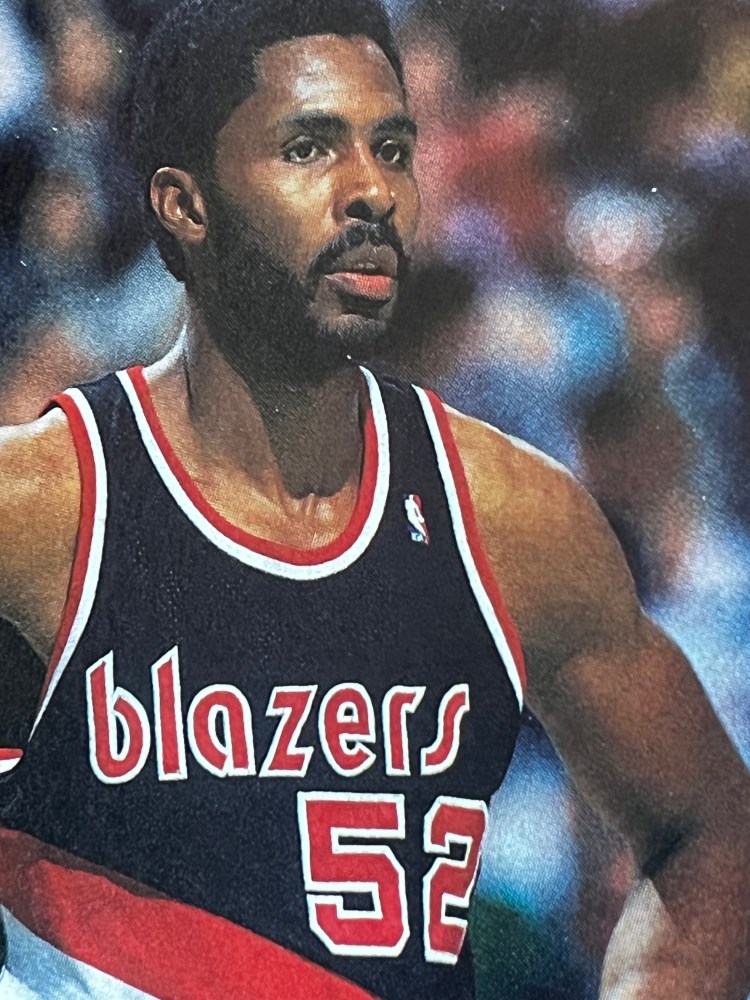
Buck Williams became interested in genealogy a few years back when somebody suggested that his family might be cursed. After all, how else could you explain the circumstances that kept one of the NBA’s hardest workers and top citizens trapped in the dungeon of the New Jersey Nets for so many years?
Williams had labored for eight long seasons with the Nets, a franchise that has never been able to pick itself up out of the muck of the swamplands on which its home arena is built. He had been named NBA Rookie of the Year. Six times he managed to pull down more than 1,000 rebounds in a season. Three times he was able to achieve all-star status for himself.
All of the time, Williams had been regarded as the consummate pro, a man who tried to make the best of a bad situation. But never once were the Nets able to win as many as 50 games or get past the second round of the playoffs. Williams would look around the rest of the league and see his friends and his peers enjoying large measures of success and wonder why good fortune never seemed to smile down on him.
“I would think about James Worthy,” says Williams, a contemporary and fellow native of North Carolina. “He won a championship at Carolina, and then he got traded [to] the Lakers. He was always in the right place at the right time. And I would often ask myself, ‘Buck, whatever have you done wrong to deserve this?’”
The answer, of course, was nothing at all. Which is why nobody deserved to reap the benefits of a cross-country trade from the Nets to Portland more than Williams. “In New Jersey, it was eight years of constant turnover,” Williams says. “It was eight years of what-ifs. Eight years of climbing a mountain and just not getting there, of expending all that energy and not gaining any ground.”
But last season at long, long last, Williams was able to jump off the treadmill, and, as a result, the Trail Blazers were able to jump up and become more than just a minor annoyance in the NBA’s Western Conference. With Williams on their frontline, the Blazers cruised to a 59-23 regular-season record and then roared through the playoffs all the way to the finals, where they bowed, 4-1, to the champion Detroit Pistons.
Four straight years of being bounced from postseason play in the first round were forgotten, as Williams gave the Blazers the muscle and the leadership to become real contenders. After years of listening to trade rumors and playing through so many rebuilding programs with the Nets, Williams was finally set free when the Blazers agreed to swap center Sam Bowie and a first-round pick. It was a deal that was so well-received by the Blazers’ fans that he was given a standing ovation when he first arrived in Portland and attended the teens 1989 draft party.
It was a deal that was quite obviously the right one for the Blazers when they jumped right out of the gate with a new, stronger, tougher style of play. Though possessing talented performers, such as Clyde Drexler, Terry Porter, Jerome Kersey, and Kevin Duckworth in recent seasons, it took the addition of Williams to really give the Blazers the appearance of a true force.
While Drexler had established himself as a perennial all-star, it was Williams who ignited a hotter spark in Clyde the Glide. “I think Clyde is now playing the best defense of his life,” says Blazers vice president Buck Buckwalter. When Portland hung a loss on the defending-champion Pistons early last season, Isiah Thomas was asked to describe the difference in the new-look Blazers, and he replied with two words, “Buck Williams.”
What Williams has always brought forth is fountains of praise from both his teammates and his coaches. Larry Brown, now the boss of the San Antonio Spurs, was Williams’ first NBA coach with the Nets. Brown is a coach who frequently makes his players victims of his sharp tongue and temper tantrums. But those who were around the Nets in those days claim Brown never once had a negative thing to say about Williams.
“Buck was like a sponge,” Brown says now. “He was the most receptive player I’ve ever coached. He would do anything at all that I asked him to do, and he would do it harder than anybody else. Buck doesn’t have a selfish bone in his body. He wins.”
He won in college at Maryland, and he is winning in Portland. But in New Jersey, he just endured. And each night, he went out and gave his all for a team that could never seem to get anywhere. “That period of my career helped breed some patience,” Williams says. “The patience bred character, and the character bred hope. Still, it was tough at times.”
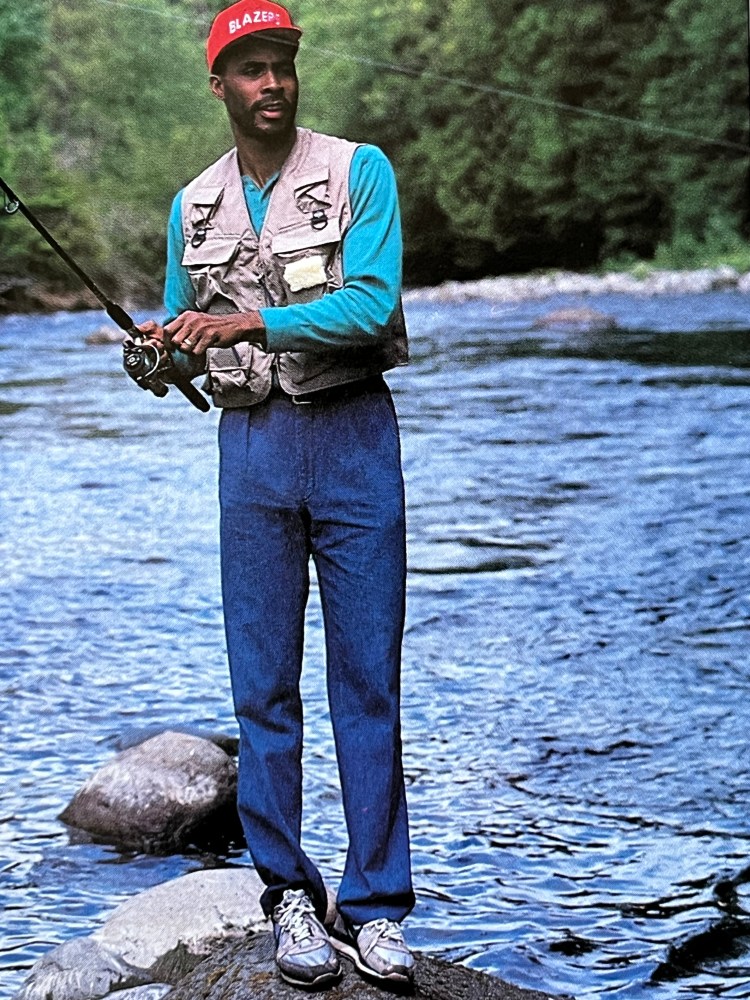
But never tough enough to beat him down. While other teams were always involved in the playoffs, Williams took up hobbies. He fished, and he built model airplanes. He learned to read music, and he learned to play the piano. He researched his family roots. He did anything to keep his mind off the game, because it hurts so much to watch.
Thus, last spring in Portland, he was raring and ready to take a bite out of the playoffs. “It was a great feeling to be a part of the playoffs again,” Williams said. “I just wanted to go on and on. After all those years of watching, I’m ready to do what it takes to chase the ring.”
Williams had been raised to know the value and the importance of work, having spent many afternoons as a baby riding around in a sack that his mother, Betty, used to sling over her shoulder as she picked cotton in the fields of North Carolina. His father, Moses, toiled long hours in a construction job just to pay the bills on a tiny, four-room house where Buck grew up with his four brothers and sisters. There was no hot water and no indoor plumbing until he reached high school age.
“There were a lot of nights when I prayed for indoor plumbing,” Williams says. “It was embarrassing to come home from school, even with my friends, and walk past my house. It was a little shack that we lived in.”
A little shack that Betty and Moses were finally able to move from after Buck signed a pro contract and bought them a home. “That was the best day of my life, putting them in the new house,” Williams says. “Yeah, it’s even got indoor plumbing.”
And now Buck Williams has a new home, too. One where he’s unclogged the pipes in Portland and has the Blazers’ water running hot again on the trail of an NBA championship.

