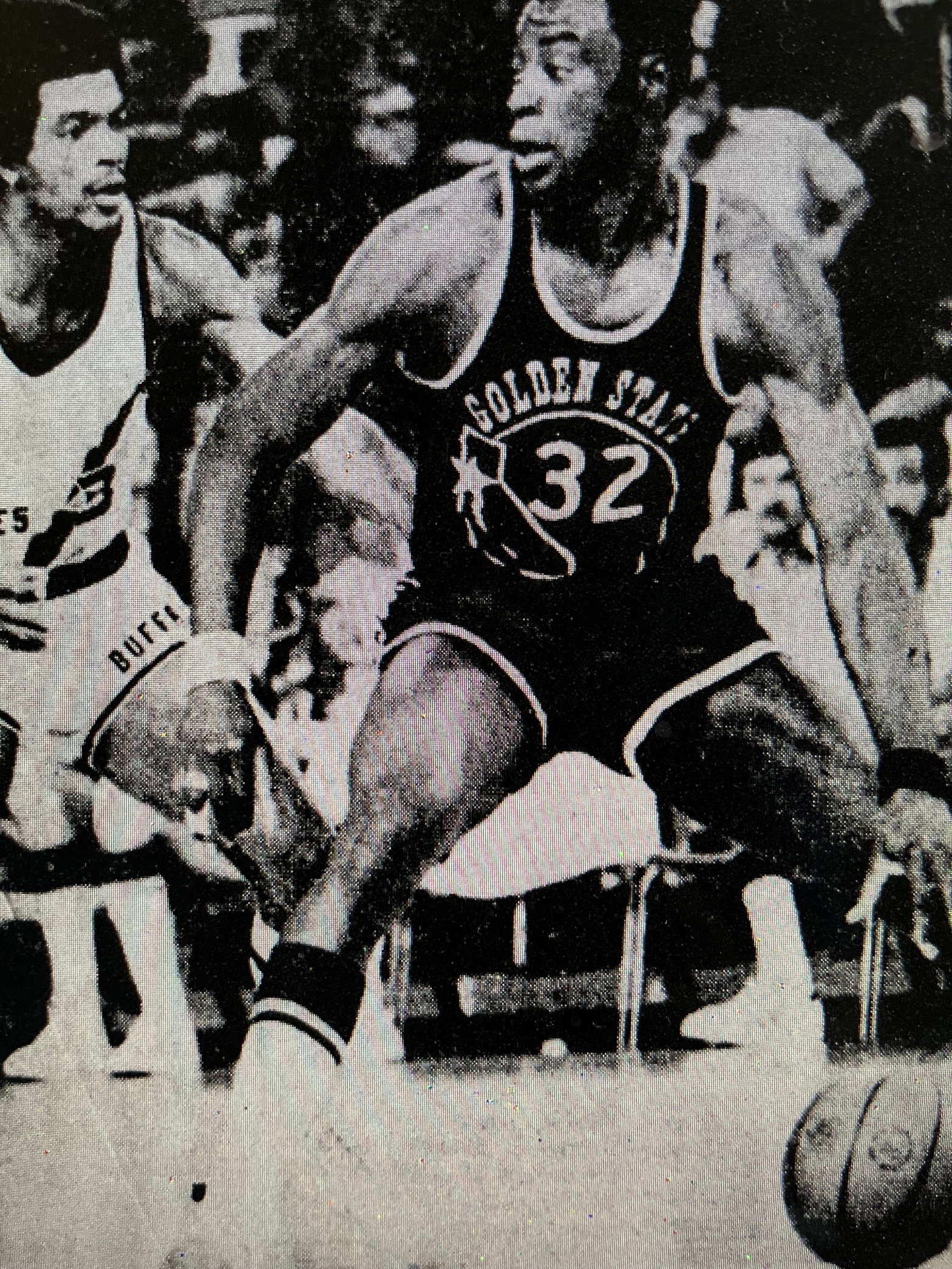
[In the 1966 NBA draft, Cazzie Russell was the highly coveted first pick. The New York Knicks grabbed the high-scoring 6-foot-5 swingman for a then-inflated six-figure rookie price. The big bucks in turn inflated public expectations that Cazzie would roll into Madison Square Garden as a 20-point-per-game revelation. Cazzie struggled mightily to meet those expectations, while injuries, Uncle Sam, Bill Bradley, and whispers about his defensive liabilities limited his playing time and stardom.
After the 1970-71 season, the Knicks sent Cazzie to Golden State for center Jerry Lucas. Many months ago, From Way Downtown ran a magazine article from way back then that analyzed Lucas’ coming benefits to the Knicks. What follows is a story about the other side of the equation: Cazzie’s benefits to the Warriors as the replacement for Rick Barry after his leap to the ABA. This brief story, written by the great San Francisco newspaper columnist Glenn Dickey, ran on February 8, 1972 in the biweekly newspaper Basketball Weekly.
One more thing. Although wearing a Warrior jersey at first went wonderfully, things quickly turned sour when Rick Barry returned to Warrior-land for the 1973-74 season. Barry was the better of the two (a more complete player and owner Franklin Mieuli’s “Wonder Boy” and obsession during the NBA-ABA War), and that made Cazzie and his big bucks expendable in the Bay Area. After some political and financial intrigue, NBA-style 1974, Cazzie would eventually land on his feet with the Lakers but as an aging role player fated never to attain the super stardom that many had predicted for him in 1966.]
****
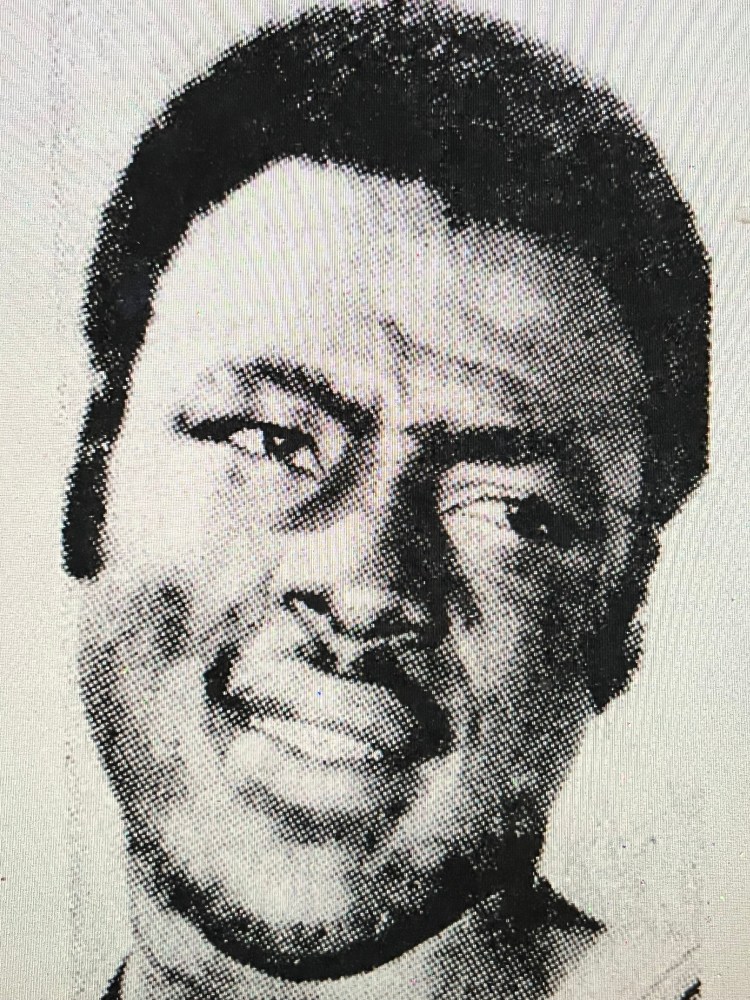
The ideal trade is said to be one that benefits both sides. But since most teams work at getting an All-Pro for a guy who can’t take two consecutive steps without stumbling, it seldom works out that way.
It has, however, happened that way in the Warriors-Knicks trade of the last offseason, in which Jerry Lucas was sent to New York and Cazzie Russel to what [owner] Franklin Mieuli thinks of as the Golden State area, but which is actually—there’s no hiding the truth anymore—Oakland.
Everybody benefited, teams and players alike. Lucas has helped the Knicks, filling in at center when Willis Reed has been hurt, which is usually. In return, he has received a healthy pay boost and is now in the city where any athlete with a touch of avarice in his soul wants to be.
But it is the Warriors and Russell who have received the most out of the deal. The Warriors have an exciting player, one who can go for the basket when two points are urgently needed—and one who can bring some people through the gate.
And Russell finally has a chance to play, to show people the objections to him in New York were bum raps. His peers in the NBA think so: He was selected to the West All-Star squad. That almost makes up for the frustrations of his years with the Knicks.
“It probably meant more to my dad than it meant to me,” says Russell. “He tries not to show his emotions, but he’s getting pretty old [65]. And he always hoped that before It was too late, he’d see me in the All-Star Game. Now I’ve made it. It will be a real big lift for him.
Russell came to the Knicks as a three-time All-American, the only Michigan player ever so honored, but his status as the Knicks’ No. 1 man didn’t help him get off the bench. First, it was inexperience; then it was Bill Bradley; finally, it was said, it was defense that kept him from starting.
“That was a bum rap,” he says. “In the playoff series against the Lakers two years ago, the game Willis Reed got injured, I had to take on Elgin Baylor. I held Elg to five points. It was one of the most physical games I’ve ever had to play. Now, does that sound like I can’t play defense?”
Warrior coach Al Attles agrees with his new star. “Many people take an incident and stamp a tag on you,” he says. “You get a guy who was unhappy about not playing too much, and you explain it that way. Cazzie has played good defense for us. We’re satisfied.”
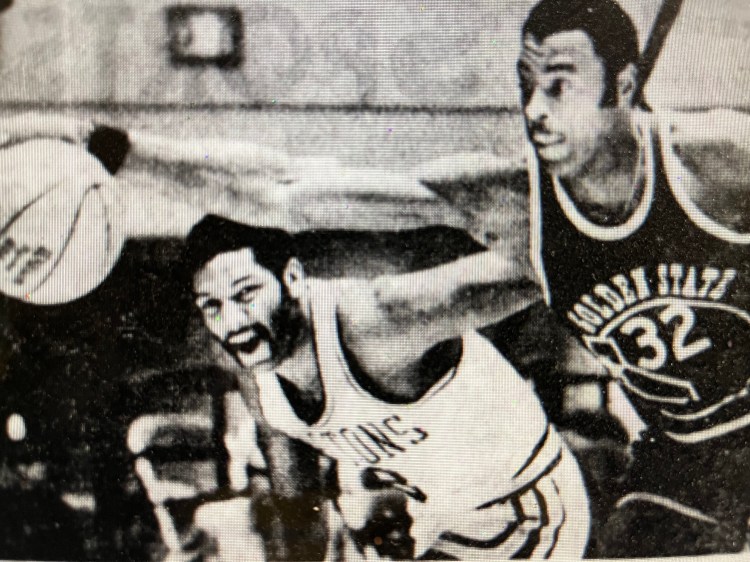
Bad rap or not, Cazzie never let his bench status keep him from working hard when he was with the Knicks. He would come early to Madison Square Garden before games and be dribbling and shooting while his teammates were dressing. “I figure it gave me a jump on the other guys,” he said.
Then, came to trade. Russell couldn’t have been happier. “I said to myself that I was going to get the chance,” he said, “so I was going to work hard. I wasn’t looking for superstar status, just a chance to play some good, sound basketball. I wanted the opportunity to play. And I got it.”
Inevitably, Russell is compared to the Warriors’ former Wonder Boy, Rick Barry, which is unfair to Cazzie. He is not the offensive player that Barry was with the Warriors, but he does have some of the same characteristics.
“The thing that impresses me,” says Warrior guard Jeff Mullins, “is his tremendous offensive endurance. That’s what Barry had. Cazzie has a good solid bass, heavy legs like Oscar Robertson. He’s one of the greatest shooters I’ve ever seen, and he hardly takes a bad shot.
“He can go 40 or 45 minutes every game. Rick could do that, too. I have to go in spurts, then try to catch my second wind.”
His routine hasn’t changed since his trade. He still works harder than anybody. “After a work-out,” he says, “I go to a health spa and take a steam bath. Then I go home and have a light meal. Then I do some reading and take a nap. Around 7 o’clock, I go down to San Mateo High and work on my game, just running and shooting and free throws. I get in 14 or 15 extra workouts a month that way. Hard work still pays off.”
Russell is a bug on physical conditioning, which extends to the food he eats. “My first year with the Knicks,” he says, “I found that in January, I got very weak.” So he started eating honey and carrot juice and wheat germ. “It’s worked great,” he says. He also drinks copious quantities of a health-food drink called Grapeberry.
Considering how he’s played, Attles is considering ordering the same drink for the rest of the team.
 From Way Downtown