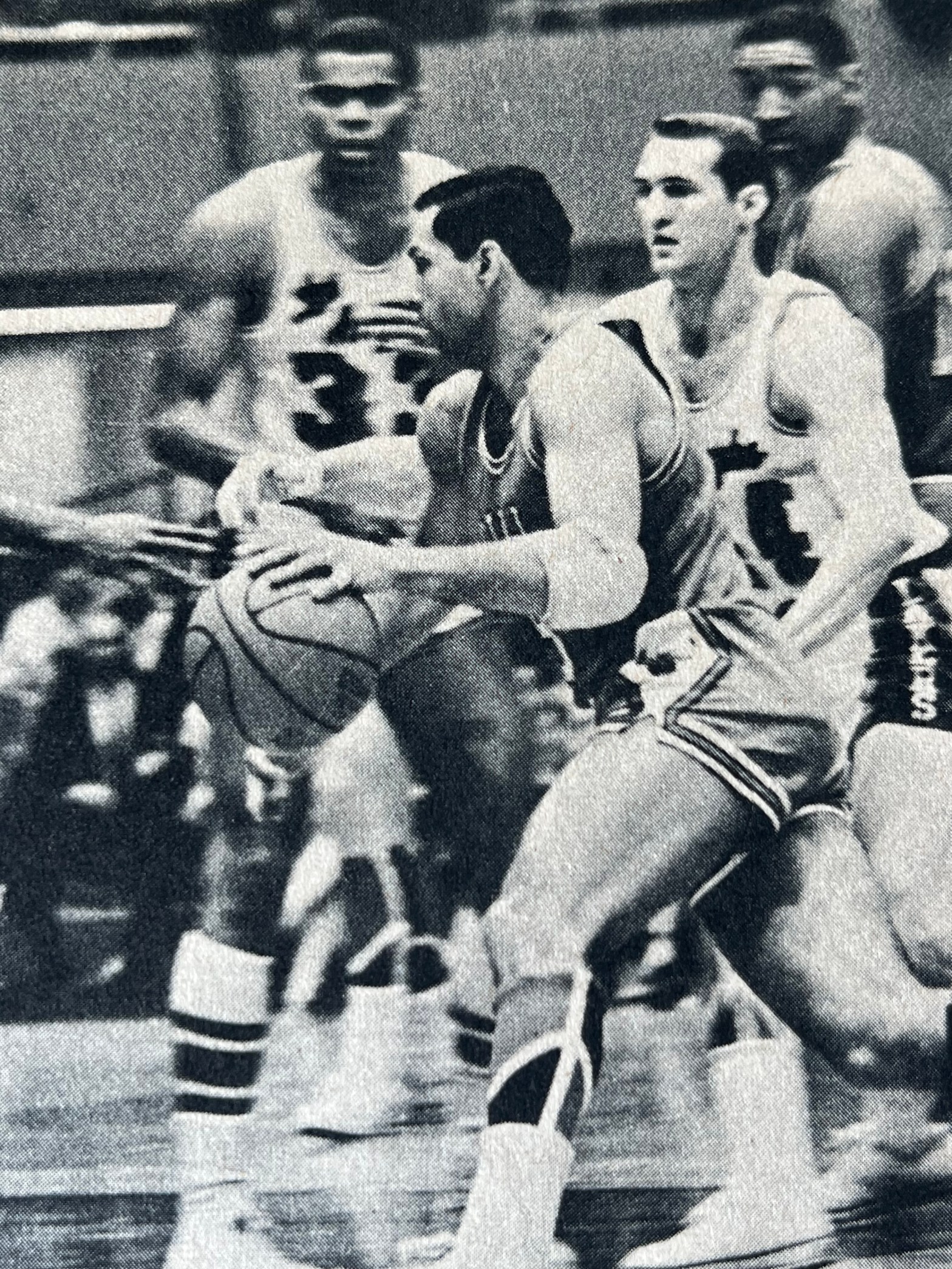
[I’ve posted a couple of articles already about the great Guy Rodgers. One I took from newspaper sources; the other I pulled from an old, dog-eared paperback that profiled the game’s top players in the early 1960s. The latter was a little too heavy on the star treatment, though its tone certainly wasn’t over the top.
The article that follows about Rodgers, from the March 1968 issue of the magazine Complete Sports, is more to my liking. Writer Paul Neimark, who would publish 52 books before passing away in 2016, does a nice job of highlighting Rodgers and his then-unique playmaking skills. When Neimark got the story assignment, Rodgers likely was still with the expansion Chicago Bulls. But on October 20, 1967, the Bulls were blown out by the Hawks, and Chicago owner Dick Klein panicked. He traded Rodgers to Cincinnati. “The honeymoon of last season is over,” Klein tried to explain his surprising decision. “I think the spark of leadership on the floor has been lost.” Ouch! Neimark also does a nice job of layering in Rodgers’ will to keep playing as his career entered its twilight years. Without further ado, take it away, Mr. Neimark.]
****

After watching NBA teams in action last year, a veteran basketball fan came to the conclusion that “the best bet to do something phenomenal every time he has the ball isn’t Wilt, Oscar, Baylor, or West. It’s that guy, Guy Rodgers!”
Fortunately for Chicago pro basketball fans last year, the league’s smallest superstar worked his ballhandling con-game for the Windy City’s Bulls. Unfortunately, he won’t be spinning his magic for Chicago this season.
Wherever Guy goes, excitement goes with him, and loyal followers of the Cincinnati Royals, who had an exciting player in Oscar Robertson these many years, now thrill in seeing the great Oscar paired with Rodgers in the same backcourt.
It wasn’t always this way. What has galvanized Guy? In his ninth season last year, what suddenly made this pugnacious six-footer the inspirational playmaker who has been confounding the best pro defenses in the league with the uncanniest moves and canniest passes ever seen on the hardcourt?
Well, some of it isn’t completely new. During the five-and-a-half years that he was feeding the ball to Wilt Chamberlain, Guy often had more assists in a game (a record 28 once) than points. But now he is suddenly on the scoring end of his own sleight-of-hand artistry, too—as evidenced by his performance during the 1966-67 season when he had several 30-point games, hit a high of 39 and wound up the season leading the Bulls with 1,459!
Two seasons back, no one would have believed it. No one expected him to be beginning his ninth pro year with a neophyte team called the Chicago Bulls, either. It was also unbelievable that the Bulls traded away Rodgers the second week of the 1967-68 season.
It was September 7, 1966, when the amazing 165-pound guard for the San Francisco Warriors received the shock of his life. They had given him away to the Bulls, the NBA’s expansion team that year! It was obviously humiliating.
His 1965-66 season with the Warriors had been the best of his career. He finished second only to Robertson in assists, with an average of 10.7 a game. What’s more, no one but Oscar ever averaged that many. That year Rodgers had also improved his shooting, both from the foul line and the field. During the season, he had made the all-star team for the first time in four years. In short, the short man had come to enjoy the Golden Gate City.
But now, he was on his way to the Bulls—a team obviously doomed to finish in the cellar. To make matters worse, what did the Warriors receive in return? Another backcourt man Jim King—who had spent three years as a substitute in Los Angeles!
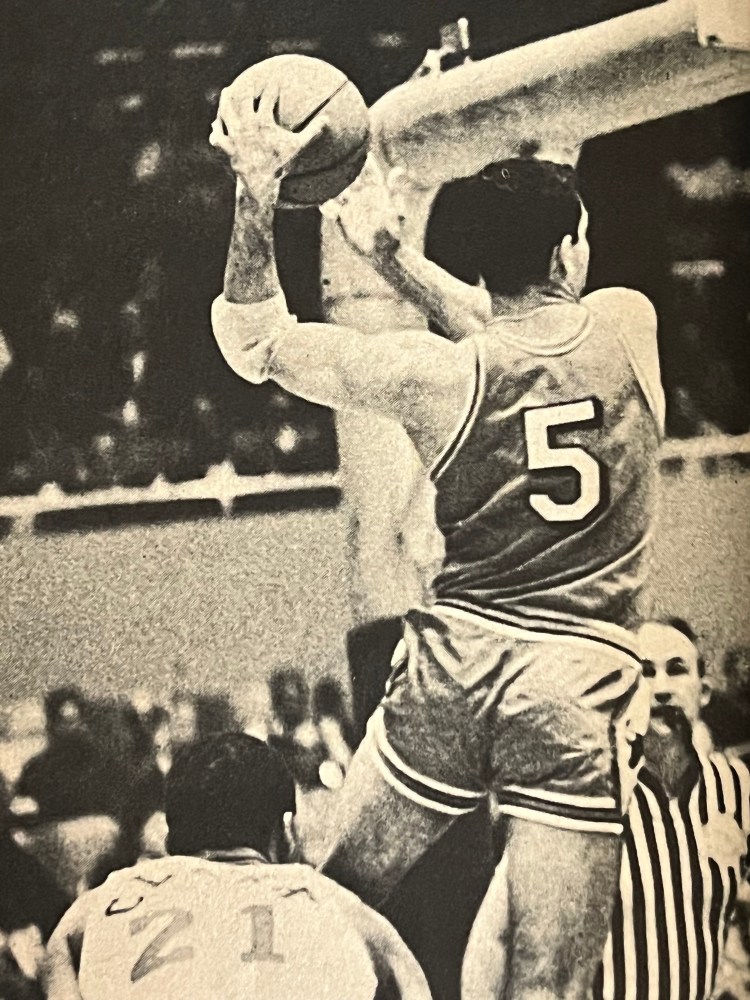
The trade was indeed a blow. It made him wonder: Was he finished? Should he feel bitter about the whole thing? Or, should he become a prima donna in his new situation?
Rodgers did neither. He ripped those thoughts from his mind and did the most professional thing possible: He buckled down and decided to really let ’em rip on the court. He vowed as never before to make the doomed-for-the-cellar Bulls get into the playoffs. And he did it—with a season that was his greatest by far.
Displaying spectacular passing techniques and dazzling driving ability, Rodgers proved to be the catalyst the baby Bulls needed to put together a cohesive and competitive unit right from the start. And when the season was over, the Bulls had accomplished a pro basketball miracle, landing a berth in the NBA playoffs—an unprecedented feat for an expansion team.
Enroute to this remarkable accomplishment, Rodgers led the league in assists, setting an all-time record with 908, beating the “unbeatable” Big O by 63. Guy somehow found time to average 18 points a game, too, leading his team in that department as well. To top it all off, he pushed his foul shooting accuracy above .800.
But it was the assist figure that was so remarkable. In averaging 11.2 dishes a game, he crossed a level previously passed by Oscar, but never approached by the likes of Bob Cousy, Dick McGuire, or Andy Philip, the great playmakers of the past.
It wasn’t just the number, though, it was the setting! In all those years with Chamberlain (and in the one year with Rick Barry), he hadn’t made so many. And Wilt got his share of baskets, needless to say. The rest of the Bulls very often didn’t, also goes without saying. Obviously, if you are feeding great scorers, you should have a much better chance for a high assist total, but who could Rodgers feed in Chicago?
There was Bob Boozer, a fairly good cornerman. But hadn’t he been declared expendable by Cincinnati, Los Angeles, and New York? Well, with Guy feeding him, Boozer averaged almost 18 a game!
How about Jerry Sloan? He had been tossed into the expansion kettle by Baltimore, for whom he played very little. Alongside Rodgers he averaged 17.4 per battle.
To gain the playoffs, Rodgers had to break a record and had to generate a team effort the likes of which the league had never seen. Al Bianchi, former Bulls coach (now handling the Seattle SuperSonics), thought he knew just how devastating Rodgers could be. He played against Guy for eight years. But even Bianchi was surprised by what Rodgers did with the Chicago team.
“Guy’s the toughest in the league coming at you with the ball,” says Bianchi, himself an excellent defensive player. “Nobody gets the ball down better on a fastbreak. Even when he is dribbling at top speed, he knows where everybody is on the floor. I still don’t understand how he does it. It’s really like an extra sense.”
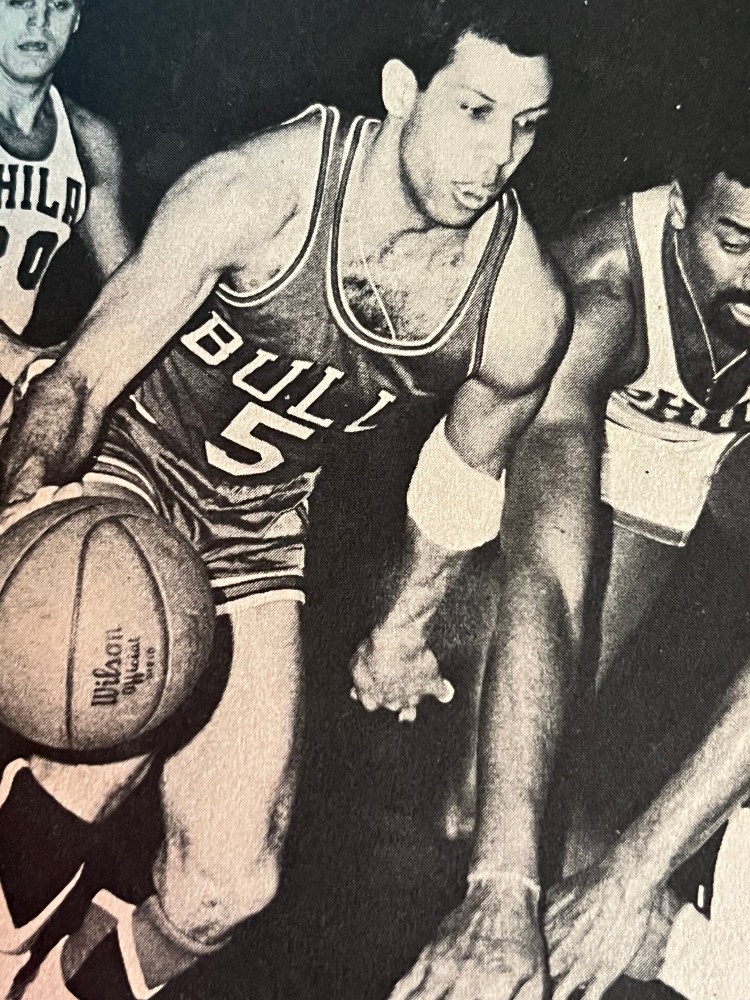
Time after time, Rodgers will race into a crowd of giants under the basket and just when it seems he’s going to be swallowed up, the ball darts out of his incredibly fast hands to a teammate breaking in alone for a layup.
Or he’ll suddenly take off at the free-throw line, confidently swing the ball behind his back to free himself and fly in for a scoop shot that leaves even the officials shaking their heads. Or he will slam on the brakes and calmly flip in a left-handed jumper when his job was just to get the ball to Chamberlain or Barry.
Rodgers does have exceptional reflexes, sharpened by year-round competition, and peripheral vision. But other than that, it’s hard even for Guy himself to explain how he does what he does. “I simply try to be aware of everything that’s going on in a game,” he told us. “Sometimes I can tell where everybody is just buy the hollering, but I do see very well out the sides.
“I guess I just do things instinctively. It’s not something I plan coming down the floor. I do whatever the defense man makes me do. I wait for him to move. If they overplay me, I can go for the basket or pitch off to an open man. Our success then comes from the fellas always running and filling the lanes,” he goes on.
One of Rodgers’ most valuable contributions is the least spectacular—he makes his free throws. And he uses the underhand method. “It is a comfortable way to shoot—there’s no strain, even when you’re tired,” he says. “I shot underhand in high school, then I switched to a one-hander in college. Why, I’ll never know.
My foul shooting wasn’t too bad, but it went kaput after I turned pro with Philadelphia. Paul Arizin was on that team. He shot underhand and was one of the best. So I copied him, studying everything he did. When I started missing again, Paul told me I was shooting too fast. I became more deliberate after that.”
“Guy’s smart,” said Red Kerr, the current Bull coach. “They give you 10 seconds before every free throw, and he uses that time to relax and concentrate.”
Somehow Rodgers seems to have lost none of his speed even at age 32 and credits his continual physical activity for it. “I feel as though I could play quite a bit of ball with the kids.”
Perhaps the most amazing thing about Rodgers, though, is that he never played basketball at all until he was 14. “I was a baseball and football player,” he told us, recalling his Philadelphia boyhood. “One day, we didn’t have enough guys for football, so I asked some older guys to teach me how to play basketball. I only scored one point, but I had a helluva time.”
It was basketball from then on. And Guy was a natural. He made the Northeast High School team that same year—as a freshman. It was there, under coach Ike Wooley, that he first played the running game and began to master all the skills that were to make him an All-American at Temple.
As a 5-foot-10 prep senior, Rodgers played all positions, even center. One day, he went head-to-navel with a 6-foot-11 phenom from Overbrook High. Little Guy made 30 points to outscore the big guy, who subsequently added two inches, a beard, and a nickname” “Wilt the Stilt.”
And today, Guy plays with just the same amount of enthusiasm displayed during his high school and college days. Even more—since he hit Chicago. And it isn’t all just for money either. The underprivileged children from Chicago’s slum areas who benefited from his enthusiasm this past summer would back that up.
“I was in counseling,” Guy admits, talking about his work for the Better Boys Foundation. “I worked with kids 8 to 16 in all phases of the program. We had some sports and free play, but we took a lot of trips, too—museums, farms, ballgames, things they’ve never seen before.
“Some of them have families, but they’re still neglected. I’d like to see the foundation all over the country. I might start one up in California when my playing days are over. But that’s a long time away, I hope,” says the unique guy named Guy.
A lot of “guys” around the NBA hope not.
 From Way Downtown