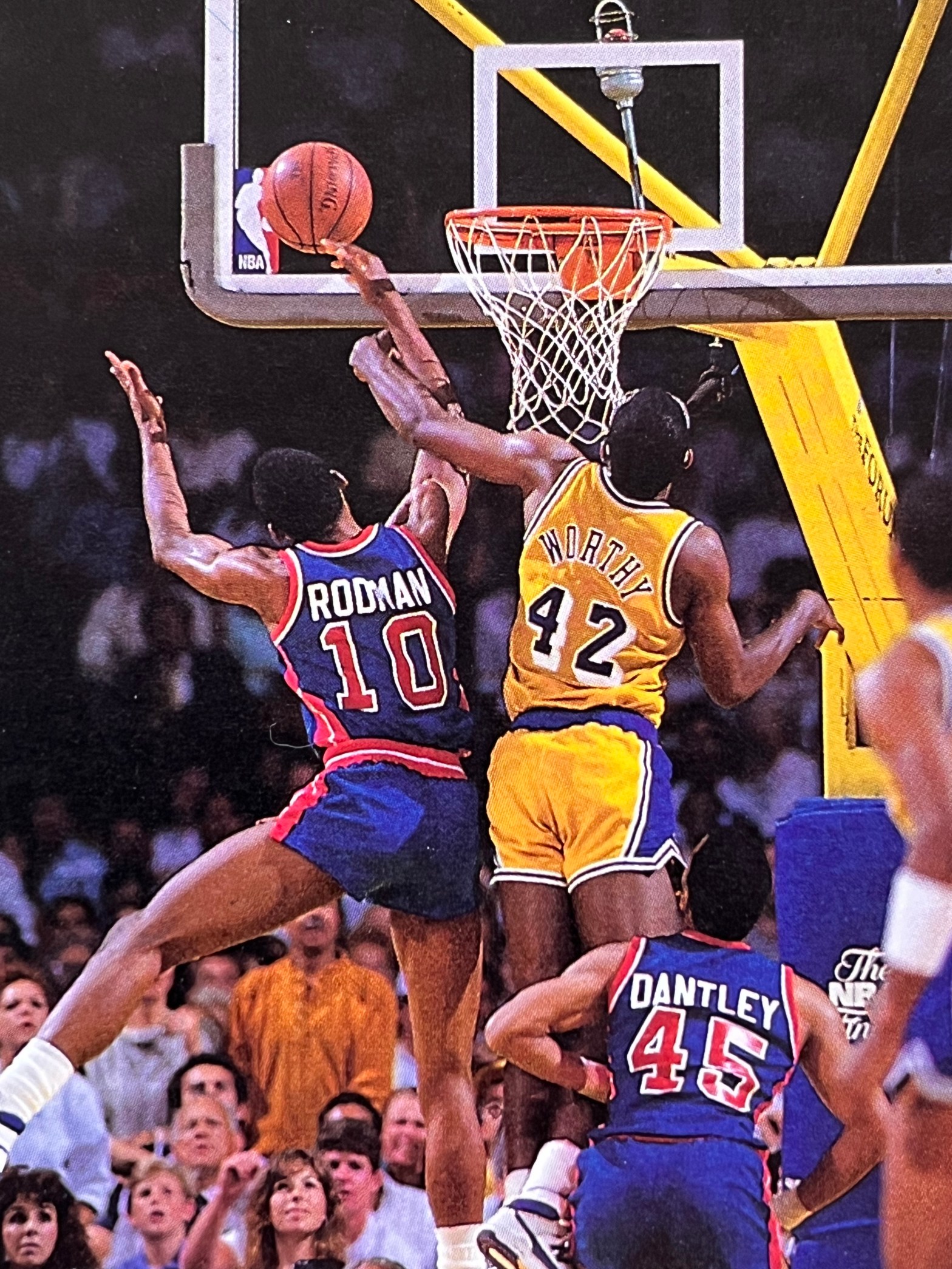
[James Worthy will release his autobiography next week, titled Becoming Worthy. For anyone who can’t wait until next week, here’s a brief article on Big Game James during his Laker days to tide you over. What’s unique about this article is Bill Needle, the late-great former Atlanta Hawks’ PR director-turned-Cleveland radio sports personality, wrote it for the January 1991 issue of Magic Magazine. Rarely do you find an official publication of another NBA team—the Orlando Magic—willing to sing the praises of a rival superstar. But Needle pulled it off, maybe because Worthy was just that respected around the NBA among players, coaches, and fans. Can’t wait to read or listen to his book! And never call him Jim!]
****
In Los Angeles, that land of fruits, nuts, no-look passes, Rambis Youth, skyhooks, Coop-a-loops, designer suits, slicked-back hair, and championships, you gotta have a gimmick, baby. You gotta have a gimmick.
And James Worthy has the best gimmick of all. He has no gimmicks.
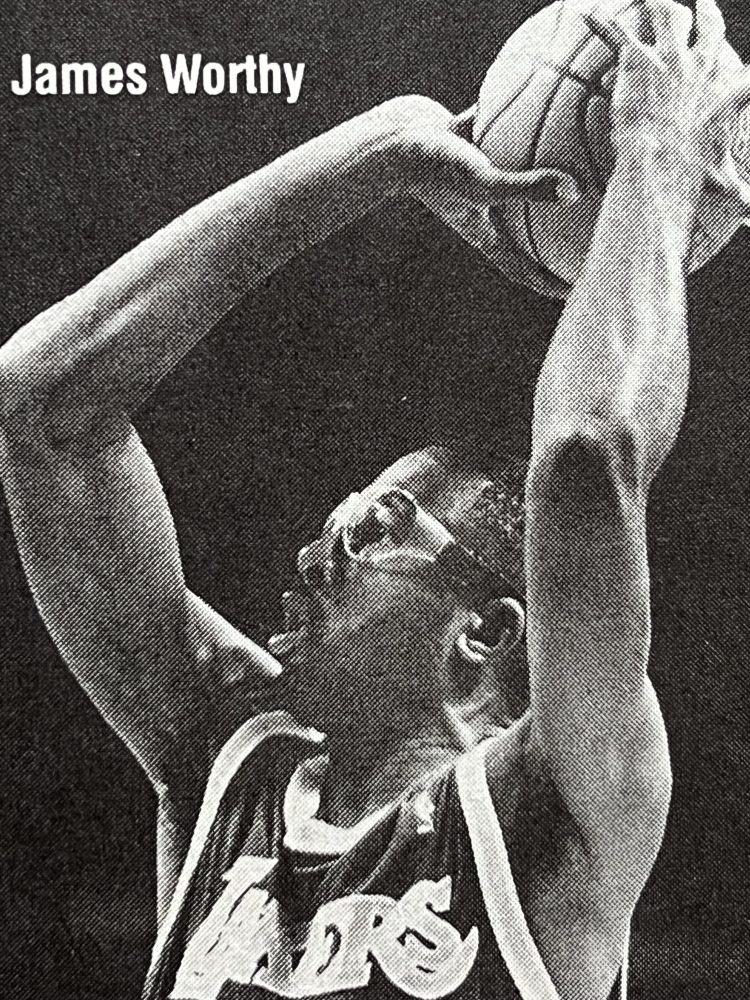
Since joining the Lakers in 1982 as the top overall pick in the NBA draft, Worthy has been an oasis of calm amidst one of the most furious media sandstorms of our generation. First there was Bird against Magic. Then Byron Scott supplanted Norm Nixon, and, of course, there was the Great Kareem Farewell. Pat Riley guaranteed a title, the Lakers won back-to-back league championships, and Earvin Johnson illuminated an entire league with his charisma and talent.
And through it all, like a silent-movie hero on L.A.’s silver screen of extravagant talking spectacles, there has been Worthy. Quiet and emotional, occasionally superhuman, always dangerous to opposing defenses, Worthy has contributed mightily—if less colorfully than others—to the Lakers’ domination of the NBA West.
Something as simple as his name gives an indication of Worthy’s lack of pretention and abundance of calm. While several of his more famous teammates received mail addressed simply: “Magic, L.A.” or “Kareem, The Lakers,” Worthy is James—just James—not Jim, not Jimmy, not the Carolina Cougar nor the Gastonia Gazelle. Just James.
“James always showed this great dignity and poise,” said Riley, the former Lakers coach. “I remember when he first came up, and we shook hands. I noticed his palms were sweating, but he had this calm, quiet look on his face. All he said was, ‘Just don’t call me Jim.’ Somehow his given name fit. You don’t need a nickname for a Worthy.”
Worthy’s selection by the Lakers didn’t please the glitter and pizzaz crowd in 1982. After all, a team led by candidates for the greatest point guard and greatest center in NBA history shouldn’t use the first pick in the draft on just anybody—especially when the explosive Dominique Wilkins, already called “The Human Highlight Film,” was available for the taking.
It wasn’t as though Worthy was an unknown coming out of college. At North Carolina, he teamed with current Lakers mate Sam Perkins and a freshman named Michael Jordan to lead the Tar Heels to the 1982 NCAA championship, earning Final Four MVP honors and scoring 28 points—on 13-for-17 from the field—in the title game.
But Wilkins seemed right for L.A.’s “Showtime,” while Worthy’s game—no matter how proficient—characterized him as some sort of sneaker-clad accountant. But Jerry West wanted Worthy, and, as West has proven so many times since, West is usually right when it comes to talent evaluation.
Worthy’s effect on the Lakers was immediate. He averaged more than 13 points as a rookie, shot almost 58 percent from the field, and was a unanimous selection to the All-Rookie team despite breaking his left leg before the playoffs.
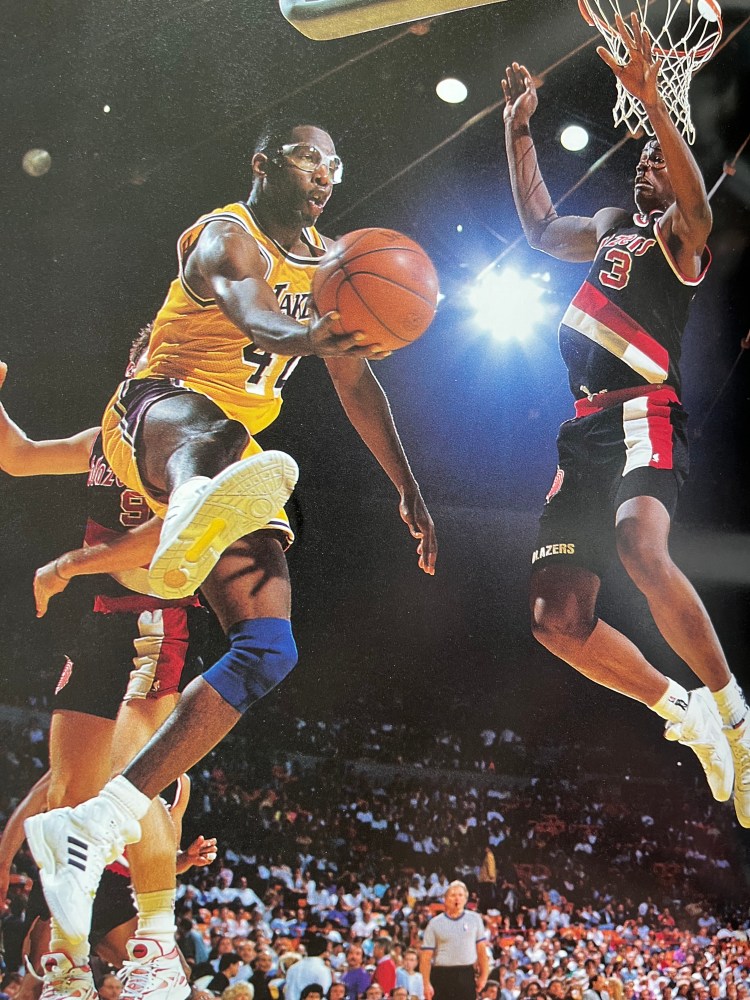
Over the past five seasons, Worthy has firmly—if unspectacularly—established himself as one of the NBA’s top forwards. He’s averaged over 20 points and shot an amazing 54.9 percent from the field, never less than 53 percent in any of the five years. And, oh yes, in that time the Lakers have won two NBA championships and three Western Conference titles.
“Worthy’s in the elite class,” said Philadelphia’s Rick Mahorn. “He’s a chore, a real nightmare. You wake up at night hearing, ‘Worthy, Worthy, Worthy.’”
“James is the best post-up player in the league,” Riley said. “The offense moves through James. Magic is the artillery, James is the ammunition.
“He cannot be handled one-on-one. He’s the best in the league with his back to the basket. He was our first option going to the basket, and when Magic is double-teamed, he sees it instantly and goes right for the glass. He has the quickest feet of any post player I’ve ever seen.”
But for all his relative anonymity, don’t get the idea Worthy is incapable of show-stopping performances. He has a history—both good and bad—of making big plays in big games. In the 1982 NCAA Championship, it was Worthy who caught an errant Georgetown pass to seal a 63-62 North Carolina victory.
In 1984, his own wayward pass was picked off by Gerald Henderson to give Boston an edge over the Lakers. And, most recently, his first career triple-double in Game Seven of the 1988 NBA Finals helped the Lakers become the first team to win back-to-back titles since 1969, a feat the Pistons have since equaled.
“I’ve just been in the right place at the right time,” Worthy said. “I’ve been the hero, and I’ve been the goat. I know what it feels like to make mistakes. But I don’t dwell on it. I never let myself get too worked up about stuff or too down.”
On the upside, the 1985 NBA championship remains Worthy’s biggest basketball thrill. “My first NBA championship was probably my biggest thrill, although the college one was big, too,” Worthy said. “I guess they’re similar, but there’s so much pressure when you play in the NBA.
“The fact that it was the Celtics, a seven-game series, and it was the first time the Lakers had beaten them in the Finals made it really intense. The pressure is really evident in the pros, and I think that’s what makes winning something like the NBA championship so enjoyable.”
Worthy has been Mr. Inside to Earvin Johnson’s Mr. Everywhere for almost a decade, and the joys of sharing the ball with perhaps the NBA’s greatest winner are not lost on the quiet, but articulate, Worthy.
“Earvin’s a great team player, and he’s a great leader on the floor. He can pretty much recognize the needs of the players around him, which is the sign of a true point guard. With Magic, it’s almost like having a sixth player out there. He knows everybody, he distributes the ball so well, and he knows what you like. Magic can read every situation and tell you when you’re in the game and when you’re not in the game, and he works with you.”
Vlade Divac, Byron Scott, and Mychal Thompson have come, and Kareem, Norm Nixon, Jamaal Wilkes, Riley, Michael Cooper, and Kurt Rambis have gone. Only Worthy and Magic remain from the dominant professional sports team of the 1980s.
“[Despite the changes] the Laker philosophy hasn’t really changed too much,” Worthy said. “We’ve pretty much built on the philosophy of the transition game. If there has been any change, it’s that we’ve become more versatile as a team.”
Don’t let James Worthy’s aura of calm fool you. He’s as fierce competitor as there is in the NBA, even if he’s far less demonstrative than his teammates. When Abdul-Jabbar retired after the 1989 playoffs, the Lakers silenced their critics by winning a league-high 63 games in 1989-90, with Worthy averaging a career-best 21.1 points.
This year, early-season questions about a new coach and a relatively slow start put the Lakers back under the microscope. And Worthy’s arrest in Houston on a charge of solicitation of prostitution in November has put him under even more scrutiny.
But Worthy’s quiet fire has helped keep the Lakers rolling. “What keeps us going is the competitiveness of the game and us asking ourselves, ‘Where do we go from here?’ We’ve tasted it before, and we like being in the Finals and winning it. I think that’s the main thing that drives us.”

