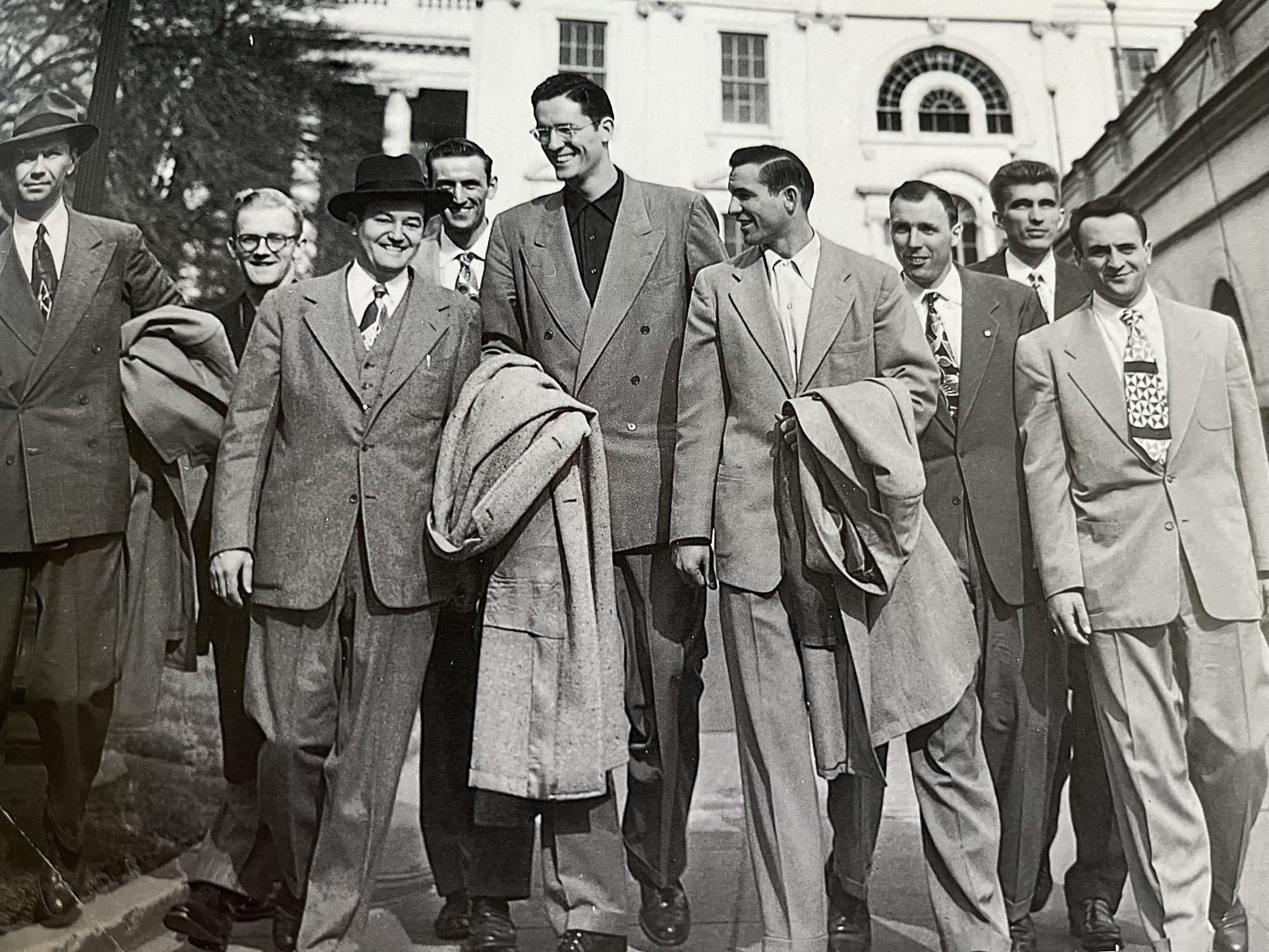
[Here’s yet another notable installment culled from Basketball Digest’s long-running series, “The Game I’ll Never Forget.” This specific remembrance, published in the Digest’s Summer 1997 issue, comes from the all-time great center George Mikan. No intro needed for Mikan, so I’ll move ahead, noting Big George chose two games, not one. He rambles a bit, but in a good way, especially the bit about Ma Collins. If you enjoy the vintage NBA, this post is definitely worth the brief read. All right, George, the blog is all yours. Go ahead and tell it like it was.]
****
When I started out, I was constantly fighting the battle to overcome the perception that I was too big. When I went to Notre Dame to try out, they thought I was too tall to play. In those days, there were a lot of short, fast guys, and they thought big guys were too slow to be effective. Ray Meyer of DePaul helped change all of that. He liked big guys. He thought of me kind of like a quarterback on a football team. It turned out he was prophetic, because nowadays everyone’s big. It made me feel good that Ray felt that way about me, though he had to do a lot of work to help my skills!
He wanted me to get some self-confidence and smoothness on the court, so what he’d do was hire these small girls from school to dance with me and teach me to be graceful! He had me run on the track team for endurance, and I skipped rope just like the boxers. I also boxed a little bit in college, too, which might have toughened me up for the pro games in the future.
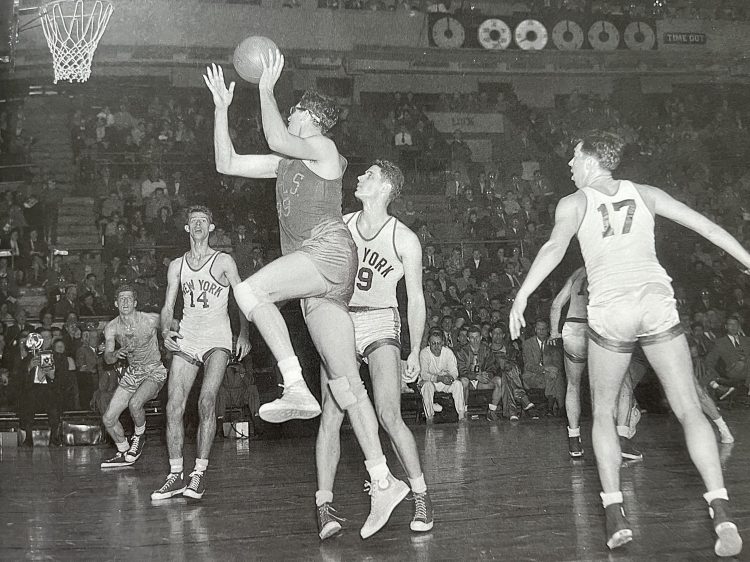
But mostly, Ray had me hit hook shots. A hundred off the right hand, a hundred off the left. My first year, I could only hit the right hook, so pretty soon teams that were scouting us would figure out that’s all I had, and they played against my right side. The next spring, Ray had me work on my left hook, and the funny thing was that, in time, that shot became more accurate.
College ball was fiercely competitive in those days—schools always wanted to beat GM and DePaul. And I wasn’t the only big guy to play the game in those days—we had some pretty big guys like Bob Kurland and Arnie Risen. Thanks to Ray, I had a little bit of ability.
One game, when we played Long Island University at Madison Square Garden, we were getting beaten badly at the half. We went into the locker room, and at MSG in those days, that happened to be the same room that the great boxer Joe Louis used. Ray was very upset with us, and above him in the ceiling were these two clothes hooks, and Ray reached up and ripped them right out. He started yelling at us, “You guys are desecrating this great man’s locker room with your performance,” and he threw the hooks on the floor with a big clang. He just chewed us up. We came out and whipped LIU in the second half. Sometimes you get lackadaisical out there on the court, but we were a lot more focused than ever after that.
The pro game in my day was a little different than it is now. Arenas were smaller, and the fans were on you from the get-go. As soon as we would show up, they would start booing. One of the toughest places to play was Fort Wayne’s North Side Gym. They had one entryway to the court, and the entire thing was surrounded by an eight-foot brick wall. That only gave me about a foot or two off each line. And when you came in, lo and behold, you’d see this one fan named Ma Collins. She had this handbag, and she whipped that thing like a bolo. She was very accurate, always hitting you in the head or face just as you came in. I learned to kind of make a roar at her, and when she jumped back, I could kind of scoot around her. Despite her handbag, the two of us actually became pretty good friends later on.
Two pro games really stand out in my career. The first was the Minneapolis Lakers’ first meeting with the Harlem Globetrotters in 1948. One of the biggest tournaments in the fledgling pro era was the Chicago Herald-American’s “World Tournament,” and in the last one, we met one of the great teams of that era, the Harlem Globetrotters. We were all kind of nervous before the game—none of us knew what to expect. This was before integration, of course, and we’d played the New York Rens the year before in the same tournament, [but] any time we played an all-Black team it was a major event. You couldn’t get a seat at the Chicago Stadium. Now, the Globetrotters, despite the “Harlem,” were actually from Chicago—they used to be called the Savoy Big Five—so they were well-known players. They had a lot of talent on that team: Goose Tatum, Marques Haynes, Sweetwater Clifton.
Against us, they played straight basketball—no comedy at all. They played real hard, and I and all the 22,000 other people there really respected them. That game was so exciting, especially the way it ended—Ermer Robinson got the ball just as the gun was going off and sank a two-pointer to win the game. But we got back at them over the next few years and won the rest of our games against them. I admired them—they were all very nice guys and very good athletes. They fought hard, and they won.
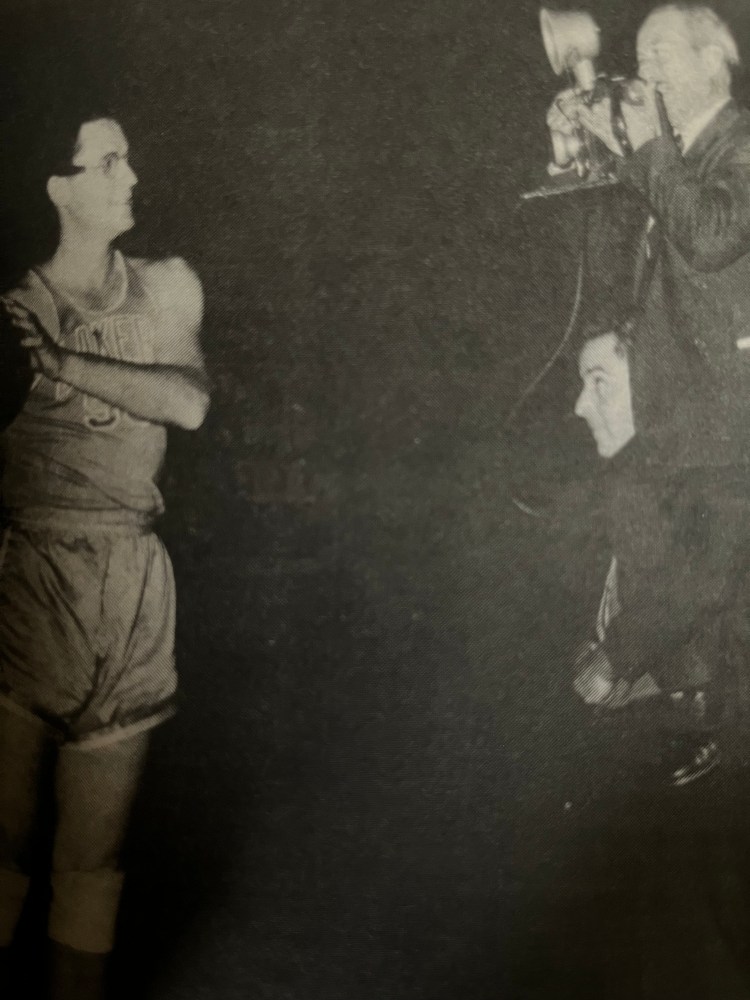
But the moment I’ll never forget came in the 1954 All-Star Game. We were losing by two with about two or three seconds left. My teammate Jim Pollard tossed me the ball, and as I wheeled around, Ray Felix fouled me real hard. So I was sent to the free-throw line with a chance to tie the game, and the ref, Sid Borgia, comes over and puts the ball in my chest and says, “Okay, big guy, all during your career you’ve been telling us how we blow shots. Now it’s your turn.”
Guys were lined up and down the lane, making frog noises and gulps at me, and Borgia’s staring at me, and lo and behold, I made these two shots to send the game into overtime. Then Bob Cousy decided to put on a dribbling exhibition, and the East ended up winning 98 to 93.
Today’s players are pretty different than we were. Now, the eighth, ninth, 10th man on the roster has to be a pretty proficient shooter. People ask me how I think Michael Jordan would have done against guys like us. I don’t know the answer to that, but I remind them that guys like that would also have to play against me. They’ve got a lot of big guys running up and down the court these days—guys my size.

