
[ABA great Darnell Hillman is remembered as “Dr. Dunk.” But during his 1971-72 rookie season with the Indiana Pacers, the 6-foot-9 Hillman was called “D,” “Dar,” and just plain “Rook.” But Hillman was more than just a “Rook” that season. In fact, in Hillman’s view, he played his most unforgettable game in his first year. The big performance came on March 12, 1972, a Sunday afternoon matinee against the Floridians at the State Fair Coliseum. The game also featured an appearance by pop singer Bobby Goldsboro, who belted out his hit song “California Wine.” But Hillman, a Northern Californian, was by the fourth quarter finer than any Mondavi cabernet sauvignon, earning a headline the next day in the Kokomo Tribune: “Darnell’s Derring-Do Wows Floridians.”
Hillman’s reflections on his most memorable game appeared in Basketball Digest, though for the first time I don’t have a citation. The text came in an old email that arrived sans citation.]
****
We were playing the Floridians in March of my rookie year with the Indiana Pacers when we had gotten into a little foul trouble. We were playing a little flat, so they sent some fresh legs into the game.
In I went to spell our center, Mel Daniels. The Floridians had a run-and-gun team with a lot of fast-breaking. They came down the court, this guy goes up for a shot, and I wipe it off the backboard, throwing it way, way out. Well, they came right back again, and I blocked a second one. The ball fell right underneath the basket. Somebody grabbed it and went fight back up with it and I got that one, blocking it and yelling out, “You only get three for a quarter, guys!”

So a timeout was called after the third blocked shot. I heard their coach [Bob Bass] telling the players on the Floridians: “Hey, he’s a rookie. You guys can’t get a rookie off the floor? He’s a damn rookie. Just go ahead and make him foul you and get him out of here.”
I had probably a little too much cockiness in me. Later on, after the timeout was over, I told the coach, “Coach, it’s not that easy. It’s not going to be that easy for them. You only get three for a quarter. They keep coming in here. See everything inside the paint, inside the key—it’s my house. You come into my house, you have to answer to me.”
I finished the game with 10 blocked shots. It’s still a team record, and it’s still the game I’ll never forget.
I enjoyed playing defense. My understanding of the game was that everyone has to produce. Sometimes, you have a role to play for a team to win. I felt one of the roles I would have to play was defense: Rebounding, blocking shots, and playing solid defense on some of the opponents’ leading scorers.
I didn’t necessarily need to have all the accolades of being recognized for how many points I scored in a game. If I had one or two great dunks in a game and could get my four or five blocked shots, with one being spectacular or close to that, then I was very happy.
George McGinnis and I were rookies on the team. The starting frontline was usually Roger Brown, Mel Daniels, and Bob Netolicky. That’s a total of five forwards who were at least very good and some of them were all-stars. Five of them! As a rookie, being surrounded by all that talent, I understood it to a point.
I was drafted my junior year out of San Jose State, and I had just come out of the Army. I did two years in the Army and played basketball for them. In two years, we played more than 300 games and only lost twice. So I understood what it was to win, and I understood what talent was.
But I didn’t understand the Pacers’ specific talents. I came in to see them play in the playoffs the season before. So I was introduced to the players and I got my first look at them. The Pacers had won their first championship the year before that, so when I came in, we were considered to be a very, very strong and talented team because of the addition of George and the return of Mel, Neto, and Roger. And then with the acquisition of myself to come in and pull down rebounds and play defense, it was just going to make us that much tougher.
I accepted the role of defensive guru. I wanted to rebound and support Mel on the boards. I was always into blocking shots. I was a high-jumper in college, jumping over the seven-foot mark. I took my high jumping skills and applied them to basketball. My jumping skills were a God-given talent, but you have to develop them. And that’s what I did.
When you go up, you know you have to come down. And going up that high sometimes surprises people; a few times I had my legs cut out from under me. Several times I fell and got hurt. One time I had fallen and broken a bone in my hip. I was in college at the time and I said, “Well, if I’m going to continue to jump like this, I need something to help me survive the falls.”
So I took a judo class. Judo teaches you how to fall. Judo teaches you how to attack the basket or attack the floor. Rather than waiting for the floor to come to you, you go to it. So I took the track and the judo and all those little things and applied them to basketball, and that’s what allowed me to excel and succeed.
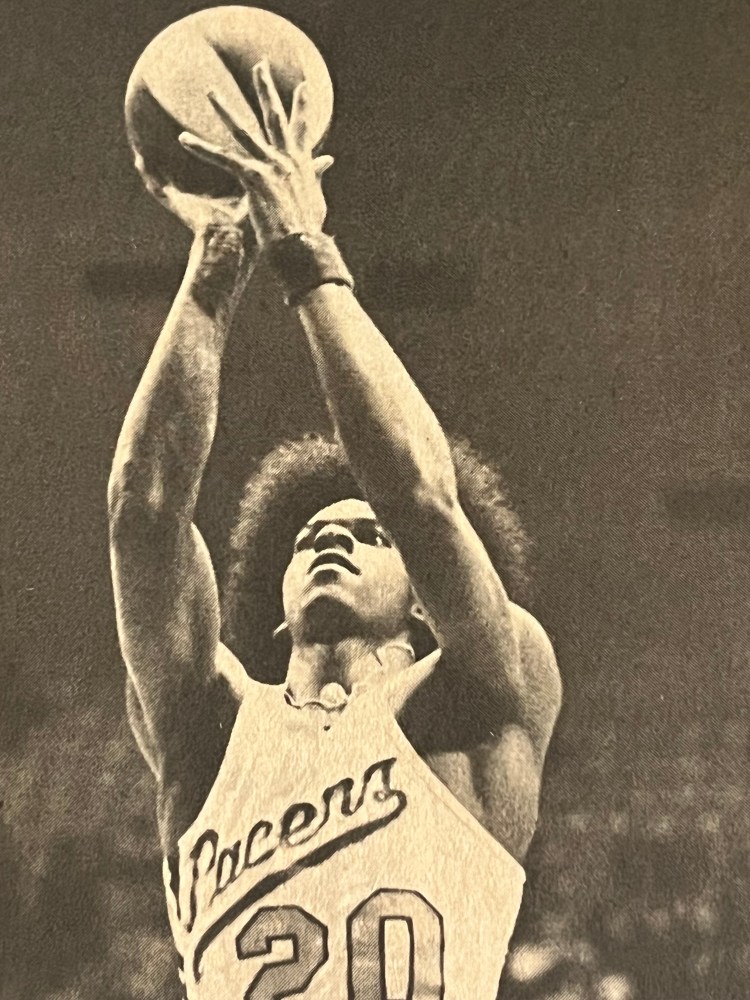
My first block that night I believe was on a guard. He was just coming down alone on a layup. I was standing there waiting for him. He had an open lane, but the first rule of basketball is you must stop the ball. So I stood at the foul line with the idea of, “Well, I have to make the guy in the middle with the ball a passer.” I selected the side I wanted him to pass to. So I cheated to the opposite side, giving him a very easy lane to make his pass to the side I wanted him to. Once he made the pass, I knew I could get in position to block the shot.
Well, this guy ran down, made his turn in, came in for a layup, and lofted it up over the square. I got up over the square and blocked it way back out. The Floridians retrieved that ball. We were still in transition, so they came right back in again, and that’s when I blocked the second shot. I can’t remember whether it was off a forward or a center, but I blocked it.
The Floridians retrieved the second blocked shot, too. There was some scrambling around, trying to get the loose ball. Someone grabbed it and went right back up, and I probably came out of nowhere from behind my teammates to block that shot. That’s when I told them, “You only get three for a quarter!”
When you block shots like that, it becomes a psychological weapon. You want opposing players thinking about it. You notice they change their normal shot. They’re looking over their shoulders, wondering, “Where is this guy going to come from next? Is he going to fall from the roof or what?”
[Here’s how the Indianapolis Star’s Dave Overpeck, one of the ABA’s best beat reporters, captured Hillman’s block party. His story ran in the newspaper on March 13, 1972.]
Darnell Hillman has the capacity to make himself stand out in a crowd—primarily because he can leap above it. The spring-legged rookie from San Jose State and the U.S. Army really stood out as the Indiana Pacers somehow or another whipped the Floridians,103-92, at the Coliseum. He had 10 points, which is not very many, and he fouled out, which you’re not supposed to do. But, in the words of acting coach Bobby Joe Hooper, “He turned the game around.”
Two other pertinent statistics more closely mirror Hillman’s part in Bobby Leonard’s 200th ABA coaching victory, albeit one that came in absentia since Slick stayed home to nurse a dandy case of tonsilitis. Hillman raked in 18 rebounds. That’s a pro career high for him. He also blocked 10 shots. That’s a pro career high for ANY Pacer—and probably for any ABA player.
On the probably invalid theory that all those blocked shots would have gone in, Hillman personally was the difference between an 11-point victory and a nine-point loss. The theory gets a little more validity when you consider Floridians coach Bob Bass’ question: “How many shots did he intimidate?” Answer: a bunch.
Hooper’s analysis that Hillman turned the game around comes from the second quarter and a stretch in the fourth. The Floridians could have blown the Pacers to kingdom come in the second quarter had it not been for Hillman. At times, he must have felt like the last Texan at the Alamo. The Pacers were missing and not getting back on defense in the second quarter. Time and again, Hillman found himself back defending the bucket against three and four Floridians.
He did a remarkable job. When he wasn’t blocking shots, he was intimidating would be drivers into longer shots than they wanted or passes that allowed the Indiana defense to make a belated recovery. By the fourth quarter, he was still blocking shots, but he was also rebounding furiously to get the Indiana fastbreak going . . .

