[This post started out as a tribute to Hall of Famer Don Nelson, who passed away last weekend at age 86. I have a fantastic Nelson profile stashed somewhere on my magazine shelf. But, as sometimes happens, I couldn’t locate it. In any case, here’s to Nellie and a life well lived!
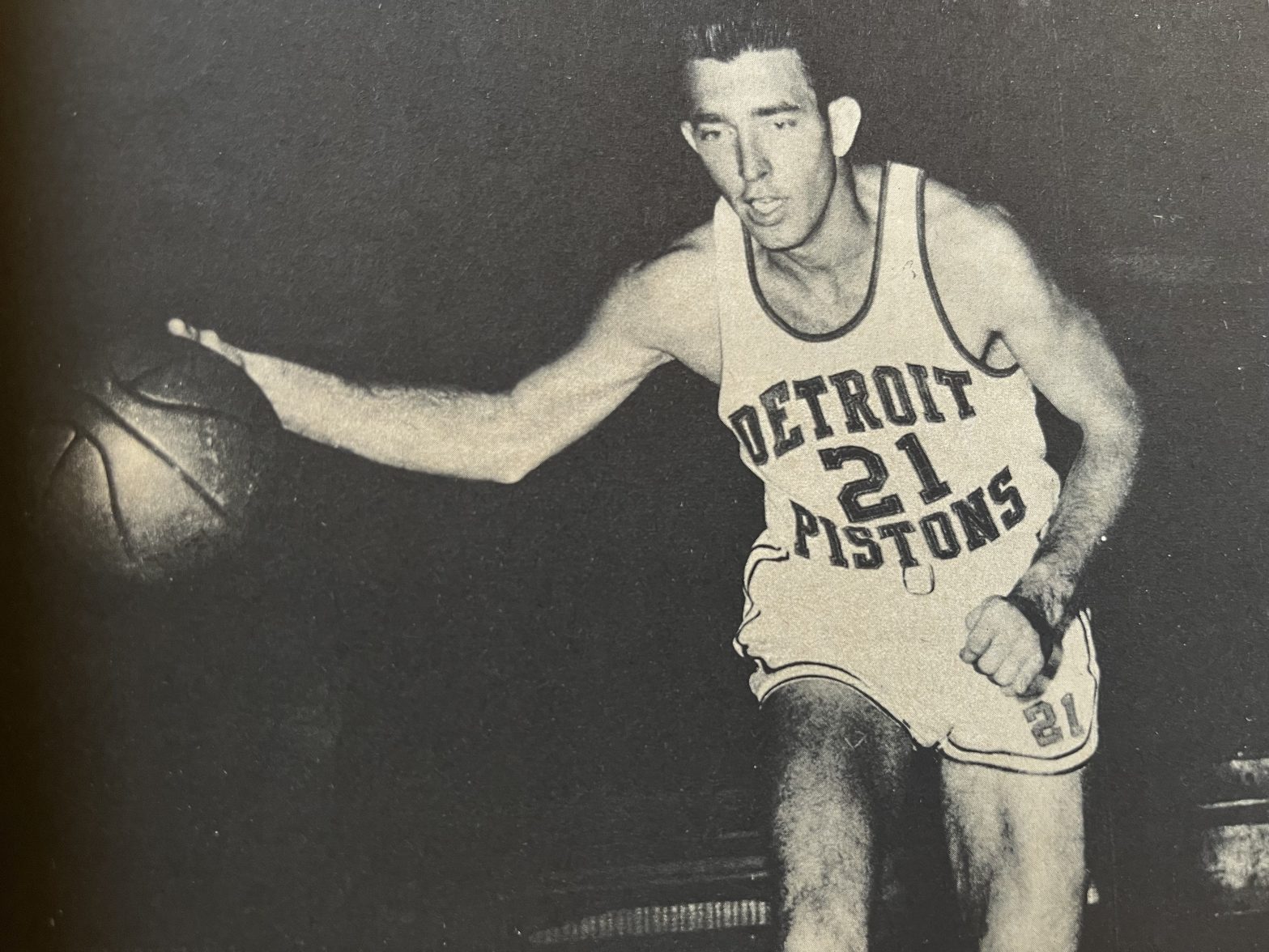
Instead, I located this nicely done profile of Gene Shue, who passed away in 2022. Shue is best remembered today as an NBA coach. The one who, in the mod early 1970s, sported an unhip flat-top haircut. Mostly forgotten is that Shue was one heck of a ballplayer a decade earlier. In fact, he was one of the NBA’s best backcourtmen, a point that’s still well worth remembering today by reading this profile of Gene Shue the Player. It ran, with no byline, in Complete 1960-61 Basketball Magazine, featuring a spry Wilt Chamberlain on the cover. In the meantime, I’ll keep looking for that fantastic Don Nelson profile.]
****
Ask any player in the National Basketball Association to name the best all-around player in the league’s 14-year history, and the answer unanimously will be “Bob Cousy.” Ask these same players to select the finest guard in the NBA today, and most of them will stop for a moment, weigh the merits of the various candidates, then pick Gene Shue of the Detroit Pistons.
There’s no disputing the claim of Cousy’s backers that, on an inch-for-inch and pound-for-pound basis, he ranks far above the field as the finest player in the NBA and perhaps in all of basketball history. “The Cooz” has tucked away enough laurels in his career to fill a freight train. But Cousy is 32, four years senior to Shue, and possibly on the decline after 10 fantastic years in the world’s toughest professional league. Basketball fans are hypnotized by Cousy’s flare for the dramatic; his sleight-of-hand tricks and behind-the-back dribbles and passes that spark the Celtics’ devastating fastbreak offense.
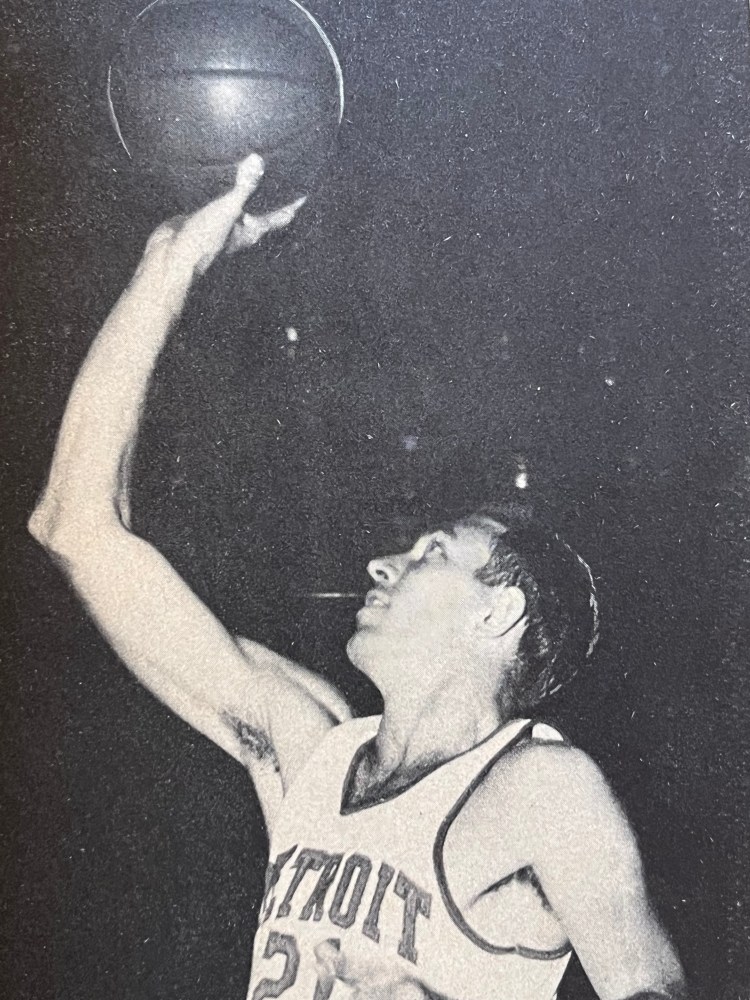
There is little of the spectacular in Shue’s makeup. Nor does he have the grace and agility of Philadelphia’s Tom Gola. He would finish behind speedsters such as Larry Costello and Hal Greer of the Syracuse Nats in a foot race. And he lacks the overwhelming power of the Knicks’ strongman Richie Guerin.
What, then, is there about Gene Shue to merit such high praise from those who know best? The answer is vary, though Cousy is one of Shue’s big admirers. “He is tough on defense,” says Bob, “because he won’t go for fakes. He slides through the picks and plays me tight.”
Arlen Bockthorn of the Cincinnati Royals goes along with that, but he sees Shue in still another light. “I’ve tried just about everything short of shooting him, but it’s impossible to stop his jumper.” Bockthorn, incidentally, stands 6-4, two inches taller than Shue, and outweighs him by 25 pounds at 195.
Detroit coach Dick McGuire, for the past three seasons a runningmate in the Pistons backcourt, comes up with this appraisal: “Gene has a great two-hand set shot to go with his jumper. That helps keep the defense honest. He’s a fine playmaker, but doesn’t get many assists because he’s been our shooter for two years. You’ll always find him near the ball on rebounds, yet he manages to pick up his man, defensively, right away if we don’t happen to get the ball.”
It’s easy to see Shue possesses, at least in part, all the qualities and abilities of men like Cousy, Gola, Costello, and Guerin. But it wasn’t until last spring that he finally emerged as a member of the NBA’s All-League squad. In spite of his All-League rating, Shue still retains the title of most underrated player in the NBA. Why?
“I’d say it’s because Gene makes everything look so easy,” declares George Yardley, who played with Shue for nearly three seasons before being traded to Syracuse in 1959. “I’ve seen him make almost impossible shots and treat them like it was an everyday occurrence.”
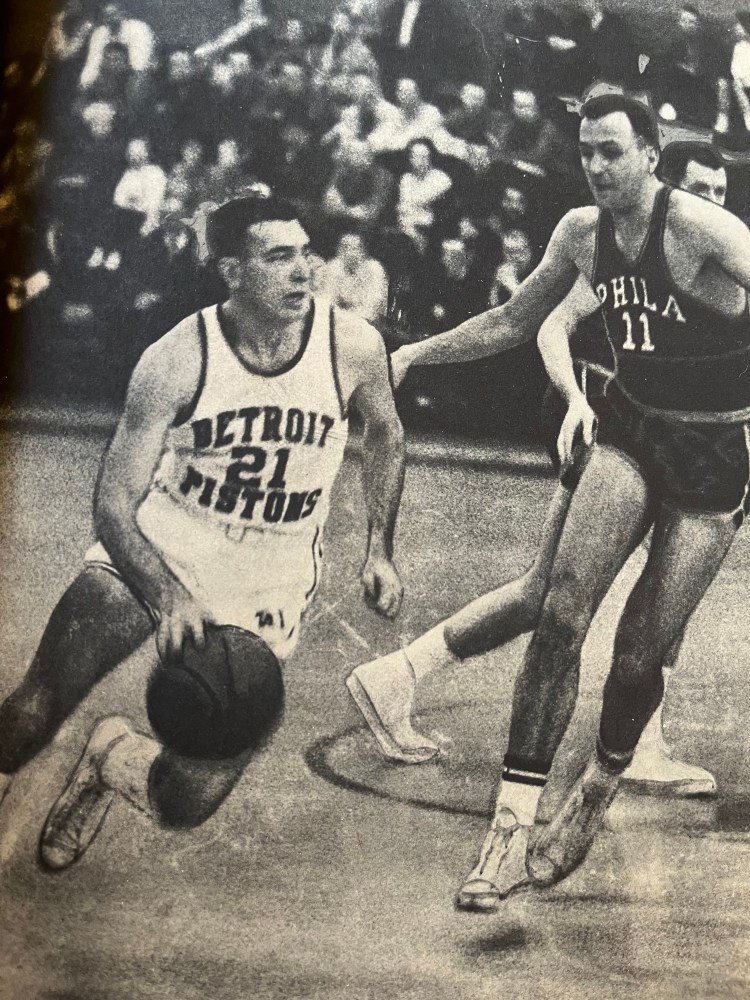
Like Bob Cousy, Shue has the uncanny knack of dribbling between and around opponents with a bewildering series of stop-and-go moves, often described as a “stutter dribble.” This maneuver generally will end in one of three ways . . . a quick jump shot, a sweeping hook, or a short pass to one of his cornermen. And it’s still done with seemingly little effort on Shue’s part.
This has been Shue’s trademark since those early days in Baltimore when he led Blessed Sacrament School’s junior team to the city’s CYO championship. “Little Mouse,” a nickname given to him by John Steadman, sports editor of the Baltimore News Post, a lifelong friend, and one-time coach, was all of 105 pounds and stood “not much taller than a baseball bat.” Noting that Bob Cousy had called Gene one of the game’s great defensive players, Steadman recalled: “Little Mouse could always do the job on defense without the slightest strain.”
At the tender age of 13, Gene’s size disrupted his immediate plans and, fortunately, catapulted him down the road to fame and fortune. “Gene had made up his mind to attend Mount St. Joseph’s,” relates Steadman, “but school officials thought he was too small for basketball. He went to Towson Catholic instead and became that school’s first All-Maryland selection.”
After high school graduation, Shue found once again he had to change his plans. “I wanted to go to Georgetown University, but wound up at Maryland instead,” Gene says. “I guess it all worked out for the best.”
After three great varsity seasons, veteran observers acclaimed Shue the finest in Terps’ cage history. With these accolades still ringing in his ears, Shue prepared in the summer of 1954 to carve his niche in professional ball with the Philadelphia Warriors, who drafted him several months earlier. “Don’t ask me about the next two seasons,” Gene says. “Anyone wanting to pin a nickname on me in those days could have called me “Splinters” and been 100 percent correct.”
Gene and Warriors owner Eddie Gottlieb were unable to come to terms on a contract, making Shue a holdout. “I missed training camp, then played about 10 games with Philly. They didn’t think I could fit into their plans, so I was sold to New York,” he recalls.
“I thought I was going to do fine with the Knicks. Joe Lapchick, who was coaching the Knicks, liked me, and I got to see quite a bit of action, considering I was playing behind Dick McGuire and Carl Braun. It was the same at the start of the next season, too. But Lapchick left the Knicks in February, and Vince Boryla took over. I wound up on the bench most of the time in the last 25 games.”
By this time, Shue was ready to give up. A better-than-average golfer who had played for both his high school and college teams, Gene took an offseason job as assistant pro for a small course at Gibson Island, near Baltimore, in the summer of 1956. His game, however, deteriorated almost at once.
“I got worse instead of better and figured that if I couldn’t teach myself golf, what was the sense of trying to teach others,” Gene says. “I wanted to continue in sports, but it looked like the end for me as far as basketball and golf were concerned.”
Twice before Dame Fate had stepped in to help Gene, and once again, she was waiting in the wings. This time, she appeared as a telephone call. The caller identified himself simply as “Charley,” but Shue recognized the voice immediately. “Once you’ve heard Charley Eckman speak, you know there’s no one else who can talk like that,” says Shue.
Eckman, a one-time NBA referee who amazed the basketball world by becoming owner Fred Zollner’s coach at Fort Wayne, asked Gene if he’d like to play for the Pistons. “I don’t exactly recall the conversation,” he declares, “but I do know that I couldn’t say ‘yes’ fast enough.” The trade became official when the Pistons gave up their No. 1 draft choice Ron Sobie to New York for the bandy-legged benchwarmer.
“I’ll always be indebted to Charley for giving me the chance to prove myself in the NBA,” he says. Eckman, known for his short modesty and long cigars, shrugs off Shue’s plaudits, however.
“I followed that kid all the way through grade school, high school, college,” he states. “We grew up in basketball together. But I was the referee, and he was the player. They say you can’t tell too much about the player’s ability when you referee because you’ve got to watch for too many things. But I knew that kid was good, even without looking too hard.”
This early association paid off handsome dividends for the Pistons. A 4.2 average scorer in his first season as a pro and a 6.2 contributor in 1955-56 with the Knicks, Gene’s average rose to 10.9 in his first campaign with the Pistons.
It wasn’t until the Pistons transferred from Fort Wayne to Detroit that Shue really started up the stairway to stardom. George Yardley, whose 2,001 points for the Pistons in 1957-58 cracked one of basketball’s greatest barriers, summed it up this way: “Like most teams in the league, the Pistons offense was geared around the big man, in our case Larry Foust. But Larry was traded to the Lakers before we got to Detroit, and I guess it was up to Gene and me to handle the scoring.”
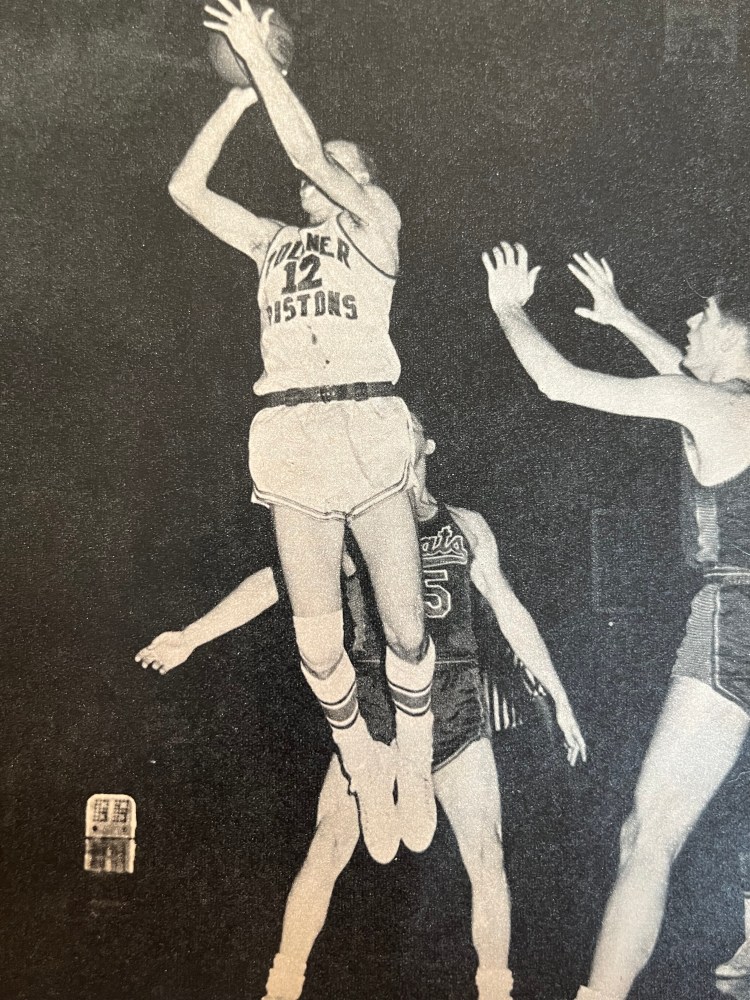
Shue suffered an early season ankle injury that sidelined him for seven straight games, and he lost two other games to a battle with the flu. In spite of this, he finished with a strong 15.6 scoring average, second only to Yardley on the team. While he was out of the lineup, the Pistons dropped five of seven games. A week later, Eckman was out as coach, and Red Rocha was called away from a selling job in Syracuse to accept his first coaching assignment.
Shue then became heir-apparent to the job as Number One scorer for the Pistons on November 9, 1958. Scene: Detroit’s Olympia Stadium. Opponent: Boston Celtics. Theme: “Game of the Week” over NBC-TV network.
The game began as a typical Celtics-Pistons meeting with Boston taking a fast 19-11 lead in the first four minutes. Then the roof fell in on the Celts as Yardley and Shue paced a surge that sent the Pistons to a 37-24 advantage at quarter’s end. Shue’s contribution was 10 points for 12 minutes.
In the second quarter, Shue sank seven of 11 field-goal tries and a pair of free throws, and at halftime, the Pistons had an unbelievable 79-57 lead. Late in the third period, with Boston threatening, Shue sank eight straight points, half of them on free throws, and it was 109-92 entering the final stanza.
Midway in the fourth quarter, Shue had pumped in another 10 points for his game total of 45, and Celtics coach Red Auerbach called timeout with his club trailing 126-105. “I knew what Auerbach had in mind,” said Red Rocha after the game. “Unless he stopped Shue, Boston was going to lose, and Auerbach hates to lost any time, but especially on TV.
“We knew that Gene was close to several records, but beating Boston before the home fans was more important. So we changed strategy, started faking the ball to Shue, and fed the ball to our cornerman.”
The new plan almost backfired. With Bill Sharman and Ben Swain hitting brilliantly, Boston crept to within five points with three minutes remaining. Two baskets by forward Earl Lloyd and six consecutive markers by Yardley in the final 90 seconds held off the rallying Celtics to cap one of the most exciting televised basketball games in history.
Shue went on to register a most successful season, collecting 1,265 points for a 17.6 average in 72 regular-season games and a 27.7 mark in three playoff contests against the Minneapolis Lakers. Included among his achievements was that of being named as a starter for the West in the annual East-West all-star game at Detroit.
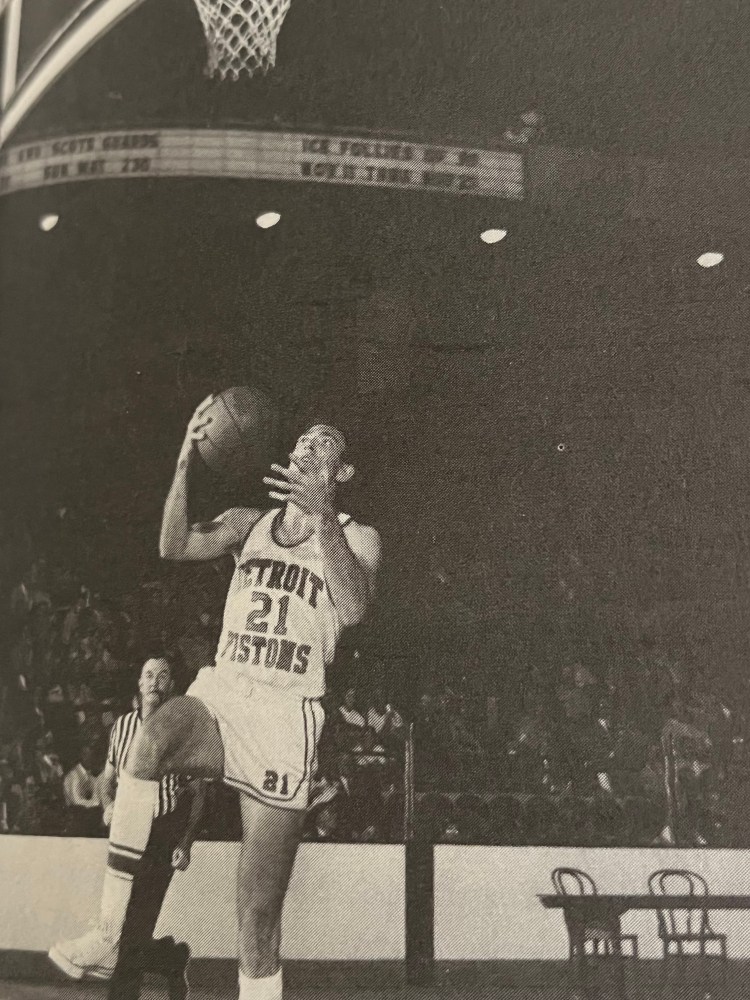
With Yardley traded and the club still lacking the big-strong pivotman and rookie forward Bailey Howell needing experience to blossom into a standout, the scoring burden fell on Shue’s slender shoulders again in 1959-60. He responded by setting three new NBA records: most minutes played (3,338) for which he tied rookie sensation Wilt Chamberlain; most total points for a guard (1,712); and best season average for a guard (22.8). His .872 free-throw average ranked second to veteran Dolph Schayes of Syracuse. Only Tom Gola (779) and Richie Guerin (505), among the league’s regular backcourtmen, outrebounded “Little Mouse” who snared 409.
Shue possesses a keen knowledge of the sport as it is played in the NBA. “To win in this league,” he said recently, “a team has to have the big men upfront who can go get the ball and then score once they have it. It’s up to little guys like myself to set the play and shoot often enough to keep the defense honest.”
Perhaps it’s this unselfish attitude, more than anything else, that has marked Gene Shue as the most underrated player in the NBA today.


Thanks for posting this! Old enough to remember him coaching the Bullets.
LikeLike