[College basketball’s senior class of 1970 featured three highly-touted All-American guards: Purdue’s Rick Mount, Niagara’s Calvin Murphy, and LSU’s Pete Maravich. All were considered must-see college stars but highly debatable pro prospects. For Maravich, the critics said he was too flashy and too scrawny. For Murphy, he was considered too small at 5-foot-9.
For Mount, the pre-draft conversation meandered in several directions, good and bad. But Mount’s pro prospects seemed to take a promising turn in March 1970 when he signed with the ABA Indiana Pacers. Mount seem destined to be the face of the Pacers in seasons to come, since he ranked as one of the Hoosier State’s favorite basketball folk heroes. Mount also seemed to be a perfect fit for the ABA. He was the college game’s premier long-range bomber in 1970 and presumably would emerge quickly as a master of the ABA’s three-point shot.
Presumably it turned out to be. Mount never hit it off with head coach Bob Leonard and struggled through a lackluster rookie season. Some blamed Mount’s rookie woes on an unfair lack of opportunity, while others believed Leonard was correct. Mount’s game had its flaws in the pros. What were they? Here’s a Leonard-tinged capsule description of Mount that I found in a 1970-71 basketball magazine:
The Golden Boy of college basketball last year . . . Consensus All-America . . . Chosen in the early draft and signed before NBA made its choices . . . Reported $300,000 contract . . . Shooter par excellence . . . Was among top three scorers in nation his junior and senior year . . . Faces scrutiny by tough Indianapolis fans because of reported deficiencies . . . “We don’t know if he can play defense,” Leonard deadpans . . . Primarily an offensive player, spent college years in zone defense and will find it difficult making adjustment to the pros’ man-to-man . . . Also questioned is his stamina and quickness . . . No one questions his shooting ability . . . Consistent from 25 feet, which is worth three points in ABA.
In the article that follows, Mount seems to have gotten his pro career back on track for the start of his sophomore season with the Pacers. Dennis Weintraub, a reporter for the Long Island-based newspaper Newsday, tells the story for Sports Review’s special basketball magazine edition, published in March 1972. By then, Leonard had soured again on Mount, nicknamed “The Rocket,” and we’ll get to that further down. But first, here’s a taste of Mount’s finest moments in a Pacers uniform to start the 1971-72 season.]
****
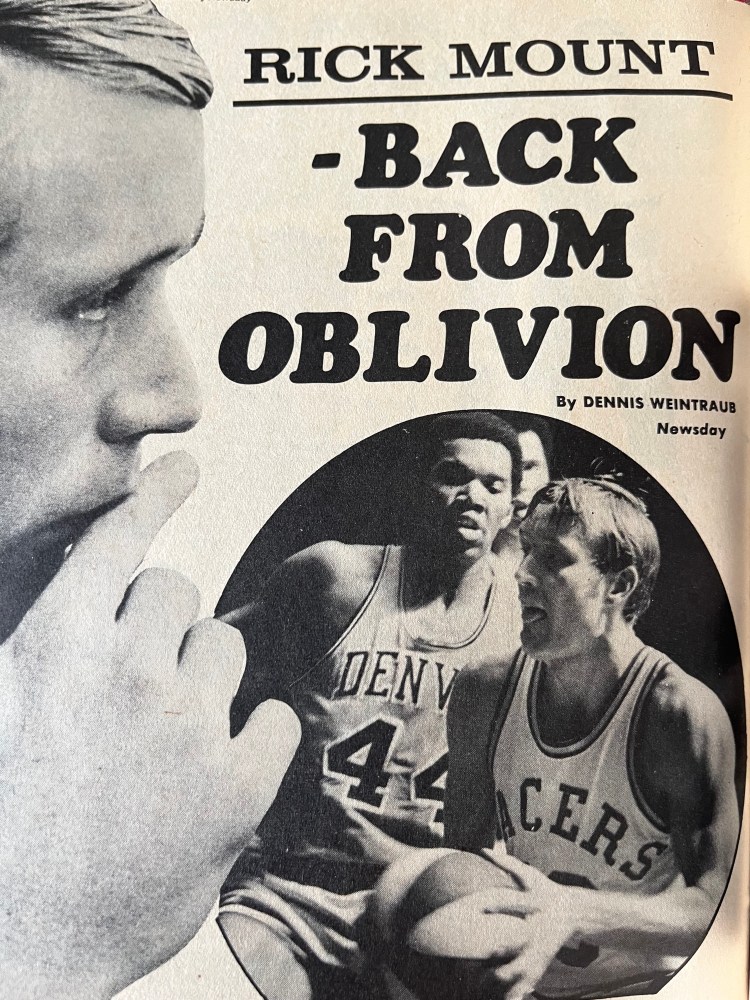
Since he was 13, says his mother Katie, Rick Mount wanted to play professional basketball. As he approached his goal, first becoming a high school folk hero in Lebanon, Indiana, then an All-American at Purdue, nearly every little boy in hoop-crazy Indiana wanted to become like Rick Mount. Rick was “Mr. Basketball” in the Hoosier state, the stuff dreams are made of.
Imagine the thrills of the little boys who would rebound for young Mr. Mount at Lebanon Memorial Park, near his home. Rick would fire a long jumpers by the hundreds and thousands, in summer and winter, rain and snow, day and even night because the courts had lights. “I’d get one of the little kids and promise to buy him an ice cream cone if he’d rebound for me,” Mount says.
It came to pass that soon there were very few rebounds. Rick Mount became such a good shooter that he rarely missed, rifling the nets accurately from as far as 30 feet. As a freshman at Lebanon High, he averaged 20 points a game. Once, in a state tournament with Lebanon trailing by five points, he brought the ball upcourt seven straight times and hit seven straight baskets.
His reputation spread. By his senior year, Sports Illustrated made him the first prep athlete ever to grace its cover. He meant so much to Lebanon that the town trusted him with the keys to the high school gym. After he went off to Purdue, his hometown made sure he would always be remembered by erecting a billboard by its entrance on US 52. A motorist is met by a red, yellow, blue, and green sign that reads: “Lebanon, Home of Rick Mount, Mr. Basketball ’66.”
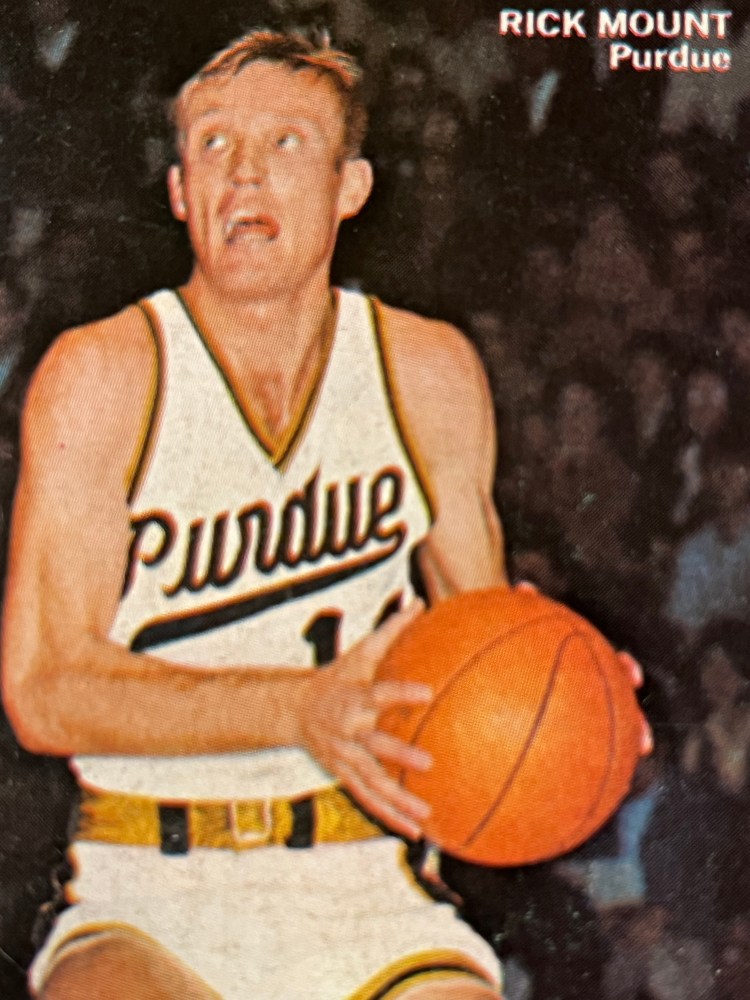
The fanfare and adulation followed him to Purdue. In his varsity debut, he played against Lew Alcindor and national champion UCLA with a bad foot. He scored 28 points, and Purdue came from 12 points behind to just miss pulling a big upset. The Boilermakers lost, 73-71, but Mount’s college career was all uphill from there.
There are nights like December 29, 1969. Mount finally arrives at Madison Square Garden. A crowd of 14,333 comes out to see him play against Pennsylvania in a Holiday Festival game. Mount is hurting again. He has missed the last four games with a damaged right knee; his left leg has also developed a cramp. He scored nine points in the first half on 3-for-9 shooting, but Purdue is down by 11.
The New York fans appreciate good basketball, but they get tough when the going gets rough. They start to get on Mount. “Go back to Purdue, you bum!” is a choice goodie. The 6-4 blond responds to the catcalls after intermission. He guns home 9-of-14 from the field, 10 of 10 from the foul line for 28 second-half points. Purdue wins by three. The crowd roars in approval. Afterwards, Mount says of the fickle crowd, “It doesn’t bother me. It makes me play better. And then, if you can win them over to your side, it’s fun.”
But booing and catcalls are not among Mount’s problems in Indiana. He doesn’t have to win the fans—he has them. He is the favorite son, the fair-complexioned, fair-tempered, small-town hero who is either hunting or fishing (he owns seven guns, 10 fishing poles, and a boat) or playing with his son Richard (now two years old) when he isn’t shooting a basketball. And at Purdue, Rick did plenty of shooting. A college career average of 32.3 points a game, a record 1,461 points in Big Ten competition, and 2,323 overall points was more than enough to satisfy the most-demanding fans.
And so it was no wonder that when it finally came time for the big moment, time for Rick Mount to sign his long coveted pro contract, an Indianapolis television station arranged to transmit it live to basketball-hungry fans around the state.
When Mount inks a three-year Indiana Pacers pact, believed to call for between $500,000 and $750,000, depending upon which newspaper you read, the Pacers and the American Basketball Association compare it to the shot heard around the pro basketball world, saying it will have strong reverberations in their bidding war with the NBA. Jack Dolph, the ABA commissioner, remarks, “With every star we sign, merger will be that much closer.”
It is taken for granted that Rick Mount is a star, that his time with the Pacers will be a continuation of his successes at Lebanon and Purdue. But this is professional basketball, and like others before him, Mount will find out—the hard way—how different it is.
Before the newest phase of his life even begins, Mount pulls a hamstring in his right leg while going up for a shot in rookie camp. “I was hurt the first six weeks of the season and never did get into top shape,” Mount said last year. “I would go for two or three minutes and get winded.”
The shortness of breath affected his shooting, by far his greatest asset. There were three experienced guards—Fred Lewis, Warren Armstrong, and Bill Keller—ahead of him. Coach Leonard said, “His ballhandling is a big problem.” Mount suddenly appeared too slow to get off his jumper in the pros, and he also seemed not to be physical enough (he only weighs 175) to defense quicker, stronger backcourt foes.
The folklore image started to tarnish. Like many ordinary rookies before him, Rick Mount started to fight himself. On the Pacers bench, he took the seat furthest from Coach Leonard and often looked at the floor. Leonard listened to the faithful fans call for Mount. But when he was inserted, which wasn’t often, Rick shot poorly and lost his man on defense. Leonard, shaking his head, removed him.
“There were times I felt like quitting,” Mount says. “Sitting on the bench was real misery for me. It was hard to take. I thought of going to the coach, but I never did.”
Other players in the league watched the plot unfold and seemed to understand the rookie’s torment. “I think he’s still nervous,” said Bill Paultz of the Nets. “He has the rookie jitters. I tried to stare at him like Sonny Liston and bump him on the court to psychologically upset him. He doesn’t talk. I guess it worked. He was expected to come in and start automatically, so I guess it has done something to his morale.”
Jim Ard of the Nets, who himself received a sizable rookie bonus, commented, “I feel sorry for him. I guess I do. But he’s good, he’s great. He’ll be the next big threat out of Indiana.”
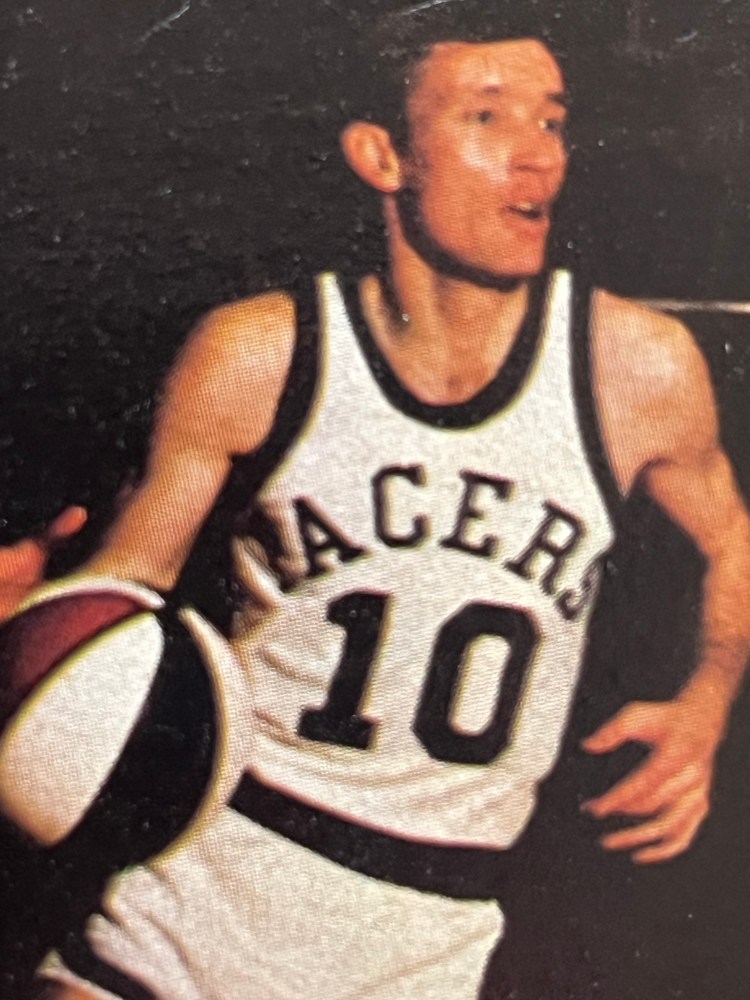
But the talk was that if Mount was not on a no-cut contract, he might have been placed on waivers. Things kept getting progressively worse. Opposing players mocked him, and the unspeakable happened. His biggest allies, the Indiana fans, started to get on him.
They started to remind him about how much money he was receiving and how little he was doing to earn it. “The fans had a lot of nasty things to say,” Mount remembers. “A lot of different stuff.” It got so bad that Mount’s wife stopped attending the home games. “I went to only a few games . . . he didn’t want me to,” remarked Donna Mount.
Finally, just like all good things must come to an end, all bad things do also—even if it happens a little slower. Mount finished his rookie season with 437 points (considerably fewer than he used to get in a much shorter college season) and added 60 in 10 playoff games. His playing time averaged out to just under 13 minutes a game. It appeared that a legend, which had taken a decade to build, had been wiped out in a year. It appeared that Rick Mount was washed up at the ripe old age of 24.
But Rick Mount had met and defeated challenges before. His childhood was marred by bouts of strep throat, earaches, a hernia operation, blood poisoning, and whooping cough. He had missed school, collapsing on the basketball floor. In college, he was plagued by leg injuries. Once, after breaking a bone in his right foot, he played nine games with a stainless-steel pin in his basketball shoe to hold the foot rigid. “He couldn’t bend or flex the foot and couldn’t move laterally at all,” said Purdue coach George King. But he played. And he played well.
And always Rick Mount tried to build up a reluctant body by working out with weights and barbells. After the frustrating experience of last year, he intensified his efforts. He started practicing his shooting again like he did when he was back in grade school. He began to run more.
When training camp opened this year, he was ready. There would be no excuses if he didn’t cut it this time around.
He almost didn’t get a second chance. Indiana tried to trade him during the offseason. The man who wanted Mount was Mike Storen, who signed him to the Indiana contract and since moved on to become president and general manager of the Kentucky Colonels. “I heard that the Pacers were thinking of unloading Mount, and I told them that since I was responsible for signing him, it would only be just that I assume the mistake.” Storen says.
Because Storen is considered a keen judge of talent, the Pacers reconsidered and decided to keep Mount. Much to Mount’s relief also, it must be added. “I really didn’t want to get traded. If I was going to make it, I wanted to make it at home,” Mount says. “This is what I want. Playing in Indiana is the big thing.”
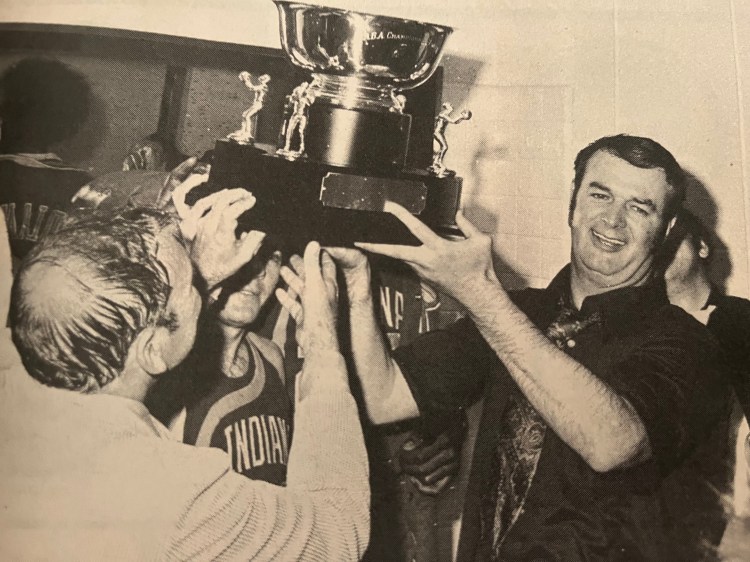
With Armstrong traded (to the Floridians) and Keller hurting, Mount finally got the chance. “I always have confidence in myself,” he added. “I know what I can do. I’m mentally ready. I got down last year, but I knew I can play.”
And now, Rick Mount was starting to show all those Indiana people all over again that he can indeed play the game of basketball. In exhibition games against Baltimore and New York of the NBA, Mount more than held his own while playing head-to-head against Walt Frazier of the Knicks and Earl Monroe, then of the Bullets. Mount had 16 points in 24 minutes against the Knicks, while not once losing the ball at all to the inimitable ball-stealing Frazier. Against Baltimore, Mount popped in 13 points in 30 minutes.
A surprised Bullet, Jack Marin, remembered that game. “Mount showed me more defense than I’d heard he played, and I know the guy is a great shot.” Frazier of the Knicks added this note of optimism: “I think Rick ought to be more physical on defense—bumping more (Frazier had only 15 points in 33 minutes)—but other than that, he looked just fine to me.”
Mount was beginning to look just fine again to the people of Indiana. That warm seat on the bench had been replaced by a spot in the starting lineup when the ABA regular-season started. Instead of being manhandled by opposing guards, he was starting to rock-and-sock back now.
“I’m in the best shape I’ve ever been in,” Mount says. “I’ve learned how to play good position [defense], how to stay close, bump, and use my hands a lot more. I play guys tighter. Last year, they tried to take me inside, but this year they won’t.”
And on offense, the touch started to reappear, the ballhandling improved. Mount started slowly to resemble The Rocket who shot 30-foot running bank shots, corner jumpers falling out of bounds, and any other shot that has ever been concocted.
“I feel like now, every time I go up for a shot, I’m going to hit it,” Mount says. “My confidence is back, and that makes all the difference in the world. I never doubted that I could play in the pros. Last year, I’d come into a game, and my teammates didn’t have much confidence in me. Now they do, and it helps.”
Rick Mount earned the confidence. By the 26th game of this year, he had already passed last year’s season total of 437 points. He was averaging 33 minutes of playing time each game, 17.5 points, and hitting almost 50 percent from the field. He was second in the ABA in three-point shooting, fourth in free-throw percentage, and 10th in assists.
“Rick isn’t bigger, but he’s physically stronger,” says teammate Roger Brown. Another teammate, center Mel Daniels, who always thought Mount would make a good pro when given the chance, added, “I think it’s marvelous the way Rick is playing. He took all that guff last year, and now he’s making all those people eat their words. I have all the confidence in the world in him. And I love to pass it to him, because I know it’s going in the hole when he shoots.”
So Rick Mount has come back, and the dreams of little boys in Indiana are alive again. Now, instead of riding him when he misses a shot, the fans yell, “Hit the next one.” Donna Mount says, “This year, I go to almost all of the home games.” Playing basketball in Indiana is a pleasant experience for Mount again. “I’m more relaxed,” he says.
How far will he progress from here is still open to question. Despite the tremendous improvement, there is considerable doubt that he will ever again become the dominating force he was in high school and college. “He’s a good, solid, very adequate, or even better than that professional,” remarks Coach Leonard, who was a fairly good NBA guard in his own playing days. “He has good hands, he can fight through traffic for his shots, he is adequate defensively, and he can shoot a super game.
“But he doesn’t have the stamina to play more than 35 minutes a game, and he doesn’t have the speed and quickness to become a super player. I don’t believe he’ll ever be a (Jerry) West or something like that. If he became a step quicker, he could improve his game 30 percent.”
Rick Barry, who knows something about being a superstar, is in basic agreement with Leonard. “I don’t think his overall game makes him that kind of player (a superstar),” says the other Rick.
But it is not fair for the story to end on an unpredictable matter of someone becoming a superstar, whatever that is anyway. Rick Mount has returned a long way, and that is the important thing. He is still as cooperative as ever, and now reporters from New York, Pittsburgh, Florida, and Virginia are asking him, “How come things are better?” instead of “What’s the matter?”
Earlier this year, Mount hit a 55-foot buzzer jump shot against the archrival Kentucky Colonels. Darel Carrier, the Kentucky guard, whispered to him, “Hey Rick, I guess I’m gonna have to start picking you up out of bounds.” Carrier was joking, but he was nevertheless talking with a newfound admiration.
“Last season was one I’d rather forget,” admits Rick. “This year, I think everyone respects my ability. I’m glad I stuck it out. It’s definitely worth it now.”
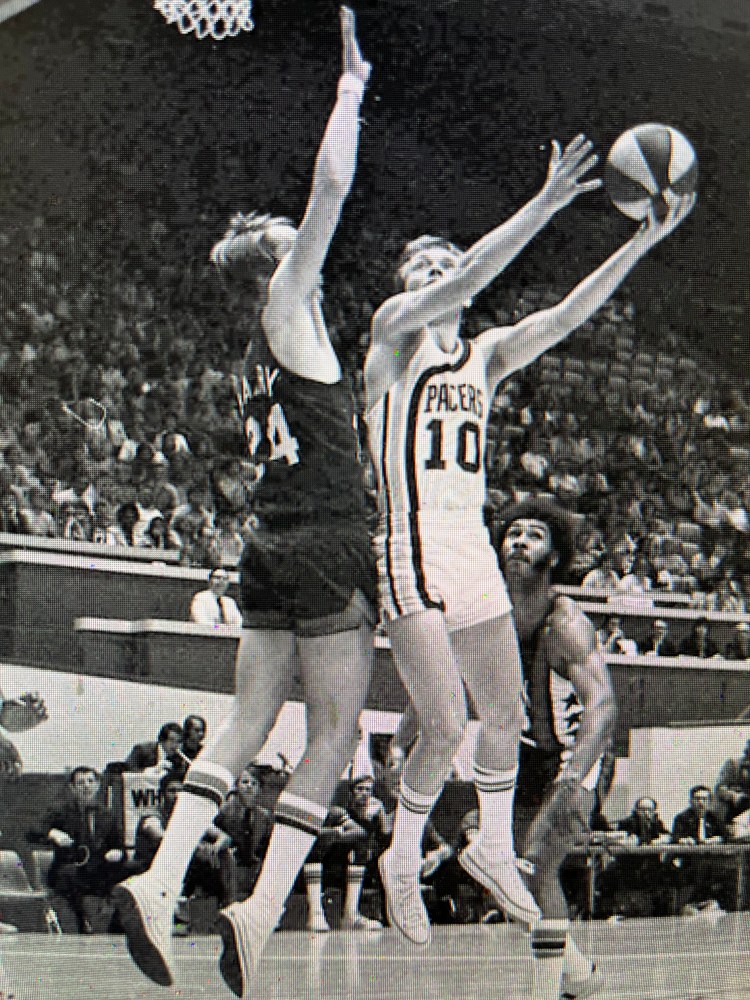
[It was “worth it” until the other shoe dropped around midseason. Coach Leonard cut Mount’s minutes without much explanation, and Mount grew disenchanted again. Rather than grin and bear it, Mount finally stood up for himself. He told his side of the story to reporter Robin Miller of the Indianapolis Star. Miller’s then-bombshell interview ran on January 30, 1972. The headline: Mount Fed Up With Leonard’s Excuses.]
As long as he’s donned No. 10 for the Indiana Pacers, Rick Mount has accepted what he was told and when he played. Last season, when he was a rookie riding the bench, Mount listened to the people badmouth him as a flop. He never said a word.
At the beginning of this American Basketball Association year, Mount was making those disbelievers eat their words by the tablespoon. He was starting at guard, averaging 20 points and five assists a game, and the Pacers were winning.
Still—he chose not to say anything—such as, “I told you so.”
But Mount’s very good year didn’t last too long. It has turned into a perplexing situation. His playing time has dropped night after night. As of late, he’s been lucky to see 10 minutes of action. And he’s just about fed up with the entire scene. So much, in fact, that he’s going to say what he thinks for the first time.
The thing that bothers him most is why Coach Bobby Leonard has cut his time. “I can’t understand why all of a sudden he’s phasing me out,” says Mount. “He’s never given me a reason [for why] I don’t get in very often. He says he’s just going to use me as a shooter, but that’s just an excuse to get me out of the lineup.”
Before the decline of time, Mount was racking up some impressive statistics. As mentioned earlier, when Indiana was 6-0, Rick was getting 20 points and five assists per game. But even when he was still playing 24 minutes, he was good for 16 points and four assists. As of this morning, he is the Pacers’ sixth-ranking scorer at 14.5. His 46 percent two-point shooting percentage is tops among the guards, and his 35 percent three-point firing is also best—and fourth in the ABA. His free-throw percentage is .831—second on the Pacers, eighth in the league. And he’s third in line in Pacers’ assists.
Against defending ABA champ and current Western Division leader Utah, The Rocket is hitting 22 points each time they meet and shooting .587 from the field.
But the stats don’t seem to impress Leonard. Instead, he chooses to point out Rick’s weaknesses on defense and his lack of quickness. “All I’ve heard about since I came here is my defense,” continued Mount. “If I have a bad night, that’s all I hear about. But if I play good D, nobody says anything.
“If somebody hits two or three hoops in a row on me, I come out. But if it happens to a couple of other players, they stay in. When you get to play, you’re going to keep in shape. But when you start to sit, you get tired sooner. It’s just natural. But I don’t believe my defense is as bad as everybody might think.”
And neither does another Pacer, who will go unnamed by preference. “All he [Leonard] does is run Rick’s defense down. He never compliments him for moving the ball on the break, picking up the slack on offense, or playing good defense. Hell, he plays better defense than Ralph Simpson, Charlie Scott, or Dan Issel. But their offense is so good, who cares how much defense they play?
“If he [Leonard] would get off Rick’s back and let him go, he’d be great. But now he’s confused. He’s almost afraid to shoot, because if he misses a couple, he’s done. I think he’s done a hell of a job for us.”
After three successive games, Leonard was quoted as saying he thought, “Rick played pretty good defense”—”Rick seems to have lost his quickness”—”Rick looked real aggressive out there.”
Mount wonders how he can lose his quickness one night and get it back the next. He also wonders why he has been pulled on a number of occasions when he’s had the hot hand. For example, on November 9 in Pittsburgh, Mount was keeping the Pacers in the game during the first half with 22 points on 11-of-14 shooting.
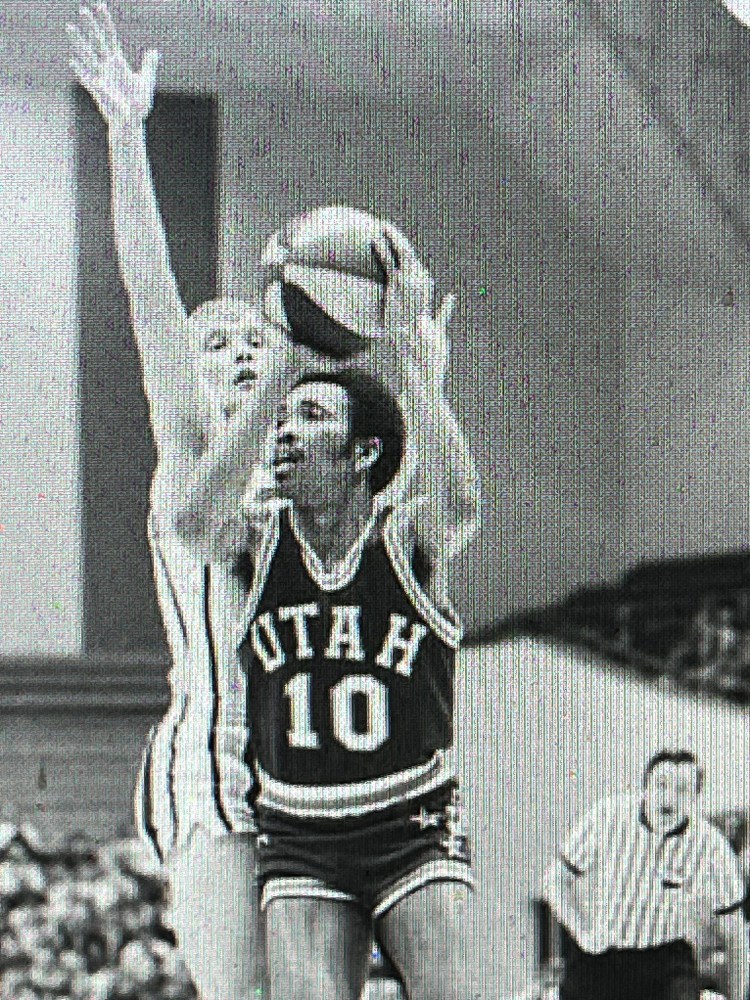
At the start of the second half, Rick hit a quick basket and followed with a three-pointer. The next time down the court, he traveled. Leonard jumped up, took him out, and didn’t put him back in until there were four minutes to go in the game.
“There’s been plenty of times this season when I could have scored 30 points,” says Mount, “but he [Leonard] usually wants to go inside in the second half, and I always do it. Hell, I’m not looking for the ball. When somebody’s open, they get it. Just ask them. [And] it should be that way, and I know it.”
A few weeks back, when Leonard announced he was moving Roger Brown to guard, he said he was going to use Mount as a shooter. “I’ll bring him in when we get behind to catch us up or I’ll bring him in to help bust things open,” were Leonard’s exact comments.
To which one ABA coach replied, “If I had Mount, he’d be in there all the time. You beat teams night in and night out with offense, and he can score as consistently as anyone in the game.”
Being told he was just supposed to be a “shooter” didn’t totally disillusion Mount because he was at least getting in for a quarter and a half. On back-to-back games (January 18 and 20), he came in and deposited 18 points and eight assists (21 minutes) and 17 points and seven assists (34 minutes) in two Pacer victories.
Since then, his time has grown short—and so has his patience. He now shares the substitution time with Billy Keller, Larry Cannon, John Barnhill, and Marv Winkler. Seven guards in total—the most in either league.
“He says he doesn’t like my style of play,” explains Mount. “If he didn’t want me, he could’ve told me so. I just wish he’d do something. If I couldn’t play, it would be different. But I’ve proved I can play, and I don’t want to sit.”
There are at least five ABA and two NBA clubs that would be more than willing to pick up Mount. Kentucky and Mike Storen are most eager.
But Mount’s predicament is really quite sad. When the Pacers don’t have a scheduled practice, Mount works out for three hours on schedule. He’s been pressed to endorse shoes and make television commercials, but those things aren’t important.
All Rick Mount wants to do is play basketball. He doesn’t want to leave Indiana, but if things don’t get better, he’ll probably ask to be traded. That’s the way it stands.
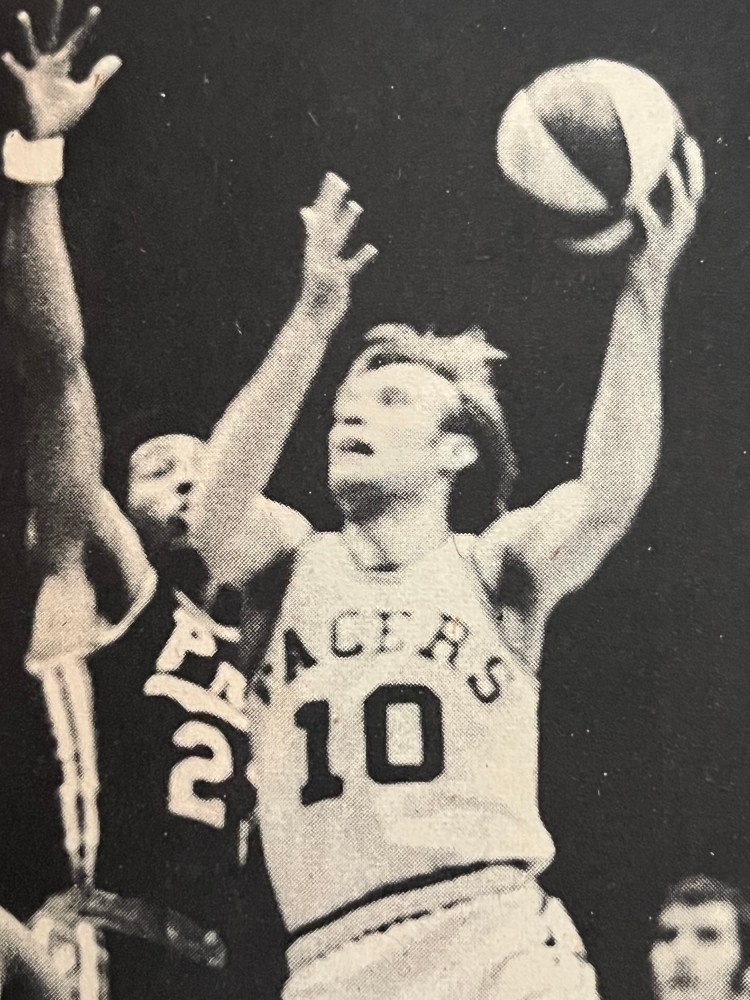
[It didn’t take long for the outspoken Coach Leonard to respond. Leonard’s rebuttal of Mount’s stated exasperation with him ran in the Indianapolis Star on February 3, 1972, though under the byline of the newspaper’s sports editor Bob Collins. Reading between the bylines, Leonard had gone straight to the influential Collins and demanded to be heard. The headline: Leonard Has His Say on the Mount Issue.]
The Indiana Pacers are the proud possessors of the best and most exciting professional game that ever has hit our city. The crowds have been big-league. So have the teams that the Pacers—and Bobby Leonard—have put on the Coliseum floor.
And the controversies have been few.
Therefore, the flak that has been flying since Rick Mount stated his case in the Sunday Indianapolis Star looks large only because flak hasn’t been seen in these parts before. Rick, one of the most popular performers in the history of athletics in this state, stated that he felt he was being “phased out” and indicated he would like to be traded.
The mail (not really heavy) and the phone calls (quite a few) have been running about 99 percent in favor of Rick. Since this is Mount country, the statistics would be startling only if they ran any other way.
However, there are at least two sides to every story. Leonard also is a man of considerable stature in our sports community. Like Mount, he is a stand-up guy.
No one man can make a basketball team. But any time we care to rummage around for a reason as to why the Pacers are the most successful franchise in the American Basketball Association, we must start with Leonard. He has been the catalyst; the man who has mixed the ingredients that produced the winners.
Personally, I think both Rick and Bob are unhappy that the disagreement has suddenly blossomed into Topic A in our town. Nevertheless, it has.
The coach, who has more things to worry about than the future of one player, has asked to present his side. He is getting it in this space, in the same manner Rick did in Robin Miller’s Sunday piece—without opinion or comment.
Here is Leonard’s statement:
“I grew up in Indiana high school basketball and attended a state university, and I feel for players of the caliber of Rick Mount or George McGinnis or Billy Keller. As knowledgeable as Indiana fans are about basketball, I don’t think they ever want to face up to the fact that a player does not do as well in college as in high school or as well in the pro game as in college.
“A lot of times they put a great deal of pressure on the ballplayer—it even gets to the point where he doesn’t want to face the facts himself.
“I would like to talk about the case of Rick Mount (and specifically) a scouting report on Rick when he came out of college. This report was made by Jerry Krause, who then was head scout for the Chicago Bulls and now is head scout for the Phoenix Suns. I contacted Jerry because the NBA scouts all season long . . . they see a player six-to-eight times, then talk to each other. I wanted to get a consensus.
“This is the report I received: ‘College forward, would have to be a guard in the pro leagues. A step slow. Lack of strength could be a factor. A great natural shooter. Due to lack of speed and quickness, needs a pick. Ballhandling and leadership at guard very questionable. Seems to be a competitor and attitude is satisfactory.’
“I did not in any way expect Rick to come into professional basketball and average 30 points a game. I thought Rick would be strongest if he was part of a team. And this is where the fans need to be educated. They expected Rick to be a superstar in this league like he was in college.
“Personally, I feel that, at this point, Rick has had success with the Indiana Pacers. I can’t put him in the same category with Dan Issel or Charlie Scott (who came into the ABA at the same time). Issel is a big man. Scott had superstar written all over him from the very start.
“I’d like to cover the article written on Rick (in the Indianapolis Star). The first thing: Why has his playing time been cut? It’s mentioned here (in the story) that the first five games, we were 5-0. Were we 5-0 because Rick was in the lineup or were we 5-0 because the team did well? I say it is because we did well as a team. What wasn’t brought up was in the next 37 games, we were 18-19. Again, I can’t say we were 18-19 because Rick was in the starting lineup. I can say we were 18-19 because we didn’t perform well as a team.
“Now, with the change we made—George McGinnis starting on the frontline and Roger Brown moving to the backline—we are 9-3. I can’t say we wouldn’t be 9-3 (over this period) with Rick Mount in the starting lineup.
“I can say this: “We needed more rebounding up front. Since George came into the lineup, he’s averaging 36.3 minutes per ballgame. He is averaging 20.2 scoring and 12 rebounds a game. Roger does not like playing in the backcourt and—even before Rick wrote the article – I was planning to move Roger back upfront.
“Also, Larry Cannon really is coming on. And by the way, here’s a guy who found it hard to sit on the bench. Last year, he averaged almost 27 points a game and was on the all-star team. But his attitude has been great, and he’s starting to show up very well. Now it is a matter of moving Roger up front and working Rick and Larry and Freddie Lewis and Bill [Keller] in the guard slots. I think here is where Rick thought he was getting phased out—a lot of times during the season when things aren’t going right, a coach is going to make changes to see if he can find something.
“Rick is fifth in playing time on our club. To break it down to the type of stamina and physical assets Rick has, I feel he has to have a rest during a ballgame. He was given a rest in college at certain points. If I were playing Rick all the time, I would sit him down four minutes in the first half and four minutes in the second half. That’s eight minutes out of 48.
“I also would like to point out that Rick has more personal fouls than anybody on our team with the exception of Mel Daniels. And Mel is playing inside, guarding big pivotmen and picking up other men. So he’s going to get into foul trouble.
“Sometimes Rick is in foul trouble in the second quarter—or the third or fourth. I can’t let him stay in the game and foul out. So he’s losing five-to-six minutes of playing time there. So (with the rest time), that that would leave 34 minutes in the game—and he’s averaging 30.
“Let’s go over the statistics. Rick, averaging almost 30 minutes a game, is averaging one assist for every 10 minutes he plays. I don’t look upon Rick as a big guard (physically) in this league. However, he is averaging one rebound for every 15 minutes played. Keller, who is 5-10 and has played 500 fewer minutes, is averaging the same number of rebounds.
“Now we look at the error department. There are many Pacer fans who think Bob Netolicky can’t handle a basketball. He is a poor ballhandling forward. Yet Neto, playing 300 more minutes than Rick, has only seven more errors.
“And there are people who think Freddie (Lewis) takes a lot of bad shots. Freddie is averaging 37 minutes—basically my reason (for Lewis playing more than Mount) is that he is a little bit quicker, a little bit stronger physically, and does not get into foul trouble.
“Freddie takes bad shots. All players do. But at this point, Freddie has played 290 minutes more than Rick and taken 66 three-point shots. Rick has taken 116. Really, I don’t think Rick’s range is much superior to either Freddie, Billy, or Roger.
“I’m trying to make a point. It’s simply this. I think the fans should stop looking at Rick Mount as a ballplayer who should never come out and make a mistake and should be scoring 35 points a game. I don’t expect that out of Rick. I think (the fans could) take a lot of pressure off of Rick. And (when that happens), I think that Rick . . . would . . . settle down and do things he does best for the Indiana Pacers.
“Rick told me that the article was written just exactly like he said it and with his approval, and it was time for him to stand up for himself. We wanted to be prepared to trade if he wanted to be traded. However, Rick Mount has a home with the Indiana Pacers and can be a contributing factor in our drive for the Western Division championship and the ABA championship. He has a place as part of our team.
“We had a team meeting in Virginia (after the story appeared), and the players there felt that Rick was wrong but were willing to accept him back to the ballclub. I feel the same way. I feel he was wrong, but I can understand the situation a lot more than most people, and I would welcome him back to the ballclub.”
[The Pacers won the 1972 ABA championship. “We won the thing (ABA title), and I thought I played pretty well and contributed to it,” Mount said afterwards. “But the way things are right now, I’d rather not talk about it too much.” By July, the Pacers had sold Mount and forward Bob Netolicky to the Kentucky Colonels. Mount didn’t excel as a Colonel, and was traded after a season-and-a-half Utah. As the ABA started to crumble, Mount and his large contract landed in Memphis (headed by Mike Storen). There, Mount had his finest—and final—ABA season, averaging 17.1 points, three assists, and 34 minutes over 26 games. Mount’s season ended prematurely when he collided with Joe Caldwell, separating his left shoulder. As a Memphis reporter wrote to mark the occasion: “You’d think that Rick Mount was born in a moonless night under a ladder in the presence of 13 black cats.”]

