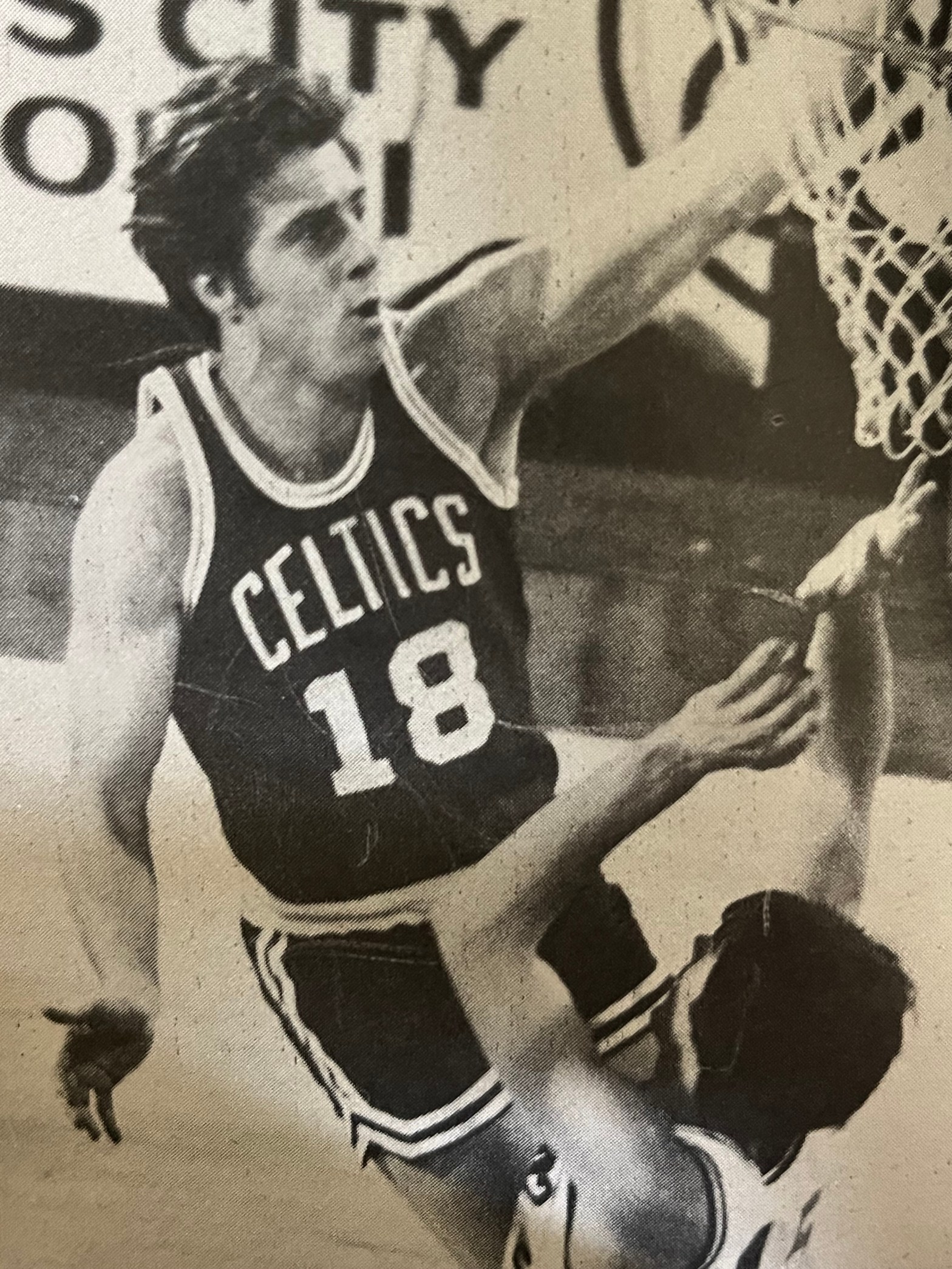
[Today, just about everybody grumbles at the NBA’s rampant flopping to pick up cheap and undeserved offensive fouls. But the grumbles come grounded in a deeper resignation. What can you do about it? Flopping is now tactical and just another unfortunate part of the modern game.
In the mid-1970s, though, when flopping first became a full-fledged NBA thing, the grumbles weren’t yet so acquiescent. Some fans lost their minds whenever officials rewarded a good flop with a bad call. The same went for certain players on the other end of the call. Flopping had no place in basketball, they argued. It was pure Hollywood, nothing but acting, an injustice that wasn’t good for the game.
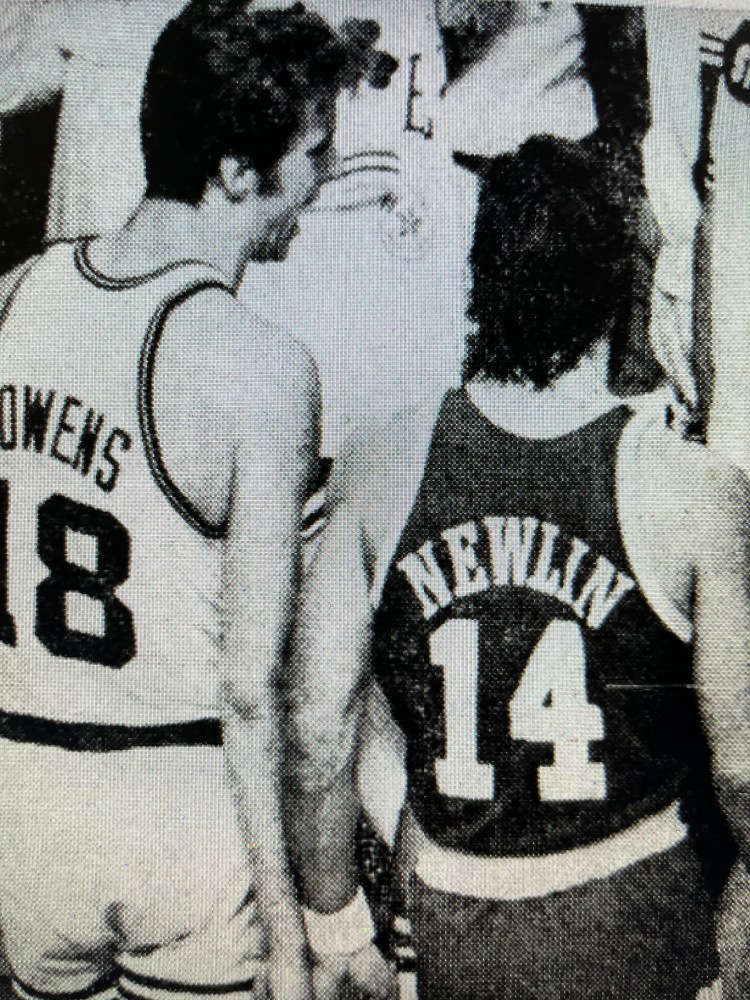
Just ask Boston Celtics star Dave Cowens. On February 25, 1976, during the Rockets-Celtics game in Boston Garden, Cowens decided to take a stand against flopping. He decided to take down—literally—one of the NBA’s most-notorious floppers, Rockets guard Mike Newlin. “I came down the court,” Cowens explained his ire after picking up his fourth personal foul on a Newlin flop, “and I felt like I was going to do something. I didn’t know what I was going to do, exactly, but then I saw Newlin coming down the middle of the court with the ball, and I said, ‘Well, here we go.’”
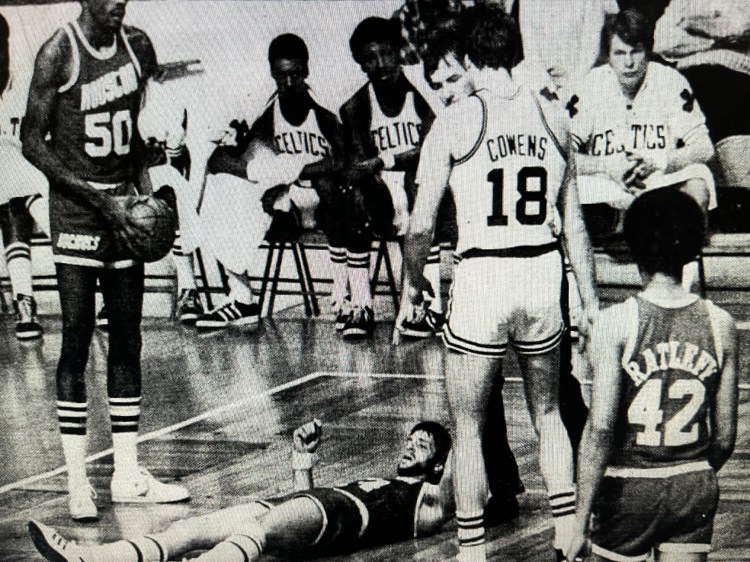
Cowens broke into a sprint and blind-sided Newlin, sending sprawling to the court on his back. “Whistles blew,” wrote Boston Globe columnist Leigh Montville. “There was a spectacular gasp usually saved only for the dropping of a prime heavyweight at an unexpected moment.”
“Now, THAT’s a foul!” Cowens screamed at young referee Bill Jones, who’d whistled Big Red’s fourth foul on the previous play.
A technical foul was immediately issued to Cowens. A few minutes later, Jones tossed Boston coach Tom Heinsohn from the game for arguing the technical (“It’s YOUR fault,” Heinsohn ranted at Jones. “You let it get out of control.”) When Newlin stepped to the free-throw line for the Cowens’ foul, a nickel hurled from the second balcony dinged him in the head. Seconds later, a cup of beer tossed from closer range doused the Houston bench. Then, two guys in private box seats came to viscous blows.
Boston Globe columnist Bob Ryan was disgusted by the whole thing: Cowens’ assault, the chaos, the flops. So much so, Ryan even mentioned it in his 2014 autobiography, Scribe: My Life in Sports. But first, Ryan vented and vilified Cowens for the Newlin takedown in the February 29, 1976 issue of the Globe. Here’s what he wrote.]
****
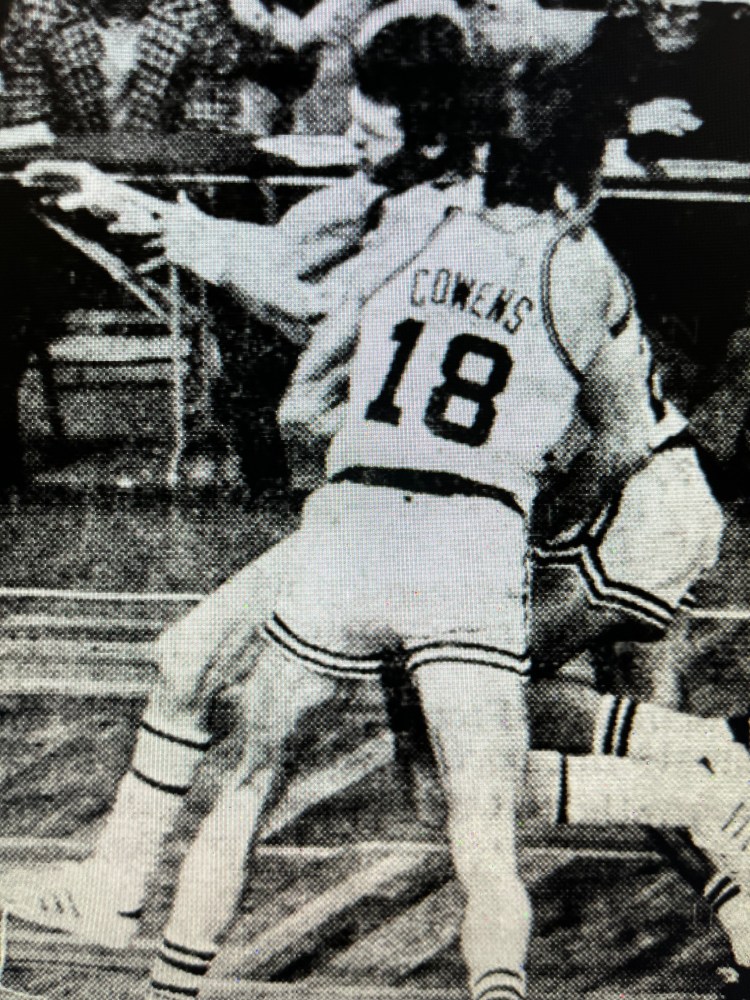
Something is wrong at Boston Garden when nobody connected with the Celtics is willing to treat Dave Cowens’ assault on Mike Newlin last Wednesday for exactly what it was—reprehensible and outrageous.
Tom Heinsohn reacted to Cowens’ attack being called a “flagrant foul” by arguing so much that referee Bill Jones had to eject him. If what Cowens did wasn’t a flagrant act, then perhaps what happened at Pearl Harbor on December 7, 1941 could more properly be called a little buzz-bombing.
Red Auerbach, meanwhile, approved Cowens’ action when he saw him in the locker room. “It’s about time!” was the gist of his comments to his mercurial center.
What is going on here? Do the Celtics really believe that getting away with falling down to draw an offensive foul can be equated with smashing into a smaller player from the blindside after running the length of the court to get up steam? Are the Celtics telling us that, no matter what they preach about class and pride, that the end, in fact, justifies the means?
Look, I agree with the basic Celtic premise. There is a falling-down epidemic going around the league. People such as Calvin Murphy, Clyde Lee, Jerry Sloan, and others are infuriating. What’s worse, this plague is infesting the colleges and high schools as well. But is a brutal attack on a player of demonstrable skill and character such as Mike Newlin the answer? If Cowens was so angry at Bill Jones, why didn’t he just punch him out and accept the consequences?
Somebody must inform Cowens that his well-known temper must be kept in check. This business of hitting a stupid fan in Houston may have been funny to the Celtics, but it certainly struck me as stupid and ill-advised. Yet who will curb Cowens? Heinsohn, whose recent actions toward referees suggest a mania which far transcends mere excitability? Or perhaps Auerbach, who freely admits harboring old-time “enforcers,” such as Bob Harris and Bob Brannum?
Dave Cowens is the single best basketball player in the world. Off the court, he is a rare individual. He is courteous, introspective, generous, and honest. But he sometimes allows emotions to overrule his reason. I am truly afraid that someday he will seriously hurt somebody unless he is made to realize that his famous temper tantrums will simply not be tolerated by management, if only because he is needed to play in the game (the foul on Newlin was his fifth, for example).
I would hate to have people thinking of Cowens in terms of his animalistic instinct, instead of in terms of his matchless dedication and heart, his jump hook, his rebounding and passing skills, or his defensive ability. I know he can play better than anybody else. Now he must learn to act better, too.
[In the March 13, 1976 issue of The Sporting News, Ryan tackled the issue again, though with greater humor. Keep reading, it’s definitely worth the laugh.]
No longer will a particularly ruthless assault on the basketball court be known as “a flagrant foul.” Henceforth it shall be known as a “Cowens.” What Dave Cowens did to Houston’s Mike Newlin on the night of February 25 at the Boston Garden has been equaled only on the ice or on the football field, and then only on very rare occasions.
Exasperated beyond words, or, apparently, normal reasoning powers by what he considered was a reprehensible basketball practice—the continual habit of falling down to draw a fake offensive foul—Cowens picked up a head of steam over some 50 feet of runway and simply smashed into a startled Newlin as the latter was passing off the ball. The vicious deed done, Boston’s mercurial center walked over to referee Bill Jones and screamed, “Now THAT’S a foul!”
Newlin, fortunately, is made of stern stuff, both physically and morally. Though he later said that “my neck still hurts,” he appeared to have escaped serious injury. Though blessed with a superb physique for a guard, Newlin still is 6-4 and about 210 pounds. Cowens, equipped with an equal physique, is 6-8 ½ and weighs around 230 pounds.
There could be no condoning Cowens’ chosen method to demonstrate his grievance, just as there could be no condoning the incredibly childish antics of Boston coach Tom Heinsohn, who had the gall to dispute referee Jack O’Donnell’s claim of a deliberate foul (“Premeditated?” inquired Houston’s Calvin Murphy. “Cowens made up his mind to foul Mike in 1958.”) and who protested so vociferously that he was ejected from the game, which, incidentally, the Celtics later won.
However, at least some portion of the blame for the incident did rest with Messiers Jones and O’Donnell, who were incapable of distinguishing between legitimate defensive plays and obvious pratfalls taken by the Rockets, particularly the diminutive (5-9) Murphy, whom Heinsohn accused of “sweeping the floor all night without joining the union.”
Murphy is perhaps the most distinguished thespian in a league, which is becoming increasingly dominated by two-bit hams who couldn’t have made a living wage in vaudeville.
Just ask Kareem Abdul-Jabbar about Philadelphia’s Clyde Lee, for example. Lee has a cute habit of bumping into a center making his move to the basket and then flinging himself backwards as if struck by a charging rhinoceros. After Lee drew two bogus offensive fouls in this manner in the first quarter of a game in Philadelphia earlier this season, Kareem angrily flung the ball at referee Bill Saar, an act which prompted his immediate ejection from the contest. So Kareem, who, like Cowens, plays a completely honest game with no room for this other nonsense, knows exactly how Cowens felt when he decided to make an example of Newlin, who, incidentally, swore complete innocence on the play in question.
The Celtics have but one actor, veteran Don Nelson. In the days past, they owned the man who wrote the book, Frank Ramsey. It appears as if they’ll have to get Ramsey to leave his old Kentucky home and come to Boston to open a Basketball Actors Studio, if the Celtics wish to compete in the modern NBA.
Obviously, referees ought to have the capability to distinguish between a man taking a good charge and a man falling down with no contact. Murphy is so conditioned to falling down that he once actually hit the deck against Boston after being brushed by referee O’Donnell.
One man could stop this whole trend and restore basketball to a more respectable level. That man is officiating supervisor John Nucatola. All he has to do is inform his entire crew that anybody caught giving calls to cheap actors on a continual basis has confirmed his incompetency and is therefore subject to instant dismissal.
“I see guys 6-10 and seven-feet tall falling down now,” says Cowens. “I wouldn’t teach that kind of stuff to anybody. Is that basketball?”
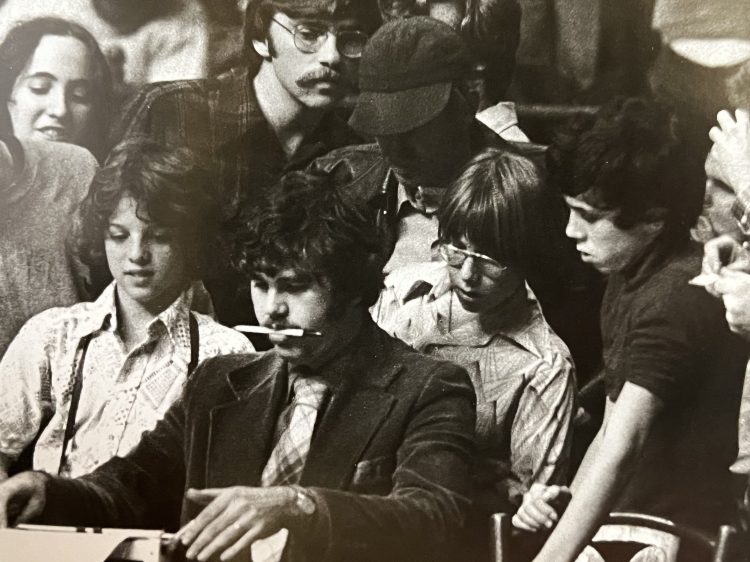
[Dave Cowens took exception to Ryan’s not-so-funny column in the Boston Globe. He wrote a long rebuttal to Ryan. So what if it clashed with Cowens’ earlier comment that “I was going to do something” to get Newlin? No harm, no foul. The Globe published the rebuttal in full on March 14, 1976.]
Dear Bob:
You know my disinterest in pouring over articles that have been written about the Celtics and/or me in particular; but before our game against the Warriors, some of my teammates insisted I read your feature article that appeared in Sunday’s paper. I agree with you that violence, defined as an act which is designed to intentionally injured another person, has no place in sports or in any other realm of society. Also, I believe that it is dangerous when a person’s temper becomes uncontrollable, and they are unable to channel their adrenaline-supplied energy to result in scoring points, grabbing rebounds, and playing defense.
What you described as an outrageous, indefensible, brutal, raging, blindsided attack on poor, helpless Mike Newlin was actually a premeditated, calculated risk (fifth foul), which was not done to deliberately hurt anyone, which it did not. I ran from one side of the court to the other when Newlin got the inside step on Kevin Stacom and was dribbling towards the bucket. He was not hit from behind but was easily able to see me coming at him, just as if I was attempting to double-team the ball, which, of course, was not my intention.
THE PURPOSE—To once and for all impress upon the referees, coaches, players and fans that fraudulent, deceiving and flagrant acts of pretending to be fouled when little or no contact is made, is just as outrageously unsportsmanlike as knocking a player to the floor. I would not and never have taught youngsters to play other than by the rules, morals, ethics and character of the game.
The following list are the reasons why I disagree with the acting that is going on in high school, college and professional basketball.
1—Pretending makes players think they can achieve their goal without putting in the work or effort that it takes to develop any skill or talent.
2—Hostilities arise among the players who are obviously being victimized by the actor’s ability to make officials react instinctively to any flagrant, out-of-place action.
3—It distracts anyone who attends the game to study fundamental basketball skills and traits of the game, i.e. scouts, coaches, players, etc.
4—It arouses the ignorant fans who react vehemently to violent gestures or seemingly unsportsmanlike conduct (almost always on the home court of the actor) and can lead to minor uprisings, thrown articles on the court, etc.
5—If this practice continues unrestrained or the actor is allowed to utilize this fraudulent exercise successfully, it will gradually become an accepted strategy and will be taught to kids more enthusiastically by their coaches. After all, everyone wants to win and will take advantage of any ploy to do so. This way, a weak defensive player will have another method of getting by without having to learn how to learn how to play defense properly.
You may think I am exaggerating this point and I am sure the public is tired of hearing about this technicality, but I have noticed that the number of pretenders has risen over the past three or four years resulting in numerous invisible contact fouls being assessed. This happens especially when the fundamentally sound strategy of creating mismatches close to the basket, with the smaller player taking a dive because of the high percentage that the big man will score. Nowadays, some average defensive big men are taking to falling down unnecessarily to get the more skilled big men in foul trouble, leaving the better player at a disadvantage. This, in plain words, is “cheating.”
As an articulate, knowledgeable and enthusiastic sports journalist, your comments on my being a terrific basketball player reinforced your expertise on the game (just kidding), but your observation that I must learn to act better is not in my repertoire.
I would appreciate receiving equal time on this matter and request that this letter be printed unedited in the Boston Globe. As I once told you, I believe it is your responsibility to report the facts and your opinions are noteworthy, but this is an issue of principle and whether or not you agree with me has little to do with the respect that I have for you and the contributions you have made to the Boston sports scene.
Sincerely,
DAVE COWENS
Wellesley, Mass.

