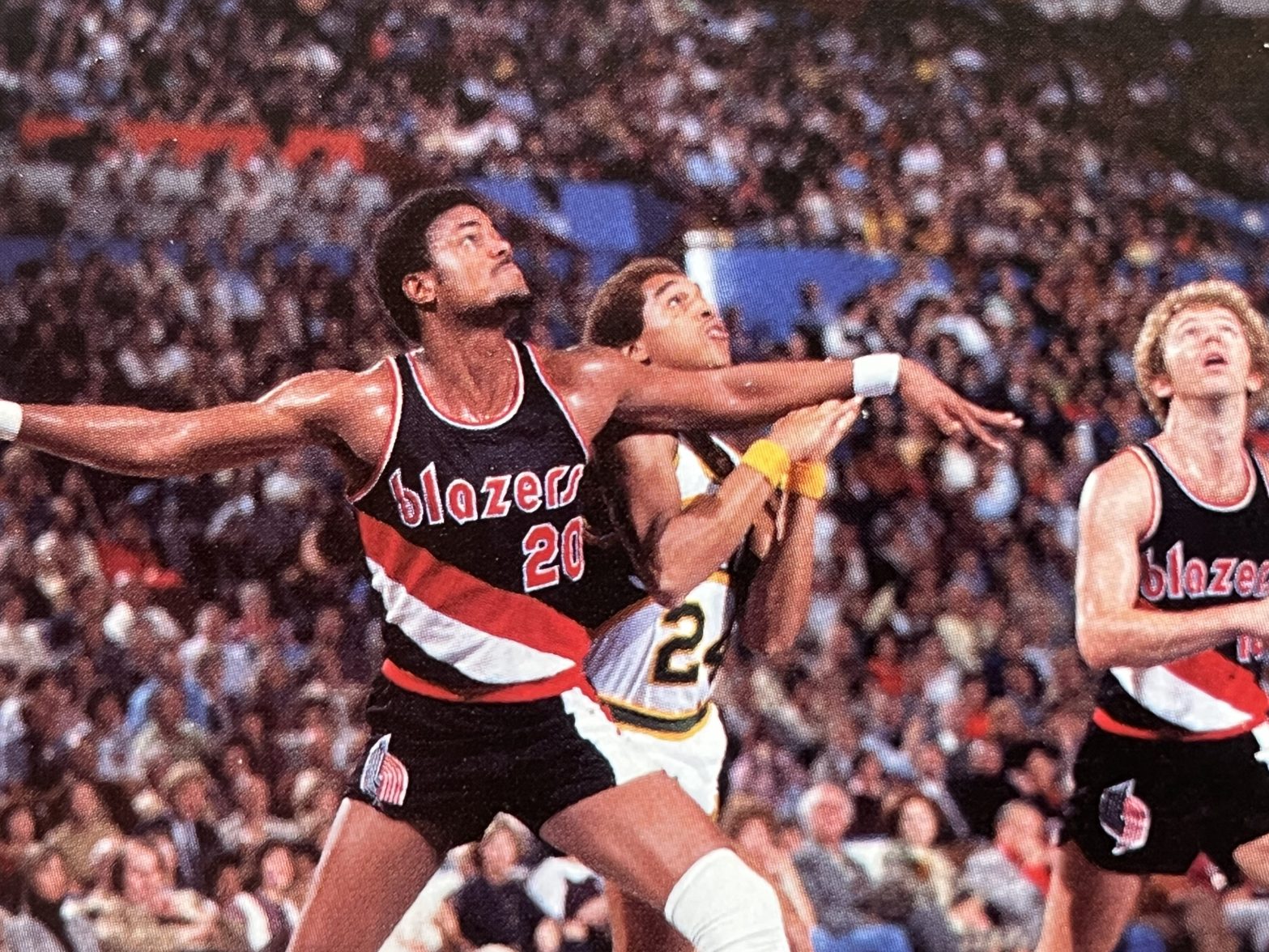
[Call it Maurice Lucas Week at the blog. I’ve got three articles ready to post on the late-great “Enforcer.” Up first is a profile of Lucas published in the April 1978 issue of the magazine Black Sports. It comes from the pen of journalist Ed Kiersh, whose career would wend its way wonderfully to golf and collectibles. Kiersh also published the 1983 book titled, Where Have You Gone, Vince Dimaggio? I don’t have a copy on my bookshelf, but the title sounds like a real fun read.
Without further ado, let’s meet Ed Kiersh and Maurice Lucas on the loose somewhere in the wilds of 1970s New Jersey.]
****
The Portland Trail Blazers are sitting in a motel dining room, their faces glued to basketball stories in morning papers. Suddenly, a loud wail splits the sleep-eyed silence. “Hail to the bald-headed emperor.” Fiery coach Jack Ramsay, who has a lot more talent than hair, pops out of his seat and stares Sherlock Holmes-like around the room. But he can’t locate the culprit. Only sees cackling players, thoroughly enjoying themselves.
“Hey Luke, stop that laughing and pay off your Super Bowl bet,” trumpets Ramsay calling to Maurice Lucas, the NBA’s reputed “best power forward.”
Lucas grins. Ramsay turns away.
“Hail to the bald-headed emperor.”
General hysteria follows. The usually reserved Lucas, obviously innocent, gives Ramsay another wide, boyish grin, then hustles over to reserve center Tom Owens for a slap of palms and then returns to eight glasses of orange juice that sit next to a mound of pancakes and eggs.
A celebratory feast is in order, as this is the day the much-traveled Lucas has long waited for. Finally, after three rather unheralded seasons with the ABA Spirits of St. Louis, Kentucky Colonels, and the Trail Blazers via the dispersal draft, recognition rebounds off his newspaper’s tally of the all-star team balloting. The fans have made him a starter, thus putting him in the illustrious company of Rick Barry and Julius Erving.
To confirm results of the vote, Lucas keeps his head buried in the newspaper. Tired from an extended Eastern road trip, which has the team playing seven games in two weeks and resting in this Piscataway, New Jersey motel before facing the Nets, he also wants to protect his solitude. Teammates walked by to offer congratulations, and Luke simply nods appreciatively and turns away, almost shame-faced.
“There’s a deep satisfaction in being named an all-star, but if I was voting (Bob) Gross and (Dave) Twardzik would also be on the team,” says Lucas, convinced that players, and not fans, should do the balloting. “Along with Walton, these are the two guys who make my team what it is. Yet I must say that seeing so many former ABA players selected makes me feel really good inside.”
Lucas scans the all-star list. His face suddenly turns bitter. He gulps down an orange juice generously filled with “Instant Protein Mix,” recommended by Ramsay. “I got to play next to that asshole Rick Barry. He’s such an arrogant son of a bitch. Every time he passes you the ball, he’s doing you a favor. I hate just the thought of suiting up with him. He’s got to be the worst.”
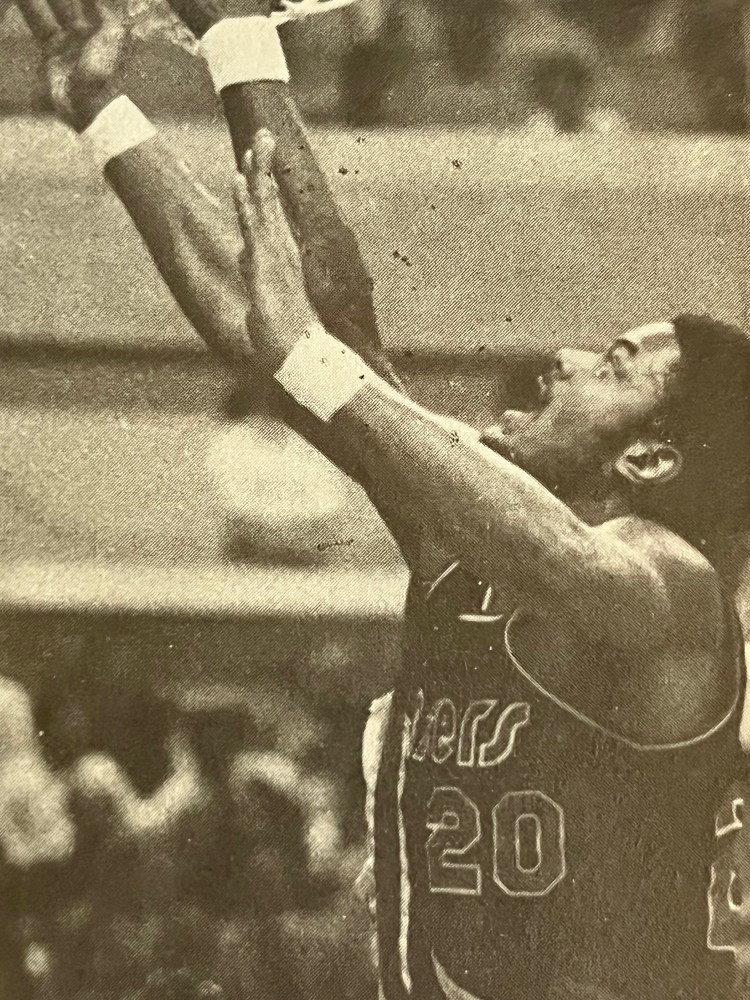
Hard words that match Lucas’ bruising style of play whenever he tangles with Barry or other name NBA forwards. The Marquette graduate is nicknamed “the Enforcer” for his run-in with Darryl Dawkins in last year’s playoffs, but despite his protest against labels, other statistics also justify such a tag. Namely, a 20.2 scoring average in 1976-77, his consistently high rebounding totals, and, perhaps more importantly, his tireless defensive “banging up” of opponents.
“Muscling underneath, the physical, that’s the way I like it,” confides Lucas, adopting a more-relaxed, less anger-sharpened tone. “Management pays me to throw my body around, and other players who play like I do expect me to bang bodies. It only bothers me that the media have fixed me with this enforcer wrap. I don’t call myself that, I’ve only had a few fights in my career. And that includes years with Al McGuire—he was so damn brawl-headed, we had to fight.
“Occasionally I’ll abuse people, but I was only trying to protect my team’s interest when I hit Dawkins. The guy tried to punch Bobby (Gross) and, with emotions so high, it was instinctual to square off. I got all the national exposure, so of course I had to be labeled.
“There’s so much violence in the NBA, the media have to make these phony associations. I feel sorry for (Rudy) Tomjanovich, but I think Kermit (Washington) is just a scapegoat. Everyone throws elbows and plays the same physical game. Blame incompetent referees for the nasty incidents. They let things get out of control. If Kermit’s instincts cost him his damn career, it’s bullshit.”
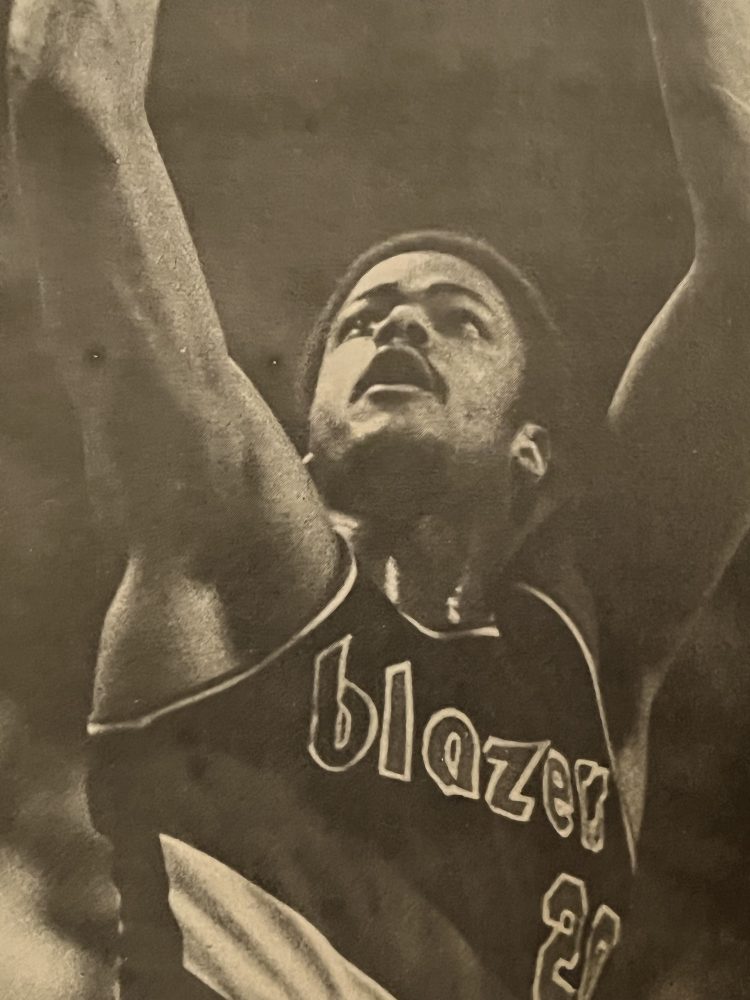
Then Lucas’ anger subsides as abruptly as it welled up. Lucas talks of the past. The Spirits of St. Louis, his entry into pro ball brought him next to “super guard” Fly Williams, Moses Malone, Marvin Barnes, and classy shooter Freddie Lewis, men who once keyed his existence. Now they’re scattered. Lucas says he tries to accept emotional separations as part of “the business,” but it isn’t working. The look of frustration is too apparent.
“If you don’t accept the body peddling in the NBA, you’d go wacko,” snaps Lucas, fidgeting with a gold, diamond-starred neck chain, just below a short goatee. “Basketball has a way of becoming impersonal, what with guys entering and leaving your life so quickly. But you have to adjust even when the chips are not in your favor. Fly Williams couldn’t do this, so there was reason to feel he had a bad attitude. It’s a shame he’s not playing, but you must recognize the game’s worst elements and still stay calm. Thankfully, Portland’s management avoids some of the excesses and is far different than the Nets’ businessman-only, Roy Boe.”
Our conversation is abruptly interrupted by loud horseplay a few tables away. Reserve forward Lloyd Neal, a big grin on his face, is complaining about not getting one of the motel’s three king-sized beds. “Why does Owens get one, he’s only a rookie,” gripes Neal, the backup to Lucas.
“I know you’re listed as 6-9, but admit it, you’re no more than 6-7, if that,” counters Owens, who turns for help from Walton. “Come on, Bill, stop your laughing and tell the guy us valuable players need our rest.”
Walton peers down at his newspaper and cries, “Look at this, Jabbar thinks he’s being picked on by the refs. Ain’t that a shame.”
“This is more important, Bill, tell ‘em I deserve the bed,” pleads Neal.
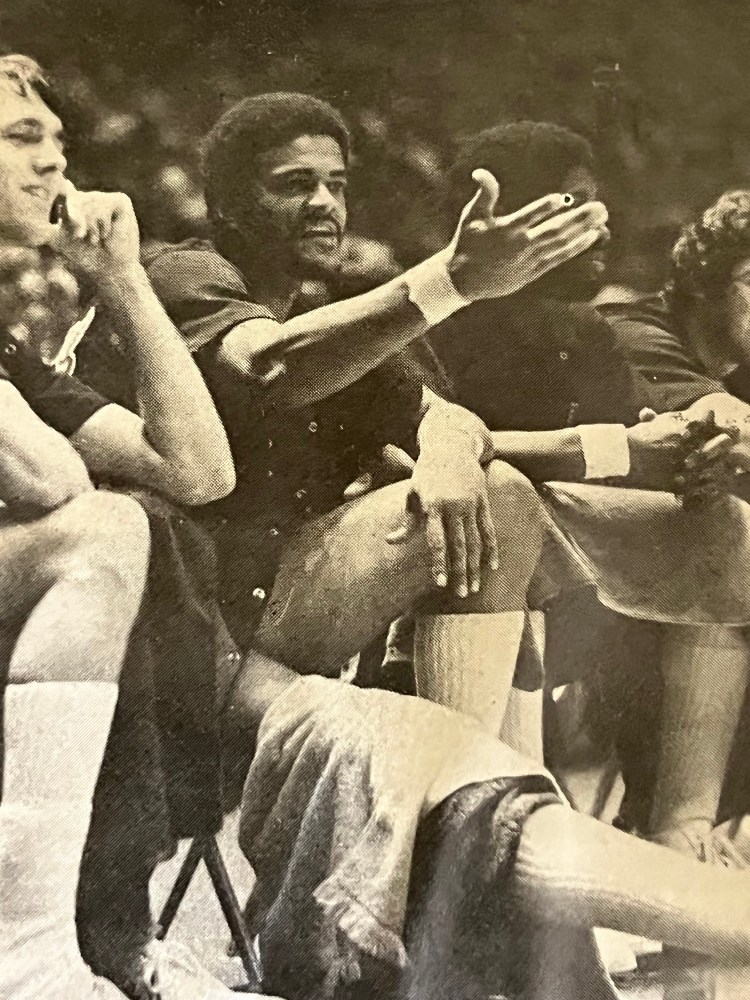
As befitting his “Enforcer” title, Lucas enters the fray. Long legs swivel out from under the table. Arms are extended, with fingers outstretched. Shoulders straighten up. Facial features working together, tighten to give a “hard” impression. Now satisfied his gunslinger imitation pulsates a scary Cool Hand Luke, he fires away.
“Rookie, how do you rate such luxuries, have you become Ramsay’s pet all of a sudden?” teases Lucas. “Your body won’t even be tired tonight, you don’t do any hitting. Just go on outside and get me another paper. Hurry.”
Such give-and-take jousting makes Portland far different from other NBA teams. Loose and tension-free, the Trail Blazers don’t seem to mind pressures or distractions that naturally accompany a hectic travel schedule. Their heads clear, egos are not easily bruised. And more importantly, there is the freedom to concentrate on what they do best—win or, as some observers will say, dominate.
Of course, Dave Twardzik’s pranks (the Harpo Marx look-alike responsible for Ramsay’s investigation) are no substitute for finely tuned skills. Nor does free-swinging confidence take the place of keen-eyed shooting. But, along with Portland’s obvious talent, there is a—for lack of a better word—chemistry. A dynamic blending that eventually might make them the best team ever to play the game.
I ask Lucas about the Blazers’ cool. “Now we feel capable of winning every game. This feeling was strengthened by last year’s playoffs, but our real success secret is that everyone likes each other. Plus, the coaching staff doesn’t get anyone uptight. Not only are there no curfews or dress codes, Ramsay works out with us every day, either going one-on-one, running, or doing the same stretching exercises we do. This makes players feel respected. They look at Ramsay as a father figure and consequently will do everything possible to win.
“I’ve been with some great teams at Marquette, but this is the greatest situation I’ve ever been in. There’s a sincerity here. No way are we going to have what went on with the Yankees, Martin and Jackson. We are just trying to have a good time. We’re only striving now to be unique. Winning is the ultimate. I think our genuinely felt harmony will prove overpowering. Instead of getting jealous about one another, the thing now is to keep playing in the context of the machine and make it run smooth.”
By this time, all other players have left the dining room, and Lucas is noticeably weary. A devoted practitioner of transcendental meditation, he says he is going back to his room to think and nap. He tells me to call him in three hours, and we’ll have lunch. So, Lucas makes for his “king-sized” bed, and I start camping out in the motel lobby.
****
I am driving a rented Ford through a deserted street in downtown New Brunswick, not far from where the Nets play, and Lucas stretched out on the passenger side, looks wistfully out the window at the shops and stores. The streets have unfamiliar names, and we suddenly find ourselves lost on a narrow, ice-slicked back road.
Not wanting to appear worried, I make small talk, and jokes start sliding out of my mouth about kidnapping a star athlete. The car suddenly goes into a 180-degree skid, and we just avoid a telephone pole. I’m shaking. My thoughts run to frontpage newspaper headlines: “Basketball star injured” or “World champions lose half their franchise.” I’m too nervous to continue the banter.
But Lucas is as composed as ever. His stretched-out legs haven’t moved. He intently looks out the window at the countryside and keeps up a smoothly running monologue on summer camping trips spent in the Southwest. “Don’t worry,” he says. “I’ve made so many trips, hunting out hot springs in Indian country. I have an infallible sense of direction.”
Excitement lights up Lucas’ face as we near a stunning Rutgers coed walking along the road. He rolls the window down and calls her over to the car. “Do you know where the gym is?” asks Lucas as she stands a safe distance away. “The one where the Nets play.”
The woman looks around for a moment then points. “That way.”
Lucas thanks her and, broadening his smile, asks, “Do you have tickets for tonight’s game?’
“I hear they’re playing someone good,” the well-built, long-haired woman says, sidestepping his maneuverings.
Lucas and I both laugh.
“But I don’t think my husband got any,” she adds.
The shot is so well-aimed, Lucas must pause for a moment. Drawing again on reserves of cool, he soon counters her, “I don’t think he’s gonna get any here.”
Frustrated from the appetizing escapade, Lucas and I look for a place to stop and have lunch. Since Lucas is a vegetarian, this is not that easy. New Brunswick just doesn’t have that many restaurants, let alone a place where Lucas can find his kind of selected fare.
Finally, after taking several wrong streets and asking a dozen students for a respectable spot, we wind up in El Greco’s Pizza Shop. A loud radio blares from the kitchen and Greek-speaking waiters scurry about. The rest of the patrons turn and stare at us. Lucas finds a booth and, after we are seated, he begins reliving the past.
Born and raised in Pittsburgh’s inner city, Lucas is one more all-too-typical ghetto story. Now he cryptically says, “The world is a ghetto.” But just a short while ago, there wasn’t the freedom for philosophical musings. His father deserted the family, leaving Lucas, his brother, and his sister to hustle and scrape to support a housing-project existence. Friends were turning quick bucks with drugs and tried to lure him into schemes. Instead, Lucas fingered basketballs and got lucky. Marquette scouts saw him playing high school ball, and he was offered a scholarship.
The glory years followed. At the Milwaukee-based school, he teamed up with Jim Chones, Earl Tatum, Bo Ellis, and, under Al McGuire’s leadership, often found himself in the bright lights of NCAA championship games, a showcase event that allowed him to show off his sweeping rebounds and quick outlet passes to hungry-eyed, open-mouthed pro talent scouts.
The ABA Spirits of St. Louis won a bidding war for his services, and Lucas was forced to play center, a change that had disastrous effects on his game and temperament. “I just couldn’t be comfortable doing what I had never done before,” recalls Lucas, who only averaged 13 points in his first Spirits’ season. “Unlike Ramsay, Rod Thorn, the coach, had a certain gameplan and wanted me to adjust to it. That’s not the way to create a winner or to have productive, happy players.”
Lucas found a new contentment in the move to Portland. Primarily, he loves his surroundings. An avid outdoorsman, he considers the Northwest “a land of opportunity” that’s conducive to getting away from it all via camping, swimming, and hiking. The sense of place keeps him in the area during the offseason, and his summer counseling of ghetto youth has made him a local folk hero.
The tranquil picture is further enhanced by Lucas’ relationship with Ramsay. Close on-and-off the court, they go beyond basketball matters to share a respect rare in the survival-at-any-cost athletic world—that atmosphere especially known for fleeting, superficial associations. At risk of sounding trite, Lucas admits to going to Ramsay for advice on personal problems and, without prompting, pays revealing compliments.
“I’m not saying that Ramsay has been specially helpful to my game, I’ve always had confidence, but he’s definitely a strong symbol,” declares Lucas, his legs propped in the booth. “Basketball is a life that passes. If you can’t communicate on other things with a coach, you’re missing an important element. There are a lot of good coaches, but many of them don’t have personalities. This guy is a fighter, his always being on the verge of hysteria gives players an extra kick. It may be his con game, but it’s his constant con.”
On a more disquieting note, there are hints that Lucas’ association with Portland’s other big man, the legendary Bill Walton, shows signs of discord. While both men deny this, reporters traveling with the team talk of Waltons irritation over sharing the limelight in Portland and the lack of intimacy between the pair. In support of this thesis, both men constantly sit apart, they seldom talk and, as one player remarked, “there can only be one Mount Hood in Oregon.”
“I wouldn’t say that we’re the tightest,” says Lucas, putting aside his tuna fish sandwich. “That’s because I’m basically a loner. I don’t really hang with anybody. But we’ve gotten a lot closer, both of us being vegetarians and sharing philosophies. People can’t say anymore that Walton’s a freak, or that he gets injured because of his diet. They’ve had to notice that I’m strong, even though I don’t eat meat. I’ve really added to Walton’s credibility.”
“Now that I’m around, Walton isn’t looked at as different anymore,” says Lucas. “The teasing has stopped, and now that he’s a family man and getting injured less, the guy’s no longer separate or aloof. He jokes around more, and we’ll talk about our food all the time. Why last year, as a recognition of my helping him straighten his head out, he gave me a blow-up picture of myself. He said to me, ‘You were my most valuable player.’”
****
On the team bus en route to the game, I asked Walton to comment on the influence Lucas has had on him. At first distant and uncooperative, Walton ponders his “credibility” remark and curtly says, “I don’t need anyone to give me credibility. I never had any trouble realizing it alone. Maurice’s contribution to my game is tremendous, he lets me play more openly. But what I am is my own doing.”
The bus is a few minutes from Rutgers gym, and the Trail Blazers look worried. There is little talking, and most players hunch up alone with books or stare straight ahead. Could the league’s patsies, the New Jersey Nets, inspire pale, anxiety-riddled expressions? Hardly. The chief concern is they are creeping at five miles an hour over ice-covered roads with a bus driver who doesn’t know the way to the arena.
Lucas huddles next to a window, staring blankly at the forlorn landscape. Dressed in his black, white, and red-striped road uniform, he’s safeguarding his solitude by doing arm-stretching exercises. He has a brown stocking cap on his head.
“I hate to play teams like the Nets,” he says. “They have nothing to lose, and they’re all pumped up. There’s just no way to get psyched up all the time. Sometimes, you just have to spot a pretty lady in the stands and say to yourself, ‘Ooh, ooh, is she fine. I’m going to play this one for her.’ It’s the only way you can get a boost.”
The bus pulls into the arena parking lot, and the players breathe a loud collective sigh of relief and rush off to the building. Shock immediately sets in. In front of them are two closet-sized locker rooms. Trainer Ray Culp comes in and yells, “Let’s get rubbing, fellas.”
Lucas picks at his Afro while on the rubdown table, all the time eyed by Lionel Hollins and Walton. They smirk. But Culp continues to put an elaborate array of jellies and bandages on Lucas’ left foot. He has been playing with a painful muscle pull. In the background, strain-faced teammates are limbering up. The ball boy announces, “The floor is cement hard.” Their cadence quickens.
“Do they have glass backboards?” one player mockingly asks. The room bursts into laughter.
Walton notices that I am absorbing all this and looks unamused. “I thought the press wasn’t allowed in here before games.”
****
The game starts, and the Trail Blazers, apparently undermotivated, are finding the Nets are psyched sky high. Especially Bernard King, the Nets’ rookie sensation. King is doing a highwire act around the basket and giving Lucas fits. Late in the quarter, Ramsay calls a timeout and switches Bob Gross onto King, relieving Lucas of the tough defensive assignment.
In the fourth quarter, the Blazers are far ahead. The Nets are only playing out the string now. They were beaten a long time ago. But the Trail Blazers are running and gunning, and the lethargy is gone, replaced by a professionalism hard to explain under such circumstances.
Most of the Nets’ fans have long since gone home, except for a few diehards, one in particular who has been riding the Trail Blazers and Walton all night.
“Bill,” screams the fan, “one of your Commie friends is sitting here. Her name is Patty Hearst.”
Walton stares blankly ahead and doesn’t say a word.
****
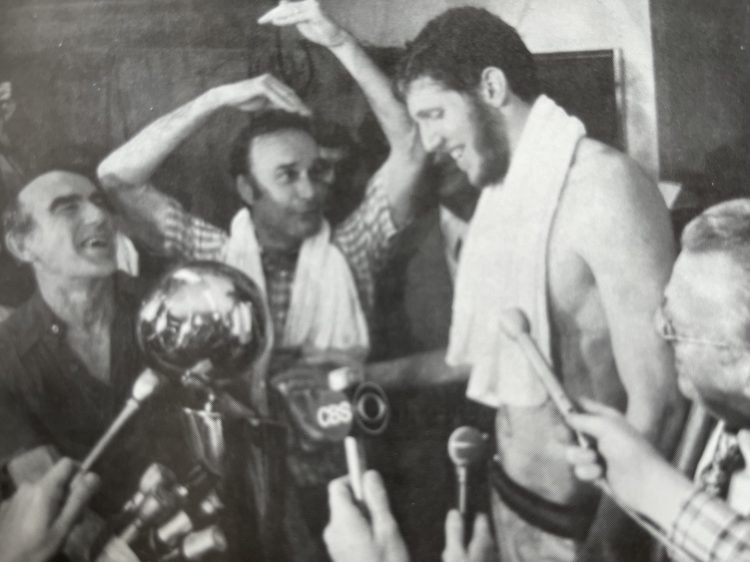
The Trail Blazers sit emotionless in the dressing room. There are beers and soda in just about every hand. Walton is surrounded by dozens of reporters, and the other players leisurely watch the scene, taking sips from the cans and apparently in no hurry to chance the icy road again.
The subdued mood continues back at the motel. A few players hang out with friends in the lobby, but most head for the privacy of their rooms. Lucas chats for a few minutes with an old teammate, the Nets’ Jan van Breda Kolff.
“You guys really make me cry,” confesses van Breda Kolff. His wife, a petite brunette who has been hanging on van Breda Kolff’s arm all along, shakes her head on every word.
“Hey, man, that’s what King was doing to me tonight,” quips Lucas, his voice almost drowned by blaring disco music coming from a lounge. “You’re coming out West soon, right? I want you to come by the house and meet my new wife. I got married last August, and she’s going to law school.”
“What are you doing tonight?”
“I’m really sweaty, man, I have to get into the shower. I don’t think tonight’s good, we got a 5:30 bus in the morning.”
“Why didn’t you go with them?” I ask. “It’s the least you guys deserve for coming all the way out to this wasteland.”
“No, man. The foot is bothering me. I have to take my galvanic-stimulator, hot-water treatment. We’re leaving tomorrow.”
Lucas sighs. “You go into cities, stare at motel walls, see all new faces, yet you never really feel an area,” says Lucas, his voice edged with a sense of sadness and regret. “You’re always looking through bus windows, wondering what do these people feel about their lives?
“The royalties are good (Lucas is reportedly making $300,000 a year), but the life is very limited. In fact, it’s not really life at all. Once I accomplish what I want—a few championships—and basketball becomes boring, I want to broaden out and get into retailing. Maybe even real estate. For right now, I want kids to mention my name when they talk about forwards. They say Big O was the best guard. I want the same thing.
“It’s not that I thrive on acclaim. I really want my solitude. I’m at peace when I can meditate and have jazz playing in the background. It’s the only real pure music.”
“Do you ever get to talk music with Spencer Haywood, he’s got a radio show in New York,” I add.
“Yeah, I’ve been to Spencer’s spread. I have about 700 albums, but his collection is something else. He’s really into it.”
“How about a drink? I’d like to talk about music, maybe get into some of your other pastimes.”
“I want to call my wife and just relax a little.” Then, opening a briefcase, Lucas points to a retailing textbook and some paperbacks, and says, “I think tonight’s going to be catch up time for my reading.”
“Which book is it going to be?”
“Have you heard about it? Wanted. It’s about the search for Nazis in America. Do you know that if this kind of shit starts up again, the Nazis will get two groups—Jews and [American Blacks]. But you know what? By that time, I’m going to be a Jamaican.”

