[Entering the 1974-75 season, the New York Knicks were running out of gas. Two seasons removed from an NBA championship, the Knicks had lost Willis Reed, Jerry Lucas, Dave DeBusschere to retirement and Dean Meminger to the expansion draft. “Once the season started, I realized how much I missed those guys,” said Walt Frazier. “It was a big adjustment. When you’re playing, sometimes you think, ‘Maybe if these guys weren’t around, I would be better.’ That was not the case. When they were gone, it was very obvious.”
Also obvious, Knicks coach Red Holzman wanted more production from Frazier to make up for all the lost points, rebounds, assists, and floor leadership. In this article, published in the March 1975 issue of the magazine Pro Sports, journalist Lee Andre asks: Are They Asking Too Much of Walt Frazier? The answer would be no. Frazier, while playing heavy minutes (41 per game), mostly matched his stat lines from the previous four seasons. But Andre lays out well the challenges ahead for the aging Knicks and specifically the 29-year-old Frazier in his eighth NBA season and, parenthetically, as a rider of the New York subway. I should note, this is a slightly condensed version of Andre’s story. And I mean slightly. But if you want the whole story, go to the original.]
****
Willis Reed has hobbled into a basketball limbo. Dave DeBusschere is making jump shots sitting down behind an executive’s desk. Jerry Lucas opted for retirement and turned in his sneakers. Dean Meminger was scooped up in the vacuum of the expansion draft.
The New York Knickerbockers, perennial playoff contenders and only two years removed from their last National Basketball Association title, are looking right at the talented Walt Frazier to replace everybody. In short, they want him to play every instrument in the band. In fact, it may be too much even for this many-faceted star.
What the Knicks really expect of Walt in return for the $250,000 a season they pay him is to function as a top gun in scoring, a house detective on defense, and also be the hot spark emotionally of the team. It’s doubtful if even great guards such as Jerry West, Oscar Robertson, and Bob Cousy ever were asked to play so many parts at one time.
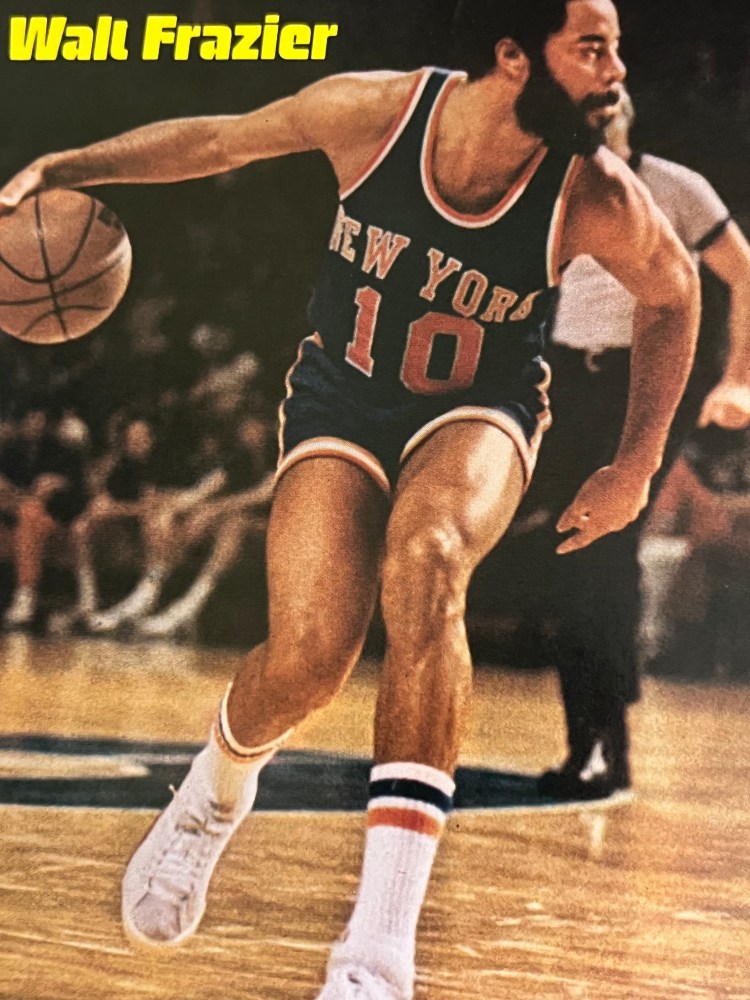
His new role—the many faces of Walt Frazier—resulted from the many faces that were missing from the Knick lineup when the team assembled in training camp. Reed’s chronic knee miseries forced the big center to retire. Lucas seemed bored with it all and also packed it in. DeBusschere quit to take over as general manager of the New York Nets of the American Basketball Association. Meminger, the cat-quick guard, went to Atlanta as part of a deal with New Orleans, the new team in the league.
Frazier has more pressure clutching at him this season than in any of his seven previous campaigns. The superb backcourt performer prides himself as being “Mr. Cool.” He’ll need full refrigeration this season. Walt was well aware of the situation as the season began and discussed it calmly. He talked about a possible change in his playing style. “It’s gonna be rough, no doubt about it,” he said. “I guess the offense will have to be structured around Earl Monroe and me.”
Monroe is the other guard and a shoot-from-the-hip type. “When Reed’s knee got real bad, I felt I had to shoot more,” Frazier continued. “In the beginning it hurt my game, but now I’m used to it.” Walt averaged 20.5 points per contest last season.
Coach Red Holzman was cautious about the change in the Knicks’ offense with John Gianelli and friends in for Reed at center, with Phil Jackson or Howard Porter in for DeBusschere at forward but maintained his usual calm. “I can’t worry in advance,” was the philosophical note from the New York skipper. But he did take note of the greater demands to be made on Frazier.
“Walt has become a much, much better shooter,” Red optimistically noted. “But Frazier’s responsibilities will go far beyond that. He fits his talents in with everyone else. And he has considerable talents. Walt is a do-it-all basketball player.”
Despite his outward calm, Red worked feverishly all summer and into the fall trying to get help for the Knicks, especially at the vital center post, where Gianelli has so much to learn. And learning in a full-length season is an expensive proposition.
He made a couple of fat offers to the Golden State Warriors for Clyde Lee—ultimately awarded to Atlanta—and also for Nate Thurmond, who went to the Chicago Bulls. The aging Thurmond would have been a glittering one or two-season man for the Knicks. But the Warriors, in addition to the package Holzman offered, also demanded the Knicks’ gangling go-go man, Phil Jackson. Red refused. In addition to playing an expert elbow game at forward, the 6-8 Jackson can also fill in at center.
There was even talk of getting Wilt Chamberlain, who was available. But the all-time scoring leader of pro basketball is pushing 40 and has a Tiffany price tag. The Knicks would not go as high as Wilt wanted, although there was always a chance that the exigencies of the season will alter that circumstance.
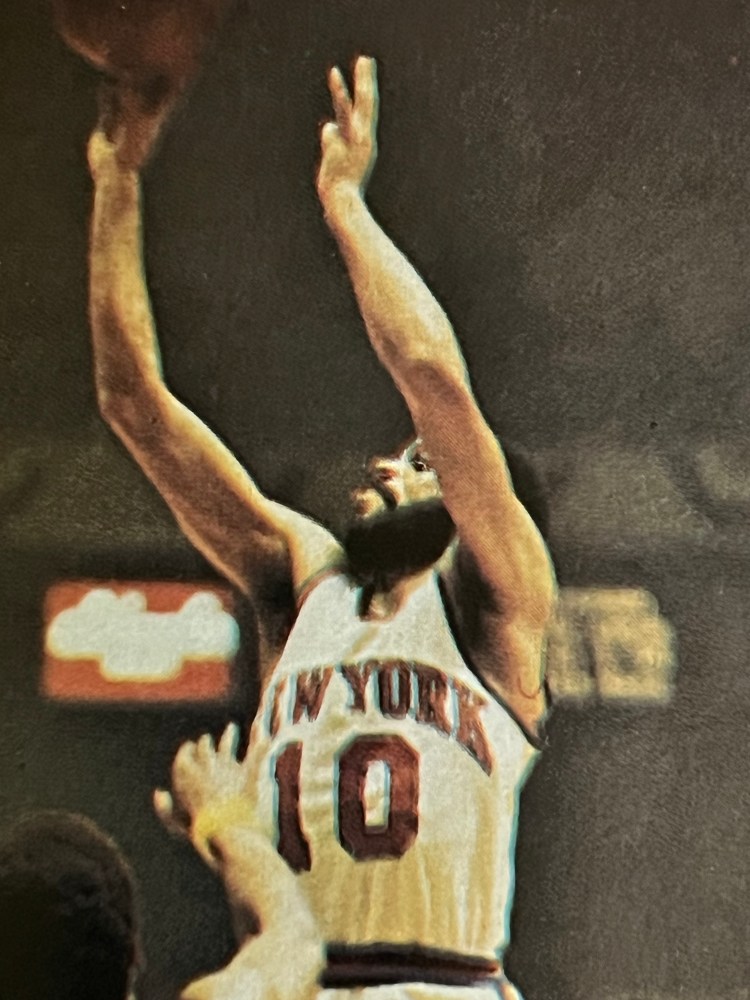
Without a guy like Reed to pull down rebounds, Frazier will have to make different moves this season. He actually began them last year. He will have to launch his 6-4 body upward for more rebounds. He will face more pressure in shooting, because there is no big scoring center to pass the ball to. Walt will have to try fewer steals. Or possibly gamble even more if the pressure mounts. The point is, he will not be able to play his usual control game. It may make him greater. That’s been known to happen in adversity.
Although never a contender for scoring honors, Walt has been a steady point producer. Last February 2 at Madison Square Garden, he made good on a close-in jump shot against Cleveland to become the fourth Knick player to reach the 10,000-point plateau. Reed, Richie Guerin, and Carl Braun were the others.
Frazier discussed his shooting. “Coming down with the ball,” he said, “I usually don’t know what’s going to happen when I cross the halfcourt line. I don’t make up my mind that I’m going to shoot. Whatever happens, happens. It’s like making up something, maybe a poem. You are in control, and it’s going to be exciting. That’s one of the joys of basketball improvisation. The amazing thing about making a move is that I might never have made it before, and I might never make it again. It’s just happening.”
Frazier is the hot-hand type of scorer and usually does his best shooting in the second half of the game, often in the fourth quarter. He is considered to be pro basketball’s number-one guard and normally is the darling of the New York fans.
But they booed him in a playoff game. It was the third game of the series with the Capital Bullets last spring. The Bullets, now the Washington Bullets, whipped the Knicks, 88-79, and Frazier was played off his feet by Phil Chenier. The boos startled Walt and also stung him. He even heard from his family in Atlanta about his lackluster play.
“I called home after the game,” Walt said, “but nobody wanted to come to the phone. My sister Brezita opened up on me by saying, ‘What’s wrong with you?’ My mom finally got on the phone and was sympathetic as only a mother can be.”
Walt tried to be fair to the fans. “I understood they are fickle,” he said. “The boos hurt me. They bothered me. Maybe the fans think I’m Superman. Maybe I’m supposed to win all the games. It hurt my pride. I don’t know if I could have taken another booing.”
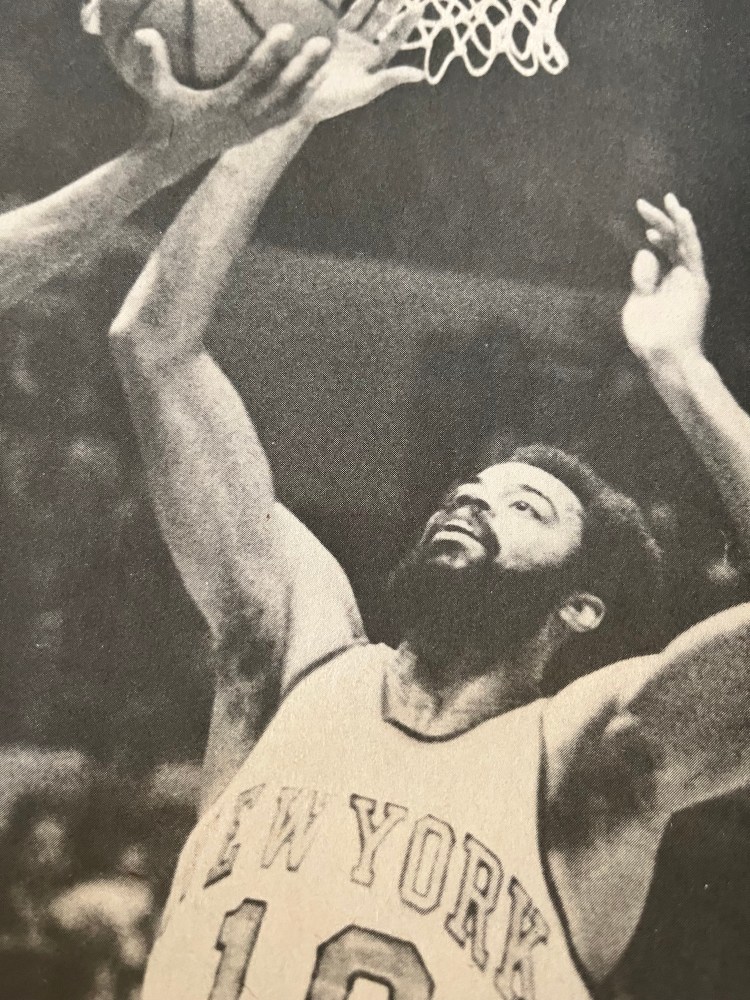
He didn’t have to. In the next game in the Garden, the fifth of the series, Frazier scored 38 points as the Knicks won a 106-105 cliffhanger from the Bullets. The crowd of 19,000 fans at the Garden rattled the rafters with their cheers. As usual, Frazier was at his best in the fourth period, scoring 16 points.
“I don’t think I’ve ever seen a streak like Frazier put on in the fourth period,” said his former teammate Mike Riordan, one of the stars for the Bullets.
“Walt was strictly phenomenal,” added the opposing coach, K.C. Jones.
Holtzman’s succinct comment was, “Frazier really made some clutch shots.”
Two weeks before the start of the playoffs, Frazier got the bright idea of going on a diet. The idea was to make him slimmer and faster. He gave up fattening foods, such as bread, potatoes, and desserts. He dropped five pounds in two weeks. But it affected his play heading into the playoffs. “My shots began to go astray,” he said. “I never seemed to regain my rhythm until the middle of the playoffs when I began eating like I normally do. Like a pig.”
If there is one thing that Walt loves, almost as much as a successful jump shot or a steal, it’s the good life. That’s what he has in midtown Manhattan, where he is a sports Beau Brummel and bon vivant on the swinging East Side.
His lavish apartment with its expensive decorations, mink bedspread, and closets filled with dazzling clothes made him a symbol of the best there is in luxury living. He also drives a Rolls-Royce and pays for two parking spaces in the garage to minimize the chance of a careless attendant scratching it by brushing against a neighboring car.
His wardrobe long ago earned him the nickname of Clyde, and that in turn has almost made him into a split personality. “Walt Frazier is quiet and shy,” he noted. “Clyde is aggressive and flirty. Up until midnight, I am Walt Frazier. Then Clyde takes over.”
It’s Clyde who is responsible for the rainbow wardrobe. A typical costume is a pair of red velveteen slacks, topped by a red-and-green silk shirt with what looks like a barracuda’s tooth on a chain hanging around his neck. In the winter, he wears fur coats. His apartment has three closets which are jam-packed with fancy duds. He had 30 custom-made shirts tailored for him last summer, and he thinks they will last a long, long time. His alligator shoes also are long-wearing.
If Clyde is the swinger, Walt Frazier is the socially conscious athlete who worries about young people. “I try to set an example for kids,” Walt said. “It’s a great feeling to be idolized, and that’s why I wouldn’t do anything the kids don’t like. You can’t fool kids. They can tell if you’re a phony.”
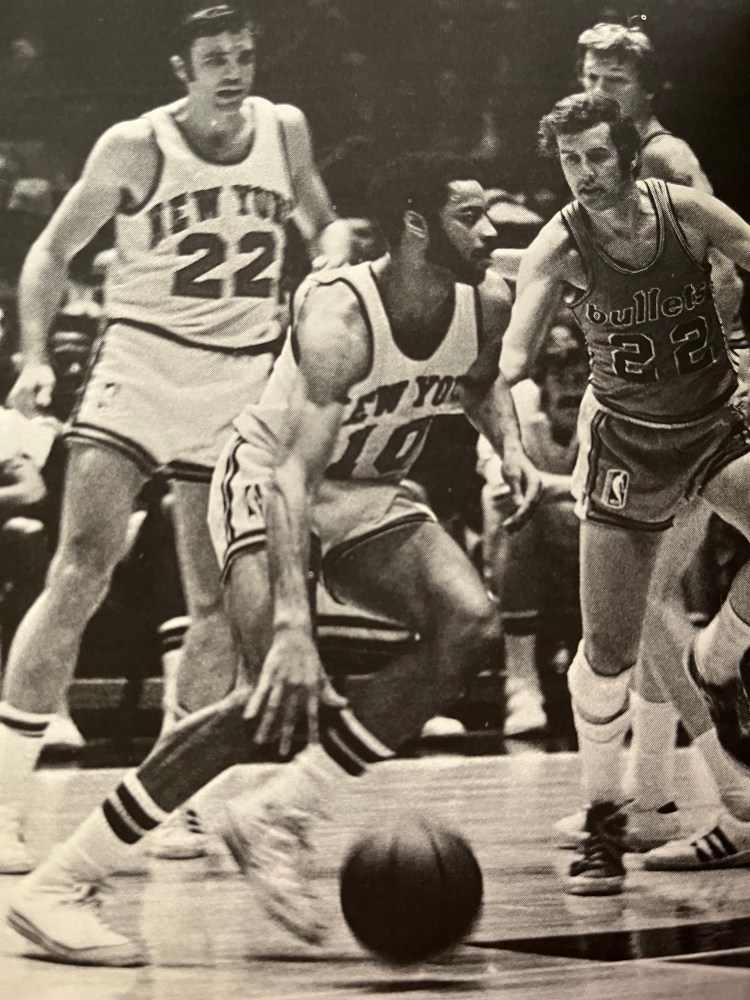
Recalling his youthful days in Atlanta, Walt says: “I was never in a gang. I was afraid of fights, and I was afraid of going to jail. My whole life was basketball. When I went to a party, I would come home smelling of whiskey. It wasn’t because I drank it. The other guys—wise guys—would pour it on me.”
Possibly more than anything else, Frazier prides himself on keeping his cool. “Cool is reactions, reflexes, and attitude,” he said. “You’ve got to feel out the situation. You can’t be out of control.”
The gag for years has been that Walt can take the hubcaps off a car as it rolls by. His hands are incredibly swift. He tells a story on himself to illustrate it. “In a cocktail lounge once, a glass slipped out of my hands, and I nabbed it in midair without spilling a drop. I do that a lot with things that are falling. It’s spooky how quick I am. It’s instinct. You can’t appreciate it. It’s a natural cool.”
Walt is the oldest of nine children in the Frazier family. He has seven sisters and one brother. He recalls that when many of the children were babies, he frequently changed their diapers and burped them at feeding time. He admits that it was sometimes difficult to convince the tough guys in the neighborhood that he-men did things like that. But he did.
Frazier is possibly the number-one celebrity to be found on the New York subways, at least on nights the Knicks are playing at home in the Garden. He refuses to drive his Rolls Royce through the heavy midtown traffic in Manhattan. For one thing, it’s tiring; and for another, the thought of any scratches or dents in the car makes Walt wince.
Riding the subway he is recognized, of course, and the fans usually have something to say. “Hey, chump, you’d better win tonight” was the salutation from one teenager as Walt left for a game in the playoffs. Another youngster was too shy to talk. He wanted Walt’s autograph but had no paper on him. He extended his hands and asked the Knick star to write his name on them. “No hands, man, no hands,” Frazier said.
Walt is Clyde until he reports to the Garden dressing room. For his ride on the subway, he put on a kind of garb that earned him the nickname from the movie, Bonnie and Clyde. He wears a black suit with a black shirt that has a red “Clyde” stitched into each sleeve. His tie is white, and his boots are black. Topping it off is a black, broad-brimmed hat.
Whether the guy was kidding or not, Walt didn’t know. But Walt reported that on one occasion as he walked down the street dressed in that manner, a grizzled truck driver shoved his head out the window of his cab and called out: “Aren’t you Wilt Chamberlain?”
Walt laughed about it. “Some guys call me [boxer] Joe Frazier because of our last name. But that’s the first time I was called Wilt Chamberlain.”
Walt admits that sometimes he is in a mean mood before a big game, and he doesn’t want to be bothered by fans. “I just don’t make any eye contact,” he said. “When I’m looking down at the floor or not smiling, they’re less likely to come over. If I’m cool about it, they’re usually cool also.”
He is well aware that the New York subway can be dangerous. But even on a dark, dingy station, he retains his cool. “I’m not scared down here,” he said. “Nothing has ever happened to me. If something did—then I’ll probably start worrying.”
Walt does make one concession to caution. After a Knick game, which means exiting from the Garden after midnight, he hails a taxi to go home or wherever else he is bound for. “It’s too late then,” he said, “and the subways get rougher. I don’t want to get hurt.”
Walt considers himself a loaner and rarely goes anywhere with an entourage. He insists he hates special treatment when he goes to a restaurant or a nightclub. “I’m not the type who feels that they should single me out,” he said. “I prefer to get lost among the people.”
The latter, of course, doesn’t apply on the basketball court. You always know where Walt is and what he’s doing. And if you play or root for the other side, it’s not a good feeling.

